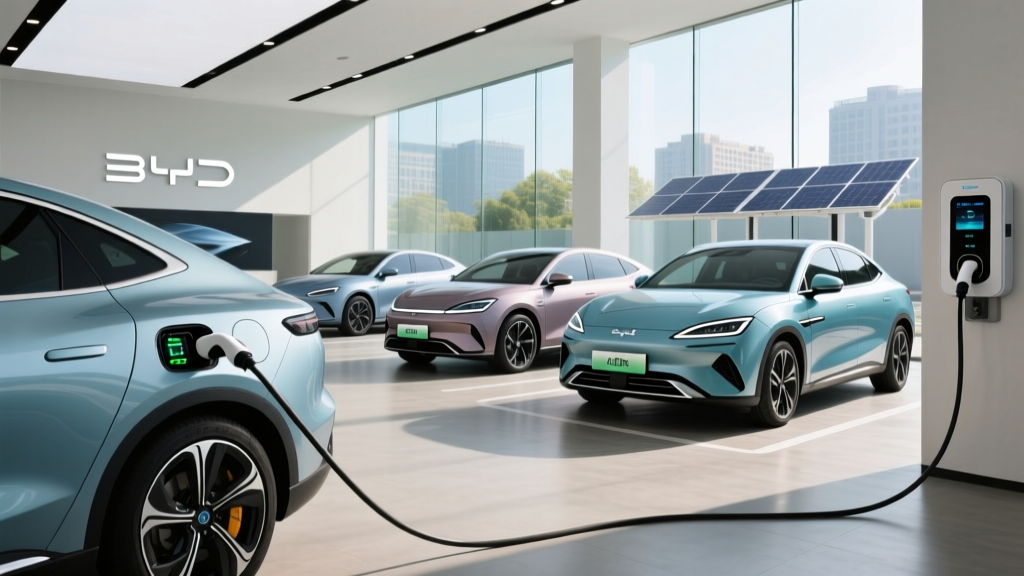
If you've followed the global EV market, you already know BYD (Build Your Dreams) has surpassed Tesla in total plug-in vehicle sales worldwide. The Chinese automaker's Blade Battery technology, aggressive pricing, and rapid expansion into Europe, Southeast Asia, and Latin America have made headlines for years. But the question American buyers keep asking is straightforward: is BYD sold in the USA?
The short answer as of 2026: No, BYD does not currently sell passenger cars or SUVs to consumers in the United States. The company sells electric buses and commercial vehicles stateside, but its passenger EV lineup — including popular global models like the Seal, Atto 3, Dolphin, and Han — remains unavailable to American retail buyers.
This guide breaks down exactly why, which BYD models could theoretically compete in the US market, what the tariff and regulatory landscape looks like, and how long you might wait before a BYD badge appears at a dealership near you.
Why BYD Passenger Cars Aren't Sold in the USA (Yet)
BYD's absence from the US passenger vehicle market isn't an accident — it's the result of compounding trade barriers, regulatory hurdles, and geopolitical tension. Here's the full picture:
The Tariff Wall: 100%+ Duties on Chinese EVs
In May 2024, the Biden administration announced a dramatic increase in Section 301 tariffs on Chinese-made electric vehicles, raising the duty from 25% to 100%. This tariff took effect in August 2024 and remains in force through 2026. The practical effect: a BYD Seal that might cost the equivalent of $38,000 at the factory gate would face over $38,000 in tariffs alone before shipping, dealer markup, and compliance costs — effectively doubling the price and destroying any value proposition.
On top of the base tariff, Chinese EVs face:
- 2.5% standard auto import duty (applied to all imported vehicles)
- Section 301 tariffs on battery components and critical minerals (25% on lithium-ion batteries from China)
- Potential additional tariffs under various trade enforcement actions
The combined effect pushes the landed cost of a Chinese-built BYD well above comparable vehicles already sold in the US by Hyundai, Tesla, and others.
Federal Tax Credit Exclusion (§30D Sourcing Rules)
Even if BYD could sell cars in the US at competitive prices, buyers would face another barrier: the IRS §30D federal EV tax credit explicitly excludes vehicles with battery components or critical minerals sourced from a "foreign entity of concern" (FEOC) — a designation that covers Chinese companies. Since BYD vertically integrates its own battery production (the famous Blade Battery), virtually every cell in a BYD vehicle would trigger the FEOC exclusion.
- Battery components manufactured or assembled by a FEOC (BYD is China-based) — disqualifying
- Critical minerals sourced from a FEOC — likely disqualifying given BYD's supply chain
- Vehicle MSRP must not exceed $55,000 (sedans) or $80,000 (SUVs/trucks) — many BYD models would clear this, but it's moot given FEOC rules
- Buyer income caps: $150K single / $300K joint — irrelevant if the vehicle itself is disqualified
This means even in a hypothetical scenario where tariffs were reduced, BYD buyers would pay full MSRP with no $7,500 federal incentive — a significant disadvantage against Tesla, Hyundai, Ford, and GM models that do qualify.
Homologation and Safety Certification
Any automaker selling in the US must certify vehicles to Federal Motor Vehicle Safety Standards (FMVSS) administered by NHTSA. While BYD's global models meet European (ECE) and Chinese (GB) safety standards, US certification requires separate crash testing, lighting compliance, bumper standards, and software adaptations. This process typically takes 18–36 months per model and costs tens of millions of dollars — an investment BYD has so far chosen not to make for a market where tariffs render its products uncompetitive.
BYD's Global Models: Specs That Could Compete in the US
While you can't buy them stateside, understanding BYD's global lineup helps explain why the brand generates so much interest. Here's a look at the models most frequently discussed by American EV enthusiasts, with specs based on their current global-market configurations:
| Model | Body Style | Battery (kWh) | Chemistry | WLTP Range | Est. EPA Range | 0-60 mph | HP | Drivetrain |
|---|---|---|---|---|---|---|---|---|
| BYD Seal | Sedan | 82.5 kWh | LFP (Blade) | 354 mi | ~300 mi | 3.8s (Perf) | 530 (AWD) | RWD / AWD |
| BYD Atto 3 | Compact SUV | 60.5 kWh | LFP (Blade) | 260 mi | ~220 mi | 7.3s | 201 | FWD |
| BYD Dolphin | Hatchback | 60.4 kWh | LFP (Blade) | 265 mi | ~225 mi | 7.0s | 201 | FWD |
| BYD Han EV | Full-size Sedan | 85.4 kWh | LFP (Blade) | 323 mi | ~275 mi | 3.9s (AWD) | 516 (AWD) | RWD / AWD |
| BYD Seagull | Subcompact | 38.9 kWh | LFP (Blade) | 190 mi | ~160 mi | ~11s | 75 | FWD |
Important note on range figures: BYD publishes WLTP range estimates for global markets. WLTP tends to be 10–20% more generous than the US EPA testing cycle. The "Est. EPA Range" column above is our adjusted projection based on typical WLTP-to-EPA conversion factors — actual EPA certification would be required before US sale.
Even if EPA-certified at ~300 miles, the BYD Seal AWD Performance would likely deliver 240–260 miles on highway road trips at 70+ mph, and 200–220 miles in freezing temperatures (LFP chemistry loses more range in cold than NMC). City driving with regen braking would push closer to or slightly above the EPA sticker. These are estimates based on comparable LFP-equipped EVs we've tested.
The Blade Battery: BYD's LFP Advantage
BYD's signature technology is its Blade Battery — a cell-to-pack lithium iron phosphate (LFP) design that uses long, blade-shaped cells arranged directly in the pack without modules. Key characteristics:
| Attribute | BYD Blade (LFP) | Typical NMC Pack |
|---|---|---|
| Energy Density | Lower (~150 Wh/kg cell) | Higher (~250 Wh/kg cell) |
| Cycle Life | 3,000+ cycles to 80% SoH | 1,000–2,000 cycles to 80% SoH |
| Thermal Stability | Excellent — passes nail penetration test without fire | Good — requires more thermal management |
| Cold-Weather Performance | Weaker — ~30-40% range loss below freezing | Better — ~20-30% range loss below freezing |
| Cost per kWh | Lower (no cobalt/nickel) | Higher |
| Recommended Charge Pattern | Can charge to 100% regularly | Better at 80% daily, 100% for trips |
For US buyers accustomed to NMC-dominant packs (Tesla, Ford, Hyundai), the LFP trade-off means longer battery lifespan and lower cost, but noticeably reduced winter range — a real concern in northern states.
Charging Specs: How Fast Would BYD Models Charge?
BYD's global models support DC fast charging, but their peak rates lag behind the 350 kW-capable Hyundai Ioniq 5 or the 250 kW Tesla Model 3. Here's what current global-spec models offer:
| Model | Max DC Fast Charge | 10–80% Time | Level 2 (AC) Rate | Level 2 Miles/Hr |
|---|---|---|---|---|
| BYD Seal | 150 kW | ~26 min | 11 kW | ~37 mi/hr |
| BYD Atto 3 | 88 kW | ~29 min | 11 kW | ~36 mi/hr |
| BYD Dolphin | 88 kW | ~29 min | 11 kW | ~36 mi/hr |
| BYD Han EV | 120 kW | ~30 min | 7 kW (some markets) | ~23 mi/hr |
Charging curve reality: The Seal's 150 kW peak is achieved at low state-of-charge (roughly 10–30%) and tapers significantly above 60%. Expect sustained average power of roughly 90–100 kW across a 10–80% session. This is adequate but unremarkable compared to the Hyundai/Kia E-GMP platform (which sustains 200+ kW across a wide SoC window) or Tesla's V3/V4 Superchargers.
For US road-trippers relying on Electrify America or Tesla Superchargers (via NACS adapter), the Seal's 26-minute 10–80% session would mean slightly longer stops than an Ioniq 5 (~18 min) but comparable to a Volkswagen ID.4 (~28 min).
Pricing Abroad vs. What US Buyers Would Pay
BYD's global pricing is the source of most American interest — and frustration. Here's what these models cost in key markets, alongside a hypothetical US landed price with current tariffs:
| Model | China Price (USD equiv.) | Europe Price (USD equiv.) | Hypothetical US Price (100% tariff) | US Competitor Baseline |
|---|---|---|---|---|
| BYD Seal (Design RWD) | ~$27,500 | ~$47,000 | ~$55,000+ | Tesla Model 3 RWD: $38,990 |
| BYD Atto 3 | ~$19,500 | ~$40,000 | ~$42,000+ | Hyundai Kona Electric: $32,975 |
| BYD Dolphin | ~$16,500 | ~$36,000 | ~$36,000+ | Chevy Bolt EV (discontinued): ~$26,500 |
| BYD Seagull | ~$10,500 | Not yet sold | ~$24,000+ | No direct US equivalent |
Several takeaways from this pricing analysis:
- China domestic prices are not transferable to the US. BYD prices its vehicles significantly higher in export markets (Europe, Australia) to account for shipping, homologation, dealer networks, and brand positioning. US pricing would follow the European pattern, not the Chinese one.
- Even without tariffs, BYD's European pricing puts it in the same ballpark as established competitors. The Seal at ~$47,000 in Europe competes directly with the Tesla Model 3 Long Range and BMW i4 — it's not the bargain some headlines suggest.
- The 100% tariff makes the math impossible. Even the Seagull, BYD's cheapest model, would land above $24,000 with tariffs, stripping away its primary appeal as a sub-$15,000 city EV.
Could BYD Enter the US Market? Three Possible Pathways
Despite the current barriers, BYD hasn't ruled out US passenger vehicle sales entirely. Here are the scenarios analysts discuss:
Pathway 1: Localized Manufacturing (Most Likely, Longest Timeline)
BYD could build a factory in North America — likely Mexico, given its existing bus plant in Lancaster, California (which assembles commercial vehicles and is partially exempt from some tariff structures). A Mexican factory could potentially sidestep the 100% China tariff under USMCA rules, but the §30D FEOC battery sourcing exclusion would still apply unless BYD restructured its supply chain to source cells and minerals outside China.
Timeline estimate: 4–7 years minimum. BYD would need to commit billions to a North American passenger vehicle plant, establish a dealer network, complete FMVSS certification for multiple models, and navigate an uncertain political landscape.
Pathway 2: Tariff Reduction via Trade Agreement
A future US-China trade deal could reduce EV tariffs, making direct import viable. This is entirely speculative and depends on geopolitical developments far beyond the auto industry.
Pathway 3: Technology Licensing or Joint Venture
BYD could license its Blade Battery technology to a US-based automaker (similar to how Ford licensed CATL's LFP technology for the Mustang Mach-E and F-150 Lightning). This wouldn't put BYD badges on American roads, but it would bring BYD's battery tech into US-market vehicles.
What to Buy Instead: US-Available Alternatives to BYD Models
If you're drawn to BYD's value proposition, these currently available US models fill similar roles:
→ Tesla Model 3 Long Range AWD — EPA 341 mi, 346 hp, from $42,490, qualifies for partial §30D credit, 250 kW DC fast charging. The default comparison and the car the Seal was designed to beat.
→ Hyundai Ioniq 6 SE Long Range — EPA 361 mi, 800V architecture, 230 kW DC charging, from $37,500.
If you want a BYD Atto 3 (compact electric SUV, ~220 mi range):→ Hyundai Kona Electric — EPA 261 mi, from $32,975, strong warranty, widely available.
→ Kia EV6 Light RWD — EPA 232 mi, 800V fast charging (10–80% in ~18 min), from $42,900.
If you want a BYD Dolphin (affordable electric hatchback):→ Chevrolet Bolt EV/EUV — if you can find remaining inventory, EPA 259 mi, from ~$26,500 (used market increasingly viable).
→ Wait for the next-gen Chevrolet Bolt (announced, expected late 2025/2026) with faster DC charging.
If you want a BYD Seagull (ultra-affordable city EV):→ No direct US equivalent exists. The closest option is a used Nissan LEAF (EPA 149–212 mi depending on battery) on the secondary market, typically $12,000–$18,000.
BYD in the USA: Pros, Cons, and the Bottom Line
- Blade Battery LFP chemistry offers exceptional cycle life (3,000+ cycles) and strong thermal safety
- Competitive pricing in export markets suggests strong value if tariff barriers were removed
- Vertically integrated supply chain (BYD makes its own chips, batteries, motors) reduces supply risk
- Broad model range from city car (Seagull) to performance sedan (Seal AWD)
- Standard 100% SoC charging recommended for LFP — simpler ownership than NMC daily limits
- Not available for purchase — no US dealer network, no FMVSS-certified passenger vehicles
- 100% tariff on Chinese EVs makes direct import economically unviable
- FEOC battery sourcing rules would disqualify all models from the $7,500 §30D tax credit
- DC fast-charge speeds (88–150 kW peak) lag behind Hyundai/Kia 800V and Tesla platforms
- LFP cold-weather range loss (~30–40%) is a real drawback for northern US climates
- No US service/parts infrastructure — even if you imported one privately, maintenance would be extremely difficult
- Infotainment and ADAS features designed for Chinese/European markets, not US roads and regulations
Frequently Asked Questions
Can I privately import a BYD from China or Europe?
Technically, you can attempt to import a vehicle under NHTSA's "show or display" exemption (limited to 2,500 miles/year) or through a Registered Importer who modifies the vehicle to FMVSS standards. In practice, this is prohibitively expensive ($20,000–$50,000+ in modifications and testing), and the vehicle still wouldn't qualify for registration in most states for normal use. It's not a realistic path to BYD ownership.
Does BYD sell anything in the United States at all?
Yes. BYD operates a factory in Lancaster, California, that manufactures electric buses and heavy-duty commercial vehicles. BYD also sells battery energy storage systems and has partnerships with US transit agencies. However, these are commercial/industrial products — not consumer vehicles.
Will BYD ever sell cars in America?
BYD executives have stated publicly that the US market is on their long-term radar, but no timeline has been announced. The most realistic entry path involves building a North American factory (likely Mexico) and restructuring battery supply chains to comply with FEOC rules. Given current tariffs and political climate, most industry analysts project a 2030 or later timeframe at the earliest, and only if trade conditions shift significantly.
How does BYD's Blade Battery compare to Tesla's 4680 cells?
They represent different engineering philosophies. BYD's Blade Battery uses LFP chemistry with a cell-to-pack structural design prioritizing safety, longevity, and cost. Tesla's 4680 uses NMC chemistry with a tabless cylindrical design prioritizing energy density and manufacturing speed. The Blade Battery wins on cycle life and thermal safety; the 4680 wins on range-per-kilogram and fast-charge capability. Both are legitimate approaches.
What's the best alternative to a BYD if I want an affordable EV?
For 2026, the strongest value plays in the US are the Tesla Model 3 RWD ($38,990, EPA 272 mi), Hyundai Kona Electric ($32,975, EPA 261 mi), and the upcoming next-gen Chevrolet Bolt (pricing TBD, expected under $30,000). On the used market, 2023–2024 Model 3 and Bolt EV examples offer strong value between $18,000–$28,000.
Would a BYD qualify for the $7,500 federal EV tax credit?
Almost certainly not. Under current IRS §30D rules, any vehicle with battery components or critical minerals sourced from a Foreign Entity of Concern (FEOC) is disqualified. Since BYD manufactures its own Blade Batteries in China, this exclusion would apply to every model in the lineup — regardless of price or where the vehicle was assembled.