Quick Verdict: The BYD Pickup Truck America Can't Buy (Yet)
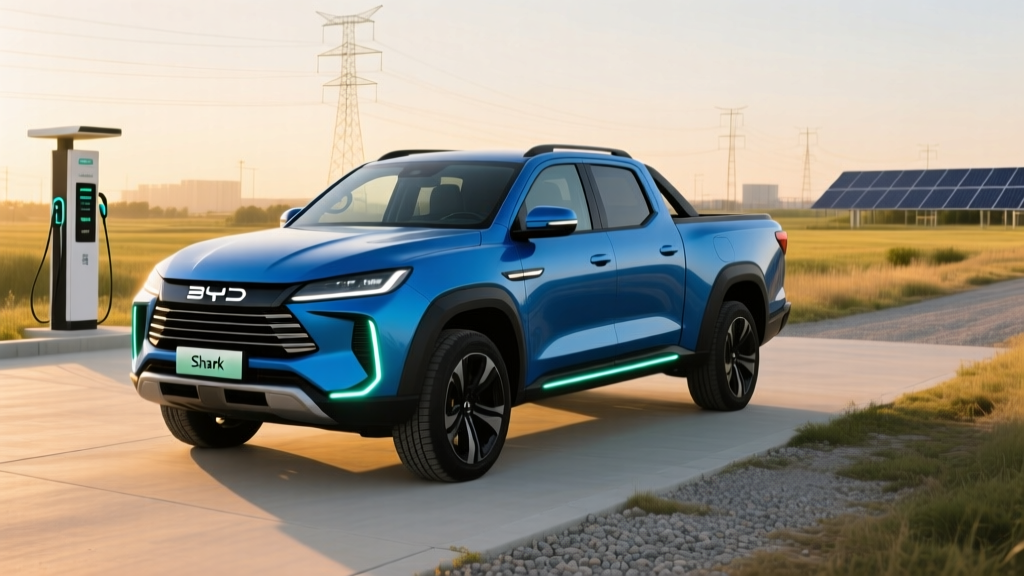
The BYD Shark — the Chinese automaker's first body-on-frame pickup truck — is a plug-in hybrid electric (PHEV) midsize truck that has drawn global attention since its late-2024 launch in markets like Mexico, Australia, and Brazil. Built on BYD's DMO (Dual Mode Off-Road) platform, the Shark pairs a 1.5-liter turbocharged engine with dual electric motors and a 29.58 kWh Blade battery to deliver an EPA-equivalent electric-only range of roughly 62 miles and a total combined range exceeding 500 miles.
But here's the headline for US readers: BYD does not currently sell passenger vehicles in the United States, and the Shark is not available for purchase here. This review covers the truck's full specification set based on international-market data, evaluates its real-world viability, and explains what would need to change for it to reach American driveways. If you're researching the BYD pickup truck to understand the competitive landscape — or to anticipate what a future US launch might look like — you're in the right place.
Sticker (WLTP): ~100 km (62 mi) electric-only; ~800+ km (500+ mi) combined
Real-World Expectation: Expect 45–55 mi on electric-only in mixed driving, dropping to ~35 mi in cold weather (below 40°F) or under heavy load. Combined gas+electric range of 400–450 mi is realistic on highway trips at 70+ mph.
Note: BYD publishes WLTP figures, which tend to run 10–15% higher than US EPA estimates. No EPA certification exists for this vehicle as of 2026.
BYD Shark Pickup: Full Specification Table
| Spec | BYD Shark (PHEV) |
|---|---|
| Powertrain | 1.5L turbo I4 + dual electric motors (PHEV) |
| System Horsepower | 430 hp combined |
| Drivetrain | AWD (e-4WD, electric rear axle) |
| 0–60 mph | ~5.7 seconds |
| Battery Capacity | 29.58 kWh (BYD Blade, LFP chemistry) |
| Electric-Only Range (WLTP) | ~100 km / 62 mi |
| Combined Range (WLTP) | ~800+ km / 500+ mi |
| DC Fast Charge (Peak) | ~70 kW (30–80% in ~18 min) |
| Level 2 AC Charge | 6.6 kW (~5–6 hours 0–100%) |
| Towing Capacity | 2,500 kg / 5,511 lbs (braked) |
| Payload | ~805 kg / 1,775 lbs |
| Bed Length | ~1,520 mm / 59.8 in |
| Ground Clearance | ~240 mm / 9.4 in |
| Base MSRP (Int'l) | ~AUD $59,990 / ~$38,000 USD equiv. |
| US Availability | Not available — no US sales network |
| Battery Warranty (Int'l) | 8 years / 160,000 km (~100,000 mi) |
Powertrain & Performance: DMO Platform Explained
The BYD Shark rides on the DMO (Dual Mode Off-Road) Super Hybrid platform, a body-on-frame architecture shared with the BYD Fang Cheng Bao 5 SUV. This isn't a unibody crossover masquerading as a truck — it's a legitimate body-on-frame midsize pickup with a ladder chassis, solid rear axle, and independent front suspension.
How the Powertrain Works
The Shark uses BYD's DM-i (Dual Mode intelligent) system, which prioritizes electric drive in most conditions:
- Front motor: ~150 kW (201 hp) integrated with the 1.5L turbo engine
- Rear motor: ~150 kW (201 hp) on the rear axle, enabling electric AWD without a mechanical driveshaft
- Combined system output: 430 hp, with peak torque delivered instantly from the electric motors
- Engine role: Primarily acts as a generator at low speeds (series hybrid mode) and directly drives the wheels at highway speeds (parallel mode) for efficiency
The 0–60 mph time of ~5.7 seconds puts the Shark in Ford Ranger Raptor territory for straight-line acceleration, though the BYD is far heavier at roughly 2,570 kg (5,666 lbs) curb weight. In practice, the electric torque fill makes the truck feel quicker than the number suggests around town — there's zero turbo lag and no transmission shift shock.
Off-Road Capability
The e-4WD system provides torque vectoring between front and rear axles without a traditional transfer case. BYD includes multiple drive modes (Sand, Mud, Snow, Rock) and a tank-turn-assist feature that brakes the inside wheels to tighten turning radius on loose surfaces. With 9.4 inches of ground clearance and approach/departure angles competitive with a Toyota Tacoma, the Shark is genuinely trail-capable — not just a lifestyle truck.
Charging Speed: DC Fast, Level 2, and Realistic Expectations
As a PHEV, the Shark's charging needs are modest compared to a full BEV like the Ford F-150 Lightning or Rivian R1T. But for a truck with a nearly 30 kWh battery, charging speed still matters — especially if you want to maximize electric-only driving on a daily basis.
| Charging Level | Power | Time | Use Case |
|---|---|---|---|
| Level 1 (120V) | ~1.4 kW | ~22 hours (0–100%) | Emergency / trickle only |
| Level 2 (240V) | 6.6 kW | ~5–6 hours (0–100%) | Overnight home charging |
| DC Fast Charge | ~70 kW peak | 30–80% in ~18 min | Road-trip top-ups |
Charging-curve reality: The 70 kW peak rate is useful but not sustained. Expect the Shark to hold close to peak speed between 20–60% State of Charge, then taper significantly above 70%. On a typical 150 kW Electrify America or Tesla Supercharger station (via adapter), the truck will only pull what its onboard system allows — roughly 70 kW max. Don't expect to leverage 350 kW CCS stations at anywhere near their capacity.
Home charging practicality: A standard 240V/32A Level 2 home charger (like a ChargePoint Home Flex or Emporia Level 2) will refill the 29.58 kWh battery from empty in roughly 5 hours. For most owners, plugging in overnight means starting every morning with a full battery and ~50+ miles of electric-only range — enough to cover most commutes without burning a drop of gasoline.
Real-World Range: Electric-Only, Combined, and Cold-Weather Impact
BYD's official WLTP rating puts the Shark at 100 km (62 miles) of electric-only range. But WLTP testing is more generous than the US EPA cycle, and real-world conditions introduce further variables.
- City driving (electric-only): ~55–60 mi — regenerative braking extends range in stop-and-go traffic
- Highway driving (electric-only, 70 mph): ~40–45 mi — aerodynamic drag on a boxy truck body is punishing at speed
- Cold weather (below 32°F, electric-only): ~30–38 mi — LFP chemistry loses more usable capacity in cold than NMC, and cabin heating draws from the battery
- Combined gas + electric (highway road trip): ~400–450 mi total before needing fuel — the 70L (18.5 gal) tank plus battery gives substantial total range
Why this matters: The Shark's value proposition as a PHEV is that most daily driving (commutes under 40 miles) can be done on electricity alone, while the gasoline engine eliminates range anxiety for longer trips. Owners who charge nightly will use very little fuel in normal weeks. But if you regularly drive 60+ miles one-way on the highway, the electric-only advantage diminishes and you're essentially driving a heavy hybrid truck getting roughly 25–28 MPG combined once the battery is depleted.
Pricing, Tax Credits, and US Availability
This is where the BYD pickup truck story becomes complicated for American buyers.
International Pricing
In Australia, the Shark launches at AUD $59,990 (roughly $38,000 USD at early-2026 exchange rates) for the base Premium trim. A higher-spec variant pushes closer to AUD $65,000. In Mexico, where BYD has an established dealer network, pricing is competitive with the Toyota Hilux and Nissan Frontier. In Brazil, the Shark undercuts most body-on-frame rivals significantly.
US Tax Credit Eligibility (IRS §30D)
Because BYD does not sell vehicles in the United States, the Shark cannot qualify for the IRS §30D Clean Vehicle Credit. Even if BYD entered the US market, several hurdles would apply:
- MSRP cap: Trucks must be under $80,000 MSRP (Shark would likely pass this)
- Buyer income cap: $150,000 single / $300,000 joint AGI
- Battery sourcing: Critical minerals and battery components must meet phased-in percentages from US or FTA-partner countries — BYD's vertically integrated Chinese supply chain would face significant compliance challenges
- Foreign Entity of Concern (FEOC): Vehicles with battery components from a FEOC (which includes many Chinese manufacturers) are disqualified from the credit entirely as of 2024+ rules
Could BYD Enter the US Market?
BYD has repeatedly stated it has no immediate plans to sell passenger vehicles in the US, citing the 100% tariff on Chinese-built EVs (raised from 25% in 2024) and the politically charged regulatory environment. Even if BYD built a US or Mexico factory to circumvent tariffs, FEOC battery-sourcing rules would make tax-credit qualification nearly impossible. For now, US buyers looking at the BYD pickup truck are looking at a vehicle they cannot purchase domestically.
Interior, Cargo, and Technology
Cabin & Infotainment
The Shark's interior borrows heavily from BYD's passenger-car design language — a 12.8-inch rotating center touchscreen (landscape for maps, portrait for climate/media), a 10.25-inch digital instrument cluster, and a flat-bottom steering wheel. Materials are hard-plastic-heavy on the lower dash and door panels (expected for a work truck) but soft-touch on the upper dash and armrests.
Standard tech includes wireless Apple CarPlay and Android Auto, a 360-degree camera system, and BYD's DiLink connected-car platform with over-the-air updates. The gear selector is a rotary dial on the center console, freeing up space for a large wireless charging pad and cupholders.
Cargo & Passenger Space
- Bed length: ~59.8 inches (1,520 mm) — shorter than a Ford Ranger's 72-inch bed, limiting sheet-rock or lumber hauling
- Bed width between wheel wells: ~44 inches — won't fit standard pallets flat
- Rear legroom: ~36 inches — adequate for adults on short trips but tight for long hauls compared to a Tacoma or Colorado
- Payload: ~1,775 lbs — competitive for the midsize segment
- Towing: 5,511 lbs braked — solid for a midsize PHEV, but well short of the F-150 Lightning's 7,700–10,000 lbs
Driver Assistance (ADAS)
The Shark includes BYD's DiPilot suite: adaptive cruise control, lane-keeping assist, automatic emergency braking, blind-spot monitoring, and rear cross-traffic alert. This is SAE Level 2 driver assistance — it does not drive itself, and the driver must keep hands on the wheel and eyes on the road at all times. There is no hands-free driving mode comparable to GM's Super Cruise or Ford's BlueCruise.
Pros and Cons
- Genuine body-on-frame capability with e-AWD and off-road modes
- ~50 mi electric-only range covers most daily commutes gas-free
- 430 hp system output delivers brisk acceleration (5.7s 0–60)
- LFP Blade battery is durable, safe, and cobalt-free
- Competitive international pricing (~$38K USD equivalent)
- Strong towing (5,511 lbs) for a midsize PHEV
- V2L (vehicle-to-load) capability for powering tools or campsite equipment
- Not available in the United States — no dealer network, no US spec
- Short 5-foot bed limits utility vs Ranger, Tacoma, Colorado
- DC fast charging limited to ~70 kW — slow for a nearly 30 kWh pack
- LFP battery loses more range in cold weather than NMC alternatives
- Heavy curb weight (~5,666 lbs) hurts fuel economy once battery depletes
- Unproven long-term reliability outside China/Australia markets
- No US crash-test ratings (NHTSA/IIHS have not evaluated)
- Would almost certainly not qualify for §30D tax credit even if sold in US
Who Should Consider the BYD Shark (and Who Should Look Elsewhere)?
This truck suits you if:
- You live in Australia, Southeast Asia, Latin America, or the Middle East where BYD has an active dealer network
- Your daily commute is under 45 miles and you have home charging — you'll rarely use gasoline
- You need a midsize truck for weekend work (towing a boat, hauling to a job site) but don't need a full-size bed
- You want electric-like torque and acceleration without range anxiety on longer trips
Look elsewhere if:
- You're a US-based buyer — the Shark simply isn't available, and importation isn't practical
- You need a 6-foot+ bed for construction or agricultural work
- You regularly tow over 6,000 lbs (step up to an F-150 Lightning or Rivian R1T)
- You live in a cold climate where LFP range loss would cut your electric-only commuting range to 30 miles or less in winter
- Ford F-150 Lightning: Full-size BEV, 230–320 mi EPA range, 7,700+ lbs towing, starts ~$55,000 — may qualify for §30D credit
- Rivian R1T: Premium midsize BEV, 270–420 mi range, 11,000 lbs towing (Dual-Motor), starts ~$75,000 — no federal credit
- Ford Maverick Hybrid: Compact HEV (not PHEV), 42 MPG city, no electric-only mode, starts ~$28,000 — excellent efficiency for light-duty work
- Chevrolet Colorado ZR2 / Toyota Tacoma i-FORCE MAX: Gasoline turbo-hybrids with no plug-in capability but proven US dealer support and strong off-road credentials
Warranty & Long-Term Ownership
In international markets, BYD provides the Shark with:
- Battery warranty: 8 years / 160,000 km (~100,000 miles) with a guaranteed minimum 70% State of Health (SoH) retention
- Vehicle warranty: 6 years / 150,000 km (~93,000 miles)
- Powertrain (engine + motors): Covered under the vehicle warranty period
The LFP (lithium iron phosphate) Blade battery is a key longevity advantage. LFP cells tolerate more charge cycles (typically 3,000+ cycles to 80% SoH) than NMC chemistry and are far less prone to thermal runaway. BYD's Blade cell format — long, thin prismatic cells arranged in a structural pack — has demonstrated strong degradation resistance in independent testing. For a PHEV with a relatively small battery that cycles frequently, LFP is the right chemistry choice for longevity.
However, long-term ownership outside BYD's core markets remains a question mark. Parts availability, service-center expertise, and software-update infrastructure in countries like Australia and Brazil are still developing. In the US, there is no support infrastructure at all.
Frequently Asked Questions
What is the real-world electric-only range of the BYD Shark pickup truck?
Expect roughly 45–55 miles in mixed city/highway driving on a full charge, dropping to 30–38 miles in freezing temperatures. The official WLTP figure of 62 miles is optimistic compared to real-world conditions, especially at highway speeds where aerodynamic drag significantly reduces efficiency.
How fast does the BYD Shark charge?
DC fast charging peaks at approximately 70 kW, delivering a 30–80% charge in about 18 minutes. Home Level 2 charging at 6.6 kW refills the 29.58 kWh battery in 5–6 hours. Level 1 (standard 120V outlet) takes over 20 hours and is only practical for emergency trickle charging.
Can I buy the BYD pickup truck in the United States?
No. BYD does not sell passenger vehicles in the US as of 2026. The company faces a 100% tariff on Chinese-built EVs, FEOC battery-sourcing restrictions, and no established dealer or service network. There are no announced plans for a US launch.
Does the BYD Shark qualify for the $7,500 federal EV tax credit?
No. Since it isn't sold in the US, it cannot qualify. Even hypothetically, BYD's Chinese battery supply chain would likely disqualify it under the IRS §30D FEOC (Foreign Entity of Concern) rules that bar credits for vehicles with battery components from designated foreign entities.
Is the BYD Shark a full electric vehicle or a hybrid?
The Shark is a plug-in hybrid electric vehicle (PHEV), not a battery-electric vehicle (BEV). It has a 1.5L turbocharged gasoline engine paired with dual electric motors and a 29.58 kWh battery. It can drive on electricity alone for ~50 miles but also uses gasoline for extended range.
How does the BYD Shark compare to the Ford F-150 Lightning?
They're fundamentally different vehicles. The F-150 Lightning is a full-size, fully electric truck with 230–320 miles of EPA range, a longer bed, and significantly more towing capacity (up to 10,000 lbs). The Shark is a midsize PHEV with ~50 miles of electric range plus a gas engine for extended trips. The Lightning is available in the US and may qualify for tax credits; the Shark is not available in the US at all.
What battery chemistry does the BYD Shark use?
The Shark uses BYD's proprietary Blade battery with LFP (lithium iron phosphate) chemistry. LFP offers excellent cycle life (3,000+ cycles), superior thermal stability (very low risk of fire), and no cobalt or nickel. The trade-off is lower energy density than NMC and greater range loss in cold weather.