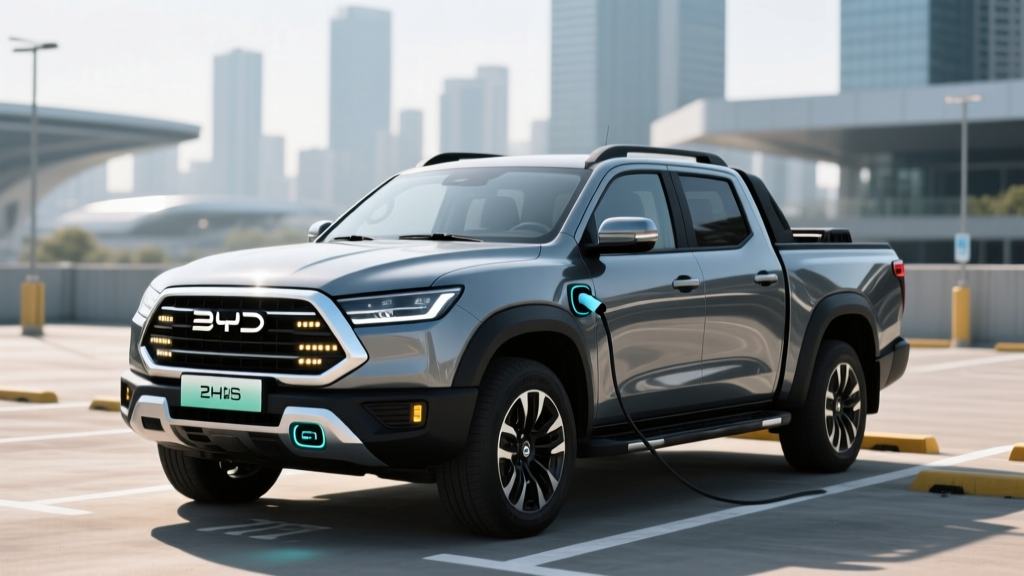
The BYD Shark has been making waves since its global debut in mid-2024 as the Chinese automaker's first plug-in hybrid pickup truck. With a dual-motor DMO (Dual Mode Off-Road) powertrain, over 60 miles of electric-only range, and a starting price in international markets that undercuts established midsize trucks, it has generated significant search interest among US buyers wondering if BYD will finally bring a pickup stateside. Here is every confirmed spec, the real-world ownership picture, and a clear-eyed assessment of whether the BYD Shark pickup could actually reach American driveways.
BYD Shark Powertrain and Performance Specs
The Shark uses BYD's DMO Super Hybrid platform, which pairs a turbocharged 1.5-liter inline-four engine with a dual-motor setup — one on each axle — delivering all-wheel drive without a mechanical driveshaft. The system is designed for both on-road efficiency and off-road capability, with multiple drive modes including EV-only, series hybrid, and parallel hybrid.
| Spec | Value |
|---|---|
| Powertrain | 1.5L turbo I4 + dual electric motors (PHEV) |
| System Horsepower | 430 hp combined |
| 0–60 mph (claimed) | 5.7 seconds |
| Drivetrain | AWD (electric rear axle, no mechanical driveshaft) |
| Battery Capacity | 29.58 kWh (LFP — BYD Blade) |
| EV-Only Range (NEDC) | 100 km / 62 mi |
| Total Range (NEDC) | ~840 km / 522 mi |
| Max Tow Rating | 2,500 kg / 5,512 lb (braked) |
| Payload Capacity | ~805 kg / 1,775 lb |
| Bed Length | ~1,520 mm / 59.8 in |
| Ground Clearance | 230 mm / 9.1 in |
| Warranty (Australia) | 6 yr / 150,000 km vehicle; 8 yr / 160,000 km battery |
The 430-hp system output puts the Shark in the same ballpark as the Ford Ranger Raptor on power, though the BYD's emphasis is efficiency and torque-fill rather than desert-running suspension travel. The 5.7-second 0–60 claim is quick for a body-on-frame midsize pickup and benefits from instant electric torque at the rear axle.
Electric Range and Real-World Efficiency
The 29.58 kWh BYD Blade battery uses lithium iron phosphate (LFP) chemistry, which trades energy density for superior thermal stability, longer cycle life, and lower cost. For a PHEV that will see daily shallow cycles (charge to 80–90%, drain to 20–30%), LFP is arguably the better chemistry choice — it handles thousands of partial cycles with minimal degradation.
In hybrid mode with the 1.5L turbo engine engaged, BYD claims a combined fuel consumption of approximately 6.5 L/100 km (roughly 36 mpg) on the NEDC cycle. Real-world mixed driving in global-market reviews has shown figures closer to 28–32 mpg combined once the battery is depleted and the truck operates as a conventional hybrid. This is competitive with the Ford Maverick Hybrid (42 mpg city EPA) but falls short on the highway, where the Shark's boxy aerodynamics and 5,000-lb curb weight work against it.
Charging Speed: DC Fast and Home Level 2
Charging capability is where PHEV pickups often disappoint, and the Shark is adequate rather than exceptional. Here is the confirmed breakdown:
| Charge Level | Power | Time (10–80% or 0–100%) | Practical Notes |
|---|---|---|---|
| Level 1 (120V) | ~1.4 kW | ~20+ hours (0–100%) | Overnight won't fill; best for trickle top-up |
| Level 2 (240V AC) | ~6.6 kW | ~3.5 hours (0–100%) | Full charge overnight on home wallbox |
| DC Fast Charge | ~55 kW peak | ~25 min (30–80%) | Modest peak rate; LFP charge curve stays flat then tapers hard above 85% |
The 55 kW DC fast-charge peak is low by full-EV standards (where 150–350 kW is common) but typical for a PHEV with a sub-30 kWh pack. The charge C-rate — the ratio of charge power to battery capacity — is roughly 1.86C at peak, which is actually aggressive for LFP chemistry. The practical implication: you will not be lingering at highway fast-chargers for long, but you also will not add 200 miles in 15 minutes. The Shark's DC charging is best thought of as a "top-up while you grab lunch" feature rather than a road-trip backbone.
At home on a Level 2 wallbox, 6.6 kW means you can fully replenish the 29.58 kWh pack in about 3.5 hours. If you plug in every evening after a commute, you will start each morning with a full battery and 45–50 real-world electric miles — enough to cover most daily driving without the gas engine ever starting.
US Availability and the Tariff Problem
As of early 2026, BYD has not announced any plans to sell the Shark in the United States. The company's global rollout has prioritized Australia, Southeast Asia, Latin America, and select European markets. The barriers to US entry are substantial:
- 100% tariff on Chinese-made vehicles: The US imposed a 100% import tariff on Chinese-built EVs and PHEVs effective 2024, which would roughly double the Shark's price and eliminate its cost advantage.
- No US dealer or service network: BYD has zero retail presence in the US passenger-vehicle market. Building one takes years and billions.
- Federal crash-test certification: The Shark has not been tested by NHTSA or IIHS, and US-spec compliance (lighting, bumper standards, OBD-II protocols) would require re-engineering.
- No §30D tax credit eligibility: Even if imported, the Shark's Chinese-manufactured battery and critical minerals would fail the IRS §30D sourcing requirements, and the 100% tariff would push MSRP well above the $80,000 truck cap.
BYD has hinted at building factories in Mexico and potentially other locations outside China, but any near-term production would still face US trade-policy headwinds. For American buyers, the Shark remains a "what-if" rather than a showroom option.
How the BYD Shark Stacks Up Against US-Market PHEV Trucks
Since the Shark is not available in the US, here is how its confirmed global specs compare to the plug-in hybrid and hybrid pickups you can actually buy stateside:
| Spec | BYD Shark (Global) | Ford Maverick Hybrid | Toyota Tacoma i-FORCE MAX |
|---|---|---|---|
| Type | PHEV (dual-motor AWD) | HEV (FWD) | HEV (RWD/4WD) |
| EV-Only Range | ~45–50 mi (est. EPA) | None (HEV) | None (HEV) |
| System HP | 430 hp | 191 hp | 326 hp |
| 0–60 mph | 5.7 sec | ~7.5 sec | ~6.0 sec |
| Tow Rating | 5,512 lb | 2,000 lb | 6,000 lb |
| Fuel Economy (mixed) | ~30 mpg (hybrid mode) | 42 city / 33 hwy EPA | ~22–24 mpg EPA |
| Base Price (USD equiv.) | ~$38,000 (Australia) | ~$28,000 | ~$40,940 |
| US Availability | Not available | On sale now | On sale now |
The Shark's combination of EV-only commuting and serious towing is genuinely unique — neither the Maverick Hybrid nor the Tacoma i-FORCE MAX offers a plug-in option with electric range. The closest US-market analog is the now-discontinued Jeep Gladiator 4xe concept, which never reached production. If BYD ever solves the tariff and distribution puzzle, the Shark would occupy an uncontested niche.
Cargo, Interior, and Tech Highlights
The Shark rides on a ladder-frame chassis with a bed measuring approximately 59.8 inches long — shorter than a Ford Ranger's 72-inch bed but comparable to other lifestyle-oriented midsize trucks. Payload capacity of roughly 1,775 lb is competitive for the class.
Inside, the cabin features a 12.8-inch rotating touchscreen (a BYD signature), a 10.25-inch digital instrument cluster, wireless Apple CarPlay and Android Auto, and a 360-degree camera system. Higher trims include a panoramic sunroof, heated and ventilated front seats, and a 12-speaker Dynaudio sound system in some markets.
Driver-assistance tech includes adaptive cruise control, lane-keep assist, automatic emergency braking, and blind-spot monitoring — all SAE Level 1 features requiring full driver attention. There is no hands-free driving system offered.
One standout feature is the Shark's V2L (Vehicle-to-Load) capability, which allows the high-voltage battery to power external devices through a standard outlet in the bed — useful for job-site tools, camping, or emergency backup power. BYD rates this at up to 6 kW output, enough to run a circular saw or a small refrigerator.
Pros, Cons, and Who the BYD Shark Suits
- 62 mi NEDC EV range eliminates daily gas use for commuters
- 430 hp / 5.7-sec 0–60 is sports-sedan quick for a truck
- 5,500-lb tow rating beats Maverick Hybrid by 3,500 lb
- LFP Blade battery offers long cycle life and thermal safety
- 6 kW V2L outlet for job-site and camping use
- Competitive pricing in global markets (~$38K USD equiv.)
- Not available in the US — no timeline, tariff barriers
- 55 kW DC fast charge is slow by modern EV standards
- Short 59.8-in bed limits utility for full-sheet plywood
- NEDC range ratings overstate real-world EV miles
- No NHTSA/IIHS crash-test data
- Unproven long-term reliability outside China/Australia
Who it suits (in markets where it's sold): The BYD Shark is ideal for a truck buyer who commutes 30–45 miles daily and wants to do so on electricity, but also needs to tow a boat or trailer on weekends without range anxiety. It bridges the gap between a pure EV commuter and a traditional body-on-frame work truck. If you never tow and rarely haul, the Ford Maverick Hybrid delivers better fuel economy at a lower price. If you tow heavy and drive long distances, the Tacoma i-FORCE MAX or Ford Ranger remain stronger choices with established dealer support.
Frequently Asked Questions
What is the real-world electric range of the BYD Shark?
The Shark is rated at 62 miles EV-only on the generous NEDC cycle. On the stricter EPA test used in the US, expect approximately 45–50 miles. In cold weather below freezing, LFP chemistry and cabin heating demands can reduce that to 35–40 miles. For warm-climate city commuting, 50+ real-world electric miles is realistic.
How fast does the BYD Shark charge at home and on DC?
On a home Level 2 charger (240V, 6.6 kW), the 29.58 kWh battery charges from empty to full in about 3.5 hours. On a DC fast charger, it peaks at roughly 55 kW and can go from 30–80% in approximately 25 minutes. The LFP charge curve holds steady through the mid-range then tapers sharply above 85%.
Does the BYD Shark qualify for the US federal EV tax credit?
No. The Shark is not sold in the US, and even if it were, it would almost certainly fail the IRS §30D battery-sourcing and critical-mineral requirements due to its Chinese-manufactured LFP cells. Additionally, the 100% tariff on Chinese-made vehicles would push its price above the $80,000 MSRP cap for trucks. Always consult a tax professional for credit eligibility on any vehicle purchase.
Is the BYD Shark worth waiting for vs buying a US-market truck now?
For US buyers, waiting is not practical — there is no confirmed launch date, and trade policy makes a near-term debut extremely unlikely. If you need a fuel-efficient truck today, the Ford Maverick Hybrid (42 mpg city, ~$28K) or the Toyota Tacoma i-FORCE MAX (326 hp, 6,000-lb tow) are proven options with full dealer networks. Watch for BYD's potential Mexican or South American production plans as a long-shot pathway to eventual US availability.
What is the BYD Shark's towing capacity?
BYD rates the Shark at 2,500 kg (5,512 lb) for braked towing. That is competitive with midsize trucks like the Toyota Tacoma and well above the Ford Maverick Hybrid's 2,000-lb limit. Note that towing at max capacity will significantly reduce EV-only range and increase fuel consumption in hybrid mode.
Sources: BYD global press specifications; Australian-market launch data. For US tax credit rules, see IRS §30D Clean Vehicle Credits. For US-market truck efficiency data, see fueleconomy.gov.