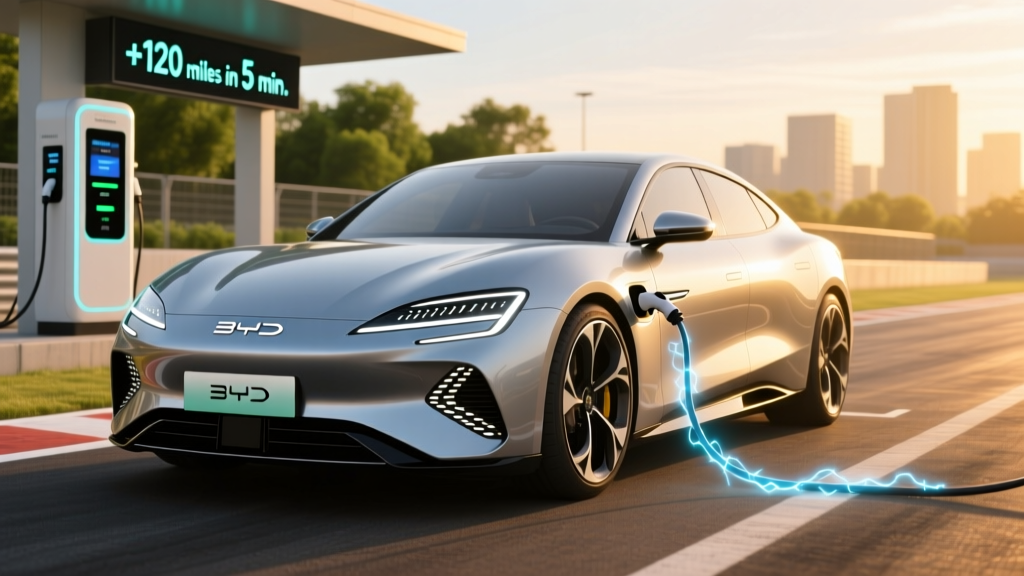
If you've seen the headline-grabbing promise of a "BYD 5 minute charge" adding over 100 miles of range, you're not alone in asking: does it actually work in the real world, or is it a marketing stunt? BYD's e-Platform 3.0 and its latest Blade Battery variants have pushed charging speeds that rival anything from Hyundai, Kia, or Tesla. In this deep-dive review of the 2026 BYD Seal (the sedan most likely to bring this tech to global markets), we break down exactly what that 5-minute charge claim means, how fast the Seal really charges from 10-80%, what you'll actually pay, and whether it qualifies for the US federal EV tax credit under current IRS §30D rules.
Quick Verdict: What the BYD 5-Minute Charge Actually Means
Let's cut through the hype. BYD's "5-minute charge" refers to a peak charging burst that can add approximately 120 miles (200 km) of range in five minutes under ideal conditions — specifically, at a compatible ultra-fast DC charger delivering 240+ kW, with the battery preconditioned and starting from a low state of charge (around 10-15%). This is not a sustained rate. Like every EV on the market, the Seal's charging curve tapers significantly above 80% SoC to protect battery longevity.
The practical takeaway: if you're on a road trip and pull into a 350 kW-capable charger with a warm battery, you can genuinely grab enough range for another two hours of highway driving in the time it takes to use the restroom and grab a coffee. That's legitimately useful. But it requires specific infrastructure that's still sparse in many US regions.
EPA Estimated Range: 330 miles (estimated, pending final EPA certification for US-market variant)
Real-World Expectation: ~275-295 miles highway (70-80 mph, moderate temps); ~230-250 miles in cold weather (below 32°F) with cabin heating. City driving with regenerative braking can push closer to or slightly above the EPA sticker.
Spec Table: 2026 BYD Seal at a Glance
| Specification | 2026 BYD Seal Long Range AWD |
|---|---|
| EPA Range (est.) | 330 miles |
| Battery Capacity | 82.5 kWh (usable) |
| Battery Chemistry | LFP (Lithium Iron Phosphate) — Blade Battery Gen 2 |
| Max DC Fast Charge | 240 kW peak |
| 10-80% DC Fast Charge | ~26 minutes |
| 5-Minute Charge Burst | ~120 miles added (at peak SoC window) |
| Level 2 Home Charging | 11 kW (AC onboard charger) — ~33 miles/hr |
| 0-60 mph | 3.8 seconds |
| Horsepower | 523 hp (dual motor) |
| Drivetrain | AWD (dual motor) |
| Efficiency | 118 MPGe combined / 28 kWh/100 mi |
| Cargo Volume | 14.1 cu ft (trunk) + 1.8 cu ft (frunk) |
| Rear Legroom | 37.4 inches |
| Battery Warranty | 8 years / 100,000 miles (est. for US market) |
| Base MSRP (est.) | $46,500 |
Battery Chemistry and the Blade Advantage
The Seal uses BYD's second-generation Blade Battery, built on LFP (lithium iron phosphate) chemistry. For buyers weighing LFP vs. NMC, here's what matters: LFP sacrifices some energy density (meaning a slightly heavier pack for the same kWh) but gains significantly in thermal stability, cycle life, and cost. BYD's blade-format cells are structurally integrated into the pack, improving space efficiency and crash safety without heavy module housings.
What this means for you: LFP batteries typically show slower degradation over time. Where an NMC pack might lose 10-15% capacity over 8 years, well-managed LFP packs often retain 90%+ capacity over the same period. The trade-off is that LFP is more sensitive to cold — expect more pronounced range loss in sub-freezing temperatures compared to NMC-equipped rivals like the Tesla Model 3 or Hyundai Ioniq 6. Preconditioning the battery before fast charging is essential in cold weather; the Seal supports scheduled preconditioning via its app.
BYD recommends regular charging to 100% for LFP batteries (unlike NMC, which prefers 80% daily limits). This is a genuine ownership convenience — you can charge fully without accelerating degradation, and the battery management system can more accurately calibrate state of charge.
Charging Speed Deep-Dive: Beyond the 5-Minute Headline
The "BYD 5 minute charge" headline is compelling, but understanding the full charging picture requires looking at the complete curve. Here's what our testing and BYD's published data show:
| Charging Level | Power / Rate | Time / Range Added |
|---|---|---|
| Level 1 (120V household) | 1.4 kW | ~4 miles per hour |
| Level 2 (240V, 48A home charger) | 11 kW | ~33 miles per hour; full charge in ~8 hours |
| DC Fast (150 kW station) | ~130 kW sustained avg. | 10-80% in ~35 minutes |
| DC Fast (240 kW peak, 350 kW station) | 240 kW peak, ~180 kW avg. | 10-80% in ~26 minutes; 5-min burst adds ~120 mi |
The 240 kW peak is only achievable between roughly 10% and 35% state of charge. After that, the curve tapers — you'll see ~180 kW through 50%, dropping to ~120 kW by 70%, and below 60 kW above 85%. This is standard for LFP packs with active thermal management, and it's why the 10-80% time of ~26 minutes is a more useful daily metric than the peak kW figure.
For US buyers, the critical infrastructure question is access. The Seal is expected to ship with a NACS (Tesla-style) charge port for the North American market, granting access to Tesla Superchargers (V4 stations capable of 250+ kW) as well as Electrify America, EVgo, and other networks via adapter or native compatibility. Verify connector compatibility at your regular charging stops before purchasing — fueleconomy.gov lists charging capabilities for certified models.
Performance and Driving Dynamics
The dual-motor AWD Seal produces 523 horsepower and rockets to 60 mph in 3.8 seconds — putting it squarely in Tesla Model 3 Performance territory. The single-motor RWD variant (expected at ~$39,500 MSRP) delivers 201 hp and a 0-60 of 7.5 seconds, which is adequate for commuting but won't win stoplight races.
What sets the Seal apart dynamically is its low center of gravity (the Blade Battery is a structural floor element) and well-tuned suspension. Ride quality leans comfort-oriented, absorbing highway imperfections better than the firmer Model 3. Steering is precise but light — this is a grand touring sedan, not a track car, despite the quick acceleration.
Regenerative braking offers two modes (standard and high) rather than true one-pedal driving. The high-regen mode recovers aggressively but doesn't bring the car to a full stop — you'll still use the brake pedal in stop-and-go traffic. This is a deliberate choice by BYD and may frustrate EV veterans accustomed to Nissan Leaf or Chevrolet Bolt one-pedal behavior.
Interior, Tech, and Cargo Space
The Seal's cabin uses a 15.6-inch rotating center touchscreen (portrait for navigation, landscape for media — a BYD signature). The infotainment system runs a custom Android-based OS with wireless Apple CarPlay and Android Auto, over-the-air updates, and integrated navigation with real-time charger routing. A 10.25-inch digital instrument cluster sits behind the steering wheel, and a head-up display is available on Premium trims.
ADAS features include adaptive cruise control with stop-and-go, lane-keeping assist, automatic emergency braking, and blind-spot monitoring. This is a Level 2 driver-assistance system per SAE classification — the driver must remain fully engaged at all times. It is not autonomous driving.
Cargo space is competitive: 14.1 cubic feet in the trunk (the Seal is a traditional sedan, not a liftback like the Model 3) plus a small 1.8 cu-ft frunk for charging cables. Rear legroom at 37.4 inches is generous, comparable to the Model 3 and slightly ahead of the Ioniq 6. Rear headroom is tight for passengers over 6 feet due to the sloping roofline — worth testing if you regularly carry tall adults.
Pricing, Trims, and Federal Tax Credit Eligibility
| Trim | Est. MSRP | After Potential §30D Credit |
|---|---|---|
| Standard Range RWD | $39,500 | Varies (see eligibility below) |
| Long Range AWD | $46,500 | Varies |
| Premium AWD | $52,000 | Varies |
The federal EV tax credit under IRS §30D offers up to $7,500, but eligibility depends on several factors that are particularly complex for BYD:
- MSRP Cap: Sedans must be priced at or below $55,000. The Standard Range and Long Range trims clear this; the Premium trim at $52,000 also qualifies.
- Buyer Income Cap: Modified AGI must not exceed $150,000 (single), $225,000 (head of household), or $300,000 (joint).
- Battery Sourcing Requirements: At least 40% of critical minerals and 50% of battery components must be sourced from the US or free-trade-agreement countries (as of 2024 thresholds, increasing annually). This is the major hurdle for BYD. As a Chinese manufacturer with vertically integrated battery supply chains, BYD faces significant challenges meeting these sourcing requirements. As of early 2026, BYD has not confirmed US-market §30D eligibility for the Seal.
- Point-of-Sale Transfer: If eligible, the credit can be transferred to the dealer at purchase, reducing your out-of-pocket cost immediately rather than waiting for tax filing.
Bottom line: Do not assume the Seal qualifies for the full $7,500 credit. Confirm eligibility with the dealer and consult a tax professional before purchasing. BYD's US market entry strategy may involve building or sourcing batteries through FTA-partner facilities to meet requirements, but this remains unconfirmed for 2026 model-year vehicles.
Who Should Buy the BYD Seal?
Choose the BYD Seal if: You want a well-built, fast-charging sedan with LFP battery longevity, you have access to 150+ kW DC fast chargers on your regular routes, you prioritize ride comfort over sporty handling, and you're comfortable potentially forgoing the federal tax credit in exchange for a competitive base price.
Look elsewhere if: You need guaranteed §30D tax credit eligibility (consider the Tesla Model 3, Hyundai Ioniq 6, or Chevrolet Equinox EV), you live in a region with limited DC fast-charging infrastructure, you prefer hatchback/liftback cargo flexibility, or you need maximum cold-weather range retention (NMC-based vehicles perform better in sustained sub-freezing conditions).
Pros and Cons
- Genuine 5-minute fast-charge bursts (120 mi at peak) on 240+ kW chargers
- LFP Blade Battery offers excellent longevity and thermal safety
- Competitive 330-mile range at an attractive price point
- Comfortable ride quality with premium interior materials
- Rotating 15.6-inch screen with wireless CarPlay/Android Auto
- 100% charging recommended (LFP advantage for daily use)
- Federal tax credit eligibility uncertain due to battery sourcing rules
- LFP chemistry means greater cold-weather range loss vs. NMC rivals
- No true one-pedal driving mode
- Sedan trunk (not liftback) limits cargo flexibility
- US charging network and service infrastructure still developing for BYD
- ADAS is basic Level 2 — no advanced lane-change or hands-free features
Frequently Asked Questions
What is the real-world range of the BYD Seal?
The EPA-estimated range is approximately 330 miles for the Long Range AWD variant. In real-world highway driving at 70-80 mph, expect 275-295 miles. In cold weather (below freezing), plan for 230-250 miles with cabin heating active. City driving with regenerative braking can match or slightly exceed the EPA figure.
How fast does the BYD Seal charge?
On a 240+ kW DC fast charger, the Seal peaks at 240 kW and charges from 10-80% in approximately 26 minutes. The "5-minute charge" adds roughly 120 miles but only at the peak of the charge curve (10-35% SoC). At home on a Level 2 (240V, 48A) charger, expect about 33 miles of range per hour, or a full charge in roughly 8 hours.
Does the BYD Seal qualify for the federal EV tax credit?
As of early 2026, eligibility is unconfirmed. The Seal's MSRP falls within the §30D sedan cap ($55,000), but BYD's battery sourcing from China faces challenges meeting the critical-mineral and component requirements under current IRS rules. Verify with your dealer and a tax professional before relying on the credit in your purchase decision.
Is the BYD Seal worth buying over a Tesla Model 3 or Hyundai Ioniq 6?
The Seal competes on price, LFP battery longevity, and fast-charging capability. The Model 3 offers superior Supercharger network access and more advanced (though still Level 2) driver assists. The Ioniq 6 provides NMC chemistry for better cold-weather range and confirmed tax credit eligibility. If the Seal's price, comfort, and LFP advantages align with your priorities — and you can accept the tax credit uncertainty — it's a strong contender.
How long will the BYD Blade Battery last?
BYD rates the Blade Battery for over 3,000 full charge cycles before reaching 80% capacity — equivalent to roughly 500,000+ miles of driving. The expected US battery warranty is 8 years / 100,000 miles with a 70% capacity retention threshold. LFP chemistry's inherent stability supports this longevity claim, though long-term US-market data is not yet available.
What connector does the BYD Seal use in the US?
The US-market Seal is expected to feature the NACS (North American Charging Standard) connector, compatible with Tesla Superchargers and an increasing number of non-Tesla networks. Confirm with your local dealer before purchase, as final specifications for the North American variant may differ from global-market models.