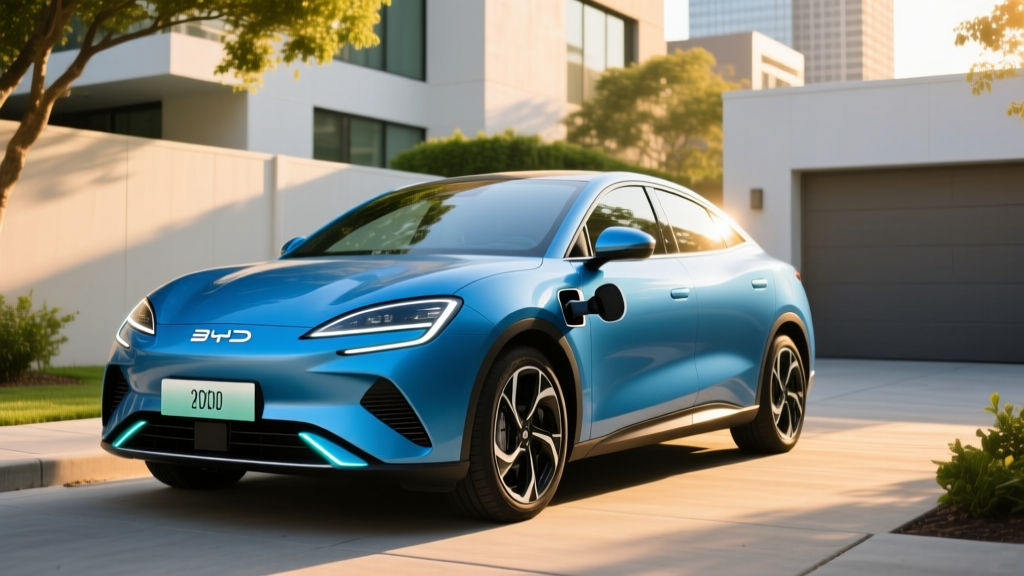
The BYD Seagull has become one of the most talked-about compact electric vehicles globally, selling in massive volumes across China, Southeast Asia, and Latin America since its 2023 debut. For US-based EV shoppers searching for an affordable electric car, the question is straightforward: Can you actually buy a BYD Seagull in the United States, and if so, what are you getting in terms of range, charging, and value?
This review breaks down the BYD Seagull's specifications, real-world efficiency, charging performance, and ownership economics based on the latest 2026 model-year data available in international markets — while addressing the critical question of US availability head-on.
US Availability: Where Does the BYD Seagull Stand in 2026?
Let's address the elephant in the room first. As of early 2026, BYD does not sell the Seagull — or any passenger vehicle — in the United States. The company has no US dealership network, no EPA certification for its passenger cars, and faces a 100% US tariff on Chinese-made EVs imposed in 2024. That tariff effectively doubles the vehicle's landed cost, making a $20,000 car into a $40,000 proposition overnight.
BYD has signaled interest in entering the US market eventually, potentially through a Mexican manufacturing plant, but no timeline has been confirmed. For US buyers, the Seagull remains an announced/international-market vehicle — one you can study and compare, but cannot currently purchase or test-drive domestically.
If you're researching the Seagull as a benchmark for what affordable EVs could cost, or you're considering importing one (not recommended without EPA/DOT compliance), the specs below reflect the latest international-market configuration.
BYD Seagull Specifications at a Glance
| Spec | Value |
|---|---|
| Battery (usable) | 38.9 kWh (LFP — Blade Battery) |
| EPA-estimated range | Not EPA-rated (US not available); WLTP ~252 mi (405 km) |
| Estimated EPA range (if certified) | ~200–220 mi |
| Motor output | 75 kW (101 hp) / 135 Nm torque |
| Drivetrain | FWD (single front motor) |
| 0–60 mph | ~11.0 seconds (est.) |
| Top speed | 81 mph (130 km/h) |
| DC fast charging (peak) | 60 kW |
| 10–80% DC charge time | ~35 minutes |
| Level 2 AC charging | 6.6 kW (~22 mi/hr) |
| Connector (international) | GB/T (China); CCS2 (export markets) |
| Length / Width / Height | 146.5 in / 67.7 in / 60.6 in |
| Wheelbase | 97.6 in |
| Cargo volume (rear seats up) | ~12.4 cu ft |
| Curb weight | ~2,610 lbs |
| Base MSRP (China) | ~¥79,800 (~$11,000 USD) |
| Base MSRP (export markets) | ~$20,000–$25,000 USD equivalent |
| Battery warranty | 8 years / 100,000 mi (varies by market) |
Range and Efficiency: WLTP vs. Real-World Expectations
WLTP combined: ~252 mi (405 km)
Estimated EPA equivalent: ~200–220 mi
Real-world highway (70 mph): ~160–180 mi
Real-world cold weather (20°F): ~130–150 mi
The BYD Seagull uses a 38.9 kWh (usable) lithium iron phosphate (LFP) Blade Battery pack. Because the Seagull is not EPA-certified, we don't have an official US range sticker. However, based on the WLTP-to-EPA conversion factor (typically 15–20% lower for EPA), a reasonable estimate would be 200–220 miles EPA combined if the vehicle were certified for US sale.
In real-world driving, efficiency depends heavily on conditions. The Seagull's compact size and light curb weight (~2,610 lbs) help it achieve strong city efficiency — roughly 3.8–4.2 miles per kWh in urban stop-and-go driving. That translates to an estimated 148–164 MPGe combined, competitive with the Chevrolet Bolt EV's 120 MPGe and the Nissan LEAF's 111–123 MPGe.
Highway driving at 70+ mph is where the Seagull's limited aerodynamic optimization and small battery show their limits. Expect range to drop to roughly 160–180 miles on sustained highway runs. In cold weather (below 32°F), LFP chemistry experiences more pronounced capacity loss than NMC — plan for 130–150 miles of usable range in winter conditions without a heat pump preconditioning strategy.
The Seagull does not come equipped with a heat pump in most trim levels (it's an option on higher trims in some markets), which means cabin heating draws directly from the traction battery via resistive elements — a significant range penalty in cold climates.
Charging Performance: DC Fast and Home Level 2
| Charging Level | Power / Rate | Miles Added per Hour | Notes |
|---|---|---|---|
| Level 1 (120V household) | ~1.4 kW | ~5 mi/hr | Emergency/trickle only |
| Level 2 (240V home/public) | 6.6 kW | ~22 mi/hr | Full charge in ~6 hours |
| DC Fast Charge | 60 kW peak | ~130 mi/hr (at peak) | 10–80% in ~35 min |
The Seagull's charging profile is the area where budget-EV compromises become most apparent. The 60 kW peak DC fast-charge rate is modest by 2026 standards — the Hyundai Ioniq 5 peaks at 240 kW, and even the Chevrolet Bolt EUV managed 55 kW with a larger battery. At 60 kW, the Seagull's 10–80% charge takes approximately 35 minutes, which is serviceable for occasional road trips but noticeably slower than the 18–25 minute times common on 800V architectures.
The charge curve is relatively flat through the 30–60% SoC window (sustaining near-peak 55–60 kW), then tapers progressively above 70%. Charging from 80–100% adds another 25–30 minutes, so plan to unplug at 80% on road trips for the best time efficiency.
For home charging, the 6.6 kW onboard charger is adequate for daily use. Plugging into a Level 2 home wallbox overnight yields a full charge in roughly 6 hours — more than sufficient for commuters who start each morning at 100% SoC. A standard NEMA 14-50 outlet installation (240V/40A) typically costs $500–$1,500 depending on panel proximity and local permitting, per US Department of Energy guidance.
Connector compatibility for any hypothetical US version would likely use CCS1 (the North American standard for non-Tesla EVs), though BYD could adopt NACS if the vehicle launches after 2026, given the industry-wide shift toward Tesla's connector.
Performance and Driving Dynamics
The Seagull's single front-mounted motor produces 75 kW (101 horsepower) and 135 Nm (100 lb-ft) of torque. That's enough for a 0–60 mph time of approximately 11 seconds — leisurely by EV standards, but perfectly adequate for urban merging and city driving where instant torque delivery makes the car feel more responsive than the numbers suggest.
Top speed is electronically limited to 81 mph, which is a practical limitation for US highway driving where speed limits of 75–85 mph are common in western states. This is a vehicle engineered primarily for urban and suburban use.
Ride quality, based on international-market reviews, is firm but compliant over typical city road surfaces. The short 97.6-inch wheelbase means the Seagull can feel choppy over larger highway expansion joints, and wind noise becomes noticeable above 60 mph. Steering is light and low-effort — ideal for parking, less confidence-inspiring at highway speeds.
Regenerative braking offers two levels (standard and strong), but the Seagull does not support true one-pedal driving to a complete stop. You'll still need the friction brake for the final few mph.
Interior, Cargo, and Technology
Inside, the Seagull follows BYD's now-familiar design language with a rotating 10.1-inch central touchscreen (landscape for navigation, portrait for media — a BYD signature). The digital instrument cluster is a compact 5-inch unit behind the steering wheel. Wireless Apple CarPlay and Android Auto are included on most export-market trims.
Passenger space is tight but usable for the segment:
- Front legroom: ~41.0 in
- Rear legroom: ~33.5 in
- Front headroom: ~39.4 in
- Cargo (rear seats up): ~12.4 cu ft
- Cargo (rear seats folded): ~34.0 cu ft
The rear seats accommodate two adults comfortably for short trips but will feel cramped for anyone over 5'10" on longer journeys. Cargo capacity is adequate for weekly groceries but limited for family road-trip luggage — a roof box isn't an option due to the lack of roof rails on most trims.
Driver-assistance technology is basic compared to US-market expectations. Higher export trims include:
- Adaptive cruise control (stop-and-go capable)
- Lane-keeping assist
- Automatic emergency braking with pedestrian detection
- 360-degree camera
- Rear cross-traffic alert
These features constitute SAE Level 1–2 driver assistance — the driver must remain fully engaged at all times. There is no hands-free highway driving system comparable to GM's Super Cruise or Ford's BlueCruise.
Pricing, Trims, and Tax Credit Eligibility
| Trim | Price (USD equiv.) | Key Features |
|---|---|---|
| Vitality (base) | ~$20,000 | 30.1 kWh battery, ~185 mi WLTP, basic ADAS |
| Freedom | ~$22,500 | 38.9 kWh battery, ~252 mi WLTP, upgraded infotainment |
| Flying (top) | ~$25,000 | 38.9 kWh, full ADAS suite, heated seats, 360° camera |
Pricing above reflects export-market conversions (Latin America, Southeast Asia). In China, the Seagull starts at approximately ¥79,800 (~$11,000 USD), but Chinese domestic pricing benefits from local supply-chain economics that don't translate to export markets.
Because the BYD Seagull is not sold in the US and is manufactured in China, it does not qualify for the IRS §30D federal EV tax credit. Even if BYD began US sales, the vehicle would face disqualification on multiple fronts:
• Battery sourcing: §30D requires critical minerals and battery components to meet US/FTEA-sourced thresholds — Chinese-manufactured LFP cells currently fail this test.
• Foreign Entity of Concern (FEOC): BYD is a Chinese-headquartered company, and battery components from FEOC entities disqualify vehicles from the credit entirely as of 2024+.
• See IRS §30D guidelines for current eligibility rules.
Battery Longevity and Warranty
BYD's Blade Battery architecture uses LFP (lithium iron phosphate) chemistry in a cell-to-pack design that eliminates module-level hardware, improving volumetric energy density and structural rigidity. LFP offers several ownership advantages:
- Cycle life: 3,000+ full charge cycles before 80% capacity retention — significantly more than NMC (~1,000–1,500 cycles)
- Thermal stability: LFP is far less prone to thermal runaway than NMC/NCA chemistries
- Daily charging: BYD recommends regular 100% charging for LFP (unlike NMC, where 80% daily is preferred for longevity)
- Cost: LFP cells are cheaper to manufacture, reducing eventual replacement cost
The trade-off is lower energy density — LFP packs are heavier and bulkier for the same kWh capacity, which is why the Seagull's range is modest despite a battery size comparable to some NMC-equipped competitors.
BYD's international battery warranty is typically 8 years / 100,000 miles (or 160,000 km), with a capacity retention threshold of 70% — consistent with industry norms from Hyundai, Kia, and Volkswagen. For a daily commuter covering 12,000 miles annually, that warranty covers roughly 8 years of ownership before any significant degradation concern.
BYD Seagull vs. US-Market Alternatives
Since the Seagull isn't available in the US, here's how it compares to the closest domestic alternatives in the affordable compact EV segment:
| Spec | BYD Seagull (Intl.) | Chevy Bolt EV* | Nissan LEAF S | Hyundai Kona Electric |
|---|---|---|---|---|
| EPA Range | ~200–220 (est.) | 259 mi | 149 mi | 261 mi |
| Battery | 38.9 kWh LFP | 65 kWh NMC | 40 kWh NMC | 64.8 kWh NMC |
| DC Fast Charge | 60 kW | 55 kW | 50 kW | 100+ kW |
| 0–60 mph | ~11.0 sec | ~6.5 sec | ~7.9 sec | ~7.5 sec |
| Base MSRP | ~$20K (intl.) | ~$28,000 | ~$29,000 | ~$33,000 |
| US Tax Credit | None | Up to $7,500 | Up to $7,500 | Up to $7,500 |
| Net Price (after credit) | ~$20K | ~$20,500 | ~$21,500 | ~$25,500 |
* Chevrolet Bolt EV was discontinued after 2023; a next-gen Bolt is expected for 2026–2027 on the Ultium platform. Pricing is estimated based on prior-gen MSRP and anticipated positioning.
The comparison reveals an important insight: once you factor in the $7,500 federal tax credit on US-market alternatives, the Seagull's price advantage narrows dramatically. A post-credit Chevy Bolt at ~$20,500 offers more range, faster acceleration, and full US service infrastructure — making the Seagull's value proposition less compelling even if it were available stateside at its international export price.
Pros and Cons
- Extremely low purchase price (in international markets)
- LFP Blade Battery offers excellent cycle life and safety
- Compact dimensions ideal for city parking
- Rotating infotainment screen is a unique touch
- Low operating cost — ~$0.04–0.06/mi on home electricity
- Surprisingly complete feature list for the price
- Not available in the United States
- 60 kW DC charging is slow for road trips
- 81 mph top speed limits highway usability
- No heat pump standard — significant winter range loss
- Tight rear seat and limited cargo space
- Would not qualify for §30D tax credit even if US-available
- No US service/parts network
Who Should Consider the BYD Seagull?
Not Ideal For: US buyers (not available), highway-heavy commuters, cold-climate drivers without garage parking, families needing rear-seat space, or anyone who needs road-trip charging speed.
For US-based EV shoppers who are drawn to the Seagull's price point, the practical alternatives are the used EV market (a 2022–2023 Chevrolet Bolt EV can be found for $15,000–$20,000), or waiting for the next-generation Bolt or a similarly priced compact EV from a manufacturer with US presence.
Frequently Asked Questions
What is the real-world range of the BYD Seagull?
In mixed city/highway driving in temperate conditions, expect roughly 180–200 miles from a full charge. Highway-only driving at 70 mph drops that to ~160–180 miles. Cold weather (below freezing) can reduce range to 130–150 miles due to LFP chemistry sensitivity and resistive cabin heating.
How fast does the BYD Seagull charge?
DC fast charging peaks at 60 kW, delivering a 10–80% charge in approximately 35 minutes. Home Level 2 charging at 6.6 kW takes about 6 hours for a full charge. Level 1 (120V) trickle charging adds roughly 5 miles of range per hour.
Can I buy the BYD Seagull in the United States?
No. As of 2026, BYD does not sell passenger vehicles in the US. The company faces a 100% tariff on Chinese-made EVs and has no US dealer or service network. No timeline for US entry has been confirmed.
Does the BYD Seagull qualify for the federal EV tax credit?
No. Even if the Seagull were sold in the US, it would be disqualified from the IRS §30D credit due to Chinese battery component sourcing and BYD's status as a Foreign Entity of Concern (FEOC) under current IRS rules.
Is the BYD Seagull worth buying vs. competitors?
In international markets where it's sold, the Seagull offers exceptional value at its price point. For US buyers, post-tax-credit pricing on domestic alternatives like the Chevrolet Bolt or Nissan LEAF narrows the gap significantly while offering longer range, faster charging, and full US service infrastructure.
What is the BYD Seagull's battery warranty?
BYD provides an 8-year / 100,000-mile battery warranty in most international markets, covering capacity retention above 70%. This is consistent with industry-standard EV battery warranties from Hyundai, Kia, and Volkswagen.