The BYD Seagull has dominated headlines as one of the cheapest electric vehicles on the planet — a sub-$10,000 city car in China that looks surprisingly well-built for the money. But for US buyers, the conversation shifts fast: availability, safety certification, and whether this compact hatchback can survive American highways. This review breaks down the BYD Seagull interior, powertrain specs, charging behavior, and the regulatory hurdles that determine whether you can actually buy one stateside.
Important context for US readers: As of early 2026, the BYD Seagull is not officially sold in the United States. BYD has not announced a US launch date, and any pricing or specs discussed here reflect international-market models (primarily the Latin American and European variants). We cover it because it represents a benchmark for ultra-affordable EVs and may eventually reach North America through a Mexico or Brazil manufacturing corridor. Treat all figures as preliminary for any future US-spec version.
BYD Seagull Interior: Materials, Layout, and Cargo Space
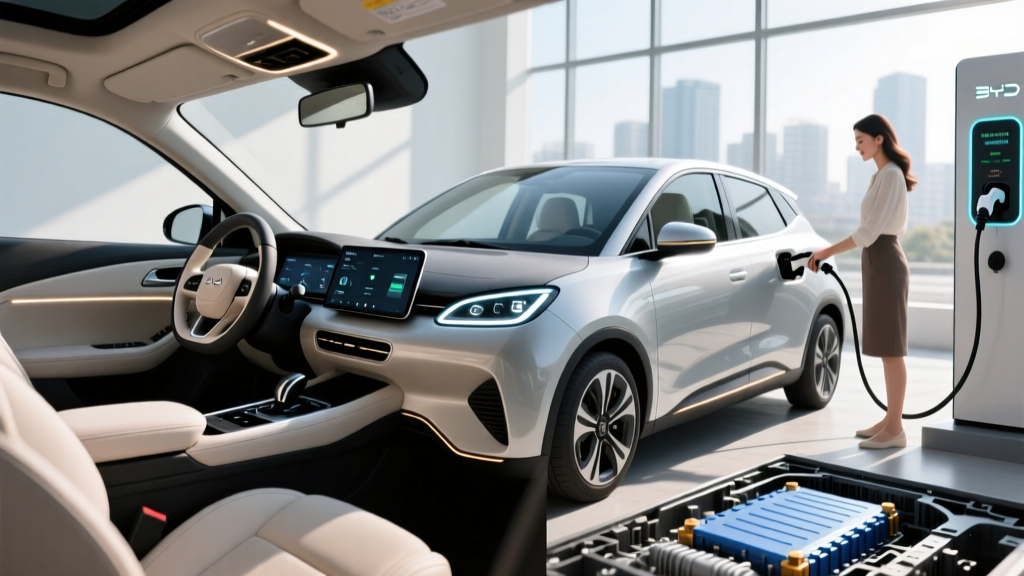
The headline question — "What's the BYD Seagull interior actually like?" — gets a surprisingly favorable answer if you calibrate expectations to the price point. The cabin uses hard plastics throughout, but the dashboard features a soft-touch stitched-look vinyl panel that elevates the visual quality beyond what you'd expect from a vehicle in this segment.
The centerpiece is a 10.1-inch rotating infotainment touchscreen (standard on the Comfort and Active trims) running BYD's DiLink OS. It supports wireless Apple CarPlay and Android Auto, and the portrait-to-landscape rotation is genuinely useful for navigation. Below it sits a row of physical climate controls — a welcome choice over the touchscreen-only approach many competitors use.
The instrument cluster is a compact 5.0-inch digital display behind the flat-bottom steering wheel, showing speed, range, and energy consumption. Build quality on international-spec models we've examined at auto shows shows tight panel gaps and consistent stitching on the vegan-leather seats (standard on Comfort, optional on base models).
| Measurement | Value |
|---|---|
| Front headroom | 38.6 in |
| Front legroom | 41.1 in |
| Rear headroom | 37.2 in |
| Rear legroom | 33.5 in |
| Cargo volume (rear seats up) | 8.3 cu ft |
| Cargo volume (rear seats folded) | 26.4 cu ft |
| Infotainment screen | 10.1-in rotating touchscreen |
| Instrument cluster | 5.0-in digital display |
| Wireless phone charging | Standard (Comfort/Active) |
The biggest interior compromise is width. At roughly 67.3 inches wide, the Seagull is a true subcompact, and the rear bench comfortably fits two adults but not three. The 8.3 cu ft of cargo space behind the rear seats is tight — think a couple of grocery bags or a small carry-on, not luggage for a weekend trip. Fold the 60/40 split rear bench and you gain 26.4 cu ft, enough for a bicycle or several large boxes.
Range, Battery Chemistry, and Real-World Efficiency
The BYD Seagull is offered internationally with two battery options: a 30.08 kWh pack and a larger 38.88 kWh pack. Both use BYD's proprietary Blade battery, which is a lithium iron phosphate (LFP) cell in a cell-to-pack architecture. LFP chemistry trades energy density for longevity and thermal stability — it degrades more slowly than NMC and tolerates repeated 100% charging without damage, which is a major advantage for daily drivers who charge at home.
Range Reality Check
CLTC-rated range (China cycle): 30 kWh = ~190 mi / 38.88 kWh = ~252 mi
Estimated EPA-equivalent range (if US-certified): ~170 mi (30 kWh) / ~220 mi (38.88 kWh)
Real-world expectation: City driving in mild weather should return close to EPA estimates. Highway driving at 70+ mph will reduce range by 15-20%. In cold weather (below 32°F), expect a 25-35% range reduction due to cabin heating and battery resistance — the Seagull lacks a heat pump on base trims, which significantly impacts winter efficiency. The smaller 30 kWh battery could realistically deliver 110-130 miles in freezing highway conditions.
Efficiency figures from international testing suggest roughly 3.8-4.2 miles per kWh (approximately 120-130 MPGe combined), which is competitive for the segment. The LFP Blade pack's weight contributes to a slightly higher consumption rate than you'd see from a lighter vehicle with an equivalent NMC pack, but the trade-off is a battery that should retain 90%+ capacity after 8 years of daily use.
Charging Speed: DC Fast Charge and Home Level 2
Charging is where the Seagull's budget positioning becomes most apparent. DC fast charging tops out at approximately 40 kW on the 30 kWh model and around 50 kW on the larger battery. BYD quotes a 30-80% charge time of roughly 30 minutes under ideal conditions, but real-world sessions at public chargers will vary based on battery temperature and charger availability.
| Charging Method | Power | Estimated Time / Rate |
|---|---|---|
| Level 1 (120V household) | ~1.4 kW | ~8-10 mi/hr added |
| Level 2 (240V home/public) | ~6.6 kW | ~25-30 mi/hr added; 0-100% in ~5-6 hrs |
| DC Fast Charge (CCS/NACS TBD) | 40-50 kW peak | 30-80% in ~30 min |
The 40-50 kW DC peak is slow by 2026 standards — most mainstream EVs charge at 150-350 kW. However, the Seagull's small battery means you don't need high peak rates to add meaningful range. A 30-minute DC session adds roughly 90-110 miles, which covers most city driving needs between top-ups.
For home charging, the onboard charger accepts up to 6.6 kW on Level 2, which fully replenishes the 30 kWh pack in about 5 hours. If you're installing a home Level 2 charger, a standard 240V/30A circuit is sufficient — no panel upgrade required for most homes. See our DOE EV charging guide for home installation basics.
Performance: 0-60, Horsepower, and Drivetrain
The BYD Seagull uses a single front-mounted permanent-magnet synchronous motor producing 75 horsepower (55 kW) and approximately 100 lb-ft of torque. Power goes to the front wheels through a single-speed reduction gear. There is no AWD option.
| Metric | Value |
|---|---|
| Horsepower | 75 hp (55 kW) |
| Torque | ~100 lb-ft |
| Drivetrain | FWD (single motor) |
| 0-60 mph (estimated) | ~11.0 seconds |
| Top speed (electronically limited) | 81 mph |
| Curb weight | ~2,535 lbs (30 kWh) / ~2,720 lbs (38.88 kWh) |
An 11-second 0-60 time places the Seagull firmly in the "adequate for city use" category. Merging onto a 70-mph freeway requires planning, and the 81-mph top speed limiter means this car is not designed for sustained high-speed travel. In urban environments where speeds rarely exceed 45 mph, the instant torque delivery makes the Seagull feel peppy off the line, and the low curb weight helps with agility in tight parking situations.
Pricing, Trim Levels, and Federal Tax Credit Eligibility
International pricing for the BYD Seagull starts at approximately the equivalent of $10,000-$12,000 USD for the base 30 kWh model and $13,000-$15,000 for the larger-battery Comfort trim. These are China and Latin America prices. Any future US-spec version would carry additional costs for safety certification, compliance modifications, dealer network setup, and potential import tariffs.
| Trim | Estimated US MSRP | After §30D Credit |
|---|---|---|
| Base (30 kWh) | $18,000-$22,000 (est.) | $10,500-$14,500 (if eligible) |
| Comfort (38.88 kWh) | $22,000-$26,000 (est.) | $14,500-$18,500 (if eligible) |
Federal tax credit reality: Under current IRS §30D rules, the Seagull would need to meet three criteria to qualify for the full $7,500 credit: (1) final assembly in North America, (2) MSRP under $55,000 (passenger car cap), and (3) battery component and critical-mineral sourcing thresholds that phase in annually through 2030. Since BYD currently manufactures the Seagull in China, it would not qualify for §30D in its current form. A future Mexico- or Brazil-built version might qualify, but battery-sourcing rules could still limit the credit to $3,750 or zero depending on mineral origin. Always verify current-year rules with a tax professional before purchasing.
Additionally, the §30D credit has income caps: $150,000 modified AGI for single filers, $225,000 for head of household, and $300,000 for joint filers. If BYD ever sells the Seagull in the US, the point-of-sale transfer option would let dealers apply the credit at purchase rather than at tax filing.
Driver Assistance, Safety, and Standout Tech
The international-spec Seagull includes a basic ADAS suite on Comfort and Active trims: forward collision warning, automatic emergency braking, lane departure warning, and rear cross-traffic alert. Higher trims add adaptive cruise control and a 360-degree camera system. All driver-assist features operate at SAE Level 1-2 — meaning the driver must remain fully engaged at all times.
ADAS Limitations
The Seagull's driver-assist features are basic by 2026 standards. There is no lane-centering assist on base trims, no hands-free driving capability, and no automated lane changes. The system is designed for collision mitigation, not autonomous operation. Always keep your hands on the wheel and eyes on the road.
On the safety front, the Latin NCAP-tested Seagull received a 4-star rating (out of 5) for the Latin American market. US-spec models would need to meet NHTSA FMVSS standards and IIHS crash-test protocols — a process that typically requires structural reinforcement and airbag calibration changes. No US crash-test data exists because the vehicle is not sold here.
Standout tech includes the rotating center screen (a BYD signature), NFC key card support, vehicle-to-load (V2L) capability on select trims (allowing you to power small electronics from the car's battery), and over-the-air software updates. Notable drawbacks include the absence of a heat pump on base trims (hurting winter range), no front trunk (frunk), and limited rear-seat width for three passengers.
Who Should Consider the BYD Seagull?
If it becomes available in the US, the Seagull targets a specific buyer: a single person or couple who needs an ultra-low-cost daily commuter for city and suburban driving under 50 miles round-trip. It's ideal as a second car for errands, a first EV for budget-conscious buyers, or a fleet vehicle for urban delivery services.
It is not suited for: families needing rear-seat space for car seats, drivers who regularly take highway road trips over 100 miles, or anyone in a cold climate who needs reliable winter range without a heat pump. The limited DC fast-charge rate also makes it impractical as a sole vehicle for anyone without home charging access.
Pros
- Extremely low purchase price — potentially cheapest new EV in the US if imported
- LFP Blade battery offers excellent longevity and thermal safety
- Rotating infotainment screen and solid cabin design for the price
- Tight turning radius and easy urban maneuverability
- V2L capability on select trims
Cons
- Not available in the US as of 2026 — no confirmed launch date
- Slow DC fast charging (40-50 kW peak) limits road-trip utility
- No heat pump on base trims — severe cold-weather range loss
- 75 hp and 81-mph top speed make highway merging stressful
- Tiny 8.3 cu ft cargo area with seats up
- Would not qualify for §30D tax credit if China-assembled
How It Compares: Seagull vs. US-Market Alternatives
Since the Seagull isn't available stateside, the closest current alternatives include the Chevrolet Bolt EV (used market, ~$15,000-$20,000), the Nissan Leaf S (starting ~$29,000 new), and the upcoming next-generation budget EVs from Hyundai and Kia. The Bolt offers 259 miles of EPA range and CCS fast charging but is larger and heavier. The Leaf offers 149 miles on the base 40 kWh battery and uses the aging CHAdeMO connector. The Seagull's advantage, if it arrives, would be pure price — nothing new in the US market undercuts $20,000 before incentives.
Frequently Asked Questions
What is the real-world range of the BYD Seagull?
The 30 kWh model should deliver roughly 170 miles in EPA-equivalent testing, with real-world city range close to that figure. Highway driving at 70 mph drops it to ~135-145 miles. In freezing temperatures without a heat pump, expect as little as 110-130 miles on the smaller battery. The 38.88 kWh model extends these figures by roughly 25-30%.
How fast does the BYD Seagull charge?
DC fast charging peaks at 40-50 kW, achieving a 30-80% charge in approximately 30 minutes under ideal conditions. At home on a Level 2 (240V/6.6 kW) charger, a full charge takes 5-6 hours. Level 1 (120V) trickle charging adds about 8-10 miles of range per hour.
Does the BYD Seagull qualify for the federal EV tax credit?
Not in its current form. The §30D credit requires final assembly in North America, and BYD builds the Seagull in China. Even if production moved to Mexico or Brazil, the battery-sourcing and critical-mineral requirements could limit or eliminate the credit. Always check the latest IRS guidance and consult a tax professional.
Is the BYD Seagull available in the United States?
No. As of 2026, BYD has not launched the Seagull in the US market. The company has expressed interest in entering Latin America and Europe, but US safety certification (FMVSS/NHTSA), import tariffs on Chinese-built vehicles, and dealer network requirements present significant barriers.
What is the BYD Seagull interior like?
The cabin uses hard plastics with a stitched-look vinyl dashboard accent, a 10.1-inch rotating touchscreen, a 5.0-inch digital instrument cluster, and vegan-leather seats on upper trims. Front legroom is generous at 41.1 inches, but the rear seat is narrow (best for two passengers) and cargo space is just 8.3 cu ft behind the rear bench.
Is it worth waiting for the BYD Seagull vs buying a US-market EV now?
Unless BYD announces a US launch with a confirmed timeline and safety certification, waiting is speculative. The used Chevrolet Bolt EV, Nissan Leaf, or a certified pre-owned Hyundai Kona Electric offer known quantities with US crash-test ratings, established dealer networks, and potential tax-credit eligibility today.