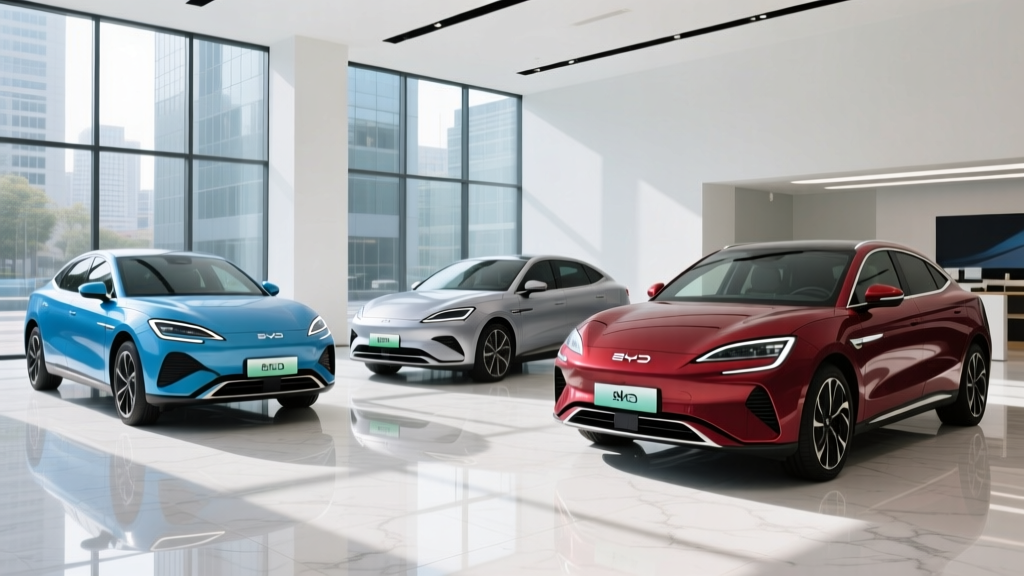
If you've been following the global EV market, you already know BYD (Build Your Dreams) has become the world's largest plug-in electric vehicle manufacturer, surpassing 3 million annual NEV sales. But for US-based shoppers searching for BYD sales in USA, the reality is far more complicated. As of 2026, BYD does not sell passenger vehicles in the United States — and a web of tariffs, political barriers, and supply-chain restrictions makes near-term entry unlikely.
This guide cuts through the noise to explain exactly where BYD stands with American buyers, which models you can access through commercial channels, and what the competitive landscape looks like if you're shopping for an EV today.
Why BYD Passenger Cars Aren't Sold in the US
BYD's absence from the US consumer market isn't an accident — it's the result of deliberate trade policy. Since 2024, Chinese-built EVs face a 100% tariff under Section 301 trade actions, effectively doubling the sticker price of any BYD import. Combined with existing 2.5% auto tariffs and additional duties on Chinese battery components, the economics of importing a BYD Seal or Dolphin into the US simply don't work.
Beyond tariffs, several structural barriers remain:
- Connected vehicle ban: The US Department of Commerce has restricted hardware and software from Chinese-connected vehicles, impacting BYD's infotainment and telematics systems.
- Battery sourcing rules: Under IRS §30D, vehicles with battery components from a "foreign entity of concern" (FEOC) — which includes Chinese manufacturers — are disqualified from the $7,500 federal tax credit.
- Dealer network: BYD has made no public announcements about establishing a US dealer or direct-sales network for passenger vehicles.
For context, BYD does operate commercially in the US — but only in electric buses and commercial trucks through its Lancaster, California manufacturing facility. These fleet vehicles are not available to individual consumers.
BYD Models Americans Can't Buy (But Wish They Could)
To understand what US shoppers are missing — and what BYD's competitors need to match — here are the specs for BYD's most popular global models. All figures are from BYD's international spec sheets and represent WLTP estimates, which tend to run 10-15% higher than US EPA ratings.
| Model | Battery (kWh) | Chemistry | WLTP Range | Est. EPA Range | 0-60 mph | HP | Drivetrain | Max DC Charge | Global Price (USD equiv.) |
|---|---|---|---|---|---|---|---|---|---|
| BYD Seal (2025) | 82.5 kWh | LFP Blade | 354 mi | ~300 mi | 5.9s | 312 | AWD Dual | 150 kW | ~$38,000 |
| BYD Dolphin | 60.4 kWh | LFP Blade | 265 mi | ~225 mi | 7.0s | 201 | FWD | 88 kW | ~$29,000 |
| BYD Atto 3 | 60.5 kWh | LFP Blade | 260 mi | ~220 mi | 7.3s | 201 | FWD | 88 kW | ~$32,000 |
| BYD Han EV | 85.4 kWh | LFP Blade | 320 mi | ~270 mi | 3.9s | 516 | AWD Dual | 120 kW | ~$45,000 |
| BYD Seagull | 44.9 kWh | LFP Blade | 250 mi (CLTC) | ~180 mi | ~10s | 75 | FWD | 40 kW | ~$12,000 |
The BYD Seagull has drawn particular attention as a potential sub-$15,000 EV, but even if imported, tariffs would push it above $25,000 — eliminating its core value proposition.
BYD's Blade Battery: What Makes It Different
BYD's signature technology is the Blade Battery — a lithium iron phosphate (LFP) cell designed in a long, thin form factor that improves thermal stability and packaging efficiency.
| Attribute | BYD LFP Blade | Typical NMC (Nickel Manganese Cobalt) |
|---|---|---|
| Energy Density | Lower (~150 Wh/kg cell-level) | Higher (~250 Wh/kg cell-level) |
| Cycle Life | 3,000+ cycles to 80% SoH | 1,000-2,000 cycles to 80% SoH |
| Thermal Stability | Excellent — passes nail penetration test without fire | Good, but more prone to thermal runaway |
| Cold-Weather Performance | Moderate range loss (~30-40% in sub-freezing) | Slightly better cold performance (~25-35% loss) |
| Cost | Lower — no cobalt or nickel | Higher — commodity-sensitive materials |
| Charging to 100% | Recommended periodically for BMS calibration | Best kept at 80% for longevity |
BYD claims the Blade Battery can withstand nail penetration without thermal runaway — a significant safety advantage. However, the lower energy density means BYD vehicles tend to be slightly heavier for a given range compared to NMC-equipped competitors.
What US Buyers Can Get Instead: Closest Competitors
If you were hoping to buy a BYD in the US, here are the closest alternatives currently available, with full EPA-certified specs:
| Model | EPA Range | Battery | Max DC kW | 10-80% Time | 0-60 | Base MSRP | §30D Credit Eligible? |
|---|---|---|---|---|---|---|---|
| Tesla Model 3 RWD | 341 mi | 60 kWh LFP | 170 kW | ~25 min | 5.8s | $38,990 | Yes (income/MSRP rules apply) |
| Hyundai Ioniq 6 SE | 361 mi | 77.4 kWh NMC | 235 kW | ~18 min | 6.8s | $39,750 | Yes (sourcing-dependent) |
| Chevrolet Equinox EV LT | 319 mi | 85 kWh NMC | 150 kW | ~30 min | 7.9s | $33,600 | Yes |
| Volvo EX30 | 261 mi | 69 kWh NMC | 153 kW | ~25 min | 5.0s (Twin) | $34,950 | No (China-built) |
| Nissan Leaf SV Plus | 212 mi | 62 kWh NMC | 100 kW | ~40 min | 6.9s | $31,670 | Yes |
The Tesla Model 3 RWD is the closest direct competitor to the BYD Seal in the US market — similar price point, LFP chemistry, and range. The Chevy Equinox EV undercuts BYD's global pricing while offering competitive range and full §30D eligibility.
Federal Tax Credit Reality Check
Even if BYD could sell passenger vehicles in the US, they would almost certainly not qualify for the IRS §30D Clean Vehicle Credit. Here's why:
- FEOC battery restriction: BYD's batteries are manufactured in China. Under current rules, any vehicle with battery components from a foreign entity of concern is disqualified from the full $7,500 credit.
- Critical minerals sourcing: The credit requires a percentage of critical minerals sourced from the US or free-trade-agreement partners — BYD's supply chain is predominantly China-domestic.
- MSRP caps still apply: Even qualifying competitors must stay under $55,000 (sedans) or $80,000 (SUVs/trucks/vans).
- Buyer income limits: AGI must not exceed $150,000 (single), $225,000 (head of household), or $300,000 (joint filing).
For the latest rules, always check the IRS §30D page or consult a tax professional before making a purchase decision. The point-of-sale transfer option allows qualifying buyers to apply the credit as a down payment reduction at participating dealerships.
Will BYD Ever Sell Cars in America?
As of early 2026, BYD executives have stated publicly that the US market is not a priority due to the tariff and regulatory environment. The company is instead focusing expansion on:
- Europe: Active sales in Germany, UK, Norway, and other markets (though facing potential EU countervailing duties).
- Southeast Asia: Thailand, Indonesia, and Malaysia are major growth markets.
- Latin America: Brazil and Mexico, where BYD has established or announced local manufacturing.
- Middle East and Australia: Growing dealer networks with competitive pricing.
The one scenario that could change the calculus: BYD establishing a US or North American manufacturing plant (similar to how Chinese-owned Volvo builds the EX30 in China but may shift production). However, no such announcement has been made as of 2026.
The Bottom Line for US EV Shoppers
BYD makes compelling EVs at aggressive price points globally — the Seal, Dolphin, and Seagull offer strong value with proven LFP battery technology. But for US buyers, BYD sales in USA remain a non-starter for the foreseeable future.
Your best move: Focus on EVs currently available in the US with strong charging infrastructure, §30D eligibility, and proven reliability. The Tesla Model 3, Hyundai Ioniq 6, Chevrolet Equinox EV, and Ford Mustang Mach-E all offer competitive specs without the import uncertainty.
Frequently Asked Questions
Can I import a BYD from another country to the US?
Technically possible but impractical. You'd pay 100%+ in tariffs, face DOT/EPA compliance challenges (BYD vehicles aren't US-homologated), and receive no warranty support. The total landed cost would exceed comparable US-market EVs.
Does BYD sell any vehicles in the US at all?
Yes, but only electric transit buses and some commercial trucks through its Lancaster, CA facility. These are fleet-only products not available to individual consumers.
Is BYD's Blade Battery safer than other EV batteries?
BYD's LFP Blade Battery demonstrates excellent thermal stability and passes nail penetration testing without thermal runaway. LFP chemistry is generally safer than NMC, though modern battery management systems have made all major EV batteries quite safe in practice.
What's the cheapest EV I can buy in the US right now?
The 2026 Nissan Leaf starts at $31,670 and qualifies for the §30D credit, bringing the effective price to ~$24,170 for eligible buyers. The Chevrolet Equinox EV at $33,600 is also credit-eligible and offers significantly more range.
Will tariffs on Chinese EVs change?
Trade policy is subject to change with new administrations, but the 100% tariff on Chinese EVs has bipartisan support as of 2026. Any rollback would likely require reciprocal market access for US automakers in China.