Why US Buyers Are Searching the BYD Price List in 2026
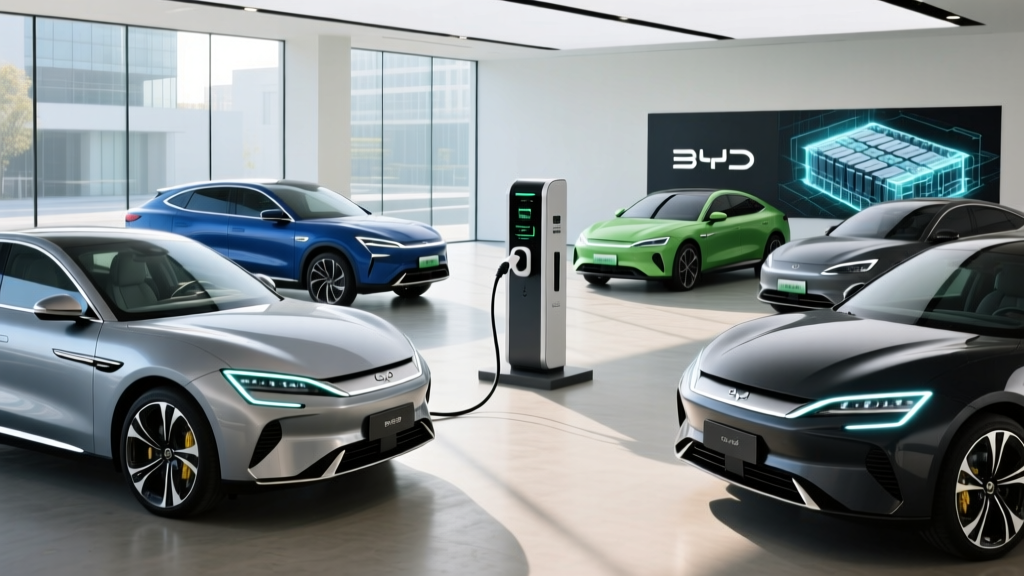
BYD (Build Your Dreams) has surged past Tesla in global EV sales volume, dominating markets across China, Europe, Southeast Asia, and Latin America with aggressively priced electric vehicles built on proprietary Blade Battery (LFP) technology. Naturally, US shoppers scanning headlines about $15,000 EVs and sub-$30,000 crossovers are searching for a BYD price list they can act on. Here's the reality check this article provides: as of early 2026, BYD does not sell passenger vehicles in the United States, and a combination of 100%+ tariffs on Chinese-built EVs, federal battery-sourcing rules under the Inflation Reduction Act, and the absence of a US dealer network means that's unlikely to change in the near term.
What BYD does sell in the US are battery-electric transit buses and heavy-duty commercial trucks — built at a factory in Lancaster, California. Those vehicles sit far outside the consumer price list most shoppers are hunting for. Below, we break down the global BYD passenger-EV price list (converted to USD), explain why those sticker prices don't translate to American driveways, and identify the US-market EVs that actually compete on value, range, and tax-credit eligibility today.
Global BYD Price List: What These Models Cost Overseas
The figures below reflect late-2025 / early-2026 manufacturer MSRPs in BYD's primary export markets (China, Europe, Australia), converted to USD at approximate exchange rates. These are not US prices — they cannot be imported for road use, and US-spec versions do not exist.
| Model | Segment | Battery (kWh) / Chemistry | WLTP Range | Approx. USD Price (Export) |
|---|---|---|---|---|
| Seagull (Dolphin Mini) | Subcompact hatch | 30 / 38.9 kWh LFP Blade | 190–250 mi | $9,500–$12,500 |
| Dolphin | Compact hatch | 44.9 / 60.5 kWh LFP Blade | 210–265 mi | $18,000–$24,000 |
| Atto 3 (Yuan Plus) | Subcompact SUV | 49.9 / 60.5 kWh LFP Blade | 210–260 mi | $22,000–$28,500 |
| Seal | Midsize sedan | 61.4 / 82.5 kWh LFP Blade | 290–355 mi | $30,000–$40,000 |
| Seal U (Song Plus EV) | Compact SUV | 71.8 / 87 kWh LFP Blade | 260–310 mi | $32,000–$41,000 |
| Han EV | Full-size sedan | 85.4 kWh LFP Blade | 325 mi | $42,000–$52,000 |
| Tang EV | 3-row SUV | 108.8 kWh LFP Blade | 280 mi | $48,000–$58,000 |
Two caveats on the range column: BYD publishes WLTP figures outside China, which run 10–15% higher than the EPA cycle US buyers rely on. A Seal rated at 355 miles WLTP would likely sticker around 300–315 EPA miles if it were certified for US sale. Cold-weather and sustained-highway driving would knock that number down another 15–25%, consistent with LFP chemistry behavior.
Why the BYD Price List Doesn't Apply to US Buyers
Three structural barriers keep these headline-grabbing numbers off American showroom windows:
- Section 301 tariffs. Chinese-built passenger EVs face a 100% tariff under trade policy updated in 2024–2025, effectively doubling the landed cost of a Seagull or Dolphin before dealer markup, freight, or compliance modifications.
- IRA battery-sourcing rules. The IRS §30D clean vehicle credit disqualifies any vehicle whose battery contains components from a "foreign entity of concern" (FEOC) — a category that includes BYD and its supply chain. Even if BYD built a US plant, the credit would be off the table.
- No dealer or service network. BYD has signaled no plans for a US passenger-vehicle launch. Without NHTSA crash-test certification, FMVSS compliance, and a parts-and-service footprint, private import is not a realistic path.
Net effect: the BYD price list you see on social media is aspirational for US shoppers, not actionable. The smarter move is to map BYD's global lineup against the US EVs that occupy the same segments at comparable (if higher) price points — and that actually qualify for federal and state incentives.
US-Market Equivalents: What to Buy Instead
For each popular BYD model, here's the closest US-spec EV in segment, price, and capability — with the exact numbers buyers need to compare.
| BYD Model | US Equivalent | EPA Range | Battery (kWh) | Base MSRP | §30D Credit Eligible? |
|---|---|---|---|---|---|
| Seagull | Chevrolet Equinox EV 2LT | 315 mi | 85 (NMC) | $34,900 | Yes (up to $7,500) |
| Dolphin | Nissan LEAF SV Plus | 212 mi | 60 (NMC) | $36,000 | Partial — verify sourcing |
| Atto 3 | Hyundai Kona Electric SEL | 261 mi | 64.8 (NMC) | $34,000 | Yes (up to $7,500) |
| Seal | Tesla Model 3 RWD | 363 mi | 60 (LFP) | $39,990 | Yes (up to $7,500) |
| Seal U | Ford Mustang Mach-E Select | 250 mi | 75.7 (NMC) | $42,995 | Yes (up to $7,500) |
| Han EV | Hyundai Ioniq 6 Limited | 316 mi | 77.4 (NMC) | $46,500 | Yes (up to $7,500) |
| Tang EV | Kia EV9 Land AWD | 282 mi | 100 (NMC) | $59,900 | Yes (up to $7,500) |
The US alternatives carry higher base MSRPs than BYD's export pricing, but the §30D federal tax credit closes much of that gap when you qualify. Point-of-sale transfer now lets dealers apply the credit as an immediate rebate at purchase, subject to these guardrails:
- Buyer AGI caps: $150k single / $225k head-of-household / $300k joint
- MSRP caps: $55,000 for sedans/hatchbacks, $80,000 for SUVs/trucks/vans
- Battery must meet critical-mineral and component-sourcing thresholds — no FEOC content
- Credit amount varies $3,750–$7,500 depending on whether the pack meets one or both sourcing tests
Deep Dive: Tesla Model 3 RWD vs. BYD Seal (The Closest Matchup)
The BYD Seal is the model most often floated as a "Tesla killer" in European and Australian reviews. Since it won't land stateside, here's a spec-by-spec look at how the US-market Model 3 RWD stacks up — useful context if you've been reading Seal coverage and wondering what you're missing.
| Spec | 2026 Tesla Model 3 RWD | BYD Seal RWD (Export) |
|---|---|---|
| EPA / WLTP range | 363 mi (EPA) | 355 mi (WLTP) ≈ 305 EPA est. |
| Battery / chemistry | 60 kWh LFP (CATL) | 82.5 kWh LFP Blade |
| Peak DC charge rate | 170 kW | 150 kW |
| 10–80% DC time | ~25 min | ~30 min |
| Level 2 home rate | 11.5 kW / ~44 mi/hr | 11 kW / ~40 mi/hr |
| 0–60 mph | 5.8 sec | 5.9 sec |
| Horsepower | 271 hp | 312 hp |
| Drivetrain | RWD single motor | RWD single motor |
| Efficiency | 132 MPGe / 25 kWh/100mi | ~120 MPGe est. |
| Cargo (trunk + frunk) | 23 cu ft + 3 cu ft | 14 cu ft + 2 cu ft |
| Base MSRP | $39,990 | ~$33,000 (export) |
| After §30D credit | ~$32,490 | N/A in US |
| Warranty (basic / battery) | 4 yr/50k mi / 8 yr/120k mi | 6 yr/150k km / 8 yr/160k km (export) |
Charging Reality: Home and DC Fast Charging
Charging infrastructure is where US-market EVs hold a decisive edge over any hypothetical BYD import. Tesla's Supercharger network (now open to NACS-equipped rivals via adapters) and the growing CCS networks from Electrify America, EVgo, and ChargePoint give American buyers proven routes; a new entrant would need years to integrate with these networks and payment systems.
| Level | Power | Miles of Range Added per Hour | Where |
|---|---|---|---|
| Level 1 (120V) | 1.4–1.9 kW | 3–5 mi/hr | Standard household outlet |
| Level 2 (240V) | 7.7–11.5 kW | 25–44 mi/hr | Home wallbox, workplace, public AC |
| DC Fast Charge | 150–250 kW peak | ~180–700 mi/hr equivalent | Supercharger, EA, EVgo, ChargePoint |
A critical detail often missing from spec sheets: peak kW is not sustained kW. A 170 kW peak on the Model 3 RWD typically holds for only the 10–40% state-of-charge window, then tapers to ~80 kW above 60% and ~40 kW above 80%. That's why the 10–80% time (~25 minutes) is the meaningful metric — not the headline peak number. LFP packs (in both the Model 3 RWD and the Seal) tolerate frequent 100% charges better than NMC, which is a genuine daily-ownership advantage for commuters who can charge at home overnight.
Tax Credits, Total Cost, and the Real Price Gap
| Cost Factor | Tesla Model 3 RWD | BYD Seal (Hypothetical US) |
|---|---|---|
| Base MSRP | $39,990 | $33,000 (export) |
| Tariff (100% Section 301) | — | +$33,000 |
| Landed pre-dealer price | $39,990 | ~$66,000 |
| §30D federal credit | -$7,500 | $0 (FEOC sourcing) |
| Effective purchase price | ~$32,490 | ~$66,000+ |
| Estimated 5-yr fuel (electricity) | $3,100 | $3,100 |
| Estimated 5-yr insurance | $8,500 | Unknown (no US book) |
The math is stark: tariffs alone erase the BYD price advantage, and the FEOC battery-sourcing rule in the IRA blocks the credit that would otherwise help. Even if BYD opened a US factory tomorrow (which would sidestep the tariff), the Blade Battery's Chinese-sourced LFP cathode and cell manufacturing would likely keep the §30D credit out of reach for years.
For US buyers chasing value in the $30k–$40k range, the actionable takeaway is this: the EVs on American showroom floors — Equinox EV, Kona Electric, Model 3, Ioniq 6 — are the real "BYD price list" you can drive home, and the federal credit makes them surprisingly close to BYD's export MSRPs once you factor in the point-of-sale transfer.
Who Should Watch BYD Anyway?
There are three scenarios where tracking BYD's global moves still matters for US-based EV shoppers:
- Used-EV buyers in 2028+. If BYD eventually enters adjacent markets (Canada, Mexico) with right- or left-hand-drive models, grey-market imports could trickle in once the 25-year import rule is irrelevant and tariff policy evolves. Unlikely soon, but worth a bookmark.
- Buyers considering a move or extended stay abroad. If you're relocating to Europe, Australia, or Southeast Asia, BYD's local price list is very real and often undercuts legacy OEMs by 20–30%.
- Value benchmarking. BYD's pricing sets a global floor that pressures every OEM. The sub-$35k Equinox EV and refreshed LEAF are, in part, responses to what BYD is doing elsewhere. Knowing the BYD price list helps you negotiate and evaluate whether US OEMs are pricing fairly.
Pros and Cons: BYD Globally vs. US Alternatives
BYD Global Lineup — Pros
- Best-in-class LFP Blade battery safety and cycle life
- Aggressive export MSRPs undercut rivals by 20–30%
- Rotating center display, V2L standard on many trims
- Strong build quality in 2025+ models per Euro NCAP
BYD Global Lineup — Cons (for US buyers)
- Not available in the US — no sales, service, or parts
- Tariffs + IRA sourcing rules eliminate price advantage
- No NHTSA/IIHS crash-test ratings on US cycles
- Driver-assist stack unproven vs. Tesla Autopilot / GM Super Cruise
FAQ: BYD Price List and US Availability
Can I buy a BYD EV in the United States in 2026?
No. BYD does not sell passenger vehicles in the US. The company offers electric transit buses and commercial trucks built in Lancaster, CA, but its consumer lineup (Seagull, Dolphin, Atto 3, Seal, Han, Tang) is not available through any US dealer or direct channel.
Why are BYD EVs so much cheaper overseas?
BYD vertically integrates battery, motor, and semiconductor production in China, where labor, energy, and supply-chain costs are lower. Export-market MSRPs also don't reflect US tariffs, compliance costs, dealer markup, or the logistics of building a service network from scratch.
Would a BYD qualify for the $7,500 federal EV tax credit?
Almost certainly not, even if it were sold here. The IRS §30D rules bar credits for vehicles with battery components from a foreign entity of concern (FEOC), and BYD's supply chain falls squarely in that category.
What's the closest US EV to the BYD Seal?
The Tesla Model 3 RWD at $39,990 before the §30D credit (~$32,490 after) is the closest match in segment, range (363 EPA miles), and LFP chemistry. The Hyundai Ioniq 6 and Polestar 2 are also strong cross-shops.
Will BYD ever enter the US market?
BYD executives have publicly stated they are not prioritizing US passenger-vehicle sales due to the tariff and political environment. Mexico and Brazil are current focal points for Western-hemisphere expansion. Treat any "BYD coming to America" headline as speculative.
What's the cheapest EV I can actually buy in the US right now?
The Nissan LEAF S starts around $30,000 before incentives, with the Chevrolet Equinox EV 2LT close behind at ~$34,900 and eligible for the full $7,500 credit. After §30D, the Equinox EV is currently the value benchmark in the crossover segment.