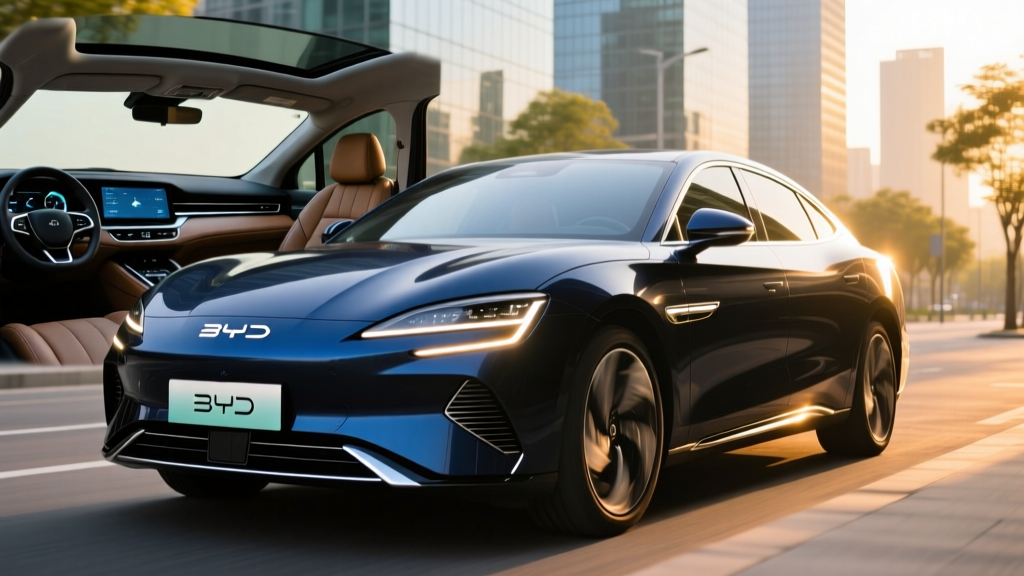
The BYD Han has been a headline act in China and parts of Europe since 2020, but for US-based EV shoppers, the question remains: can BYD's flagship electric sedan actually compete with the Tesla Model S, Lucid Air, and BMW i5 on American soil? As of early 2026, the BYD Han remains officially unavailable in the United States due to steep import tariffs (100% on Chinese-built EVs under current trade policy) and the absence of a confirmed US dealership network. However, with BYD expanding aggressively into Mexico, South America, and Southeast Asia, and with ongoing speculation about a North American production facility, the Han Flagship deserves a close technical look — both as a benchmark for what global competitors offer and as a potential future option for buyers in tariff-exempt jurisdictions.
This review evaluates the latest-generation BYD Han Flagship (the top-trim EV variant sold in global markets as of 2025–2026) using manufacturer-published specs, independent European and Chinese test data, and comparisons against US-market rivals. Where US-specific data (EPA range, NHTSA safety, IRS tax credit eligibility) is unavailable, we note that explicitly and provide the closest equivalent figures.
BYD Han Flagship Quick Verdict
The BYD Han Flagship is a premium electric sedan that punches well above its price class in build quality, interior materials, and standard equipment — but its 120 kW DC fast-charging ceiling and lack of NACS connector support put it behind the 2026 charging-infrastructure curve. If BYD ever brings this car to the US at its global price point (~$45,000–$50,000 equivalent), it would undercut the Tesla Model S by tens of thousands and challenge the BMW i5 eDrive40 on value. For now, US buyers can only admire from afar — or import through grey-market channels at significant cost and regulatory risk.
Spec Table: BYD Han Flagship at a Glance
| Specification | BYD Han Flagship (EV) |
|---|---|
| Battery Capacity | 85.4 kWh usable (BYD Blade, LFP chemistry) |
| CLTC Range | 610 km (~379 mi) |
| WLTP Range (est.) | ~520 km (~323 mi) |
| Estimated EPA Range | ~310–330 mi (if US-certified) |
| Drivetrain | Dual-motor AWD |
| Horsepower | 516 hp (380 kW combined) |
| 0–100 km/h (0–62 mph) | 3.9 seconds |
| Max DC Fast Charge | 120 kW (CCS2 / GB/T depending on market) |
| 10–80% DC Charge Time | ~30 minutes (claimed) |
| Level 2 AC Charging | 7 kW onboard charger (~25 mi/hr) |
| Efficiency (WLTP) | ~16.4 kWh/100 km (~26.4 kWh/100 mi) |
| Length / Width / Height | 194.1 in / 75.2 in / 58.3 in |
| Wheelbase | 113.8 in |
| Cargo Volume | 14.5 cu ft (trunk, no frunk) |
| Rear Legroom | ~37.4 in |
| Curb Weight | ~4,980 lb (2,260 kg) |
| Global MSRP (equiv.) | ~$45,000–$50,000 USD (varies by market) |
| Battery Warranty | 8 years / 150,000 km (~93,000 mi) in most markets; lifetime in China (first owner) |
Range and Efficiency: CLTC vs. WLTP vs. Real World
The BYD Han Flagship's 85.4 kWh Blade battery uses lithium iron phosphate (LFP) chemistry — a BYD hallmark. LFP offers excellent thermal stability, a long cycle life (typically 3,000+ full cycles before significant degradation), and lower raw-material cost. The trade-off is lower energy density than NMC (nickel manganese cobalt), which is why the Han's battery is physically large and heavy for its capacity, contributing to the nearly 5,000-pound curb weight.
BYD's official 610 km range figure comes from China's CLTC test cycle, which is known to be optimistic compared to WLTP and significantly more generous than the US EPA cycle. European reviewers testing the Han EV under WLTP conditions have reported figures closer to 500–530 km (310–330 miles). Translating that to EPA methodology — which applies a 0.7 adjustment factor to lab results and includes aggressive driving and HVAC loads — the Han would likely sticker at approximately 310–330 miles EPA, putting it in the same ballpark as the BMW i5 eDrive40 (295 mi EPA) but well short of the Lucid Air Pure (419 mi) or Tesla Model S (402 mi).
Efficiency in real-world mixed driving hovers around 26–28 kWh per 100 miles, which is respectable for a 5,000-lb AWD sedan but not class-leading. The Tesla Model S, by comparison, achieves roughly 24 kWh/100 mi thanks to its more advanced heat pump and SiC inverter architecture. In cold weather, LFP batteries experience more pronounced capacity loss than NMC — expect a 25–35% range reduction in sustained sub-freezing temperatures, compared to 15–25% for NMC-equipped rivals.
Charging Speed: The Han's Biggest Weakness
| Charging Level | Power / Rate | Speed (approx.) | Notes |
|---|---|---|---|
| Level 1 (120V) | 1.4 kW | ~5 mi/hr | Emergency / overnight trickle only |
| Level 2 (240V AC) | 7 kW (onboard limit) | ~25 mi/hr | Full charge in ~12 hours |
| DC Fast Charge | 120 kW peak | 10–80% in ~30 min | Tapers significantly above 80%; CCS2 in Europe, GB/T in China |
The 120 kW DC fast-charging peak is where the BYD Han Flagship falls behind 2026 expectations. Competitors like the Hyundai Ioniq 6 (peak 240 kW, 10–80% in ~18 minutes on 800V architecture) and the Tesla Model S (peak 250 kW on V3 Superchargers) charge roughly twice as fast. The Han's LFP battery can accept high C-rates in theory, but BYD has conservatively limited the charge curve to protect long-term cell health — a reasonable engineering choice, but one that means road-trip charging stops will be noticeably longer.
The 7 kW Level 2 onboard charger is adequate for overnight home charging (a full 0–100% charge takes about 12 hours) but is on the low side for a vehicle in this price class. Many rivals offer 11 kW or even 19.2 kW onboard chargers, which matters if you're trying to replenish a depleted battery between evening errands and a morning commute.
Connector compatibility is another US-market barrier. The Han uses CCS2 in European markets and GB/T in China. Neither is directly compatible with North America's CCS1 standard or the now-dominant NACS (Tesla) connector. Any US-market version would require a redesigned charge port or a reliable adapter solution — neither of which BYD has announced.
Performance and Driving Dynamics
The Flagship trim is the performance-oriented variant, with dual electric motors producing a combined 516 hp (380 kW) and launching the Han from 0–62 mph in 3.9 seconds. That's genuinely quick — within a few tenths of the Tesla Model S Plaid's territory in everyday driving, though the Model S extends the gap at higher speeds thanks to its tri-motor setup and 1,020 hp.
The AWD system provides confident traction in wet and light snow conditions, and the Han's low center of gravity (courtesy of the floor-mounted Blade battery pack) keeps body roll well-controlled through corners. However, at nearly 5,000 pounds, the Han feels its weight during aggressive direction changes. The steering is precise but numb — a common complaint in reviews from European automotive press — and the brake feel under regenerative blending is less linear than Tesla's or BMW's implementations.
Ride quality is a strong point. The adaptive suspension (standard on Flagship) soaks up rough pavement with a compliance that rivals the Mercedes EQE, and cabin isolation at highway speeds is excellent. This is a grand-touring sedan first, a sports sedan second.
Interior, Tech, and Cargo
The Han Flagship's interior is where BYD makes its strongest case. Standard equipment on global-market Flagship trims includes:
- 15.6-inch rotating center touchscreen (landscape for media, portrait for navigation)
- 12.3-inch digital instrument cluster
- Nappa leather upholstery with heated and ventilated front seats
- Heated rear seats and rear climate control zone
- Dynaudio 12-speaker premium audio system
- Panoramic glass roof
- Wireless phone charging (15W)
- Head-up display
- 360-degree surround camera system
The infotainment system runs BYD's DiLink software, which is feature-rich but occasionally sluggish in response time compared to Tesla's or BMW's iDrive. Apple CarPlay and Android Auto are supported via wired connection (wireless in some 2025+ markets). Over-the-air updates are supported for powertrain, infotainment, and ADAS modules.
Driver assistance includes adaptive cruise control, lane-keeping assist, automatic emergency braking, blind-spot monitoring, and rear cross-traffic alert. These are SAE Level 2 features — the driver must remain fully engaged at all times. BYD's DiPilot system does not offer anything analogous to Tesla's FSD (Supervised) or GM's Super Cruise hands-free highway driving. This is a conventional Level 2 suite, competent but not cutting-edge.
Cargo space is a relative weak point. The trunk offers 14.5 cubic feet — adequate for a week's luggage for two but less than the Tesla Model S's 28 cu ft (including front trunk). The Han has no frunk, as the front motor and power electronics occupy the space. Rear seat folding is 60/40, which helps with longer items, but the trunk opening is narrow compared to a liftback design.
Passenger space is generous. The 113.8-inch wheelbase translates to approximately 37.4 inches of rear legroom, which is competitive with the BMW 5 Series and significantly more than the Tesla Model 3. Rear headroom is slightly compromised by the sloping roofline, which may bother taller passengers.
Pricing, Tax Credits, and US Availability
In global markets, the BYD Han Flagship EV is priced at the equivalent of approximately $45,000–$50,000 USD, depending on local taxes and incentives. In China, the Han EV starts at roughly ¥269,800 (~$37,500) for lower trims, with the Flagship AWD variant near ¥330,000 (~$46,000). European pricing typically lands between €50,000–€58,000 (~$54,000–$63,000) after VAT and shipping.
For US buyers, the pricing question is largely academic as of 2026. The 100% tariff on Chinese-manufactured electric vehicles (imposed under Section 301 and expanded in 2024) effectively doubles the import cost, pushing a theoretical US price well above $90,000 — eliminating any value proposition. BYD has not announced a US production facility, dealership network, or certification timeline.
How the BYD Han Flagship Compares
| Metric | BYD Han Flagship | Tesla Model S (LR) | BMW i5 eDrive40 | Hyundai Ioniq 6 (SEL AWD) |
|---|---|---|---|---|
| Est. EPA Range | ~310–330 mi | 402 mi | 295 mi | 316 mi |
| Battery (kWh) | 85.4 LFP | ~100 NMC | 84.3 NMC | 77.4 NMC |
| DC Fast Charge | 120 kW | 250 kW | 205 kW | 240 kW |
| 0–60 mph | 3.9 sec | 3.1 sec | 5.7 sec | 5.1 sec |
| HP | 516 | 670 | 335 | 320 |
| US MSRP | N/A (not sold) | $79,990 | $57,900 | $46,750 |
| Tax Credit | Not eligible | $7,500 (if eligible) | $7,500 (if eligible) | $3,750–$7,500 |
The comparison reveals the Han's positioning: it offers Model S–adjacent performance and BMW i5–level range at a significantly lower global price point, but its charging speed is a generation behind, and its US unavailability makes the exercise theoretical. The Hyundai Ioniq 6 remains the value benchmark for US buyers who want a sleek electric sedan with fast charging and available tax credits.
Pros and Cons
✓ Pros
- Exceptional build quality and materials for the price class
- LFP Blade battery offers excellent thermal safety and cycle life
- 516 hp AWD performance at a mainstream price (globally)
- Generous rear-seat legroom and ride comfort
- Comprehensive standard equipment (no expensive option packages)
- Strong crash-test performance in C-NCAP (5 stars)
✗ Cons
- 120 kW DC charging is slow for 2026 standards
- Not available in the US; no announced US launch timeline
- No NACS connector; CCS2/GB/T only
- LFP range loss in cold weather is significant (~30%+)
- Trunk space (14.5 cu ft) is modest; no frunk
- DiPilot ADAS is basic Level 2 — no hands-free highway mode
- Would not qualify for §30D tax credit due to FEOC/sourcing rules
Who Should Consider the BYD Han Flagship?
Given its US unavailability, the Han Flagship is most relevant to:
- Buyers outside the US (Europe, Latin America, Southeast Asia, Australia) where the Han is sold and competitively priced against the Tesla Model 3/Y and BMW i4/i5.
- EV industry watchers benchmarking BYD's engineering against Western and Korean competitors.
- US-based enthusiasts considering grey-market import (though this carries significant regulatory, warranty, and charging-infrastructure challenges).
For US buyers shopping today, the Tesla Model S remains the performance-sedan benchmark (despite its aging interior), the BMW i5 offers a luxury alternative with strong build quality and available tax credits, and the Hyundai Ioniq 6 delivers the best charging-speed-to-price ratio in the segment.
Frequently Asked Questions
What is the real-world range of the BYD Han Flagship?
Under WLTP testing, the Han Flagship achieves approximately 323 miles (520 km). In real-world highway driving at 70 mph, expect 260–280 miles. In cold weather (below freezing), LFP chemistry and heating demands reduce that to roughly 220–240 miles. If EPA-rated, it would likely sticker at 310–330 miles.
How fast does the BYD Han charge?
On DC fast charging, the Han peaks at 120 kW, reaching 10–80% in approximately 30 minutes. On a Level 2 home charger (240V), the 7 kW onboard charger adds about 25 miles of range per hour, requiring roughly 12 hours for a full charge. These speeds are below 2026 class averages — the Hyundai Ioniq 6 charges twice as fast on DC.
Does the BYD Han qualify for the US federal EV tax credit?
No. Even if sold in the US, the Han would not qualify for the §30D clean vehicle credit. Its Chinese-manufactured LFP battery fails the critical-minerals and battery-component sourcing requirements, and BYD is subject to FEOC (Foreign Entity of Concern) exclusions that disqualify vehicles with Chinese battery supply chains from receiving the credit.
Is the BYD Han Flagship worth buying over a Tesla Model S?
On paper, the Han offers 80% of the Model S's performance at 50% of the global price. However, the Model S has 402 miles of EPA range, 250 kW Supercharging, access to the Supercharger network, and US availability with potential tax-credit eligibility. For US buyers, the Model S (or the more affordable BMW i5 or Hyundai Ioniq 6) is the practical choice. The Han is compelling only in markets where it's sold at its native price and charging infrastructure is less critical.
What is BYD's Blade battery, and is it safe?
The Blade battery is BYD's proprietary LFP (lithium iron phosphate) cell design, arranged in long, thin prismatic cells that double as structural elements within the pack. LFP chemistry is inherently more thermally stable than NMC — it is extremely resistant to thermal runaway. BYD's nail-penetration tests (a severe abuse scenario) show the Blade battery does not ignite or vent toxic gas. Long-term degradation data shows LFP cells typically retain 80%+ capacity after 3,000 full charge cycles, translating to well over 300,000 miles in real-world use.
Can I import a BYD Han to the United States?
Technically, you can attempt to import a vehicle under the 25-year exemption (not applicable to a new car) or through a Registered Importer who modifies it to meet FMVSS standards. However, the 100% Section 301 tariff on Chinese EVs would roughly double the cost, and you would have no warranty support, no dealer service network, and no compatible DC fast-charging connector without a custom adapter. It is not a practical path for most buyers.
Sources: BYD official specifications (global press site), European WLTP test data via independent automotive reviewers, IRS §30D Clean Vehicle Credit guidelines. Note: The BYD Han is not currently sold or EPA-certified in the United States. US-specific figures (EPA range, NHTSA ratings, tax credit eligibility) are estimated based on comparable vehicles and current regulations as of 2026.