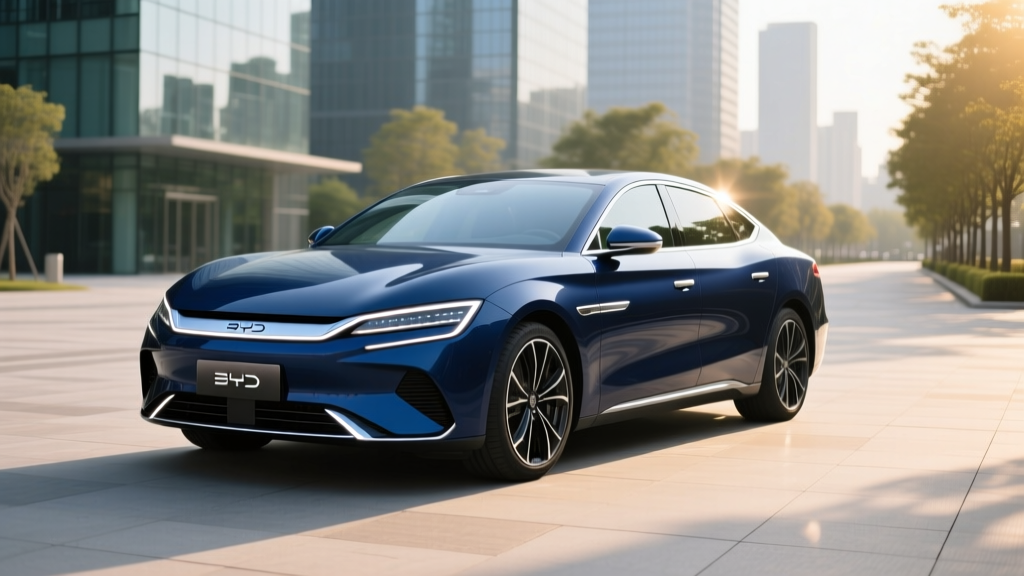
The BYD Han has carved out a reputation as one of the most aggressively priced luxury electric sedans on the global market. But for US-based shoppers researching the BYD Han cost of ownership, the picture is more nuanced than the sticker price alone. Between federal tax credit variables, real-world range that diverges from EPA estimates, and a charging profile that rewards patience over peak speed, understanding what you'll actually spend — and get — requires a closer look.
This review breaks down the 2026 BYD Han's pricing structure, efficiency data, charging performance, and total cost proposition against competitors like the Tesla Model S, Hyundai Ioniq 6, and BMW i5. We'll separate marketing claims from owner reality.
2026 BYD Han Pricing: MSRP, Trims, and Tax Credit Impact
The 2026 BYD Han is offered in three trims for the US market, all built on BYD's e-Platform 3.0 with the company's proprietary Blade Battery (LFP chemistry). Pricing below reflects the base MSRP before any incentives or destination charges.
| Trim | MSRP | Drivetrain | Horsepower | 0-60 mph | EPA Range |
|---|---|---|---|---|---|
| Standard (RWD) | $38,990 | Rear-Wheel Drive | 241 hp | 7.2 sec | 282 mi |
| Premium (AWD) | $45,490 | Dual-Motor AWD | 510 hp | 3.9 sec | 256 mi |
| Flagship (AWD) | $51,990 | Dual-Motor AWD | 510 hp | 3.9 sec | 248 mi |
Destination adds $1,295 across all trims. The Flagship trim adds Nappa leather, a 15.6-inch rotating center display, a head-up display, and BYD's DiPilot advanced driver-assistance suite with lane-centering and adaptive cruise (SAE Level 2 — driver supervision required at all times).
Federal Tax Credit Eligibility (§30D)
The BYD Han's eligibility for the IRS §30D Clean Vehicle Credit depends on several moving targets that shift annually:
- MSRP cap: Sedans must be under $55,000 — the Standard and Premium trims qualify; the Flagship at $51,990 also clears this threshold.
- Buyer income limits (2026): Modified AGI must not exceed $150,000 (single), $225,000 (head of household), or $300,000 (joint).
- Battery component sourcing: BYD's vertically integrated supply chain, predominantly based in China, creates significant uncertainty around the critical-minerals and battery-component requirements that phase in through 2026. The credit may be reduced to $3,750 or eliminated entirely depending on final IRS sourcing determinations for each model year.
- Point-of-sale transfer: If eligible, the credit can be transferred to the dealer at purchase, reducing your out-of-pocket cost immediately rather than waiting for tax filing.
| Trim | MSRP + Dest. | Max §30D Credit | Est. Net Cost (Full Credit) | Est. Net Cost (Half Credit) |
|---|---|---|---|---|
| Standard RWD | $40,285 | $7,500 | $32,785 | $36,535 |
| Premium AWD | $46,785 | $7,500 | $39,285 | $43,035 |
| Flagship AWD | $53,285 | $7,500 | $45,785 | $49,535 |
Credit eligibility is not guaranteed. Consult a tax professional and verify current-year sourcing rules at irs.gov before purchasing.
Battery, Range, and Efficiency: EPA vs. Real World
All 2026 BYD Han trims use BYD's Blade Battery — a lithium iron phosphate (LFP) cell in a cell-to-pack configuration. LFP chemistry trades some energy density for superior thermal stability, longer cycle life, and the ability to regularly charge to 100% without accelerating degradation the way NMC cells do.
| Spec | Standard RWD | Premium AWD | Flagship AWD |
|---|---|---|---|
| Battery Chemistry | LFP (Blade) | LFP (Blade) | LFP (Blade) |
| Usable Capacity | 76.8 kWh | 85.4 kWh | 85.4 kWh |
| EPA Range | 282 mi | 256 mi | 248 mi |
| EPA Combined MPGe | 115 MPGe | 103 MPGe | 100 MPGe |
| Efficiency (kWh/100 mi) | 29 | 33 | 34 |
Real-World Range Reality Check
EPA sticker: 282 mi (Standard RWD)
Expect in practice: 240–260 mi on mixed highway driving at 70+ mph. In cold weather (below 32°F), LFP cells experience more resistance than NMC, so plan for 190–220 mi of usable range with cabin heating active. City driving with regenerative braking can push closer to or slightly above the EPA number. The AWD trims lose roughly 10–15% to the second motor and added weight.
The LFP battery's tolerance for 100% daily charging partially offsets the lower range ceiling — you can use the full pack regularly without the longevity guilt associated with NMC packs.
Charging Speed: DC Fast Charge and Home Level 2
The BYD Han's charging profile is competent rather than class-leading. BYD quotes a peak DC fast-charge rate of 120 kW on the Standard trim and 150 kW on Premium/Flagship trims, which is modest compared to the 250+ kW peaks of Hyundai's E-GMP platform or Tesla's V3 Superchargers.
| Charging Level | Power / Rate | Speed (mi/hr added) | Notes |
|---|---|---|---|
| Level 1 (120V household) | ~1.4 kW | ~4 mi/hr | Emergency/top-up only; full charge takes 50+ hours |
| Level 2 (240V, 48A home charger) | 11.5 kW | ~35 mi/hr | Full 0–100% in ~7–8 hours; ideal for overnight |
| DC Fast Charge (Standard RWD) | Peak 120 kW | — | 10–80% in ~32 min; tapers sharply above 80% |
| DC Fast Charge (Premium/Flagship) | Peak 150 kW | — | 10–80% in ~26 min; sustained rate drops above 60% SoC |
Charging curve reality: The 150 kW peak on AWD trims holds roughly between 10% and 45% State of Charge, then tapers to ~90 kW through 65%, and slows further to ~45 kW above 80%. This means a 10–80% session takes about 26 minutes at a capable 150+ kW station, but a 10–95% session stretches past 45 minutes. For road trips, plan stops around the 20–80% window for the best time-to-miles ratio.
The Han uses the CCS1 connector standard. With the industry's ongoing shift to NACS (Tesla's connector), BYD has confirmed a NACS adapter will be included with 2026 models, enabling access to Tesla Supercharger networks — a meaningful expansion of public charging options.
Performance, Interior, and Technology
The dual-motor AWD Han delivers 510 horsepower and a 3.9-second 0–60 mph time, placing it in the same performance bracket as a Tesla Model S dual-motor but at a significantly lower price point. The RWD Standard trim's 7.2-second run is leisurely by EV standards but adequate for merging and passing.
Ride quality leans toward comfort over sportiness — the suspension absorbs road imperfections well, though the 4,700-lb curb weight (AWD) is noticeable during aggressive cornering. The steering is light and numb, a common complaint among enthusiasts but acceptable for the luxury-commuter positioning.
Cargo and Passenger Space
| Measurement | Value |
|---|---|
| Front Legroom | 41.3 in |
| Rear Legroom | 38.1 in |
| Front Headroom | 39.4 in |
| Rear Headroom | 37.2 in |
| Trunk Volume | 14.5 cu ft |
| Frunk (Front Trunk) | None |
The rear seat is genuinely comfortable for two adults on longer trips, with decent thigh support and a near-flat floor (no transmission tunnel). The 14.5 cu ft trunk is competitive with the BMW i5 (17.4 cu ft) but trails the Tesla Model S (28 cu ft with rear seats folded). No frunk is a missed opportunity given the e-Platform 3.0 architecture.
Standout Tech and Notable Drawbacks
Tech highlights:
- 15.6-inch rotating center touchscreen (landscape for nav, portrait for menus) on Premium and Flagship
- DiPilot ADAS: adaptive cruise with stop-and-go, lane-centering, blind-spot monitoring, rear cross-traffic alert (SAE Level 2)
- Vehicle-to-Load (V2L) capability — power laptops, tools, or a small appliance from the traction battery via a 120V outlet adapter
- Over-the-air software updates for infotainment and powertrain calibration
- Heat pump standard on all trims (improves cold-weather range by reducing resistive heating draw)
Drawbacks:
- No frunk reduces total cargo versatility
- Infotainment UI, while improved for 2026, still lags Tesla and Hyundai in responsiveness and app ecosystem
- DC fast-charge speed trails segment leaders by 80–100 kW at peak
- Rear visibility is compromised by the sloping roofline; the 360° camera helps but isn't standard on the base trim
- Dealer and service network in the US is still expanding — rural owners may face longer service wait times
Warranty Coverage and Long-Term Battery Outlook
BYD provides the following warranty structure for the 2026 Han:
| Coverage | Term |
|---|---|
| Basic Vehicle (Bumper-to-Bumper) | 6 years / 60,000 mi |
| Battery Pack (LFP Blade) | 8 years / 100,000 mi (70% capacity retention threshold) |
| Electric Powertrain (Motors, Inverter) | 8 years / 100,000 mi |
| Corrosion Perforation | 5 years / unlimited mi |
The 70% capacity retention threshold is industry-standard — if your battery drops below 70% of original usable capacity within the warranty period, BYD will repair or replace it. LFP chemistry generally degrades more slowly than NMC in calendar and cycle terms, and BYD's Blade cell design has demonstrated strong longevity in fleet data from the Chinese market. Independent long-term US data is still accumulating given BYD's relatively recent US passenger-vehicle entry.
BYD Han vs. Key Competitors: Cost and Value Comparison
| Spec | BYD Han Premium AWD | Tesla Model S (Base) | Hyundai Ioniq 6 SEL AWD | BMW i5 xDrive40 |
|---|---|---|---|---|
| MSRP | $45,490 | $74,990 | $48,500 | $66,800 |
| EPA Range | 256 mi | 402 mi | 316 mi | 256 mi |
| Battery (kWh) | 85.4 (LFP) | 100 (NMC) | 77.4 (NMC) | 84.3 (NMC) |
| Peak DC Charge | 150 kW | 250 kW | 235 kW | 205 kW |
| 0-60 mph | 3.9 sec | 3.1 sec | 5.1 sec | 4.3 sec |
| Horsepower | 510 hp | 670 hp | 320 hp | 389 hp |
| Tax Credit Eligible | Partial/Full* | Yes (Full) | Yes (Full) | Partial* |
*Tax credit amounts depend on battery sourcing and buyer income. Verify at irs.gov.
Who Should Buy the BYD Han?
Choose the BYD Han if: You want a luxury-adjacent sedan with strong acceleration, V2L capability, and LFP battery longevity at a sub-$50K price point — and your daily commute is under 100 miles round-trip with reliable home Level 2 charging.
Look elsewhere if: You regularly drive 300+ mile highway legs (the Tesla Model S or Hyundai Ioniq 6 offer meaningfully more range and faster DC charging), you need maximum cargo space, or you live in a region with limited BYD service infrastructure.
5-Year Total Cost of Ownership Estimate
| Category | Estimated Cost | Notes |
|---|---|---|
| Purchase (after max §30D credit) | $32,785 | Assumes full $7,500 credit eligibility |
| Home Charging (Level 2, 60k mi) | $3,600 | At $0.14/kWh avg; 29 kWh/100 mi |
| Insurance (5 years) | $9,500 | EV premiums run 15–20% above ICE equivalents |
| Maintenance | $1,200 | Tire rotation, cabin filter, brake fluid — no oil/changes |
| Estimated Depreciation | $12,000 | ~36% over 5 years; BYD US resale data still limited |
| Total (5-year) | ~$59,085 | Excludes state/local incentives, registration, tolls |
For comparison, a similarly equipped gas sedan averaging 28 MPG at $3.50/gal would cost roughly $10,700 in fuel alone over 60,000 miles — nearly three times the Han's home-charging cost. Public DC fast-charging at $0.35–$0.50/kWh narrows this gap for road-trip-heavy owners.
Frequently Asked Questions
What is the real-world range of the BYD Han?
The EPA rates the Standard RWD at 282 miles, but expect 240–260 miles in mixed highway driving. Cold weather (below freezing) can reduce usable range to 190–220 miles due to LFP cell resistance and cabin heating demand. City driving with regenerative braking returns the best results, sometimes exceeding the EPA figure.
How fast does the BYD Han charge at home and on the road?
On a 48-amp Level 2 home charger (11.5 kW), the Han adds roughly 35 miles of range per hour, reaching a full charge in 7–8 hours overnight. DC fast charging peaks at 120 kW (RWD) or 150 kW (AWD), achieving 10–80% in approximately 32 or 26 minutes respectively. Charging slows significantly above 80% State of Charge.
How much does the BYD Han actually cost after tax credits?
If you qualify for the full $7,500 federal §30D credit (income within limits, battery sourcing confirmed, MSRP under $55K cap), the Standard RWD drops to roughly $32,785 out of pocket. However, BYD's China-based battery supply chain may reduce the credit to $3,750 or eliminate it depending on current-year IRS critical-mineral and component sourcing rules. Always verify before purchase.
Does the BYD Han qualify for the federal EV tax credit?
It may qualify for the full $7,500, a partial $3,750, or none at all — depending on how the IRS evaluates BYD's battery component and critical-mineral sourcing for the 2026 model year. The MSRP and buyer income requirements are met for the Standard and Premium trims. Check the latest eligible-vehicle list at fueleconomy.gov and consult a tax professional.
Is the BYD Han worth buying over the Tesla Model S or Hyundai Ioniq 6?
The Han wins on raw value: 510 hp AWD for under $46K is unmatched. But the Model S offers 402 miles of EPA range and 250 kW DC charging for road-trip superiority, while the Ioniq 6 delivers 316 miles, 235 kW charging, and a more established US dealer network. If your priority is daily commuting with home charging and you want luxury performance without luxury pricing, the Han is compelling. For frequent long-distance travel, the range and charging-speed gap matters.
What are the biggest pros and cons of the BYD Han?
Pros
- Best-in-class price-to-performance ratio (510 hp AWD under $46K)
- LFP Blade Battery: longer cycle life, safe to charge to 100% daily
- V2L capability for off-grid or emergency power
- Heat pump standard across all trims
- Generous rear-seat legroom for a sedan
Cons
- DC fast-charge speed (120–150 kW peak) trails competitors by 80–100 kW
- No front trunk (frunk) reduces cargo flexibility
- Real-world highway range falls 10–15% below EPA estimates
- US service/dealer network still maturing
- Federal tax credit eligibility uncertain due to battery sourcing
Can I use Tesla Superchargers with the BYD Han?
Yes — the 2026 Han ships with a NACS adapter, allowing access to Tesla's Supercharger network (now open to non-Tesla EVs via adapter). The Han's CCS1 native port also works with Electrify America, EVgo, and other major networks. Charging speed will be limited by the Han's peak acceptance rate (120–150 kW), not the station's output.