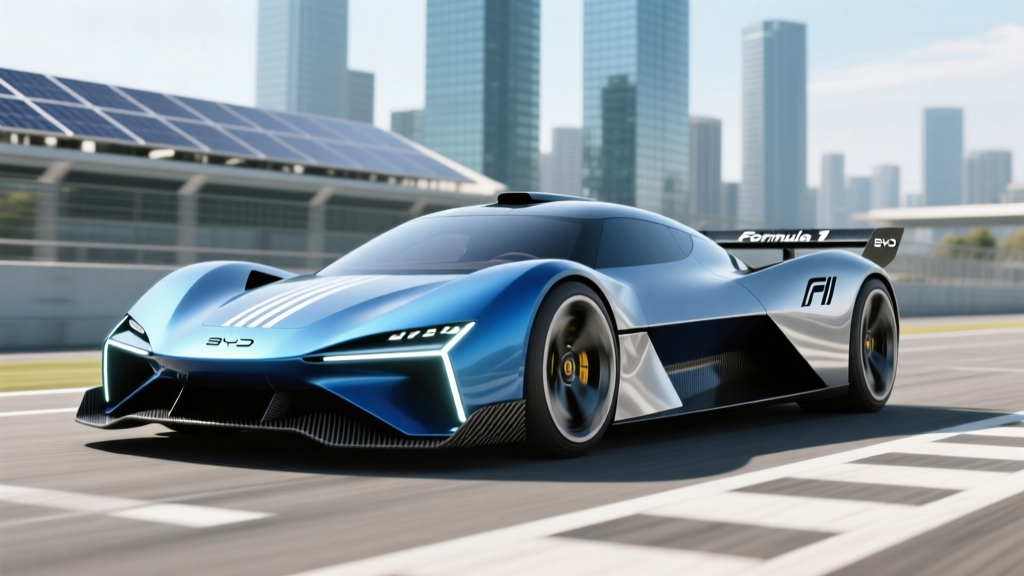
If you have been searching for a "BYD Formula 1" electric vehicle, you are not alone — but the term is the source of widespread confusion in the EV community. There is no production car called the BYD Formula 1. BYD (Build Your Dreams), the Chinese automaker that surpassed Tesla in global BEV sales in late 2023, does not manufacture a Formula 1 race car, nor does it have a consumer model by that name. What does exist is a web of overlapping rumors, concept renders, and BYD's actual high-performance EV lineup that buyers often conflate under this search term.
This article untangles the confusion, explains BYD's real performance-oriented EVs available or announced as of 2026, and gives US-based buyers a clear-eyed look at what they can actually purchase — and what remains out of reach due to trade barriers and market availability.
What "BYD Formula 1" Actually Refers To
The search term "BYD Formula 1" typically maps to one of three things in online discussions:
- BYD's Yangwang U9 — a 1,287-horsepower electric supercar that debuted in China in 2024 and is the closest thing BYD has produced to a track-capable, F1-adjacent vehicle.
- Viral concept renders — fan-made or AI-generated images of a hypothetical BYD single-seat or open-wheel race car that circulated on social media in 2024–2025.
- BYD's sponsorship and tech partnerships — BYD has sponsored various motorsport events and has been rumored to explore Formula E or other racing series entries, fueling speculation about an F1 program.
None of these constitute a purchasable "BYD Formula 1" vehicle. The closest real-world product is the Yangwang U9, which we will profile below, alongside the more accessible BYD Seal performance sedan that US buyers are more likely to encounter through import channels or future market entry.
Yangwang U9: BYD's Actual Supercar
| Spec | Yangwang U9 (2025–2026 Model Year) |
|---|---|
| EPA Range | Not EPA-rated (China-only); CLTC ~280 mi (450 km) |
| Battery Capacity | ~80 kWh usable, LFP (Blade Battery) |
| Powertrain | Quad-motor AWD (e4 platform) |
| Horsepower | 1,287 hp combined |
| 0–60 mph | ~2.0 seconds (manufacturer claim) |
| Top Speed | ~190 mph (305 km/h) |
| DC Fast Charge (peak) | ~200 kW (800V architecture) |
| 10–80% DC Charge | ~20 minutes (estimated) |
| Level 2 Home Charge | ~11 kW AC (~25–30 mi/hr equivalent) |
| Base Price (China) | ¥1,680,000 (~$232,000 USD) |
| US Availability | Not available — no US homologation |
BYD Seal: The Performance EV You Could Actually Consider
For buyers who land on this page looking for a BYD performance EV they might realistically own, the BYD Seal is the relevant model. Positioned as a Tesla Model 3 competitor, the Seal is sold in China, Europe, Australia, and parts of Southeast Asia — but as of early 2026, BYD does not sell vehicles in the United States through official channels. The US imposes a 100% tariff on Chinese-built EVs (raised from 25% in mid-2024 under Section 301), making direct import economically impractical for consumers.
| Spec | BYD Seal Excellence AWD (2025–2026) |
|---|---|
| EPA Range | Not EPA-rated; WLTP ~323 mi (520 km) |
| Battery Capacity | 82.5 kWh usable, LFP (Blade Battery) |
| Powertrain | Dual-motor AWD |
| Horsepower | 523 hp combined |
| 0–60 mph | 3.8 seconds |
| DC Fast Charge (peak) | 150 kW |
| 10–80% DC Charge | ~26 minutes |
| Level 2 Home Charge | 11 kW AC (~30 mi/hr) |
| MPGe (est. based on WLTP) | ~110 MPGe combined (unofficial) |
| Cargo Volume | 14.1 cu ft trunk + 1.8 cu ft frunk |
| Base Price (Europe) | €48,000 (~$52,000 USD) |
| US Availability | Not sold in the US; 100% import tariff applies |
Charging Infrastructure: What BYD Owners Face Abroad
BYD vehicles sold in Europe and other markets use the CCS2 connector for DC fast charging and Type 2 for AC. In China, GB/T is the standard. Neither maps directly to the North American NACS (Tesla Supercharger) or CCS1 ecosystem, though adapters exist. This connector mismatch is yet another barrier to unofficial US imports.
| Charging Level | Power | Speed (BYD Seal) | Connector |
|---|---|---|---|
| Level 1 (120V) | ~1.4 kW | ~4 mi/hr | Adapter required in US |
| Level 2 (240V) | 11 kW | ~30 mi/hr | Type 2 (EU) / GB/T (CN) |
| DC Fast Charge | 150 kW peak | 10–80% in ~26 min | CCS2 (EU) / GB/T (CN) |
A critical ownership note: BYD's 150 kW peak DC charge rate is modest by 2026 standards. Competitors on 800V architectures — such as the Hyundai Ioniq 5 (240 kW peak, 10–80% in ~18 min) and Kia EV6 (239 kW) — charge substantially faster. The Seal's charge curve also tapers significantly above 80% SoC, adding roughly 15–20 additional minutes to reach a full charge from 80–100%.
Tax Credits, Tariffs, and the US Buying Reality
Even if you could physically import a BYD Seal or Yangwang U9 to the United States, the economics are prohibitive:
- 100% Section 301 tariff on Chinese-manufactured EVs (effective August 2024, continuing through 2026).
- No §30D federal tax credit — the IRS requires battery components and critical minerals to be sourced from the US or FTA partners. Chinese-built BYD batteries (Blade Battery, LFP) do not meet these sourcing thresholds. The IRS §30D guidelines explicitly exclude vehicles with battery components from "foreign entities of concern," which includes Chinese manufacturers.
- No state incentives — most state EV rebates mirror federal eligibility requirements.
- No dealer network — no US-based service centers, warranty support, or parts supply chain.
For US buyers interested in the BYD ownership experience, the practical answer is: you cannot buy one here, and the regulatory environment makes it unlikely before 2028 at the earliest — and only if BYD establishes non-China manufacturing (such as their planned Mexico or Brazil plants) that might navigate tariff structures.
BYD vs. Competitors US Buyers Can Actually Purchase
If the BYD Seal's profile appeals to you, here is how it stacks up against US-available alternatives at similar price points:
| Spec | BYD Seal AWD (EU) | Tesla Model 3 LR AWD | Hyundai Ioniq 6 SEL AWD |
|---|---|---|---|
| EPA Range | N/A (WLTP 323 mi) | 363 mi | 316 mi |
| Battery | 82.5 kWh LFP | 75 kWh NMC | 77.4 kWh NMC |
| HP | 523 | 346 | 320 |
| 0–60 mph | 3.8s | 4.2s | 5.1s |
| DC Peak kW | 150 kW | 250 kW | 240 kW |
| 10–80% Time | ~26 min | ~18 min | ~18 min |
| Base MSRP (US) | Not available | $47,740 | $46,700 |
| Federal Tax Credit | $0 | Up to $7,500* | Up to $7,500* |
*Tax credit eligibility depends on MSRP caps, buyer income limits, and battery-sourcing requirements under IRS §30D rules. Consult a tax professional. Point-of-sale transfer is available for eligible buyers in 2026.
Pros of BYD's EV Lineup (Global)
- Blade Battery (LFP) offers excellent thermal stability and slower degradation
- Yangwang U9 delivers hypercar performance at a fraction of European supercar pricing
- Competitive global pricing — Seal undercuts Model 3 in most markets
- Strong build quality and interior materials in recent models
- Standard V2L (vehicle-to-load) on many models
Cons for US Buyers
- Not sold in the US — no purchase path
- 100% tariff makes import economically unviable
- No §30D federal tax credit eligibility
- No US service network, warranty support, or parts availability
- Slower DC charging (150 kW) vs. US competitors (200–250+ kW)
- Connector incompatibility (CCS2/GB/T vs. NACS/CCS1)
Who Should Be Watching BYD — and Who Should Buy Now
Wait and watch if: You are interested in BYD's long-term US market entry strategy, particularly if the company establishes manufacturing in Mexico or South America that could circumvent current tariffs. BYD's LFP Blade Battery technology and aggressive pricing could reshape the US market if trade policy shifts.
Buy now if: You need a performance EV today in the US. The Tesla Model 3 Long Range AWD, Hyundai Ioniq 6, and BMW i4 M50 all deliver strong performance, full EPA ratings, established charging network access, and potential §30D tax credit eligibility. None offer the Yangwang U9's 1,287 hp, but all are practical, warrantied, and chargeable on US infrastructure.
Frequently Asked Questions
Does BYD have a Formula 1 car?
No. BYD does not manufacture a Formula 1 race car or any consumer vehicle named "Formula 1." The closest product is the Yangwang U9 electric supercar, which produces 1,287 hp but is not a race car and is not sold in the US.
Can I buy a BYD vehicle in the United States in 2026?
No. BYD does not have a US dealer network, and Chinese-built EVs face a 100% import tariff under Section 301. Even if imported, BYD vehicles would not qualify for the §30D federal EV tax credit due to battery-sourcing rules.
What is BYD's Blade Battery and why does it matter?
The Blade Battery is BYD's proprietary LFP (lithium iron phosphate) cell design using a blade-like form factor. LFP chemistry offers better thermal stability (lower fire risk), longer cycle life (~3,000+ cycles to 80% capacity), and no cobalt or nickel. The trade-off is lower energy density compared to NMC, meaning heavier packs for the same range.
How does the BYD Seal compare to the Tesla Model 3?
The Seal offers more horsepower (523 vs. 346 in the Model 3 LR AWD) and a competitive WLTP range, but it charges slower (150 kW peak vs. 250 kW), has no US availability, no Supercharger access, and no federal tax credit eligibility. For US buyers, the Model 3 remains the practical choice.
Will BYD ever sell cars in the US?
BYD executives have stated they are studying the US market, but the 100% tariff and geopolitical tensions make near-term entry unlikely. BYD is building factories in Brazil, Hungary, Thailand, and potentially Mexico — any of which could eventually serve as export hubs, though tariff structures may still apply. Most analysts do not expect US sales before 2028–2029 at the earliest.
Does the Yangwang U9 qualify for any tax incentives?
No. Even if imported, the U9 exceeds the §30D MSRP cap ($80,000 for sedans/super-cars), its Chinese-manufactured battery fails critical-mineral and component sourcing requirements, and the buyer income caps would further limit eligibility. See IRS guidance on clean vehicle credits for full rules.
The "BYD Formula 1" search reflects genuine enthusiasm for BYD's rapid rise as a global EV powerhouse. The company's technology — particularly the LFP Blade Battery and the e4 quad-motor platform — is legitimately impressive. But for US-based buyers in 2026, the practical path forward is choosing from EVs that are actually available, warrantied, and incentivized on American soil. Keep watching BYD's global moves; the story is far from over.