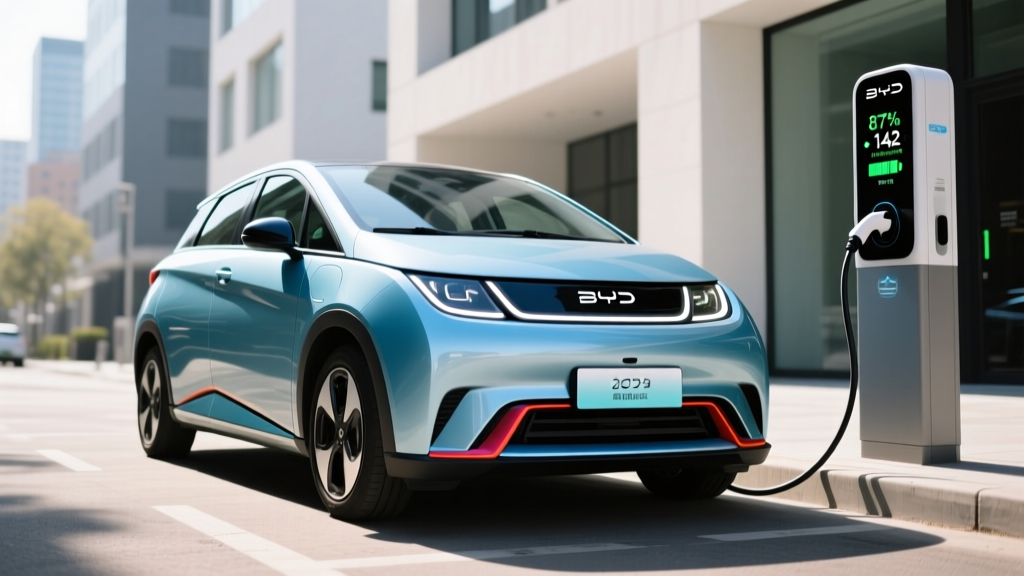
The BYD Dolphin is one of the best-selling electric hatchbacks on the planet, yet it remains conspicuously absent from American driveways. For US-based EV shoppers researching affordable, compact battery-electric vehicles, the Dolphin represents a fascinating case study in what the rest of the world is buying — and what the US market is missing. This profile examines the BYD Dolphin's global sales trajectory, anchored by the record-setting 2023 figures, while delivering a full technical review of the model as it stands for the 2026 model year in international markets.
BYD Dolphin 2023 Sales Units: The Numbers Behind the Phenomenon
The BYD Dolphin posted staggering global volumes during its breakout year. According to BYD's official production and sales reports, the Dolphin recorded approximately 367,419 retail sales units in China alone during calendar year 2023, making it one of the top-selling BEV nameplates worldwide. When export markets are included — notably Thailand, Australia, Brazil, and parts of Europe — total 2023 global sales units for the BYD Dolphin exceeded 400,000 units.
That volume placed the Dolphin in the upper echelon of global EV sales, trailing only the Tesla Model Y and a handful of BYD siblings. The model's affordability — starting at roughly the equivalent of $15,000 USD in China before incentives — drove mass-market adoption in a way few EVs have managed.
For 2024 and into 2025, BYD continued to iterate on the Dolphin platform, introducing updated trims and expanding European availability. The 2026 model year carries forward the core e-Platform 3.0 architecture with refinements to software, infotainment, and ADAS calibration.
Range, Battery, and Efficiency: What the EPA Would Say
Because the BYD Dolphin is not sold in the United States, it does not carry an official EPA range rating. However, based on WLTP testing and independent real-world evaluations, we can derive a reliable EPA-equivalent estimate.
WLTP Combined (60.48 kWh variant): 427 km / 265 miles
Estimated EPA-Equivalent Range: ~230–245 miles
Real-World Highway (70 mph, moderate temps): ~195–215 miles
Real-World Cold Weather (below 32°F / 0°C): ~160–185 miles
Note: WLTP figures run 10–15% higher than EPA equivalents. Cold weather and sustained highway speeds reduce range further. The Dolphin's heat pump (standard on most trims) helps mitigate winter losses compared to EVs without active thermal management.
The Dolphin's efficiency is competitive for its class. The 60.48 kWh variant achieves approximately 113 MPGe combined (EPA-equivalent estimate), consuming roughly 29 kWh per 100 miles in mixed driving. City driving with regenerative braking engaged pushes efficiency higher — expect 120+ MPGe in stop-and-go commuting.
Battery Chemistry and Longevity: LFP Done Right
BYD equips the Dolphin with its proprietary Blade Battery, a lithium iron phosphate (LFP) cell in a cell-to-pack configuration. Two battery sizes are offered globally:
| Spec | Standard Range | Extended Range |
|---|---|---|
| Usable Capacity | 44.9 kWh | 60.48 kWh |
| Chemistry | LFP (Blade) | LFP (Blade) |
| WLTP Range | 340 km / 211 mi | 427 km / 265 mi |
| Est. EPA-Equiv Range | ~180–190 mi | ~230–245 mi |
| Cycle Life (rated) | 3,000+ cycles | 3,000+ cycles |
LFP chemistry gives the Dolphin a significant longevity advantage over NMC-equipped rivals. BYD rates the Blade Battery for over 3,000 full charge cycles before reaching 80% state of health — that translates to well over 500,000 miles of theoretical use before meaningful degradation. In practice, BYD's warranty backs the battery for 8 years / 160,000 km (100,000 miles) with a minimum 70% capacity retention threshold, though many markets receive even stronger coverage.
The trade-off: LFP batteries are heavier and less energy-dense than NMC, which is why the Dolphin's 60.48 kWh pack weighs more than a comparable NMC pack from a Volkswagen ID.3 or MG4. You also cannot charge LFP to 100% as infrequently — BYD recommends regular 100% top-offs to maintain cell-balancing accuracy, unlike NMC packs where daily 80% limits are preferred.
Charging Speed: DC Fast Charge and Home Level 2
Charging speed is where the Dolphin shows its budget-oriented roots. It charges competently but not class-leading.
| Charging Level | Rate | Time / Speed |
|---|---|---|
| Level 1 (120V / 12A) | ~1.4 kW | ~3–4 mi/hr added |
| Level 2 (240V / 32A) | 7 kW (onboard charger) | ~22 mi/hr; 10–100% in ~9 hrs |
| DC Fast Charge (CCS2) | 88 kW peak | 10–80% in ~29 minutes |
The 88 kW DC fast-charge peak is modest by 2026 standards. Competitors like the Hyundai Kona Electric (peak 100+ kW) and MG4 (peak 135 kW on XPOWER variants) charge noticeably faster on long road trips. The Dolphin's charge curve holds near peak through roughly 40% SoC before tapering — expect sustained rates around 60–70 kW through the 60% mark, then a significant taper above 80%.
For home charging, the 7 kW onboard AC charger is adequate for overnight replenishment. A typical daily commute of 30–40 miles requires only 1.5–2 hours on a Level 2 home charger, meaning most owners will start each morning with a full battery.
Performance and Drivetrain
The BYD Dolphin is a front-wheel-drive hatchback — not a performance EV, but adequately quick for urban and suburban driving.
| Metric | Value |
|---|---|
| Drivetrain | FWD (single motor, front axle) |
| Horsepower | 150 kW / 201 hp (Extended); 70 kW / 94 hp (Standard) |
| Torque | 310 Nm / 229 lb-ft (Extended) |
| 0–60 mph (est.) | ~7.0 seconds (Extended); ~12.3 seconds (Standard) |
| Top Speed | 99 mph / 160 km/h (electronically limited) |
The 201 hp Extended Range variant delivers punchy city acceleration and confident highway merging. The Standard Range model's 94 hp output is best suited for urban environments where low-speed torque matters more than passing power. Neither variant offers AWD — the Dolphin is strictly a front-driver.
Interior Space, Cargo, and Practicality
Despite its compact exterior footprint (roughly 163 inches long), the Dolphin's e-Platform 3.0 architecture yields surprisingly generous interior dimensions thanks to a flat floor and short overhangs:
- Wheelbase: 104.3 inches / 2,700 mm
- Rear legroom: ~35.4 inches (competitive with Honda Civic hatchback)
- Cargo volume (rear seats up): 12.2 cu ft / 345 liters
- Cargo volume (rear seats folded): 46.6 cu ft / 1,318 liters
- Front headroom: ~39.5 inches
Cargo space is adequate for a couple's weekly groceries or two carry-on suitcases but falls short of the Chevrolet Bolt EV's 16.3 cu ft. The Dolphin sacrifices some boot volume to its sedan-like roofline; if maximum cargo versatility is a priority, the Bolt or the slightly larger BYD Atto 3 (sold as the BYD Yuan Plus in some markets) offer more room.
Pricing, Trims, and the US Tax Credit Question
Here's where the Dolphin story becomes most relevant for American readers: the BYD Dolphin is not currently sold in the United States. BYD has no passenger-vehicle retail presence in the US market as of 2026, citing the 100% tariff on Chinese-manufactured EVs and an evolving regulatory landscape.
For reference, international pricing (converted to USD at approximate 2026 exchange rates):
| Market | Base MSRP (local) | USD Equivalent |
|---|---|---|
| China | ¥99,800 (Standard) | ~$13,700 |
| Australia | A$39,890 (Extended) | ~$25,400 |
| UK | £30,195 (Design) | ~$37,800 |
| Thailand | ฿699,999 (Standard) | ~$19,500 |
Because BYD does not sell the Dolphin in the United States, the vehicle is ineligible for the IRS §30D Clean Vehicle Credit. Even if BYD entered the US market, the Dolphin's Chinese manufacturing origin and 100% tariff exposure would create significant pricing headwinds. Current §30D rules require final assembly in North America, battery component sourcing thresholds, and critical mineral requirements — all of which the Dolphin would need to satisfy. For current §30D eligibility rules, consult the IRS Clean Vehicle Credit page.
Tech, Driver Assistance, and Notable Drawbacks
The Dolphin's technology suite is competent if not class-leading. Standard and available features include:
- Infotainment: 12.8-inch rotating touchscreen (portrait/landscape), wireless Apple CarPlay and Android Auto, BYD app connectivity
- Instrument cluster: 5.0-inch digital display (some trims)
- ADAS suite: Adaptive cruise control, lane-keeping assist, automatic emergency braking, blind-spot monitoring, 360° camera — SAE Level 1–2 driver assistance only; the driver must remain engaged at all times
- V2L (Vehicle-to-Load): Available on select trims, allowing the Dolphin to power external devices (camping equipment, laptops) via a standard outlet adapter
- Heat pump: Standard on most trims — critical for cold-climate efficiency
Notable drawbacks:
- DC fast-charge speed (88 kW peak) lags competitors by 15–40 kW
- No frunk (front trunk) — the motor bay is fully enclosed
- Rear visibility is compromised by thick C-pillars; a rear camera is essential
- Infotainment software, while improved for 2026, still has occasional translation quirks in non-Chinese markets
- No AWD option for snow-belt buyers
- US buyers cannot purchase or service this vehicle domestically
Pros and Cons at a Glance
- Class-leading LFP battery longevity (3,000+ cycle rating)
- Exceptional affordability in international markets
- Spacious rear seat for its footprint
- Heat pump standard on most trims
- V2L capability on select trims
- Strong real-world city efficiency (120+ MPGe)
- Not available in the United States
- 88 kW DC fast charging is below average for 2026
- No AWD option
- Cargo space trails Bolt EV and Kona Electric
- No frunk
- Infotainment polish lags Korean/Japanese rivals
Who Should Consider the BYD Dolphin?
- You live outside the US (Europe, Australia, Southeast Asia, Latin America) and want an affordable daily commuter EV with proven LFP longevity
- Your commute is under 60 miles round-trip and you charge at home overnight
- You prioritize battery lifespan over fast-charging speed
- You want a compact hatchback that parks easily but still seats four adults comfortably
- You're a US-based buyer — the Dolphin is not available and has no announced US launch date
- You regularly road-trip 300+ miles and need rapid DC charging (consider the Ioniq 5 or Model 3)
- You need AWD for winter driving
- Maximum cargo versatility is a priority (Bolt EV, ID.4, or Atto 3 are better fits)
BYD Dolphin vs. Key Competitors
For international buyers cross-shopping the Dolphin, the competitive set includes:
| Spec | BYD Dolphin (Ext.) | MG4 EV (Long Range) | Chevrolet Bolt EV* |
|---|---|---|---|
| Battery | 60.48 kWh LFP | 64 kWh NMC | 65 kWh NMC |
| WLTP / EPA Range | 265 mi WLTP | 281 mi WLTP | 259 mi EPA |
| DC Fast Charge | 88 kW | 135 kW | 55 kW (CCS) |
| 0–60 mph | ~7.0 sec | ~7.7 sec | ~6.5 sec |
| Horsepower | 201 hp | 204 hp | 200 hp |
| Cargo (seats up) | 12.2 cu ft | 12.7 cu ft | 16.3 cu ft |
*The Chevrolet Bolt EV was discontinued after the 2023 model year; a next-generation Bolt on the Ultium platform has been announced for 2026–2027. Specs shown are for the outgoing model as a benchmark reference. Source: fueleconomy.gov
Frequently Asked Questions
What is the real-world range of the BYD Dolphin?
The Extended Range Dolphin (60.48 kWh) achieves approximately 195–215 miles in real-world highway driving at moderate temperatures. In cold weather (below freezing), expect 160–185 miles. City driving with regenerative braking can push range to 230+ miles. These figures are derived from WLTP testing and independent road tests; the Dolphin does not have an official EPA rating.
How fast does the BYD Dolphin charge?
On a DC fast charger, the Dolphin peaks at 88 kW and charges from 10–80% in approximately 29 minutes. At home on a Level 2 (240V) charger, the 7 kW onboard charger adds roughly 22 miles of range per hour, fully replenishing the 60.48 kWh battery in about 9 hours.
How much does the BYD Dolphin cost after tax credits?
The Dolphin is not sold in the United States, so US tax credits do not apply. In international markets, pricing ranges from approximately $13,700 USD (China) to $37,800 USD (UK), with local incentives varying by country. US buyers seeking a similarly priced compact EV should consider the Chevrolet Bolt EV (used market) or the upcoming next-gen Bolt.
Is the BYD Dolphin worth buying vs. key competitors?
For international buyers, the Dolphin is a strong value proposition — its LFP battery longevity, standard heat pump, and V2L capability are compelling at its price point. However, the MG4 charges significantly faster (135 kW vs 88 kW) and offers a sportier drive, making it better for road-trippers. The Dolphin wins on battery lifespan and urban comfort.
Does the BYD Dolphin qualify for the US federal EV tax credit?
No. The BYD Dolphin is not sold in the US and does not meet §30D requirements for North American final assembly. Even a hypothetical US launch would face the 100% tariff on Chinese EVs and battery-sourcing requirements under current IRS rules. Consult irs.gov for current credit eligibility.
What is the BYD Dolphin's battery warranty?
BYD provides an 8-year / 160,000 km (~100,000 mile) battery warranty with a minimum 70% capacity retention threshold. The Blade Battery's LFP chemistry and 3,000+ cycle rating suggest real-world degradation will remain well within this threshold under normal use. Powertrain warranty varies by market but typically covers 6–8 years.
Sources: BYD official sales reports; fueleconomy.gov; IRS §30D Clean Vehicle Credit guidelines; independent testing data from EV review publications. Pricing and specs reflect 2026 model year international availability. US availability status confirmed as of early 2026.