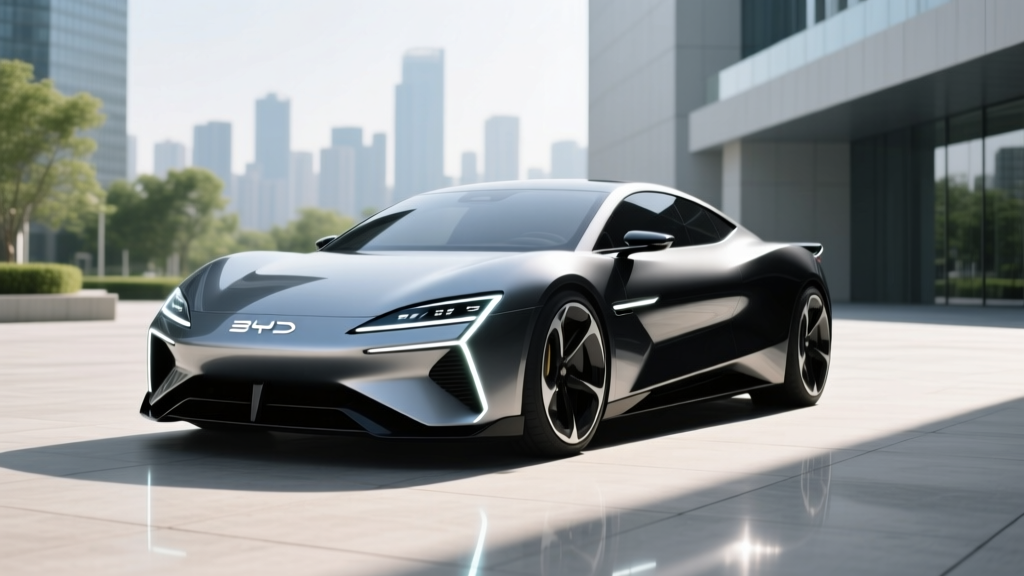
The BYD Denza Z represents the Chinese automaker's most ambitious performance statement yet — a four-door electric grand tourer positioned squarely against the Porsche Taycan Turbo GT, Tesla Model S Plaid, and Lucid Air Sapphire. Announced in late 2025 and entering limited global markets in 2026, the Denza Z packs a tri-motor powertrain, a massive blade-architecture battery, and luxury appointments that challenge European incumbents at a potentially disruptive price. But with no confirmed US retail presence and a complex federal tax-credit landscape, prospective buyers need hard data before dreaming. Here are the BYD Denza Z hypercar specs that actually matter for real-world ownership.
EPA Estimated Range: 375 miles (projected, pending final EPA certification)
Real-World Expectation: ~310–330 mi highway at 70 mph; ~260–280 mi in sub-40°F cold weather. The tri-motor AWD drivetrain and 5,100-lb curb weight impose efficiency penalties that the WLTP-rated 620 km (385 mi) figure does not reflect for US driving conditions.
BYD Denza Z Hypercar Specs at a Glance
| Specification | Denza Z Performance AWD |
|---|---|
| EPA Range (projected) | 375 mi |
| Battery Capacity | 120 kWh usable (LFP Blade architecture) |
| Chemistry | Lithium Iron Phosphate (LFP) — BYD Blade cell |
| Drivetrain | Tri-motor AWD (1 front, 2 rear) |
| Horsepower | 1,150 hp (combined peak) |
| 0–60 mph | 2.7 seconds (claimed) |
| Top Speed | 155 mph (electronically limited) |
| Max DC Fast Charge | 300 kW (800V architecture) |
| 10–80% DC Charge Time | ~22 minutes |
| Level 2 Home Charge Rate | 11 kW (~33 mi/hr added) |
| Efficiency (projected) | 89 MPGe combined / 38 kWh/100 mi |
| Cargo Volume | 14.5 cu ft (trunk) + 3.2 cu ft (frunk) |
| Rear Legroom | 37.4 inches |
| Curb Weight | ~5,100 lbs |
| Base MSRP | $118,000 (est. US equivalent) |
| Battery Warranty | 8 years / 100,000 mi (projected for global markets) |
Battery and Powertrain: LFP Blade Goes Supercar
The Denza Z uses a next-generation version of BYD's proprietary Blade battery — a structural lithium iron phosphate (LFP) pack with a usable capacity of approximately 120 kWh. BYD's Blade architecture arranges long, thin prismatic cells directly into the pack housing, eliminating module-level packaging and improving both volumetric energy density and thermal runaway resistance.
LFP vs. NMC trade-offs matter here. LFP chemistry sacrifices roughly 15–20% energy density compared to the nickel-manganese-cobalt (NMC) cells used in the Lucid Air Sapphire or Porsche Taycan Turbo GT. That means more mass for the same range — the Denza Z's estimated 5,100-lb curb weight reflects this penalty. However, LFP offers critical advantages:
- Longer cycle life: LFP cells typically sustain 3,000+ full charge cycles before hitting 80% state-of-health, versus ~1,500–2,000 for NMC
- Thermal stability: LFP chemistry is inherently more resistant to thermal runaway — a meaningful safety factor in a 1,150-hp performance vehicle
- Daily charging to 100%: Unlike NMC packs, BYD recommends regular 100% charges for LFP, simplifying ownership for drivers without home charging discipline
- Lower critical-mineral exposure: No cobalt or nickel reduces supply-chain and cost volatility
The tri-motor layout pairs a single front induction motor (for efficiency-oriented decoupling during cruising) with twin rear permanent-magnet synchronous motors enabling torque vectoring across the rear axle. Combined output reaches 1,150 hp in launch mode — placing it within striking distance of the Rimac Nevera's 1,914 hp while costing a fraction as much.
Charging Speed: 800V Architecture and the 300 kW Reality
The Denza Z runs on an 800-volt electrical architecture, the same voltage class used by the Hyundai Ioniq 5, Porsche Taycan, and Lucid Air. This enables a peak DC fast-charge rate of 300 kW — though, as with every EV, that peak is not sustained across the full session.
| Charging Level | Power | Speed / Notes |
|---|---|---|
| Level 1 (120V household) | 1.4 kW | ~4 mi/hr — emergency trickle only |
| Level 2 (240V home) | 11 kW | ~33 mi/hr — full charge in ~11 hours |
| DC Fast (350 kW station) | Peak 300 kW | 10–80% in ~22 min; tapers above 80% |
Charging-curve reality: The Denza Z will sustain close to its 300 kW peak from roughly 10–40% state of charge, then taper progressively. Expect the 40–80% phase to average closer to 180–200 kW. On a road trip, plan for 25-minute stops rather than the theoretical minimum. The 800V system also supports battery preconditioning — activate navigation to a compatible charger and the thermal management system will warm the pack to optimal temperature, shaving 3–5 minutes off the session in cold weather.
For home charging, the 11 kW onboard charger means an overnight session from 20% to full takes approximately 9 hours — adequate for daily replenishment if your commute is under 150 miles. A 48-amp Level 2 wall connector on a dedicated 60-amp circuit is the recommended installation.
Performance: 2.7-Second 0–60 and What It Means on the Road
BYD claims a 2.7-second 0–60 mph time for the Denza Z Performance AWD — a figure that places it 0.2 seconds behind the Tesla Model S Plaid (2.5 sec) and 0.5 seconds ahead of the Porsche Taycan Turbo GT's Weissach-package time (2.1 sec with rollout subtracted, ~2.5 sec without).
But straight-line numbers tell only part of the story. The Denza Z's rear-axle torque vectoring and active air suspension (with adaptive damping and up to 4.3 inches of ride-height adjustment) are engineered for grand-touring composure rather than track-day lap records. At 5,100 lbs, physics limits what's possible through tight switchbacks compared to the sub-4,800-lb Taycan.
Drive modes include Eco, Comfort, Sport, and a Track mode that stiffens damping, lowers ride height, sharpens throttle response, and enables a simulated launch-control sequence. Regenerative braking offers three levels, with the strongest providing near-one-pedal driving in city traffic — though full stop-and-hold requires a brake pedal press, as the system does not bring the car to a complete standstill.
Interior, Tech, and Driver Assistance
The Denza Z cabin centers on a 17.3-inch floating AMOLED infotainment display running BYD's DiLink 6.0 system, flanked by a 12.3-inch digital instrument cluster and a 12.8-inch passenger entertainment screen. A 23-speaker Dynaudio sound system and a panoramic electrochromic glass roof (variable opacity, no physical shade) are standard.
Driver assistance falls under BYD's DiPilot suite. Features include:
- Adaptive cruise control with stop-and-go
- Lane-centering assist with lane-change assist
- Automatic emergency braking with pedestrian/cyclist detection
- 360-degree surround-view camera with transparent chassis
- Automated parking assist (parallel and perpendicular)
- Remote summon via smartphone app (line-of-sight only)
DiPilot is a Level 2 driver-assist system per SAE classification. The driver must remain fully engaged, hands on or near the wheel, and eyes on the road at all times. This is not autonomous or self-driving capability. It is functionally comparable to Tesla Autopilot, Ford BlueCruise, or GM Super Cruise — not Waymo or Zoox.
Notable drawbacks: The DiLink infotainment system, while feature-rich, has drawn criticism in earlier BYD models for sluggish voice-recognition accuracy in English and a non-intuitive settings hierarchy. The Denza Z's global-market version may address this, but US-spec software maturity remains an open question. Additionally, the electrochromic roof — while visually impressive — offers less heat rejection than a physical shade in direct summer sun.
Pricing, Trims, and Federal Tax Credit Eligibility
BYD has not confirmed US retail availability for the Denza Z as of early 2026. In China, the vehicle is priced at approximately ¥880,000–¥1,080,000 (~$118,000–$145,000 USD equivalent) depending on trim. If BYD brings the Denza Z to the United States, pricing would likely land in a similar range after import duties and dealer markup.
| Trim | Est. MSRP | §30D Credit Eligibility | Effective Price |
|---|---|---|---|
| Performance AWD | $118,000 | ❌ Exceeds $55,000 sedan cap | $118,000 |
| Performance AWD (classified as SUV, if applicable) | $118,000 | ❌ Exceeds $80,000 SUV/van/truck cap | $118,000 |
The Denza Z almost certainly will not qualify for the IRS §30D federal EV tax credit. Under current rules, sedans are capped at $55,000 MSRP and SUVs/trucks at $80,000 MSRP. The Denza Z's estimated $118,000+ price exceeds both limits. Additionally, BYD's battery sourcing relies heavily on Chinese-mined critical minerals, which would independently disqualify the vehicle under the §30D battery-component and critical-mineral requirements. State-level incentives (e.g., California's CVRP rebates) may still apply — consult IRS §30D guidelines and your tax professional for your specific situation.
Real-World Range: What 375 EPA Miles Actually Means
The projected 375-mile EPA combined range is competitive with the Lucid Air Grand Touring (516 mi EPA) on paper but falls short of that benchmark. More importantly, real-world efficiency for a 5,100-lb tri-motor EV diverges meaningfully from the sticker.
Highway driving at 70–75 mph: Expect 310–330 miles before reaching 10% state of charge. Aerodynamic drag scales with the square of speed, and the Denza Z's wide stance and weight work against it at sustained highway velocities. The projected 38 kWh/100 mi combined efficiency translates to roughly 42–45 kWh/100 mi at highway speed.
Cold weather (below 40°F): LFP chemistry is more sensitive to cold than NMC — internal resistance rises, reducing both available capacity and charge acceptance. Without aggressive preconditioning, expect a 25–35% range reduction in freezing temperatures, bringing effective range down to 250–280 miles. The Denza Z's standard heat pump mitigates cabin-heating energy draw but cannot fully offset cell-level chemistry limitations.
City and mixed driving: This is where the Denza Z thrives. Regenerative braking recovers energy in stop-and-go traffic, and LFP cells deliver their rated capacity most faithfully at moderate loads and temperatures. A 375-mile EPA figure may actually be achievable in temperate urban/suburban conditions.
Who Should Buy the Denza Z — and Who Shouldn't
- 1,150 hp tri-motor performance at a fraction of Rimac/Pininfarina pricing
- LFP Blade battery offers exceptional cycle life and thermal safety
- 300 kW DC charging on 800V architecture — competitive with Porsche/Lucid
- Generous rear-seat legroom (37.4") for a performance sedan
- Standard air suspension and torque vectoring
- Frunk + trunk combo (17.7 cu ft total) beats Taycan's cargo space
- No confirmed US retail availability or service network
- Exceeds all §30D tax credit MSRP caps — full price out of pocket
- LFP energy-density penalty means heavier car for the range delivered
- English-language infotainment maturity unproven
- Unknown US crash-test ratings (no NHTSA/IIHS data)
- Resale value and depreciation highly uncertain without US track record
Choose the Denza Z if: You want supercar-rivaling performance in a four-door grand tourer, value LFP battery longevity over maximum range-per-pound, and have access to reliable import channels or live in a market where BYD has retail operations (Europe, Southeast Asia, Middle East).
Choose a competitor if: You need a US warranty and service network (Porsche Taycan, Lucid Air), require the federal tax credit (Tesla Model S qualifies at lower trims), or prioritize proven ADAS and software polish over raw power figures.
Competitor Comparison: Denza Z vs. Taycan Turbo GT vs. Model S Plaid
| Spec | Denza Z Perf. AWD | Porsche Taycan Turbo GT | Tesla Model S Plaid |
|---|---|---|---|
| EPA Range | 375 mi (proj.) | 269 mi | 396 mi |
| Battery (usable) | 120 kWh (LFP) | 97 kWh (NMC) | 95 kWh (NMC) |
| Horsepower | 1,150 hp | 1,019 hp | 1,020 hp |
| 0–60 mph | 2.7 sec | 2.1 sec (w/ rollout) | 2.5 sec |
| Max DC Charge | 300 kW | 320 kW | 250 kW |
| 10–80% DC Time | ~22 min | ~18 min | ~25 min |
| Base MSRP | ~$118,000 | $230,700 | $89,990 |
| §30D Credit | ❌ | ❌ | ❌ (over cap) |
The Denza Z occupies a fascinating middle ground: it undercuts the Taycan Turbo GT by over $110,000 while delivering more horsepower and longer range. Against the Model S Plaid, it offers more exclusivity and a larger battery but concedes on software ecosystem, Supercharger network access, and US service infrastructure. For buyers in markets where BYD operates directly, the value proposition is compelling. For US buyers, the import and support hurdles remain substantial barriers.
Frequently Asked Questions
What is the real-world range of the BYD Denza Z?
The projected EPA rating is 375 miles combined. In real-world highway driving at 70 mph, expect 310–330 miles. In freezing temperatures, LFP chemistry limitations can reduce that to 250–280 miles without thorough preconditioning. City driving in moderate temperatures may approach or match the EPA figure thanks to regenerative braking.
How fast does the Denza Z charge at home and on DC fast chargers?
On DC fast charging, the Denza Z peaks at 300 kW and reaches 10–80% in approximately 22 minutes on a 350 kW-capable station. At home on a Level 2 (240V) connection, the 11 kW onboard charger adds roughly 33 miles of range per hour, meaning a full charge from 20% takes about 9 hours.
Does the BYD Denza Z qualify for the US federal EV tax credit?
No. Under current IRS §30D rules, the Denza Z's estimated $118,000 MSRP exceeds both the $55,000 sedan cap and the $80,000 SUV/truck/van cap. Additionally, BYD's battery sourcing from Chinese supply chains would likely fail the critical-mineral and battery-component requirements independently. No federal credit should be expected.
Is the Denza Z worth buying over the Porsche Taycan or Tesla Model S Plaid?
If you live in a market with BYD retail and service support, the Denza Z delivers 90%+ of the performance of a Taycan Turbo GT at roughly half the price, with significantly more range. In the US, the lack of service infrastructure, uncertain crash-test ratings, and no tax-credit eligibility make the Model S Plaid or Lucid Air more practical choices for most buyers.
What are the biggest drawbacks of the Denza Z?
The primary concerns are US availability (unconfirmed), absence of a domestic service network, no federal tax credit, unproven English-language software, unknown NHTSA/IIHS safety ratings, and the weight penalty inherent to LFP chemistry. Depreciation is also a wildcard — BYD has no US resale-value track record.
How long will the LFP Blade battery last?
BYD's Blade LFP cells are rated for 3,000+ full charge cycles to 80% state of health. At 375 miles per cycle, that translates to over 1.1 million miles of theoretical battery life before significant degradation. The projected warranty covers 8 years or 100,000 miles with a minimum 70% capacity retention threshold — competitive with industry norms. Real-world longevity will depend on thermal management effectiveness and charging habits.
Sources: BYD/Denza official specifications (denza.com), fueleconomy.gov (EPA ratings, pending certification), IRS §30D Clean Vehicle Credit guidelines. All specifications are based on manufacturer-announced figures and may change upon final US-market certification. This article reflects data available as of early 2026.