If you've been following global EV news, you already know BYD (Build Your Dreams) is the world's largest plug-in electric vehicle manufacturer. In 2025, BYD sold over 4.2 million plug-in vehicles globally, rivaling and at times surpassing Tesla in total deliveries. The company's Blade Battery (LFP chemistry) is renowned for safety and longevity, and models like the Seal, Atto 3 (known as the Yuan Plus in some markets), and Dolphin have earned strong reviews across Europe, Australia, and Southeast Asia.
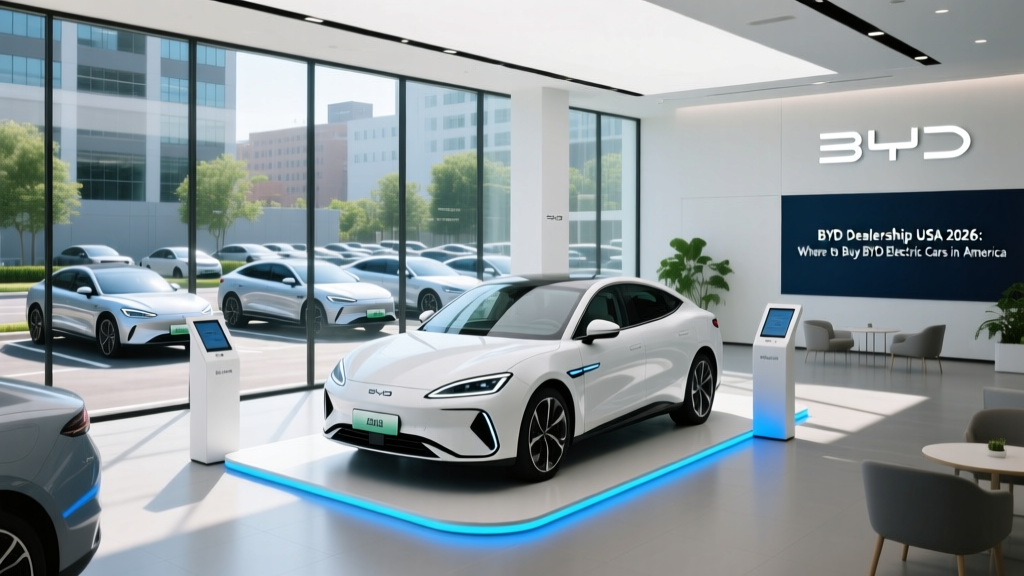
But if you're searching for a BYD dealership in the USA, here's the honest, data-driven answer: BYD does not sell passenger cars in the United States as of 2026. There are no BYD franchised dealerships offering new electric cars to American consumers. This guide explains exactly why, what your realistic options are, and which comparable EVs you can actually walk into a dealership and buy today.
Why There Is No BYD Dealership Network in the USA
BYD's absence from the US passenger car market isn't an oversight — it's the result of compounding trade policy, regulatory barriers, and geopolitical friction:
- 100% tariff on Chinese EVs: In May 2024, the Biden administration raised the Section 301 tariff on Chinese-made electric vehicles from 25% to 100%, effective August 2024. This tariff remains in effect in 2026. A BYD Seal that costs roughly $38,000 in China would face an additional ~$38,000 in import duties before reaching a US showroom, making it completely uncompetitive against domestically available EVs.
- No US homologation: BYD has not submitted any passenger vehicle for US Federal Motor Vehicle Safety Standards (FMVSS) certification through the National Highway Traffic Safety Administration (NHTSA). Without this, no BYD car can be legally sold for road use in the United States.
- No dealer infrastructure: Establishing a US dealer network requires manufacturer support for parts distribution, technician training, warranty administration, and recall management. BYD has built none of this for passenger vehicles in America.
- Geopolitical climate: Congressional scrutiny of Chinese-connected vehicles (concerns over data collection, software security, and supply-chain dependencies) makes a near-term US entry unlikely regardless of BYD's commercial ambitions.
BYD does have a US presence — but only in commercial vehicles. BYD operates a factory in Lancaster, California, that has produced electric buses for American transit agencies. However, that facility does not manufacture or sell consumer passenger cars.
BYD Models Americans Want (and Can't Have)
To understand the demand behind "BYD dealership USA" searches, here's what the global lineup looks like — with specs based on international-market versions. These figures are not EPA-certified and would differ if BYD ever pursued US homologation.
| Model | Battery (kWh) | WLTP Range | 0-100 km/h | Approx. Global Price |
|---|---|---|---|---|
| BYD Seal (RWD) | 82.5 kWh LFP | 570 km (354 mi) | 5.9 sec | ~$45,000 (EU) |
| BYD Atto 3 (Yuan Plus) | 60.5 kWh LFP | 420 km (261 mi) | 7.3 sec | ~$38,000 (AU) |
| BYD Dolphin | 60.4 kWh LFP | 427 km (265 mi) | 7.0 sec | ~$32,000 (EU) |
| BYD Han EV | 85.4 kWh LFP | 521 km (324 mi) | 3.9 sec (AWD) | ~$55,000 (EU) |
| BYD Tang EV | 108.8 kWh LFP | 530 km (329 mi) | 4.6 sec (AWD) | ~$60,000 (EU) |
The BYD Blade Battery: Why It Generates Hype
The single biggest reason American EV enthusiasts search for BYD dealerships is the Blade Battery — BYD's proprietary lithium iron phosphate (LFP) cell design that uses long, thin, blade-shaped cells arranged directly into the battery pack (cell-to-pack architecture, bypassing the module stage).
Here's why the Blade Battery matters:
| Characteristic | BYD Blade (LFP) | Typical NMC Pack |
|---|---|---|
| Thermal runaway risk | Extremely low — passed nail penetration test without fire | Higher — requires robust thermal management |
| Cycle life | 3,000+ cycles to 80% capacity | 1,000-2,000 cycles to 80% capacity |
| Energy density (cell-level) | ~150 Wh/kg (lower) | ~250 Wh/kg (higher) |
| Cold-weather performance | Greater range loss in freezing temps (~25-35%) | Better cold performance (~15-25% loss) |
| Cobalt/nickel content | None — iron and phosphate only | Contains cobalt and nickel (supply-chain/ethical concerns) |
| Cost per kWh | Lower (~$80-100/kWh at scale) | Higher (~$120-150/kWh) |
The trade-off is clear: LFP sacrifices energy density and cold-weather range for dramatically better safety, longevity, lower cost, and zero cobalt dependency. For a daily commuter who charges at home and rarely drives in extreme cold, LFP is arguably the superior chemistry. Tesla already uses LFP cells (supplied by CATL) in the Standard Range Model 3 and Model Y built in the US.
What You Can Buy Instead: Closest US-Market Equivalents
Since you can't walk into a BYD dealership in the USA, here are the closest American-market EVs that match what BYD's global models offer — with real specs, real prices, and real availability.
If You Want the BYD Seal (Mid-Size Electric Sedan)
| Spec | 2026 Tesla Model 3 Long Range | 2026 Hyundai Ioniq 6 SEL |
|---|---|---|
| EPA Range | 341 miles | 361 miles |
| Battery | 79 kWh (NMC) | 77.4 kWh (NMC) |
| Max DC Charge Rate | 250 kW | 240 kW (800V architecture) |
| 10-80% DC Time | ~25 min | ~18 min |
| 0-60 mph | 4.2 sec (AWD) | 5.1 sec (RWD) |
| Horsepower | 346 hp | 225 hp (RWD) |
| Base MSRP | $47,740 | $42,600 |
| EPA Efficiency | 132 MPGe | 140 MPGe |
| Federal Tax Credit (§30D) | Eligible (verify sourcing yearly) | Eligible (verify sourcing yearly) |
The Hyundai Ioniq 6 is the efficiency king here, and its 800V architecture delivers the fastest real-world charging in this segment. The Tesla Model 3 offers more power and access to the Supercharger network natively.
If You Want the BYD Atto 3 / Yuan Plus (Compact Electric SUV)
| Spec | 2026 Chevrolet Equinox EV 2LT | 2026 Hyundai Kona Electric SEL |
|---|---|---|
| EPA Range | 319 miles | 261 miles |
| Battery | 85 kWh (NMC) | 64.8 kWh (NMC) |
| Max DC Charge Rate | 150 kW | 100 kW |
| 10-80% DC Time | ~35 min | ~43 min |
| 0-60 mph | 7.5 sec | 7.2 sec |
| Horsepower | 213 hp (FWD) | 201 hp (FWD) |
| Base MSRP | $33,600 | $32,975 |
| Federal Tax Credit | Eligible up to $7,500 | Eligible up to $7,500 |
The Equinox EV is the value standout — 319 miles of range for under $34,000 before incentives is the kind of price-to-range ratio that BYD offers globally, now matched by an American-made EV.
Federal Tax Credit Reality for BYD Alternatives
If you're pivoting from a BYD search to a US-available EV, the IRS §30D federal tax credit can reduce your effective purchase price by up to $7,500 — but eligibility is not universal. Here's the 2026 checklist:
- MSRP caps: Vans, SUVs, and pickups must be under $80,000. Sedans and other vehicles must be under $55,000.
- Buyer income caps: Modified adjusted gross income (MAGI) must not exceed $300,000 (joint filers), $225,000 (head of household), or $150,000 (single filers).
- Battery sourcing: Increasing percentages of critical minerals and battery components must be sourced from the US or free-trade-agreement partners. Chinese-sourced components disqualify a vehicle.
- Final assembly: Vehicle must undergo final assembly in North America.
- Point-of-sale transfer: You can transfer the credit to the dealer at purchase, reducing your out-of-pocket cost immediately (rather than waiting to claim it on your tax return).
Rules are subject to change. Verify current eligibility on fueleconomy.gov and consult a tax professional before purchasing.
Any BYD vehicle — even if imported privately — would fail the final-assembly-in-North-America requirement and the battery-sourcing rules (Chinese-manufactured cells), making it ineligible for the credit regardless.
Can You Import a BYD to the USA?
Technically, the US allows importation of vehicles not originally built for the US market under certain conditions (the "25-year rule" for classics, or the "show or display" exemption for rare vehicles). But for a brand-new BYD Seal or Dolphin:
- Federalization cost: You'd need to modify the vehicle to meet all FMVSS standards (lighting, crash structures, emissions — yes, even for EVs, there are applicable standards), then submit it for EPA and DOT approval. This process typically costs $50,000-$100,000+ per vehicle through a Registered Importer (RI).
- No warranty or parts support: BYD would not honor a warranty on a grey-market import, and parts availability would be essentially zero.
- No registration guarantee: Your state DMV may refuse registration without proper federalization documentation.
- Insurance challenges: Most insurers will not write a comprehensive/collision policy on a non-federated grey-market vehicle.
The bottom line: importing a BYD to the US is technically possible under narrow legal pathways but financially irrational and practically unreliable for a daily driver. The money you'd spend federalizing a $40,000 BYD Seal would buy you a fully loaded Hyundai Ioniq 6 or Tesla Model 3 with a warranty, dealer support, and tax-credit eligibility.
Will BYD Ever Sell Cars in America?
As of 2026, BYD has made no official announcement of a US passenger vehicle launch. Industry analysts have speculated about potential paths:
- Mexico factory: BYD has explored building a manufacturing plant in Mexico, which could theoretically allow vehicles to enter the US under the USMCA trade agreement. However, the 100% tariff specifically targets Chinese-branded EVs regardless of assembly location, and US lawmakers have proposed additional legislation to close this potential loophole.
- Technology licensing: BYD could supply batteries or components to US-market vehicles without selling complete cars — a path that avoids the tariff and political friction. Indeed, BYD's batteries are already used in some non-BYD vehicles sold in other markets.
- Political shift: A future administration could reduce tariffs, but bipartisan concern about Chinese EV market dominance makes this unlikely in the near term.
The most realistic timeline for BYD passenger vehicles in the US, if it happens at all, is the late 2020s at the earliest — and likely through a non-traditional model (direct sales, online ordering) rather than a conventional dealership network.
There are no BYD dealerships selling passenger cars in the United States in 2026, and none are planned. The 100% tariff on Chinese EVs, lack of FMVSS homologation, and absence of dealer infrastructure make BYD unavailable to American consumers. The best alternatives that match BYD's value proposition — strong range, competitive pricing, LFP battery options — are the Chevrolet Equinox EV, Tesla Model 3, and Hyundai Ioniq 6, all of which are available now with federal tax credit eligibility.
Frequently Asked Questions
Is BYD sold in the United States?
No. BYD does not sell passenger electric vehicles in the United States as of 2026. BYD manufactures electric buses at a facility in Lancaster, California, but its consumer car lineup (Seal, Atto 3, Dolphin, Han, Tang) is not available through any US dealership.
Why are BYD cars banned in the US?
BYD cars are not explicitly "banned," but a 100% Section 301 tariff on Chinese-made EVs (effective August 2024) makes them economically unviable. Additionally, BYD has not pursued US safety certification (FMVSS) through NHTSA, which is legally required before any vehicle can be sold for road use in the United States.
Can I import a BYD Seal or Dolphin to the US privately?
Importing a new BYD requires federalization through a Registered Importer to meet all FMVSS standards, at a cost typically exceeding $50,000. You'd also have no warranty, no parts support, and potential insurance and registration difficulties. It is not a practical path for a daily-use vehicle.
What is the best American alternative to a BYD vehicle?
For a BYD Seal alternative (mid-size sedan), the Hyundai Ioniq 6 (361 mi EPA, from $42,600) and Tesla Model 3 Long Range (341 mi EPA, from $47,740) are the closest matches. For a BYD Atto 3 alternative (compact SUV), the Chevrolet Equinox EV (319 mi EPA, from $33,600) offers a similar value proposition.
Does BYD use LFP batteries?
Yes. BYD's proprietary Blade Battery uses lithium iron phosphate (LFP) chemistry. LFP offers superior thermal safety, longer cycle life (3,000+ cycles), and lower cost compared to NMC, at the trade-off of lower energy density and greater cold-weather range loss.
Will BYD ever open dealerships in America?
BYD has not announced any plans for US passenger vehicle sales. Potential future entry could involve a Mexican manufacturing facility, but the 100% tariff, battery-sourcing restrictions, and political opposition make a US launch unlikely before the late 2020s at the earliest.