If you've been shopping for a Tesla Model 3 and noticed subtle differences in build quality, battery chemistry, or even the badge on the window sticker, you're not imagining things. The answer to where is the Tesla Model 3 manufactured depends on which market you're buying in—and for US buyers, it matters more than you might think. Production origin affects battery chemistry (LFP vs. NMC), which in turn influences range, charging behavior, cold-weather performance, and even federal tax credit eligibility under IRS §30D sourcing rules.
This guide maps every active Tesla Model 3 factory worldwide for the 2026 model year, then delivers the full ownership-focused review: real-world range, DC fast-charge curves, Level 2 home charging, pricing after credits, and how it stacks up against the Hyundai Ioniq 6 and BMW i4.
Tesla Model 3 Manufacturing: Every Global Factory
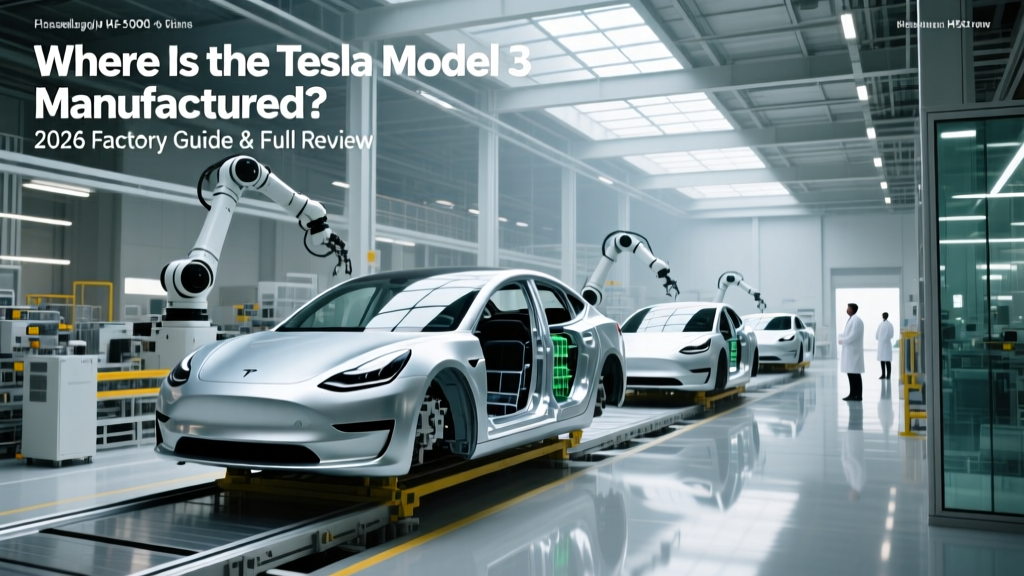
Tesla operates four vehicle gigafactories as of 2026, but not all of them build the Model 3. Here's where your car actually comes from:
| Factory | Location | Models Built | Primary Market | Battery Chemistry |
|---|---|---|---|---|
| Fremont Factory | Fremont, California, USA | Model 3, Model Y, Model S, Model X | North America | NMC (Long Range/Performance), LFP (RWD) |
| Giga Shanghai | Shanghai, China | Model 3, Model Y | Asia-Pacific, Europe, export hubs | LFP (CATL) predominantly |
| Giga Berlin | Grünheide, Germany | Model Y (Model 3 added late 2025) | Europe | NMC / LFP mix |
| Giga Texas | Austin, Texas, USA | Model Y, Cybertruck | North America | N/A for Model 3 |
For US buyers: Virtually every Model 3 sold in the United States is assembled at the Fremont Factory in California. Tesla has not shifted US-market Model 3 production to Giga Texas, which focuses on Model Y and Cybertruck. Some Canadian and Latin American units may also originate from Fremont. Giga Shanghai supplies Europe and Asia; Giga Berlin now supplements European Model 3 supply alongside Model Y.
Why does this matter? Fremont-built Model 3 RWD trims destined for the US market use LFP (lithium iron phosphate) battery cells, largely sourced from CATL in China. Long Range and Performance trims use NMC (nickel manganese cobalt) cells from Panasonic, manufactured at the Tesla-Panasonic joint venture in Nevada. This chemistry split directly affects your ownership experience.
2026 Tesla Model 3: Full Specifications at a Glance
| Spec | Model 3 RWD | Model 3 Long Range AWD | Model 3 Performance |
|---|---|---|---|
| EPA Range | 272 mi | 341 mi | 315 mi |
| Battery (usable) | ~57.5 kWh (LFP) | ~75 kWh (NMC) | ~75 kWh (NMC) |
| Drivetrain | Rear-Wheel Drive | Dual-Motor AWD | Dual-Motor AWD |
| Horsepower | 271 hp | 346 hp | 510 hp |
| 0–60 mph | 5.8 sec | 4.2 sec | 2.9 sec |
| Max DC Fast Charge | 170 kW | 250 kW | 250 kW |
| 10–80% DC Time | ~25 min | ~20 min | ~20 min |
| Level 2 Home Rate | 11.5 kW (~44 mi/hr) | 11.5 kW (~44 mi/hr) | 11.5 kW (~44 mi/hr) |
| MPGe (combined) | 132 MPGe | 130 MPGe | 119 MPGe |
| kWh/100 mi | 25 | 26 | 28 |
| Base MSRP | $38,990 | $47,740 | $54,990 |
Sources: fueleconomy.gov, Tesla Model 3 Design Studio. Specs reflect 2026 model year.
Real-World Range: What the EPA Sticker Doesn't Tell You
EPA (Long Range AWD): 341 miles
Highway (70–75 mph, mild weather): ~285–305 miles
Cold weather (below 32°F, mixed driving): ~230–270 miles
City/regenerative-heavy: ~330–350 miles (can exceed EPA)
The Tesla Model 3 Long Range's 341-mile EPA figure is among the best in its class, but real-world results depend heavily on driving style and conditions. In highway testing at sustained 75 mph in moderate temperatures, expect roughly 285–305 miles before needing to charge. The Model 3's exceptional aerodynamic efficiency (0.219 Cd drag coefficient) helps on the highway, but all EVs lose range at high speeds due to the cubic relationship between speed and air resistance.
Cold weather is the great equalizer. Lithium-ion batteries lose efficiency in freezing temperatures, and cabin heating draws significant power. The Model 3's heat pump (standard on all 2026 trims) mitigates this substantially compared to older resistive-heater EVs, but you should still budget 20–30% range loss in sub-freezing conditions. The RWD trim with its smaller LFP battery is more affected—you may see as little as 190–210 miles of usable range on a brutal January commute.
City drivers who can leverage regenerative braking often match or exceed EPA estimates. One-pedal driving in stop-and-go traffic recovers energy that would otherwise be lost to friction brakes.
Charging Speed: DC Fast Charge, Home Level 2, and the Curve
| Charging Level | Power / Rate | Miles Added per Hour | Notes |
|---|---|---|---|
| Level 1 (120V) | ~1.4 kW | ~3–5 mi/hr | Emergency/trickle only |
| Level 2 (240V, 48A) | 11.5 kW | ~44 mi/hr | Full overnight charge in 6–8 hrs |
| DC Fast (RWD) | Peak 170 kW | ~650 mi/hr (peak) | 10–80% in ~25 min |
| DC Fast (LR/Perf) | Peak 250 kW | ~950 mi/hr (peak) | 10–80% in ~20 min |
A critical distinction for buyers: the Model 3 RWD peaks at 170 kW on DC fast chargers, while the Long Range and Performance trims peak at 250 kW. On a Tesla V3 Supercharger (or any 250+ kW CCS/NACS station), the Long Range can add up to 175 miles in 15 minutes under ideal conditions.
However, peak kW is not sustained kW. The charging curve tapers significantly above 80% state of charge (SoC) to protect battery longevity. A 10–80% session takes about 20 minutes on Long Range/Performance, but going from 80–100% can add another 20+ minutes. For road trips, the practical strategy is to charge to 80% and keep moving.
LFP battery note (RWD trim): Tesla recommends charging LFP batteries to 100% at least once per week for accurate SoH calibration. LFP cells tolerate full charges better than NMC, so this isn't harmful—it's actually required for accurate range estimation.
For home charging, a Level 2 wall connector on a 60-amp circuit (48A continuous) delivers 11.5 kW, adding roughly 44 miles of range per hour. A full charge from near-empty takes 6–8 hours depending on trim. Installation costs vary: expect $500–$1,500 if your electrical panel has capacity, or $2,000–$4,500 if a panel upgrade to 200A is needed. Always consult a licensed electrician for final specs.
Pricing, Trims, and Federal Tax Credit Eligibility
| Trim | Base MSRP | Est. After §30D Credit | Tax Credit Eligibility |
|---|---|---|---|
| Model 3 RWD | $38,990 | ~$31,490 | Up to $7,500 (subject to sourcing) |
| Model 3 Long Range AWD | $47,740 | ~$40,240 | Up to $7,500 (subject to sourcing) |
| Model 3 Performance | $54,990 | ~$47,490 | Up to $7,500 (subject to sourcing) |
All 2026 Model 3 trims fall under the IRS §30D MSRP cap of $55,000 for sedans. However, the actual credit amount depends on two factors:
- Battery sourcing requirements: The $7,500 credit splits into two halves—$3,750 for critical minerals and $3,750 for battery components, each with escalating domestic-content thresholds. Tesla's US-built Long Range and Performance models (Panasonic Nevada cells) have historically qualified for the full $7,500. The RWD trim, which uses CATL-sourced LFP cells, has seen its credit fluctuate between $3,750 and $7,500 depending on the prevailing sourcing rules. Check the latest IRS clean vehicle credit page before purchasing.
- Buyer income caps: Modified adjusted gross income (MAGI) must not exceed $150,000 (single), $225,000 (head of household), or $300,000 (joint). If you exceed these, you are ineligible regardless of the vehicle.
As of 2026, the §30D credit can be transferred to the dealer at point of sale, reducing your purchase price directly rather than waiting for a tax refund. Confirm eligibility with your tax professional—rules change annually.
Interior, Cargo, Tech, and Driver Assistance
The refreshed Model 3 (introduced for 2024 and carried forward to 2026) brought meaningful interior upgrades: ventilated front seats, ambient lighting, rear-seat touchscreen, improved sound insulation, and a new "Highland" design language with a cleaner dashboard.
Dimensions:
- Cargo volume: 23 cu ft (trunk + frunk combined)
- Rear legroom: 35.3 inches
- Front headroom: 40.3 inches
- Seating: 5 passengers
Cargo space is adequate for a compact sedan but trails hatchback competitors like the Hyundai Ioniq 5 (27 cu ft behind rear seats alone). The frunk adds useful space for charging cables and small bags.
Tech highlights:
- 15.4-inch center touchscreen with Tesla OS (no Apple CarPlay/Android Auto)
- 8-camera Tesla Vision suite (no radar or ultrasonic sensors)
- Autopilot standard (lane centering, adaptive cruise, traffic-aware features)
- Full Self-Driving (Supervised) available as $8,000 option or $99/month subscription
- Over-the-air updates continuously add features
Tesla Autopilot and FSD (Supervised) are SAE Level 2 driver-assistance systems. The driver must remain fully engaged, hands on or near the wheel, and eyes on the road at all times. These are not self-driving systems. Level 4 driverless operation (no human needed) currently exists only in geo-fenced robotaxi services like Waymo in select cities.
Notable drawbacks: The absence of Apple CarPlay and Android Auto remains a dealbreaker for some buyers. The minimalist interior means nearly all controls—glovebox, mirror adjustment, vent direction—are buried in the touchscreen. The turn-signal stalk was removed in the 2024 refresh, replaced by steering-wheel-mounted buttons that some drivers find unintuitive. No rear wiper on the sedan is a persistent complaint in rain.
Pros and Cons: The Honest Assessment
- Class-leading efficiency (25–28 kWh/100 mi)
- Extensive Supercharger network access (17,000+ US stalls)
- Strong real-world range on Long Range trim (341 mi EPA)
- Excellent over-the-air update cadence
- Heat pump standard (cold-weather advantage)
- Competitive pricing after tax credit
- Low cost of ownership (no oil changes, minimal brake wear)
- No Apple CarPlay / Android Auto
- RWD fast-charge rate limited to 170 kW
- Turn-signal buttons on wheel take adjustment
- FSD (Supervised) remains Level 2 despite the name
- Limited rear visibility; no rear wiper
- Ride firmness on 19-inch sport wheels
- Tax credit on RWD trim can vary by sourcing rules
Tesla Model 3 vs. Key Competitors
| Attribute | Tesla Model 3 LR | Hyundai Ioniq 6 SE LR | BMW i4 eDrive40 |
|---|---|---|---|
| EPA Range | 341 mi | 361 mi | 301 mi |
| Max DC Charge | 250 kW | 233 kW (800V) | 200 kW |
| 10–80% Time | ~20 min | ~18 min | ~31 min |
| 0–60 mph | 4.2 sec | 6.0 sec | 5.5 sec |
| Starting MSRP | $47,740 | $42,600 | $57,900 |
| Apple CarPlay | No | Yes (wireless) | Yes (wireless) |
| NACS Native | Yes | Adapter needed (2026: CCS) | CCS (adapter avail.) |
The Hyundai Ioniq 6 beats the Model 3 on EPA range (361 mi) and charges slightly faster thanks to its 800-volt architecture, but it lacks native NACS access to Tesla Superchargers—a significant real-world advantage for road trippers. The BMW i4 offers a more premium interior and traditional controls but at a substantially higher price point and with slower DC charging.
- Choose the Model 3 if: You want Supercharger network access, strong software/OTA updates, proven efficiency, and don't mind a screen-centric interior.
- Choose the Ioniq 6 if: You prioritize max EPA range, faster 800V charging, wireless CarPlay, and a more traditional cockpit.
- Choose the BMW i4 if: You want a luxury badge, premium materials, and a driving-oriented chassis—and are willing to pay a premium.
Warranty and Long-Term Ownership
Tesla's warranty coverage is competitive but not class-leading:
- Basic vehicle: 4 years / 50,000 miles
- Battery & drive unit (RWD): 8 years / 100,000 miles
- Battery & drive unit (Long Range/Performance): 8 years / 120,000 miles
- Capacity retention threshold: 70% over the warranty period
Tesla guarantees the battery will retain at least 70% of its original capacity during the warranty window. Real-world degradation data from Tesla's fleet suggests most Model 3 batteries retain roughly 88–92% capacity after 100,000 miles, well above the threshold. LFP batteries in the RWD trim tend to degrade even more slowly, though they start with less total capacity.
Insurance costs are a real ownership factor: the Model 3 averages $2,100–$2,800/year depending on state and driver profile, which is above the compact-sedan average. Always get a quote before purchasing.
Frequently Asked Questions
Where is the Tesla Model 3 manufactured for US buyers?
US-market Tesla Model 3 vehicles are assembled at the Fremont Factory in Fremont, California. Giga Texas does not currently produce the Model 3—it focuses on Model Y and Cybertruck. European-market Model 3s come from Giga Berlin (Germany) and Giga Shanghai (China).
Does the Tesla Model 3 qualify for the $7,500 federal tax credit?
All 2026 Model 3 trims are under the $55,000 MSRP cap for sedans. The Long Range and Performance trims (Panasonic NMC cells, US-built) have consistently qualified for the full $7,500. The RWD trim's credit depends on current battery-sourcing rules and may be $3,750 or $7,500. Buyer income caps apply ($150K single / $300K joint). Always verify at irs.gov before purchasing.
What is the real-world range of the Tesla Model 3?
The Long Range AWD is EPA-rated at 341 miles. In real-world highway driving at 75 mph, expect ~285–305 miles. In cold weather below freezing, budget 20–30% less (~230–270 miles). City driving with regenerative braking can match or exceed the EPA figure.
How fast does the Model 3 charge at home?
On a Level 2 home charger (240V, 48A / 11.5 kW), the Model 3 adds approximately 44 miles of range per hour. A full charge from near-empty takes 6–8 hours. Installation costs $500–$4,500 depending on whether your electrical panel needs upgrading.
Is the Tesla Model 3 self-driving?
No. Tesla Autopilot and FSD (Supervised) are SAE Level 2 driver-assistance systems. The driver must remain fully attentive and in control at all times. True self-driving (Level 4) is not available in any consumer vehicle as of 2026.
Should I buy the RWD or Long Range Model 3?
If you need maximum range, frequent road-trip, or live in a cold climate, the Long Range AWD ($47,740) is worth the premium—you get 69 more EPA miles, dual-motor traction, and 250 kW DC fast charging. If you commute short distances, have reliable home charging, and want the lowest price, the RWD ($38,990) is an excellent value, especially after the tax credit.