BYD's Canadian Arrival: Separating Hype From Reality
The question circulating in Canadian EV forums and dealerships alike is straightforward: Is BYD coming to Canada? As of early 2026, BYD (Build Your Dreams) has not officially launched retail vehicle sales in Canada. However, the Chinese automaker — the world's largest plug-in EV manufacturer by volume — has been expanding aggressively into Europe, Australia, Southeast Asia, and Latin America. Industry reporting and Canadian dealership inquiries suggest that a North American entry remains under evaluation, with Canada viewed as a plausible first foothold due to its federal EV incentive structure and relatively open import framework compared to the United States.
This profile examines the BYD models most likely to arrive in Canada, based on global export lineups and regulatory filings, and provides the best available data on range, charging, pricing, and ownership economics. Where figures are preliminary or based on international-spec vehicles, we flag them clearly. If and when BYD confirms a Canadian launch, expect specs to shift to meet Transport Canada and CMVSS (Canadian Motor Vehicle Safety Standards) requirements.
The Likely Canadian BYD Lineup: Seal, Atto 3, and Dolphin
Based on BYD's export strategy and the models already certified for right- and left-hand-drive markets, three vehicles are most frequently cited as candidates for a Canadian launch:
- BYD Seal — A mid-size electric sedan competing with the Tesla Model 3 and Hyundai Ioniq 6
- BYD Atto 3 (Yuan Plus) — A compact electric crossover targeting the Hyundai Kona Electric and Kia Niro EV segment
- BYD Dolphin — A subcompact hatchback positioned as an affordable urban EV
Below, we break down each model with the most current global-spec data available.
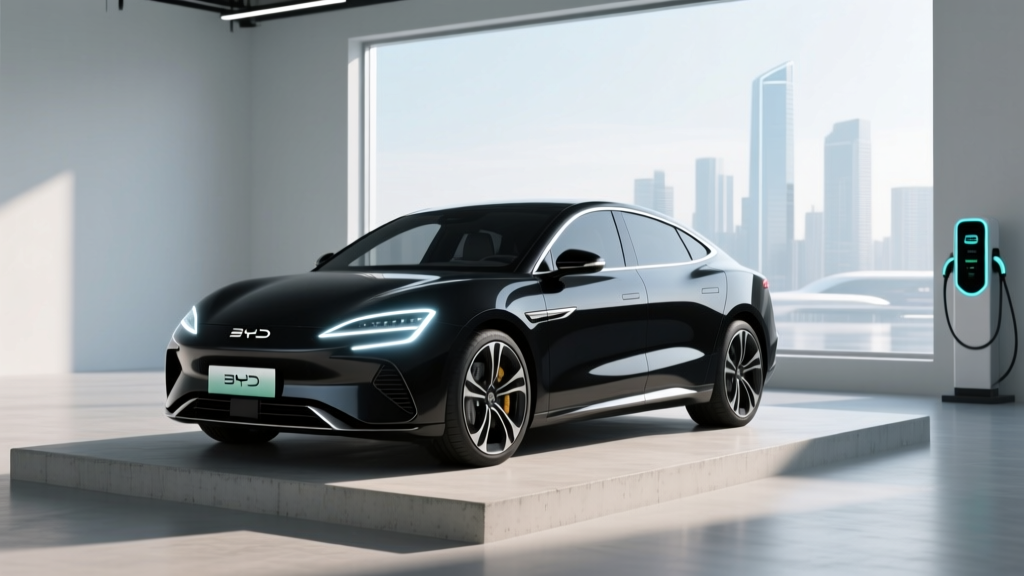
BYD Seal: The Tesla Model 3 Challenger
| Spec | Value |
|---|---|
| Battery | 82.5 kWh usable, LFP (Blade Battery) |
| EPA Range (est.) | ~310 mi (WLTP: 570 km / 354 mi) |
| Drivetrain | RWD single motor / AWD dual motor |
| Horsepower | 201 hp (RWD) / 523 hp (AWD) |
| 0-60 mph | 7.5s (RWD) / 3.8s (AWD) |
| Max DC Fast Charge | 150 kW peak |
| 10-80% DC Time | ~26 min |
| Level 2 Home Charge | 11 kW AC (~36 mi/hr) |
| Efficiency (est.) | ~115 MPGe / 29 kWh/100 mi |
| Cargo Volume | 14.1 cu ft trunk + front trunk |
| Global Price | ~€45,000 (Europe) / ~C$50,000 est. |
The BYD Seal's standout feature is the Blade Battery — BYD's proprietary cell-to-pack LFP (lithium iron phosphate) design. LFP offers superior thermal stability and longer cycle life compared to NMC (nickel manganese cobalt), making it well-suited to daily charging to 100% without the degradation concerns that NMC owners manage by limiting to 80%. The trade-off is lower energy density, which is why the Seal's 82.5 kWh pack is heavier than a comparable NMC pack, slightly reducing efficiency.
Charging Speed: Adequate, Not Class-Leading
The Seal's 150 kW peak DC fast-charge rate is competitive but not exceptional in 2026. For comparison, the Hyundai Ioniq 6 peaks at 240 kW and the Tesla Model 3 Highland at 250 kW. On a 350 kW Electrify America or Petro-Canada charger, the Seal will charge from 10-80% in approximately 26 minutes. The charge curve is relatively flat through 60% SoC, then tapers significantly past 80% — typical of LFP packs, which have a very flat voltage curve that makes precise SoC estimation harder for the BMS (battery management system).
| Level | Power | Speed |
|---|---|---|
| Level 1 (120V) | ~1.4 kW | ~5 mi/hr |
| Level 2 (240V, 48A) | 11 kW | ~36 mi/hr |
| DC Fast Charge | 150 kW peak | 10-80% in ~26 min |
BYD Atto 3 (Yuan Plus): The Compact Crossover Play
| Spec | Value |
|---|---|
| Battery | 60.5 kWh usable, LFP (Blade Battery) |
| EPA Range (est.) | ~230 mi (WLTP: 420 km / 261 mi) |
| Drivetrain | FWD single motor |
| Horsepower | 201 hp |
| 0-60 mph | 7.3s |
| Max DC Fast Charge | 88 kW peak |
| 10-80% DC Time | ~29 min |
| Level 2 Home Charge | 7 kW AC (~23 mi/hr) |
| Efficiency (est.) | ~110 MPGe / 30 kWh/100 mi |
| Cargo Volume | 15.7 cu ft (rear seats up) / 47.0 cu ft (folded) |
| Global Price | ~€38,000 (Europe) / ~C$42,000 est. |
The Atto 3 is BYD's global-volume hero — it has been a top-selling EV in markets from Thailand to Israel to Australia. For Canadian buyers, it would slot into the hottest EV crossover segment, directly challenging the Hyundai Kona Electric (EPA 261 mi, ~C$44,000), Kia Niro EV (EPA 239 mi, ~C$45,000), and the base Tesla Model Y RWD.
The Atto 3's 88 kW peak DC charge rate is its most notable limitation. On a road trip from Toronto to Montreal (540 km / 335 mi), you'd need at least one charging stop, and that stop would take roughly 30 minutes for a 10-80% top-up. That's 8-10 minutes slower than competitors with 150+ kW architectures. For city and suburban commuters who charge at home, this matters far less.
BYD Dolphin: The Affordable Urban EV
| Spec | Value |
|---|---|
| Battery | 60.4 kWh usable, LFP (Blade Battery) |
| EPA Range (est.) | ~240 mi (WLTP: 427 km / 265 mi) |
| Drivetrain | FWD single motor |
| Horsepower | 201 hp |
| 0-60 mph | 7.0s |
| Max DC Fast Charge | 88 kW peak |
| 10-80% DC Time | ~29 min |
| Level 2 Home Charge | 7 kW AC (~23 mi/hr) |
| Efficiency (est.) | ~118 MPGe / 28 kWh/100 mi |
| Cargo Volume | 12.2 cu ft (rear seats up) / 36.5 cu ft (folded) |
| Global Price | ~€33,000 (Europe) / ~C$36,000 est. |
The Dolphin's significance for the Canadian market is price. At an estimated C$36,000 before incentives, it would undercut most EVs on sale in Canada and compete with the base Nissan Leaf (discontinued after 2025) and lower trims of the Chevy Equinox EV. For urban commuters in Vancouver, Montreal, or Toronto who need 200+ miles of range and can charge at home, the Dolphin could be a compelling second car or first EV.
Canadian Pricing and Incentive Landscape
Canada's federal iZEV (Incentives for Zero-Emission Vehicles) program offers a C$5,000 rebate on eligible battery-electric vehicles with a base MSRP under C$55,000 (for cars) and C$60,000 (for SUVs/pickups). Several provinces stack additional incentives:
- British Columbia: Up to C$4,000 (income-tested CEV rebate)
- Quebec: Up to C$7,000 (Roulez vert program, decreasing annually)
- Nova Scotia: C$3,000 (Universal EV rebate)
- Prince Edward Island: C$5,000 + free Level 2 charger
| Model | Est. MSRP (CAD) | Federal iZEV | BC + Fed | QC + Fed |
|---|---|---|---|---|
| BYD Dolphin | ~C$36,000 | C$31,000 | ~C$27,000 | ~C$24,000 |
| BYD Atto 3 | ~C$42,000 | C$37,000 | ~C$33,000 | ~C$30,000 |
| BYD Seal (RWD) | ~C$50,000 | C$45,000 | ~C$41,000 | ~C$38,000 |
| BYD Seal (AWD) | ~C$58,000 | Not eligible* | Not eligible* | Not eligible* |
*The Seal AWD may exceed the iZEV MSRP cap depending on final Canadian pricing. Transport Canada confirms eligibility only after the model is officially registered for sale.
US federal tax credit note: For American readers cross-shopping, BYD vehicles are not eligible for the IRS §30D clean vehicle credit ($7,500). The credit requires final assembly in North America, and BYD has no US or Canadian manufacturing facility. This is a significant competitive disadvantage versus vehicles like the Tesla Model 3 (assembled in California) or the Hyundai Ioniq 5 (assembled in Georgia).
What BYD Gets Right — and Where It Falls Short
Pros
- LFP Blade Battery — excellent thermal safety, long cycle life, can charge to 100% daily
- Aggressive pricing — potentially C$5,000-C$10,000 below comparable Tesla, Hyundai, Kia models
- Strong standard equipment — panoramic roof, heat pump, V2L (vehicle-to-load) included on most trims
- Competitive range — Seal's ~310 mi EPA est. matches the segment
- 8-year/160,000 km battery warranty (global standard; Canadian terms TBD)
Cons
- No confirmed Canadian dealer network or service infrastructure
- DC fast-charge speeds (88-150 kW) lag behind Hyundai's 800V / 240+ kW architecture
- Unknown crash-test performance — no IIHS or NHTSA ratings for current global models
- Software and infotainment may lack Apple CarPlay/Android Auto in some markets
- No North American parts supply chain — collision repair wait times could be long
- Resale value is entirely unproven in Canada
Who Should Consider BYD — and Who Should Wait
The Verdict
Consider BYD if: You're a price-sensitive urban or suburban buyer who primarily charges at home, values LFP battery longevity, and doesn't need a proven dealer network or top-tier DC charging speed. The Dolphin and Atto 3 could be excellent value plays, especially stacked with provincial rebates in BC and Quebec.
Wait or choose a competitor if: You take frequent road trips (the 88 kW charge rate on Atto 3 and Dolphin adds time), need IIHS Top Safety Pick validation, want guaranteed service access within 50 km, or plan to rely on the US §30D tax credit. The Hyundai Kona Electric, Tesla Model 3, and Chevy Equinox EV all offer established Canadian infrastructure today.
Warranty and Long-Term Ownership
BYD's global warranty standard is 8 years / 160,000 km (100,000 mi) on the battery pack and 6 years / 150,000 km on the vehicle. This is broadly competitive with Hyundai's 8-year/160,000 km battery warranty and Tesla's 8-year/120,000 mi (for Model 3 RWD). However, warranty coverage is only as good as the service network backing it. Until BYD establishes Canadian service centers and parts distribution, this remains a theoretical advantage rather than a practical one.
The LFP Blade Battery does offer a genuine longevity edge. Independent testing and BYD's own data suggest LFP cells retain 80%+ capacity after 3,000 full charge cycles — roughly double the cycle life of typical NMC cells. For a driver covering 20,000 km/year, that translates to well over 15 years of use before hitting the 80% degradation threshold.
BYD Coming to Canada: Frequently Asked Questions
Has BYD officially confirmed it's coming to Canada?
As of Q1 2026, BYD has not made an official announcement about Canadian retail sales. The company has registered trademarks in Canada and has been hiring for North American roles, but no launch date, dealer network, or Transport Canada vehicle certifications have been confirmed.
Will BYD vehicles qualify for Canada's federal iZEV rebate?
Likely yes, for models under the MSRP cap (C$55,000 for cars, C$60,000 for SUVs). The iZEV program does not restrict vehicles by country of origin, only by MSRP and battery size (minimum 15 kWh for full C$5,000). The Dolphin and Atto 3 would almost certainly qualify; the Seal AWD may exceed the cap.
What charging connector would BYD use in Canada?
BYD's European and Australian models use CCS2 (the European standard). For North America, they would need to adopt either CCS1 or the increasingly dominant NACS (J3400) connector. Tesla's Supercharger network — now open to NACS-equipped non-Tesla EVs — would be a significant charging advantage if BYD adopts the North American standard.
How does BYD's Blade Battery compare to competitors?
The Blade Battery is an LFP (lithium iron phosphate) cell-to-pack design that eliminates modules, improving volumetric efficiency. Its key advantage is thermal stability — BYD's nail penetration test shows no thermal runaway, a claim most NMC packs cannot match. The trade-off is ~15-20% lower energy density than NMC, meaning more weight for the same kWh capacity.
Is it worth waiting for BYD or should I buy now?
If you need a vehicle in 2026, buying an established competitor is the pragmatic choice. BYD's Canadian timeline is uncertain, and early imports may face teething issues with service, parts availability, and software localization. However, if you're 12-18 months out from a purchase and live in a province with strong rebates (BC, Quebec), BYD's pricing could make it worth monitoring.
Does BYD offer any autonomous driving features?
BYD's global models include Level 2 ADAS (adaptive cruise control, lane-keeping assist, automatic emergency braking) under the "DiPilot" branding. This is comparable to Toyota Safety Sense or Honda Sensing — a driver-assist system that requires constant driver supervision. BYD does not currently offer anything comparable to Tesla's FSD or GM's Super Cruise hands-free driving.
Sources: BYD Global, Transport Canada iZEV Program, IRS §30D Clean Vehicle Credit. All specifications are based on global-market models and are subject to change for Canadian certification. This article will be updated upon any official BYD Canada announcement.