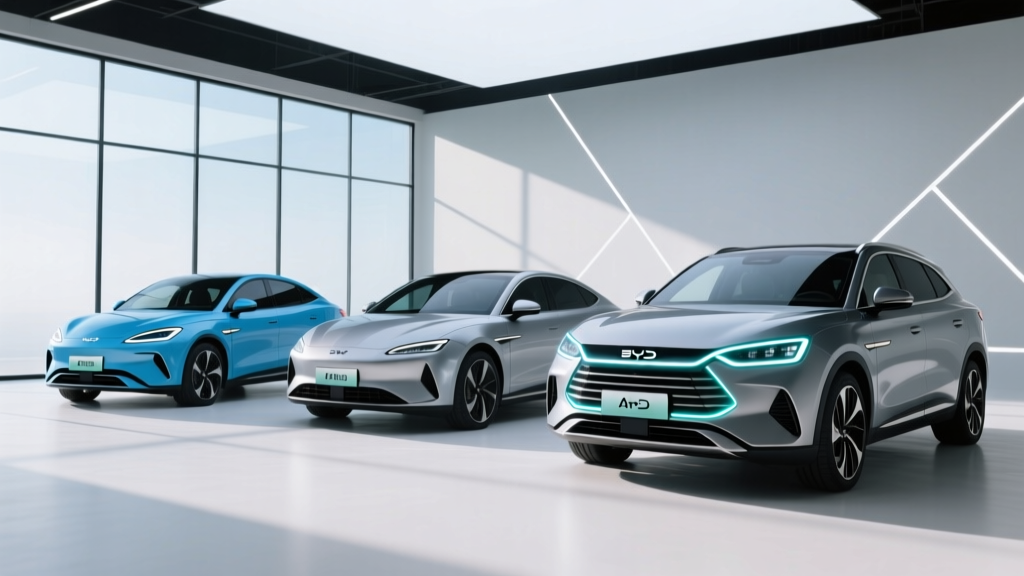
If you have been following electric-vehicle headlines, you already know BYD has overtaken Tesla as the world's largest EV manufacturer by volume. The Chinese automaker sells everything from a $10,000 city car to a $100,000 luxury sedan. But for US-based shoppers searching how much is BYD cars, the answer requires separating global sticker prices from what you can actually buy and drive on American roads.
This guide breaks down BYD's current 2026 lineup pricing across major markets, explains why most BYD models remain unavailable in the United States, and maps out the few legal pathways to own one — including federal tax-credit implications under IRS §30D.
Why BYD Pricing Matters to US EV Buyers
BYD's global pricing sets a benchmark that pressures every EV sold in North America. When the BYD Seagull launches in China at under $10,000 USD equivalent, it forces legacy automakers to defend their $30,000+ entry points. Understanding BYD's real-world pricing helps US buyers contextualize whether domestic EVs are overpriced — or whether tariff walls and regulatory compliance legitimately add cost.
BYD vertically integrates its supply chain to a degree unmatched by competitors. The company manufactures its own Blade Battery cells (lithium iron phosphate, or LFP), electric motors, semiconductors, and even owns shipping vessels. This integration is the primary reason BYD undercuts rivals by 20–40% on equivalent specs.
2026 BYD Model Lineup: Global Pricing and Specs
Below is a comprehensive breakdown of BYD's core global lineup as of early 2026. Prices reflect manufacturer-suggested retail pricing in each model's primary market, converted to USD at prevailing exchange rates. US-equivalent pricing is estimated and does not include import duties, tariffs, or homologation costs.
| Model | Segment | Battery (kWh) | Chemistry | CLTC/WLTP Range | 0-60 mph | HP | China MSRP (USD equiv.) | Europe MSRP (USD equiv.) |
|---|---|---|---|---|---|---|---|---|
| Seagull (Dolphin Mini) | City hatchback | 30.08 / 38.88 | LFP Blade | 190 / 248 mi (CLTC) | ~11.0 sec | 75 | $9,700–$12,500 | N/A (not yet in EU) |
| Dolphin | Compact hatchback | 44.9 / 60.48 | LFP Blade | 211 / 264 mi (WLTP) | ~7.0 sec (Performance) | 95 / 201 | $14,500–$19,000 | $29,900–$35,500 |
| Atto 3 (Yuan Plus) | Compact SUV | 49.92 / 60.48 | LFP Blade | 211 / 261 mi (WLTP) | 7.3 sec | 201 | $16,800–$20,500 | $32,500–$38,000 |
| Seal | Midsize sedan | 61.4 / 82.5 | LFP Blade | 276 / 323 mi (WLTP) | 3.8 sec (AWD Perf.) | 307 / 523 | $22,000–$30,000 | $41,000–$51,000 |
| Seal U (Song Plus EV) | Midsize SUV | 71.8 / 87.0 | LFP Blade | 273 / 311 mi (WLTP) | ~7.9 sec | 215 / 318 | $20,000–$26,000 | $39,500–$46,000 |
| Han EV | Full-size sedan | 85.4 | LFP Blade | 311 mi (WLTP) | 3.9 sec (AWD) | 510 | $28,000–$36,000 | $55,000–$65,000 |
| Tang EV | Midsize SUV (3-row) | 108.8 | LFP Blade | 280 mi (WLTP) | 4.6 sec | 510 | $32,000–$40,000 | $60,000–$72,000 |
Key pricing observation: The gap between China domestic pricing and European export pricing is enormous — often 100–200%. This markup reflects shipping, EU homologation, dealer networks, VAT (19–25% depending on country), and the EU's countervailing tariffs on Chinese EVs enacted in late 2024 (ranging from 17% to 35.3% on BYD specifically).
US Availability: Can You Actually Buy a BYD in America?
The short answer for most US buyers: no, you cannot currently purchase a new BYD passenger vehicle through authorized US dealerships. BYD does not sell cars in the United States, and several structural barriers explain why.
The Tariff Wall
Chinese-built EVs face a combined tariff burden of 100% when imported into the United States as of 2025 (raised from 25% under updated Section 301 trade provisions). This effectively doubles the landed cost of any BYD model, eliminating the company's core price advantage. A $12,000 Seagull becomes a $24,000+ vehicle before shipping, compliance modifications, and dealer margin — at which point it competes directly with the Chevrolet Equinox EV and Nissan Leaf on US soil.
Regulatory Homologation
BYD vehicles sold in China are certified under CCC (China Compulsory Certification) standards. Selling in the US requires full FMVSS (Federal Motor Vehicle Safety Standards) compliance, including different crash-test protocols, lighting standards, bumper regulations, and cybersecurity requirements. BYD would need to engineer US-specific variants — a multi-year, multi-billion-dollar investment that the current tariff environment makes economically irrational.
The Gray-Market Import Pathway
Under the NHTSA's 25-year import rule, you cannot legally import a BYD for road use until 25 years after manufacture. The Show or Display exemption allows limited mileage on certain vehicles but requires the model to be "of sufficient historical or technological significance" — a threshold no mass-market BYD model currently meets. In practice, there is no viable legal pathway for US consumers to buy and register a current BYD passenger EV.
BYD Blade Battery: The LFP Technology Behind the Price
Every current BYD passenger EV uses the company's proprietary Blade Battery, a cell-to-pack lithium iron phosphate (LFP) design. Understanding this chemistry is essential to evaluating BYD's value proposition.
| Attribute | BYD Blade (LFP) | Typical NMC (e.g., CATL, LG) |
|---|---|---|
| Energy density | ~150 Wh/kg (lower) | ~250 Wh/kg (higher) |
| Cycle life | 3,000+ full cycles | 1,000–2,000 full cycles |
| Thermal stability | Excellent — passes nail penetration test | Good — requires robust thermal management |
| Cold-weather performance | Greater range loss below 32°F (~30–40%) | Better cold retention (~20–30% loss) |
| Cobalt / nickel content | None | Contains cobalt and/or nickel |
| Cost per kWh | ~$70–90 (2026) | ~$100–130 (2026) |
| Recommended charge pattern | Can charge to 100% regularly | Best kept 20–80% for longevity |
The Blade Battery's cell-to-pack architecture eliminates module-level structure, improving volumetric efficiency by ~50% compared to traditional pack layouts. This partially offsets LFP's lower energy density. In practical terms, BYD packs more cells into a given volume, achieving competitive range despite the chemistry's inherent weight disadvantage.
Charging Speed: BYD's Persistent Weakness
If BYD's pricing is its greatest strength, DC fast-charging speed is its most notable limitation. Most BYD models peak at significantly lower charge rates than competitors using 800-volt architectures (Hyundai Ioniq 5, Kia EV6, Porsche Taycan).
| Model | Max DC Fast Charge (kW) | 10–80% Time | Level 2 AC Rate (kW) | Level 2 Miles/Hour (est.) |
|---|---|---|---|---|
| Seagull | 40 kW | ~35 min | 6.6 kW | ~22 mi/hr |
| Dolphin (60.48 kWh) | 88 kW | ~29 min | 11 kW | ~30 mi/hr |
| Atto 3 (60.48 kWh) | 88 kW | ~29 min | 11 kW | ~28 mi/hr |
| Seal (82.5 kWh) | 150 kW | ~26 min | 11 kW | ~27 mi/hr |
| Han EV (85.4 kWh) | 120 kW | ~30 min | 7.2 kW | ~20 mi/hr |
What this means in practice: BYD's 400-volt platform limits peak charge rates. The Seal's 150 kW peak is respectable but falls well short of the Hyundai Ioniq 5's 240 kW peak (10–80% in ~18 minutes). On a road trip, that difference compounds — a 600-mile journey in the Seal requires roughly 15–20 extra minutes of cumulative charging compared to an 800V competitor. For daily home charging on Level 2, the difference is negligible since most owners charge overnight.
Note that BYD's charge curve is relatively flat through 80% SoC, which is a positive. Unlike some competitors that hit peak kW only briefly before tapering hard, BYD sustains a more consistent rate. The 10–80% times above reflect this sustained delivery.
Federal Tax Credit Reality: §30D and BYD
This is where US buyers hoping for a bargain need a reality check. Under IRS §30D clean vehicle credit rules for 2026:
- The vehicle must undergo final assembly in North America (verified via VIN on the DOE's AFDC database)
- MSRP caps apply: $55,000 for sedans; $80,000 for SUVs, vans, and pickups
- Buyer income caps: Modified AGI ≤ $150,000 (single) / $300,000 (joint)
- Battery component and critical mineral sourcing requirements must be met (phased thresholds increase annually through 2029)
- Foreign entity of concern (FEOC) exclusion: Vehicles with battery components or critical minerals sourced from FEOC entities (which includes most Chinese supply chains) are disqualified
BYD vs. US-Available Competitors: Value Comparison
To make BYD's pricing tangible, here is how key models compare to the closest US-available equivalents at 2026 MSRPs:
| BYD Model | BYD Europe Price (USD) | US Competitor | US MSRP | Price Gap |
|---|---|---|---|---|
| Dolphin (60.48 kWh) | ~$35,500 | Chevrolet Equinox EV 2LT (319 mi) | $34,900 | BYD +$600 |
| Atto 3 (60.48 kWh) | ~$38,000 | Hyundai Kona Electric SEL (261 mi) | $34,250 | BYD +$3,750 |
| Seal AWD (82.5 kWh) | ~$51,000 | Tesla Model 3 Long Range AWD (341 mi) | $47,240 | BYD +$3,760 |
| Han EV (85.4 kWh) | ~$65,000 | BMW i5 eDrive40 (295 mi) | $68,100 | BYD −$3,100 |
The takeaway: In export markets with tariffs and VAT, BYD is not dramatically cheaper than established competitors. The Seagull's sub-$10,000 China price is a domestic-market phenomenon driven by aggressive pricing, local supply chains, and the absence of Western regulatory compliance costs. Once you add tariffs, shipping, and homologation, BYD's European pricing converges with Hyundai, Tesla, and Chevrolet.
Who Would Benefit From a BYD — And Who Shouldn't Wait
For US-based EV shoppers, here is the practical decision framework:
Do NOT wait for BYD if:
- You need a vehicle within the next 1–3 years — BYD has announced no US passenger-car launch timeline
- You want to claim the §30D federal tax credit ($7,500) or state incentives
- You rely on DC fast charging for road trips (BYD's 88–150 kW peak lags 800V competitors)
- You want US-spec safety ratings (NHTSA/IIHS) and a domestic service network
BYD's global pricing matters to you if:
- You are tracking EV price trends and want to negotiate aggressively at US dealerships
- You are considering a used import in a jurisdiction that permits it (not the US for road use)
- You are evaluating BYD's commercial vehicles (electric buses and trucks, which do operate in the US)
Frequently Asked Questions
How much is the cheapest BYD car?
The BYD Seagull (also called Dolphin Mini in some markets) starts at approximately $9,700 USD equivalent in China with a 30.08 kWh LFP Blade Battery and 190 miles of CLTC range (~160 miles real-world). This price is not available in the US or Europe.
Is BYD coming to the United States?
BYD has not announced any timeline for US passenger vehicle sales. The 100% tariff on Chinese-built EVs, FEOC battery-sourcing restrictions, and FMVSS homologation requirements make a near-term US launch economically unviable. BYD is exploring a potential Mexico-based manufacturing facility, but vehicles built there would still face US trade restrictions under USMCA rules of origin and anti-circumvention provisions.
Does BYD qualify for the $7,500 federal EV tax credit?
No. Even if BYD sold in the US, the §30D credit's FEOC (Foreign Entity of Concern) battery-sourcing restrictions would disqualify BYD vehicles, as their battery cells and critical minerals are sourced entirely from Chinese supply chains. Always verify credit eligibility on the IRS clean vehicle credit page.
How does BYD's Blade Battery compare to Tesla's LFP?
Both use LFP chemistry, but BYD's Blade form factor uses long, thin prismatic cells arranged directly in the pack (cell-to-pack), while Tesla's LFP packs (sourced from CATL) use traditional cylindrical or prismatic cells in modules. BYD claims superior thermal stability — the Blade passes nail-penetration tests without thermal runaway. Cycle life is comparable at 3,000+ cycles. Energy density slightly favors CATL's cells used by Tesla.
What is BYD's warranty coverage?
In European markets, BYD offers a 6-year/93,000-mile vehicle warranty and an 8-year/124,000-mile battery warranty (retaining ≥70% capacity). These terms are competitive with Hyundai/Kia's 10-year/100,000-mile battery warranty, though BYD's vehicle bumper-to-bumper coverage is shorter. US warranty terms do not exist since BYD does not sell here.
Can I import a BYD to the US under the 25-year rule?
Technically yes, but the 25-year rule means you would need to wait until approximately 2048–2051 to import a current-model BYD. The Show or Display exemption does not apply to mass-market vehicles. There is currently no legal pathway to import and register a new BYD for regular road use in the United States.