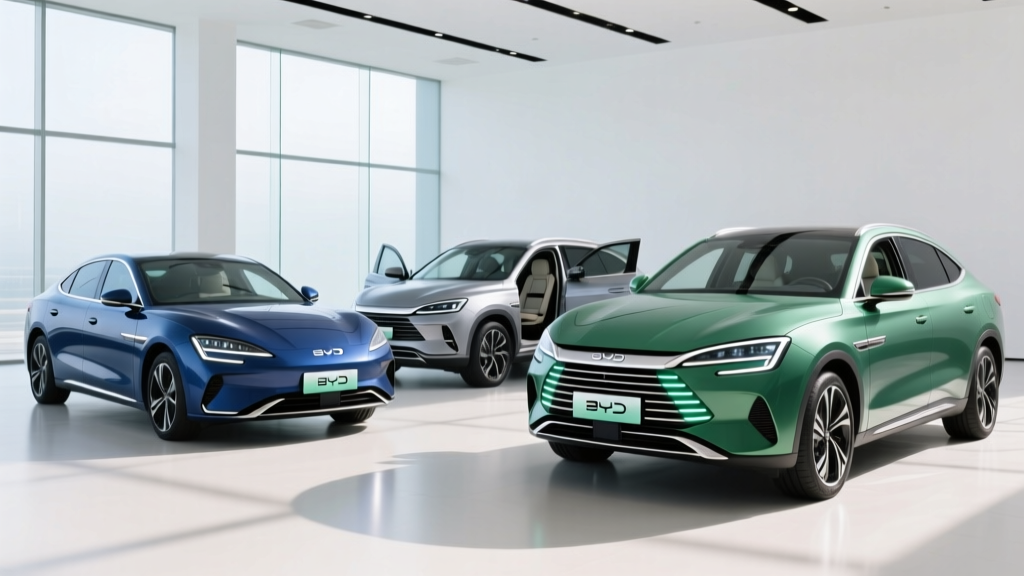
If you've been following the electric vehicle market, you've likely seen BYD's name in headlines. The Chinese automaker surpassed Tesla in global EV sales volume and has expanded aggressively into Europe, Southeast Asia, and Latin America. But for US-based shoppers searching for BYD cars cost and availability, the picture is more complicated — and understanding it requires separating global pricing from what American buyers can actually access.
As of 2026, BYD does not sell passenger vehicles directly to US consumers. High tariffs on Chinese-manufactured EVs (currently 100% under Section 301 trade provisions), combined with the absence of a US dealer network, mean there is no official US MSRP for models like the Seal, Atto 3, or Dolphin. However, BYD's global pricing strategy, its expanding presence in neighboring markets like Mexico and Canada, and its commercial vehicle footprint in the US all make understanding BYD's cost structure essential for any EV buyer tracking where the market is heading.
This guide breaks down what BYD vehicles cost in accessible markets, how they compare to US-available rivals, what federal tax credit rules mean for potential future imports, and whether BYD's technology stack holds up against the competition.
BYD's Current US Status: What You Can and Cannot Buy
Before diving into pricing, it's critical to establish what's actually available to US buyers in 2026:
- Passenger cars (Seal, Dolphin, Atto 3, Han, Tang): Not sold in the US. No dealer network, no EPA certification for current models, no US-spec compliance.
- Commercial vehicles (electric buses, trucks): BYD has a manufacturing presence in Lancaster, California, producing electric transit buses and Class 8 trucks for fleet operators. These are not consumer vehicles.
- Gray market imports: Importing a non-US-spec BYD independently is theoretically possible but faces enormous hurdles — DOT/NHTSA compliance, EPA emissions certification, and the 100% tariff make this impractical and uneconomical.
For context, BYD has hinted at a US passenger vehicle entry for years, but as of early 2026, no timeline has been announced. The company has prioritized markets with lower trade barriers: Europe, Australia, Thailand, Brazil, and Mexico.
Global BYD Pricing: What These Cars Actually Cost
Because BYD doesn't sell in the US, the most useful pricing data comes from markets where the cars are widely available. Here's a snapshot of current 2026 pricing in key markets, converted to USD for comparison:
| Model | Segment | China (USD equiv.) | Europe (USD equiv.) | Australia (USD equiv.) | US Comparable |
|---|---|---|---|---|---|
| BYD Dolphin | Subcompact hatch | ~$14,500 | ~$32,000 | ~$26,500 | Nissan Leaf, Chevy Bolt EV (discontinued) |
| BYD Atto 3 (Yuan Plus) | Compact SUV | ~$17,000 | ~$38,000 | ~$30,500 | Hyundai Kona Electric, Kia Niro EV |
| BYD Seal | Midsize sedan | ~$25,000 | ~$47,000 | ~$37,000 | Tesla Model 3, Hyundai Ioniq 6 |
| BYD Han EV | Full-size sedan | ~$30,000 | ~$55,000 | ~$45,000 | Tesla Model S, BMW i5 |
| BYD Tang EV | Midsize SUV (3-row) | ~$33,000 | ~$58,000 | ~$48,000 | Kia EV9, Tesla Model X |
The pricing gap between China's domestic market and export markets is significant. In China, BYD benefits from local battery supply chains, government subsidies, and intense domestic competition that compresses margins. Export prices include shipping, homologation costs, dealer margins, and local taxes — which is why a Dolphin that costs under $15,000 in Shenzhen costs over $30,000 in Germany.
Even at export-market prices, BYD undercuts many Western competitors. The Seal in Europe (~$47,000 USD) competes directly with the Tesla Model 3, which starts around $42,000 in the US before any credits — suggesting BYD would need to price aggressively to win US market share if tariffs were reduced.
BYD Seal Deep Dive: The Model Most Likely to Compete in the US
If BYD ever enters the US passenger market, the Seal sedan is the most likely candidate. It's the company's most globally recognized model and competes in the high-volume midsize EV sedan segment. Here's what the specs look like based on the current global-spec model:
| Spec | BYD Seal (Design AWD) | Tesla Model 3 Long Range AWD | Hyundai Ioniq 6 SEL AWD |
|---|---|---|---|
| Battery (usable) | 82.5 kWh (LFP Blade) | 75 kWh (NMC) | 77.4 kWh (NMC) |
| WLTP Range | ~323 mi (520 km) | ~390 mi (629 km) | ~320 mi (519 km) |
| EPA Range (est. if certified) | ~270-290 mi (projected) | 341 mi | 270 mi |
| Horsepower | 523 hp | 346 hp | 320 hp |
| 0-60 mph | 3.8 sec | 4.2 sec | 5.1 sec |
| Max DC Charge Rate | 150 kW | 250 kW | 240 kW |
| 10-80% DC Time | ~26 min | ~25 min | ~18 min |
| Drivetrain | AWD (dual motor) | AWD (dual motor) | AWD (dual motor) |
| Starting Price (primary market) | ~$47,000 (EU) | $47,740 (US MSRP) | $46,700 (US MSRP) |
Charging Performance: Adequate but Not Class-Leading
The Seal's 150 kW peak DC fast-charging rate is its most notable competitive weakness. While rivals like the Ioniq 6 (240 kW) and Model 3 (250 kW) can add range significantly faster, the Seal's larger battery partially compensates:
| Charging Method | BYD Seal | Notes |
|---|---|---|
| Level 1 (120V, 12A) | ~1.4 kW / ~4 mi/hr | Emergency/top-up only; full charge in 60+ hours |
| Level 2 (240V, 32A) | ~7 kW / ~22 mi/hr | Home overnight charge: ~12 hours from 10-100% |
| Level 2 (240V, 48A) | ~11 kW / ~35 mi/hr | Requires upgraded home charger; ~8 hours 10-100% |
| DC Fast (peak 150 kW) | 10-80% in ~26 min | Charge curve tapers significantly above 80% SoC |
The 150 kW peak rate means you'll add roughly 130 miles of range in 15 minutes at a compatible DC fast charger — adequate for road trips with planned stops, but noticeably slower than the 200+ mile additions you'd get from an Ioniq 6 or Model 3 in the same timeframe. For daily home charging, the 7-11 kW Level 2 rate is perfectly sufficient; most owners will wake up to a full battery every morning.
Battery Technology: The Blade Advantage
BYD's signature technology is its LFP (lithium iron phosphate) Blade Battery. Unlike the NMC (nickel manganese cobalt) chemistry used by most Western automakers, LFP offers distinct trade-offs:
| Factor | BYD LFP Blade | Typical NMC (Tesla, Hyundai, VW) |
|---|---|---|
| Energy Density | Lower (~150 Wh/kg cell) | Higher (~250 Wh/kg cell) |
| Cycle Life | 3,000+ cycles to 80% SoH | 1,500-2,000 cycles to 80% SoH |
| Thermal Stability | Excellent (nail penetration test safe) | Good (requires robust BMS) |
| Cold-Weather Performance | Greater range loss (~20-25%) | Moderate range loss (~15-20%) |
| Recommended Daily Charge | 100% (no degradation penalty) | 80% for daily (100% for trips) |
| Cost | Lower (no cobalt/nickel) | Higher (critical mineral cost) |
The practical upshot: BYD owners can charge to 100% daily without the long-term degradation concerns that NMC owners manage by capping at 80%. The Blade battery's structural design — long, thin cells arranged like blades in a pack — also doubles as a structural component, improving crash rigidity. The trade-off is heavier weight and lower energy density, which contributes to the Seal's lower EPA-projected range compared to the Model 3.
Federal Tax Credit: Would BYD Vehicles Qualify?
This is where BYD's US ambitions hit a regulatory wall. Even if tariffs were eliminated tomorrow, BYD's current vehicles would almost certainly not qualify for the federal §30D EV tax credit. Here's why:
- Final assembly in North America: BYD vehicles are manufactured in China, Thailand, Brazil, and other non-NA locations. This alone disqualifies them.
- MSRP caps: Sedans must be under $55,000; SUVs/pickups under $80,000. BYD's export pricing for the Seal ($47,000 EU) would likely clear this threshold if US pricing were similar.
- Buyer income caps: AGI under $150,000 (single) / $300,000 (joint). This applies to all EVs regardless of manufacturer.
- Battery component sourcing: Increasing percentages of battery components must be manufactured or assembled in North America, with escalating thresholds through 2029. BYD's vertically integrated Chinese supply chain would fail this requirement.
- Critical minerals: Required percentages of critical minerals must be sourced from the US or FTA partners. BYD sources minerals primarily from Chinese-controlled supply chains.
- FEOC restriction: Vehicles with battery components from a "foreign entity of concern" (which includes Chinese companies) are explicitly excluded from the credit starting in 2024 for components and 2025 for critical minerals.
Source: IRS §30D Clean Vehicle Credit guidelines. Consult a tax professional for personal eligibility.
The FEOC (Foreign Entity of Concern) restriction is the most definitive barrier. Even if BYD built a US assembly plant — which the company has not announced — the Chinese origin of its battery cells and critical minerals would likely disqualify its vehicles from the $7,500 credit. This is a structural disadvantage compared to vehicles assembled in Tennessee, Texas, or Georgia with US/FTA-sourced batteries.
How BYD Compares to US-Available EVs
Since you can't buy a BYD in the US today, the practical question is: how do BYD's specs and pricing compare to what you can buy? Here's how the Seal stacks up against its most direct US-market competitors in the midsize EV sedan segment:
- LFP Blade battery longevity (3,000+ cycles)
- 100% daily charging without degradation worry
- 523 hp AWD performance at a competitive price
- Structural battery pack improves crash safety
- Rotating center touchscreen (signature BYD feature)
- 150 kW max DC charge rate (competitors: 240-250 kW)
- No US dealer network, service infrastructure, or parts supply
- Projected ~270-290 mi EPA range vs Model 3's 341 mi
- No federal tax credit eligibility
- Unknown long-term US resale value
- No NACS connector (would need CCS or adapter)
For US buyers today, the Tesla Model 3 Long Range offers more range (341 mi EPA), faster charging (250 kW), Supercharger network access, and potential tax credit eligibility — all with established US service infrastructure. The Hyundai Ioniq 6 offers comparable range, the fastest charging in the segment (18-minute 10-80%), and a strong warranty. Neither matches BYD's battery longevity story, but both are purchasable and serviceable today.
Interior, Tech, and Practical Ownership Details
For those evaluating BYD from afar or in export markets, here are the practical ownership details for the Seal (global spec):
Cargo and Passenger Space
- Rear trunk: 14.1 cu ft (400 liters) — competitive with Model 3 (23 cu ft including under-floor), smaller than Ioniq 6 (12.3 cu ft trunk but with frunk)
- Frunk (front trunk): 1.8 cu ft (53 liters) — small, fits a charging cable bag
- Rear legroom: ~36.6 inches — adequate for adults, slightly tighter than Model 3 (35.3 in) but comparable
- Rear headroom: Sloping roofline limits taller passengers; a common coupe-sedan trade-off
Technology and Driver Assistance
- Infotainment: 15.6-inch rotating touchscreen (landscape for navigation, portrait for menus — a BYD signature)
- Instrument cluster: 10.25-inch digital display
- ADAS: Adaptive cruise control, lane-keeping assist, automatic emergency braking, blind-spot monitoring — SAE Level 2 driver assistance (driver must remain engaged at all times; this is not autonomous driving)
- Notable absence: No advanced automated lane-change or navigation-guided driving feature comparable to Tesla Autopilot/FSD Supervised or GM Super Cruise in current global spec
- Connectivity: OTA updates, BYD app for remote preconditioning and charge monitoring
Warranty (Global Spec — US Warranty Would Differ)
- Vehicle: 6 years / 150,000 km (~93,000 miles) in most export markets
- Battery: 8 years / 160,000 km (~100,000 miles) with a 70% State of Health retention guarantee
- US comparison: If BYD entered the US, it would need to match or exceed the federal minimum of 8 years/100,000 miles for emissions-related components (which includes the battery). Competitors like Hyundai offer 10-year/100,000-mile battery warranties.
Who Should Consider BYD — And Who Should Look Elsewhere
- You live in a market where BYD is officially sold (Europe, Australia, Southeast Asia, Latin America) and can access local service
- You prioritize battery longevity and LFP chemistry over maximum range
- You want strong AWD performance (523 hp) at a competitive price point
- You charge primarily at home and don't rely on DC fast charging for frequent road trips
- You're comfortable with a newer brand that may have less established resale value
- You're a US-based buyer — BYD simply isn't an option today
- You need maximum EPA range for long highway commutes or frequent road trips
- DC fast-charging speed is a priority (150 kW vs 240-250 kW from competitors)
- You want to claim the $7,500 federal tax credit
- Established service infrastructure and predictable resale value matter to you
The Bottom Line on BYD Cars Cost and US Availability
BYD's global pricing is genuinely compelling — the company's vertical integration (it manufactures its own batteries, semiconductors, and motors) allows it to undercut Western competitors by 15-30% in most markets. A Seal that costs ~$47,000 in Europe delivers 523 hp, an 82.5 kWh LFP battery, and competitive build quality at a price where the Tesla Model 3 Long Range starts at a similar MSRP in the US.
But for US buyers, BYD cars cost effectively nothing because they aren't available. The combination of 100% import tariffs, FEOC-related tax credit ineligibility, and the absence of a dealer network means these vehicles remain a "what if" for American shoppers. If trade policy shifts — or if BYD establishes North American manufacturing with FTA-compliant battery sourcing — that equation could change. Until then, US buyers are better served by the growing roster of domestically available EVs with competitive pricing, faster charging, and full tax credit eligibility.
Frequently Asked Questions
Can I import a BYD to the United States?
Technically, you can attempt to import a non-US-spec vehicle, but it must meet DOT safety standards, EPA emissions requirements (even EVs require EPA certification), and is subject to the 100% Section 301 tariff on Chinese EVs. The total cost of importation, compliance modifications, and tariffs would likely double the vehicle's price, making it economically irrational. There is no streamlined path for individual BYD imports in 2026.
Will BYD sell cars in the US eventually?
BYD executives have publicly discussed US market entry, but no timeline, manufacturing plan, or dealer network has been announced as of 2026. The company is prioritizing markets with lower trade barriers. A US entry would likely require a North American assembly plant and significant supply chain restructuring to address tariff and tax credit eligibility issues.
How does BYD's LFP Blade battery compare to Tesla's batteries?
Tesla uses both LFP (in standard-range Model 3/Y) and NMC (in Long Range and Performance variants). BYD's Blade cell design offers excellent thermal stability and cycle life (3,000+ cycles). Tesla's LFP cells, supplied primarily by CATL, offer similar chemistry benefits but in a conventional prismatic format. Both can be charged to 100% daily. The main difference is that BYD manufactures its own cells in-house, while Tesla sources from multiple suppliers.
What is the real-world range of the BYD Seal?
The global-spec BYD Seal (82.5 kWh, AWD) carries a WLTP range rating of approximately 323 miles. Under the stricter EPA cycle (if certified), this would likely translate to 270-290 miles. In real-world highway driving at 70-80 mph, expect 230-250 miles. In cold weather below freezing, LFP chemistry experiences 20-25% range loss, reducing winter highway range to roughly 190-210 miles. Preconditioning the battery before driving can mitigate some cold-weather loss.
Does the BYD Seal qualify for any US tax credits?
No. Even if the Seal were sold in the US, it would fail the §30D federal tax credit requirements on multiple fronts: final assembly is not in North America, battery components originate from a Foreign Entity of Concern (Chinese manufacturing), and critical minerals do not meet FTA-sourcing thresholds. State-level incentives vary by jurisdiction and may have different eligibility rules — check your state's official energy or DMV website for details.
What BYD vehicles are available in the US?
Only commercial vehicles. BYD manufactures electric transit buses and Class 8 electric trucks at its Lancaster, California facility. These serve fleet operators and transit agencies, not individual consumers. No BYD passenger car, SUV, or pickup is available for US retail purchase in 2026.