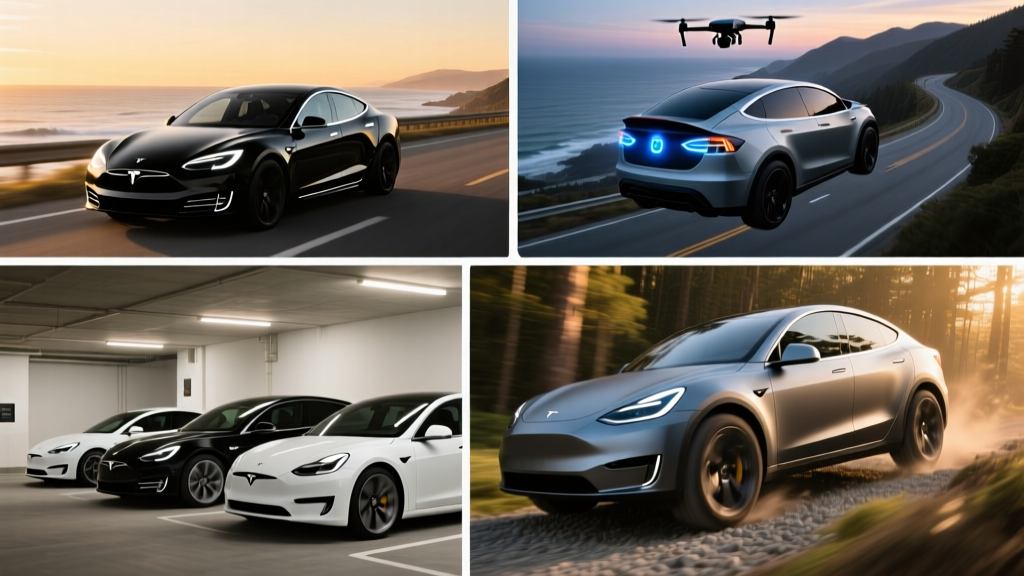
Elon Musk's original product-naming joke — arranging Tesla's first four vehicles to spell "S3XY" — has long since become the backbone of the American EV market. But in 2026, with legacy automakers fielding competitive EVs and Tesla's own lineup undergoing significant refreshes, the question isn't whether the name is clever. It's whether each model still earns its place in your driveway.
This guide reviews every current Tesla model — the Model S, Model 3, Model X, and Model Y — with the exact numbers that matter: real-world range, DC fast-charge speeds, battery chemistry, tax-credit eligibility under current IRS §30D rules, and who each car actually serves best.
Tesla Lineup at a Glance: 2026 Spec Table
| Spec | Model S LR | Model 3 LR AWD | Model X LR | Model Y LR AWD |
|---|---|---|---|---|
| EPA Range | 402 mi | 363 mi | 335 mi | 320 mi |
| Battery (usable) | ~95 kWh (NMC) | ~75 kWh (NMC) | ~95 kWh (NMC) | ~75 kWh (NMC) |
| Drivetrain | Dual-Motor AWD | Dual-Motor AWD | Dual-Motor AWD | Dual-Motor AWD |
| Horsepower | 670 hp | 384 hp | 670 hp | 384 hp |
| 0-60 mph | 3.1 sec | 4.2 sec | 3.8 sec | 4.8 sec |
| Peak DC Charge | 250 kW | 250 kW | 250 kW | 250 kW |
| 10-80% DC Time | ~30 min | ~25 min | ~30 min | ~25 min |
| MPGe (combined) | 120 MPGe | 134 MPGe | 111 MPGe | 125 MPGe |
| Cargo Volume | 28 cu ft (rear) + 5.3 frunk | 23 cu ft + 3.1 frunk | 88 cu ft (seats folded) + 6.6 frunk | 76 cu ft (seats folded) + 4.1 frunk |
| Base MSRP | $79,990 | $47,490 | $84,990 | $48,990 |
| Battery Warranty | 8 yr / 150,000 mi | 8 yr / 120,000 mi | 8 yr / 150,000 mi | 8 yr / 120,000 mi |
Sources: fueleconomy.gov, Tesla official specifications. Prices reflect 2026 MSRP before destination fees and before any incentives.
Real-World Range: What the EPA Sticker Doesn't Tell You
EPA vs. Reality: Tesla's EPA range figures are among the most optimistic in the industry relative to real-world highway driving. In sustained 75-mph highway testing, expect roughly 10-15% less range than the EPA sticker across all four models. Cold weather (below 32°F) compounds this with an additional 15-25% reduction due to battery chemistry resistance and cabin heating loads.
The Model S Long Range at 402 miles EPA remains the range king, but on a winter interstate run at 75 mph, plan for roughly 275-310 miles of usable range before needing to charge. That's still class-leading, and Tesla's Supercharger network density makes route planning relatively painless.
The Model 3 Long Range AWD posts a 363-mile EPA figure. Real-world highway testing in moderate temperatures (60-75°F) yields approximately 310-325 miles, dropping to 250-270 miles in sub-freezing conditions. For the daily commuter, the Model 3's lighter weight and smaller battery make it the most efficient Tesla per mile — it consistently posts the best kWh/100mi figures in the lineup.
The Model X and Model Y follow a similar pattern. The Model X, despite sharing the Model S platform, loses range to its heavier weight and less aerodynamic profile: expect roughly 280-295 miles real-world in good conditions, and as low as 220 miles in cold highway driving. The Model Y delivers approximately 275-290 miles in moderate weather and 215-240 miles in winter — adequate for most commutes and regional road trips, but tight for long stretches in the Mountain West charging deserts.
Charging Speed and Infrastructure
All four Tesla models share the same NACS (North American Charging Standard) connector and support up to 250 kW peak DC fast charging at V3/V4 Superchargers. However, peak rate is not sustained rate — this is where charge-curve literacy matters.
| Charging Method | Power / Rate | Time or Miles Added |
|---|---|---|
| DC Fast Charge (Supercharger V3) | Up to 250 kW peak | 10-80% in ~25-30 min (varies by model) |
| DC Fast Charge (150 kW stall) | Capped at 150 kW | 10-80% in ~35-40 min |
| Level 2 Home (Tesla Wall Connector, 48A) | 11.5 kW | ~30-44 miles of range per hour |
| Level 2 Home (32A mobile connector) | 7.7 kW | ~22-30 miles per hour |
| Level 1 (120V standard outlet) | ~1.4 kW | ~3-5 miles per hour |
The charge curve tapers significantly above 80% State of Charge. On a Model Y Long Range, for example, you'll pull the full 250 kW from roughly 10% to 45% SoC, then see power step down to ~150 kW through 65%, and drop further to ~75 kW between 65-80%. Charging from 80-100% at a Supercharger can add another 20+ minutes — which is why Tesla's navigation system defaults to routing you with enough charge to arrive at 10-15% and depart at 80%.
For home charging, Tesla's Wall Connector at 48 amps on a 60-amp circuit is the recommended setup for all models. Expect a full overnight charge from 20% to 80% in roughly 5-6 hours for the Model 3 and Model Y, and 7-8 hours for the Model S and X with their larger battery packs. Installation cost typically runs $800-$2,000 depending on panel proximity and whether a panel upgrade is needed — consult a licensed electrician for your specific situation.
One major 2026 advantage: Tesla's Supercharger network now serves non-Tesla EVs via NACS adapters at many locations, but Tesla owners still benefit from the most seamless plug-and-charge experience with no adapter needed, and generally the lowest per-kWh rates on the network.
Performance and Driving Dynamics
The Model S Plaid (1,020 hp, 0-60 in 1.99 seconds) remains available but sits outside this core lineup review. The Long Range Model S at 670 hp and a 3.1-second 0-60 is still brutally quick — and more relevant for most buyers given the $10,000+ price gap.
The refreshed Model 3 Highland (and its 2025-2026 updates) transformed what was once a firm, sometimes harsh ride into a genuinely comfortable daily driver. The dual-motor AWD Long Range posts 384 hp and a 4.2-second 0-60, with improved NVH (noise, vibration, harshness) levels that finally match its premium pricing. The steering remains quick but artificial — a Tesla hallmark that some love and others find disconnected.
The Model X shares the Model S powertrain and delivers a 3.8-second 0-60 despite weighing over 5,100 lbs. Air suspension is standard and provides a comfortable ride with adjustable height for clearance. The falcon-wing rear doors remain a polarizing feature — genuinely useful for loading car seats in tight parking spaces, but mechanically complex and occasionally slow to operate.
The Model Y received its "Juniper" refresh, bringing styling and interior updates that align it with the refreshed Model 3. At 384 hp and 4.8 seconds to 60 mph, it's the slowest in this lineup but still outpaces most competitors in its class. Ride quality improved substantially over the pre-refresh model, with better damping over rough pavement.
Pricing, Tax Credits, and Ownership Cost
| Model | Base MSRP | Federal §30D Credit | Effective Price | Income Cap |
|---|---|---|---|---|
| Model 3 LR AWD | $47,490 | Up to $7,500 (see eligibility) | ~$39,990 | $150K single / $300K joint |
| Model Y LR AWD | $48,990 | Up to $7,500 (see eligibility) | ~$41,490 | $150K single / $300K joint |
| Model S LR | $79,990 | Not eligible (MSRP cap) | $79,990 | N/A — exceeds MSRP cap |
| Model X LR | $84,990 | Not eligible (MSRP cap) | $84,990 | N/A — exceeds MSRP cap |
IRS §30D Federal Tax Credit Requirements (2026):
- MSRP Cap: Sedans (Model S/3) must be under $55,000; SUVs/pickups/vans (Model X/Y) must be under $80,000
- Buyer Income Cap: AGI must not exceed $150,000 (single), $225,000 (head of household), or $300,000 (joint filers)
- Battery Sourcing: Critical minerals and battery component requirements phase in annually — check current-year rules at irs.gov
- Point-of-Sale Transfer: Eligible buyers can transfer the credit to the dealer at purchase, reducing the purchase price directly
- Assembly: Vehicle must undergo final assembly in North America (all US-market Teslas qualify)
Tax credit eligibility rules change and have specific battery-sourcing requirements that vary by model year. Consult a tax professional and verify current rules at irs.gov before purchasing.
The Model 3 and Model Y are the credit-eligible models, and both qualify for the full $7,500 under current sourcing rules when purchased new by eligible buyers. This can be applied as a point-of-sale reduction, bringing the effective starting price of a Model 3 LR AWD to approximately $39,990 — a compelling value proposition against similarly equipped luxury sedans.
The Model S and Model X exceed the §30D MSRP cap ($55,000 for sedans, $80,000 for SUVs) and do not qualify for the federal new-vehicle credit. State incentives may still apply — check your local programs.
Technology, Driver Assistance, and Interior
All four models share Tesla's vertically integrated tech stack: a 15.4-inch (Model 3/Y) or 17-inch (Model S/X) central touchscreen running Tesla's proprietary infotainment OS. There is no Apple CarPlay or Android Auto — a deliberate choice that frustrates some buyers but keeps the interface tightly integrated with vehicle controls, navigation, and Supercharger routing.
Autopilot comes standard on all models and includes adaptive cruise control, lane-centering, and automatic emergency braking. This is a SAE Level 2 driver-assistance system — the driver must remain fully engaged with hands on the wheel and eyes on the road at all times.
Full Self-Driving (Supervised) is NOT autonomous driving. FSD is a Level 2 system that adds features like Navigate on Autopilot (automatic highway lane changes and off-ramp navigation), traffic light/stop sign recognition, and Autopark. Despite the name, the driver remains fully responsible for vehicle operation. Tesla's FSD subscription costs $99/month or $8,000 as a one-time purchase. True Level 4 autonomous driving is currently offered only by robotaxi services like Waymo in limited metro areas.
Interior quality has been a historical Tesla weakness, but the Model 3 Highland refresh and Model Y Juniper update closed much of the gap. Ventilated front seats, ambient lighting, and improved materials are now standard on Long Range trims. The Model S and X offer a more premium cabin with available yoke steering, rear-seat entertainment screens, and standard air suspension.
Cargo space varies dramatically by model. The Model Y leads practicality with 76 cubic feet of cargo volume (rear seats folded) plus a 4.1 cu ft frunk, making it the default choice for families. The Model X offers up to 88 cu ft with seats folded and an available third row (seating up to 7), but the third row is best suited for children. The Model 3 trunk is a conventional sedan design at 23 cu ft — adequate but less versatile than the hatchback/crossover designs.
Pros, Cons, and Verdict by Model
Pros
- Model 3: Best efficiency in lineup, strong real-world range, eligible for full $7,500 credit, improved ride quality post-refresh
- Model Y: Class-leading cargo space, strong family utility, eligible for full credit, excellent Supercharger access
- Model S: Best EPA range of any production sedan, effortless performance, premium interior
- Model X: Unique falcon-wing doors, available 7-seat config, strong towing (5,000 lbs)
- All: Supercharger network, OTA updates, strong resale value, over-the-air feature improvements
Cons
- Model 3: No instrument cluster, sedan trunk limits cargo, no Apple CarPlay
- Model Y: Higher price than Model 3 for similar platform, rear visibility limited
- Model S: No federal tax credit (MSRP cap), aging exterior design, premium pricing vs. competition
- Model X: No federal tax credit, falcon-wing door mechanical complexity, high price for the platform age
- All: Panel/service quality inconsistency, vision-only FSD limitations, no physical buttons for climate/media
Who Should Buy Which Tesla?
Choose the Model 3 if: You're a commuter or couple prioritizing efficiency and value. The $39,990 effective price (after credit) and 134 MPGe combined make it the most economical Tesla to own. Best for daily driving under 60 miles with home charging.
Choose the Model Y if: You need family utility — car seats, strollers, road-trip cargo. It's the best-selling Tesla for good reason, and the $7,500 credit brings it to ~$41,490 with crossover practicality.
Choose the Model S if: Range and performance are non-negotiable and budget allows. At 402 miles EPA, it's the longest-range sedan available, ideal for frequent road-trippers in regions with sparse charging.
Choose the Model X if: You need three rows and are committed to the Tesla ecosystem. The falcon-wing doors are genuinely useful for child-seat loading, but the price premium over the Model Y is substantial.
Frequently Asked Questions
What is the real-world range of a Tesla?
Real-world range depends on speed, temperature, and terrain. Expect 10-15% below EPA in warm highway driving and 25-35% below EPA in cold highway conditions. A Model Y LR rated at 320 miles EPA will typically deliver 275-290 miles at highway speeds in summer and 215-240 miles in winter.
How fast do Teslas charge?
All current Tesla models peak at 250 kW on V3/V4 Superchargers, achieving 10-80% in approximately 25-30 minutes. Home Level 2 charging at 48 amps (11.5 kW) adds 30-44 miles of range per hour, easily replenishing daily driving overnight.
Does Tesla qualify for the federal EV tax credit?
The Model 3 and Model Y qualify for up to $7,500 under IRS §30D, subject to buyer income caps ($150K single/$300K joint), battery sourcing requirements, and the MSRP cap ($55K sedans/$80K SUVs). The Model S and Model X exceed the MSRP cap and do not qualify. Always verify current eligibility at irs.gov before purchasing.
Is Tesla worth buying vs. competitors in 2026?
Tesla's Supercharger network remains its strongest competitive advantage, though NACS adoption by other automakers is narrowing this gap. The Model 3 and Y compete well on price-after-credit against the Hyundai Ioniq 6, BMW i4, Ford Mustang Mach-E, and Chevrolet Equinox EV. Where Tesla leads: charging infrastructure integration, software/OTA updates, and efficiency. Where competitors may lead: interior material quality, ride refinement, and availability of Apple CarPlay.
What are the biggest drawbacks of owning a Tesla?
Service center wait times can be long in some markets. Build quality (panel gaps, paint) has improved but remains inconsistent. The lack of physical controls for climate and media requires touchscreen reliance. FSD, despite its name, is a Level 2 driver-assist system that requires full driver attention — it does not drive the car autonomously.
How long will a Tesla battery last?
Tesla warrants its Long Range battery packs for 8 years and 120,000-150,000 miles (depending on model) with a minimum 70% capacity retention. Real-world degradation data from high-mileage Teslas suggests NMC packs typically retain 85-90% capacity at 100,000 miles with normal charging habits (avoiding frequent 100% charges and extreme heat exposure). Replacement cost for a full battery pack ranges from approximately $12,000-$20,000 depending on model, though most owners will never need one within the warranty period.