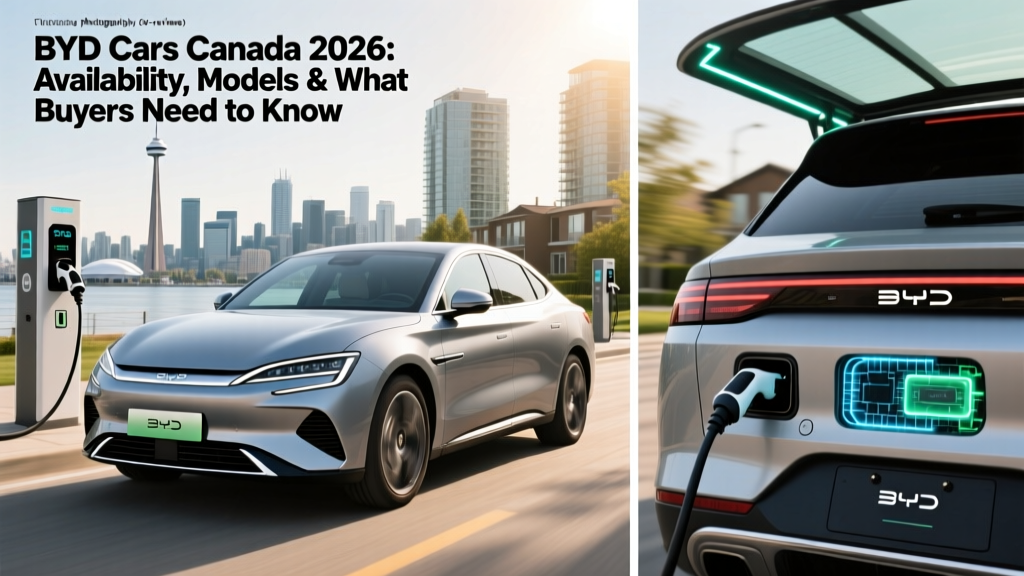
If you have been following the global electric vehicle market, you already know BYD is the world's largest plug-in vehicle manufacturer by volume. The Chinese automaker has rapidly expanded into Europe, Australia, Southeast Asia, and South America. That expansion naturally raises a question for North American EV shoppers: what is the status of BYD cars Canada availability in 2026, and are these models worth waiting for?
This guide provides a data-driven look at BYD's most globally relevant EV models, their real specifications, and the regulatory and trade barriers that currently keep them out of Canadian showrooms. We will also examine what it would take for BYD to enter the Canadian market and what buyers should consider in the meantime.
BYD's Canadian Market Status in 2026
As of early 2026, BYD does not sell passenger vehicles in Canada. The company has no retail dealership network, no Transport Canada type-approval certifications for its passenger car lineup, and no announced timeline for a Canadian launch. BYD does operate a commercial vehicle division in North America — primarily electric buses and heavy trucks — but its consumer EV portfolio remains unavailable to Canadian buyers.
The barriers are significant:
- Tariffs: Canada imposed a 100% surtax on Chinese-made EVs in October 2024, mirroring similar U.S. trade actions. This effectively doubles the import price of any BYD vehicle manufactured in China, eliminating the brand's core price advantage.
- Homologation: Every vehicle sold in Canada must meet Transport Canada's Motor Vehicle Safety Act standards, which differ from European and Chinese certification regimes. BYD would need to re-engineer or re-test numerous systems for North American compliance.
- Service infrastructure: Canadian buyers expect dealer networks for warranty service, recalls, and parts. BYD has zero retail service footprint in the country.
Given these realities, let's examine BYD's most internationally popular models — the Dolphin, Seal, and Atto 3 — using their global specifications, so you can understand what you would get if these vehicles ever reached Canadian soil, and how they compare to EVs you can actually buy today.
BYD Dolphin: The Affordable Compact EV
The BYD Dolphin is a compact hatchback that has become one of the best-selling EVs in markets like Australia, Brazil, and parts of Europe. It targets the budget-conscious urban commuter segment.
| Specification | Value |
|---|---|
| Battery Capacity | 60.4 kWh usable (LFP Blade) |
| WLTP Range | 427 km (265 mi) |
| EPA-Est. Range (projected) | ~220–240 mi |
| Motor Output | 201 hp / 310 Nm (FWD) |
| 0–100 km/h (0–62 mph) | 7.0 seconds |
| Max DC Fast Charge | 88 kW (peak) |
| 10–80% DC Charge Time | ~29 minutes |
| Level 2 AC Charge Rate | 11 kW (~35 mi/hr) |
| Efficiency | ~14.1 kWh/100 km (~22.7 kWh/100 mi) |
| Cargo Volume | 345 L seats up / 1,310 L seats folded (12.2 / 46.3 cu ft) |
| Global Price (Europe) | €35,990 (~CAD $53,000 pre-tariff) |
The Dolphin's 88 kW peak DC charging rate is modest by 2026 standards. Competitors like the Hyundai Ioniq 5 (peak 240 kW on 800V architecture) or Chevrolet Equinox EV (peak 190 kW) charge significantly faster on long road trips. The Dolphin is best suited for urban commuters with reliable home Level 2 charging rather than frequent highway travelers.
BYD Seal: The Tesla Model 3 Challenger
The BYD Seal is a mid-size sport sedan explicitly designed to compete with the Tesla Model 3. It is available globally in rear-wheel-drive and all-wheel-drive configurations and showcases BYD's Cell-to-Body (CTB) technology, where the LFP Blade battery is structurally integrated into the chassis.
| Specification | RWD (Design) | AWD (Excellence) |
|---|---|---|
| Battery Capacity | 82.5 kWh usable (LFP Blade) | 82.5 kWh usable (LFP Blade) |
| WLTP Range | 570 km (354 mi) | 520 km (323 mi) |
| EPA-Est. Range (projected) | ~295–315 mi | ~265–285 mi |
| Motor Output | 308 hp (RWD) | 523 hp (dual-motor AWD) |
| 0–100 km/h (0–62 mph) | 5.9 sec | 3.8 sec |
| Max DC Fast Charge | 150 kW (peak) | 150 kW (peak) |
| 10–80% DC Charge Time | ~26 minutes | ~26 minutes |
| Level 2 AC Charge Rate | 11 kW (~40 mi/hr) | 11 kW (~40 mi/hr) |
| Efficiency | ~15.0 kWh/100 km | ~16.5 kWh/100 km |
| Cargo Volume | 400 L trunk + 53 L frunk (14.1 + 1.9 cu ft) | 400 L + 53 L |
| Global Price (Europe) | €45,990 (~CAD $68,000) | €49,990 (~CAD $74,000) |
At 150 kW peak DC charging, the Seal is adequate but not class-leading. The Tesla Model 3 Highland charges at up to 250 kW on Superchargers, and the Hyundai Ioniq 6 hits 240 kW. On a road trip from Toronto to Montreal, the Seal would require roughly 30-minute charging stops versus 18–20 minutes for the fastest-charging competitors.
BYD Atto 3: The Compact Crossover
The Atto 3 (also known as the Yuan Plus in China) is BYD's compact electric crossover and the brand's best-selling model in several export markets. It competes in the same segment as the Hyundai Kona Electric, Kia Niro EV, and Volvo EX30.
| Specification | Value |
|---|---|
| Battery Capacity | 60.5 kWh usable (LFP Blade) |
| WLTP Range | 420 km (261 mi) |
| EPA-Est. Range (projected) | ~215–235 mi |
| Motor Output | 201 hp / 310 Nm (FWD) |
| 0–100 km/h (0–62 mph) | 7.3 seconds |
| Max DC Fast Charge | 88 kW (peak) |
| 10–80% DC Charge Time | ~29 minutes |
| Level 2 AC Charge Rate | 7 kW (~24 mi/hr) / 11 kW option |
| Efficiency | ~15.6 kWh/100 km (~25.1 kWh/100 mi) |
| Cargo Volume | 440 L seats up / 1,340 L folded (15.5 / 47.3 cu ft) |
| Global Price (Australia) | AUD $47,000 (~CAD $42,500 pre-tariff) |
The Atto 3's interior is distinctive — BYD uses a gym-themed design with muscle-fiber-inspired door trim and dumbbell-shaped air vents. Whether that appeals to you is subjective, but the 12.8-inch rotating center touchscreen is a practical standout, switching between portrait and landscape orientation depending on the app in use.
BYD Blade Battery: LFP Chemistry Deep Dive
All three models above use BYD's proprietary Blade Battery, which employs lithium iron phosphate (LFP) chemistry in a unique cell-to-pack form factor. Here is how LFP stacks up against the NMC (nickel manganese cobalt) chemistry used in most North American EVs:
| Factor | LFP (BYD Blade) | NMC (typical) |
|---|---|---|
| Energy Density | Lower (~160 Wh/kg cell) | Higher (~250–300 Wh/kg cell) |
| Cycle Life | 3,000–5,000+ cycles | 1,000–2,000 cycles |
| Thermal Stability | Excellent (resists thermal runaway) | Good (requires more thermal mgmt) |
| Cold-Weather Performance | Weaker (higher resistance below 0°C) | Better |
| Cost | Lower (no cobalt or nickel) | Higher |
| Recommended Charge Habit | Can charge to 100% regularly | Best kept 20–80% daily |
| Cobalt/Nickel Sourcing | None (easier ESG compliance) | Requires critical mineral supply chain |
For Canadian buyers, the cold-weather disadvantage of LFP is a genuine concern. LFP cells lose more usable capacity than NMC at temperatures below freezing. BYD's thermal management system helps, but real-world winter range loss of 30–40% is typical for LFP packs in prairie and eastern Canadian winters. That said, LFP's cycle life advantage means the battery will likely outlast the vehicle's useful life — a compelling long-term ownership argument.
Pricing, Tariffs, and Tax Credit Reality
Even if BYD entered Canada tomorrow, the 100% surtax on Chinese-manufactured EVs would fundamentally alter the value proposition. Here is what pricing would look like:
| Model | Global MSRP (CAD equiv.) | After 100% Tariff | Federal iZEV (if eligible) | Effective Price |
|---|---|---|---|---|
| Dolphin | ~$53,000 | ~$106,000 | –$5,000 | ~$101,000 |
| Atto 3 | ~$42,500 | ~$85,000 | –$5,000 | ~$80,000 |
| Seal RWD | ~$68,000 | ~$136,000 | –$5,000 | ~$131,000 |
At post-tariff prices, BYD vehicles would compete with premium European EVs rather than the affordable segment they target globally. This is precisely why BYD has not prioritized Canadian market entry.
Regarding Canada's federal iZEV rebate ($5,000): Even if BYD vehicles were sold in Canada, the iZEV program has MSRP caps (base model must be under CAD $55,000 for cars, CAD $60,000 for SUVs/trucks). Post-tariff pricing would push most BYD models above these thresholds. Provincial incentives (e.g., British Columbia's CEV rebate, Quebec's Roulez vert program) have their own eligibility criteria that would need separate qualification.
For U.S. readers wondering about the IRS §30D federal tax credit: BYD vehicles would not qualify regardless of price. The credit requires final assembly in North America, and BYD manufactures its vehicles in China, Thailand, Brazil, and other non-NAFTA facilities. The credit also has MSRP caps ($55,000 for sedans, $80,000 for SUVs/trucks), buyer income limits ($150K single / $300K joint), and critical mineral sourcing requirements detailed at IRS.gov.
How BYD Models Compare to Canadian Alternatives
BYD Advantages (If Available)
- LFP Blade Battery: exceptional cycle life and thermal safety
- Competitive global pricing (pre-tariff) undercuts most rivals
- Strong standard equipment levels (rotating screen, V2L, ADAS suite)
- Rapid global expansion signals strong R&D investment
BYD Drawbacks for Canadian Buyers
- Not currently sold in Canada — zero availability
- 100% tariff destroys price competitiveness
- LFP cold-weather range loss significant for Canadian winters
- No dealer network, no service infrastructure, no parts supply
- DC charging speeds (88–150 kW) lag behind 2026 competitors
- No NACS connector — would require CCS-to-NACS adapter for Tesla Supercharger access
For Canadian buyers considering the segments BYD targets, here are the currently available alternatives worth cross-shopping:
- Compact hatchback (Dolphin segment): Chevrolet Equinox EV (EPA 319 mi, ~$33,000 USD), Hyundai Kona Electric (EPA 261 mi, ~$33,000 USD)
- Mid-size sedan (Seal segment): Tesla Model 3 (EPA 363 mi Long Range, ~$47,740 USD), Hyundai Ioniq 6 (EPA 361 mi, ~$38,650 USD)
- Compact crossover (Atto 3 segment): Volvo EX30 (EPA 296 mi, ~$36,245 USD), Kia Niro EV (EPA 239 mi, ~$39,600 USD)
All of these alternatives offer Canadian dealer networks, Transport Canada certification, CCS or NACS charging connectors, and eligibility for the federal iZEV rebate where MSRP thresholds are met. Range and efficiency data for these models can be verified at fueleconomy.gov.
Will BYD Ever Enter Canada?
BYD has signaled long-term interest in North America, but the company's executive team has repeatedly stated that the current tariff environment makes entry economically unviable. Several scenarios could change this calculus:
- Local manufacturing: BYD could build a factory in Canada or Mexico to bypass import tariffs. However, BYD's current factory buildouts are focused on Hungary, Brazil, Thailand, Indonesia, and Turkey — not North America.
- Tariff reduction: A change in trade policy or a bilateral agreement could lower the surtax, though this appears unlikely in the current geopolitical climate.
- Premium repositioning: BYD's sub-brand Yangwang (with the U8 luxury SUV and U9 supercar) targets the high-end market where tariffs are more absorbable, but this is a niche play.
For now, Canadian EV buyers should focus on the growing selection of vehicles already available with full warranty support, established charging compatibility, and incentive eligibility. If BYD's trade situation changes, we will update this analysis.
Frequently Asked Questions
Can I buy a BYD car in Canada right now?
No. As of 2026, BYD does not sell passenger vehicles in Canada. There is no dealership network, no Transport Canada certification for BYD's consumer lineup, and a 100% tariff on Chinese-made EVs makes importing one economically impractical.
What is the real-world range of BYD's most popular EVs?
The BYD Seal RWD offers a projected EPA range of approximately 300 miles, but expect 220–250 miles in Canadian winter highway driving due to LFP cold-weather losses. The Dolphin and Atto 3 project to roughly 220–240 miles EPA, with real-world winter range closer to 150–175 miles.
How fast do BYD vehicles charge?
The BYD Seal peaks at 150 kW DC fast charging, reaching 10–80% in about 26 minutes. The Dolphin and Atto 3 peak at 88 kW, with 10–80% taking approximately 29 minutes. These speeds are slower than leading 2026 competitors like the Hyundai Ioniq 5 (240 kW) or Tesla Model 3 (250 kW).
Would BYD cars qualify for Canadian or U.S. EV tax credits?
In Canada, post-tariff pricing would push most BYD models above the iZEV program's MSRP caps. In the U.S., BYD vehicles would not qualify for the IRS §30D credit because they are not assembled in North America, regardless of price or buyer income.
Is BYD's Blade Battery better than other EV batteries?
Better depends on your priorities. The LFP Blade Battery offers exceptional cycle life (3,000–5,000+ cycles), superior thermal safety, and lower cost. However, it has lower energy density than NMC batteries and performs worse in extreme cold — a meaningful trade-off for Canadian climates. For daily urban commuting with home charging, LFP is an excellent choice. For road trips and harsh winters, NMC currently has an edge.
What should I buy instead of a BYD in Canada?
For the compact EV segment, the Chevrolet Equinox EV and Hyundai Kona Electric offer strong value with Canadian dealer support. For sedans, the Tesla Model 3 and Hyundai Ioniq 6 lead in range and charging speed. For compact crossovers, the Volvo EX30 and Kia Niro EV are strong contenders. All offer established service networks and incentive eligibility.