The BYD Atto 3 has become one of Australia's best-selling electric SUVs, undercutting rivals on price while packing a surprisingly long feature list. But one feature generates more forum debate and owner questions than almost any other: the interior-facing camera and the driver monitoring system (DMS) it powers. Is it watching you? Can you turn it off? Does it actually improve safety? In this review, we break down the Atto 3's cabin camera technology alongside the full ownership picture — range, charging, pricing, and how it stacks up against the MG ZS EV and GWM Ora in the Australian market.
BYD Atto 3 Core Specs at a Glance
| Specification | BYD Atto 3 (Extended Range) |
|---|---|
| Battery Capacity | 60.48 kWh usable (LFP — Blade Battery) |
| WLTP Range | 420 km (261 mi) |
| Real-World Range (AU) | ~340–380 km (211–236 mi) mixed driving |
| Motor Output | 150 kW (201 hp) / 310 Nm torque |
| Drivetrain | Front-wheel drive (single motor) |
| 0–100 km/h (0–62 mph) | 7.3 seconds |
| Max DC Fast Charge | 88 kW (peak) |
| 10–80% DC Charge Time | ~29 minutes |
| AC Level 2 Charge Rate | 7 kW (onboard charger) |
| Efficiency (Combined) | ~16.0 kWh/100 km (WLTP) |
| Cargo Volume | 440 L seats up / 1,340 L seats folded |
| Battery Warranty | 8 years / 160,000 km |
| Vehicle Warranty | 6 years / 150,000 km |
Note: The Atto 3 is sold primarily in Australia, Europe, and Asia — it is not currently available in the United States. Range figures use the WLTP standard, which tends to read 10–15% higher than the US EPA cycle. We've converted to miles for reference, but Australian buyers should think in kilometres.
The Interior Camera and Driver Monitoring System Explained
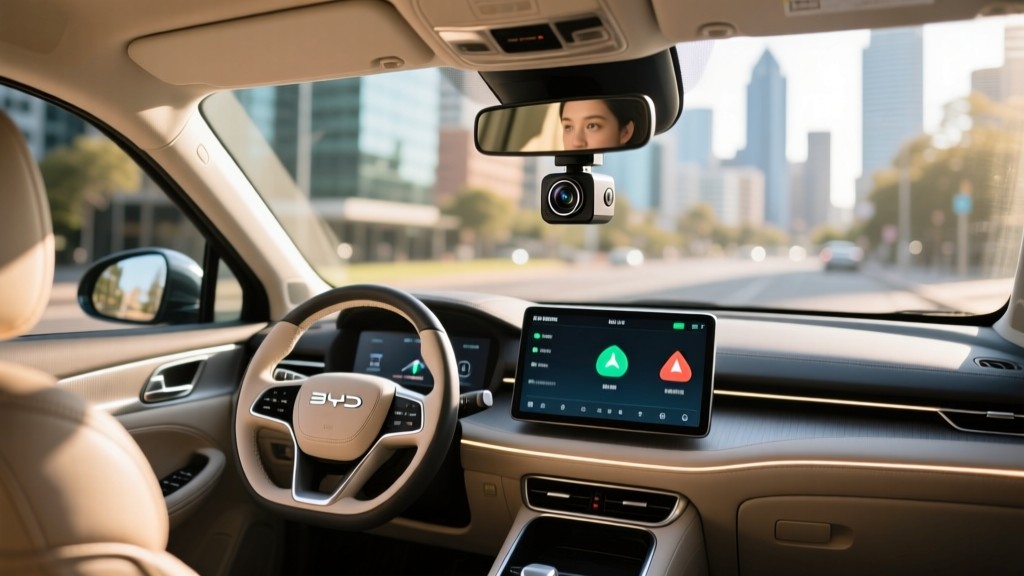
Mounted above the rear-view mirror housing, the Atto 3's inward-facing camera is part of BYD's Driver Monitoring System (DMS). It uses infrared illumination to track the driver's eye gaze and head position in real time, including in low-light or nighttime conditions. The system is designed to detect:
- Drowsiness: Prolonged eye closure or slow blink patterns trigger an audible alert and a dashboard warning suggesting a break.
- Distraction: If your gaze drifts away from the road ahead for an extended period — looking at a phone, turning to talk to rear passengers — the system issues a progressive visual and audible warning.
- Head position: Sustained head-down postures (suggesting phone use or nodding off) are flagged.
The DMS is integrated with the Atto 3's ADAS suite, which BYD markets under the "DiPilot" branding. On Australian-delivered models, this includes adaptive cruise control, lane-keeping assist, automatic emergency braking (AEB), and blind-spot detection. The interior camera adds a layer of driver-state awareness on top of these outward-facing sensors.
Can You Turn the Interior Camera Off?
Yes — and this is where Australian owners have the most practical flexibility. Through the 12.8-inch (or 15.6-inch on higher trims) rotating infotainment screen, you can navigate to Settings → Vehicle → Driver Assistance and toggle the DMS off. The camera's physical shutter (a small sliding cover present on most model years) can also be closed for a hardware-level privacy block. However, disabling DMS may also deactivate certain ADAS-linked warnings, and the system may prompt you to re-enable it at each ignition cycle depending on firmware version.
Privacy Considerations for Australian Buyers
BYD has stated that the DMS camera processes data locally on the vehicle's onboard computer and does not transmit images or video to external servers. No cabin footage is recorded or stored in a user-accessible format under normal operation. For Australian buyers concerned about data sovereignty — a particularly sensitive topic given broader debates around Chinese-manufactured technology — this local-processing architecture is a meaningful distinction. The Office of the Australian Information Commissioner (OAIC) governs data privacy, and BYD's Australian distributor EVDirect has published compliance statements addressing local privacy law.
Real-World Range Reality Check
WLTP Sticker: 420 km (261 mi)
Our Expectation in Australia: Around 340–380 km in mixed suburban and highway driving. On a pure highway run at 110 km/h in warm conditions, expect closer to 310–330 km. In cooler southern-state winters (Tasmania, Victoria), range can drop to ~300 km due to reduced battery efficiency and cabin heating load. The LFP chemistry holds up well to daily 100% charging, which partially offsets the shorter total range.
Charging Speed: DC Fast and Home Level 2
The Atto 3's 88 kW peak DC fast-charge rate is the most common criticism from spec-sheet shoppers — and it's worth unpacking with real-world context rather than dismissing it outright.
| Charging Level | Power / Rate | Time / Range Added |
|---|---|---|
| DC Fast Charge (CCS2) | 88 kW peak | 10–80% in ~29 min; ~150 km in 15 min |
| DC Fast Charge (tapered) | ~50–60 kW sustained above 60% SoC | 80–100% adds another ~20 min |
| Public AC (Level 2) | 7 kW (onboard limit) | ~60 km of range per hour; 0–100% in ~9 hrs |
| Home AC (single-phase 7 kW wallbox) | 7 kW | Full overnight charge in ~9 hrs |
| Emergency (10A domestic outlet) | ~2.3 kW (granny cable) | ~20 km per hour; 0–100% in ~26 hrs |
The 88 kW peak means the Atto 3 will not match the 150–250 kW charge rates of rivals like the Hyundai Kona Electric or Kia Niro EV. On a typical Australian road trip using the Chargefox or Evie Networks 350 kW ultra-rapid stations, the Atto 3 will be the bottleneck — not the charger. However, for the 90% of driving that happens within daily commute range, the 7 kW home wallbox covers overnight replenishment easily, and the 29-minute 10–80% DC session is adequate for a lunch stop on a Sydney-to-Melbourne run (which requires two charge stops regardless of vehicle).
The LFP Blade Battery chemistry has a practical charging advantage: BYD recommends and supports regular charging to 100%, unlike NMC-equipped EVs where daily 80% limits are advised to slow degradation. This means your usable daily range from a full charge is closer to the sticker figure, not 80% of it.
Pricing, Trims, and Australian Market Positioning
The Atto 3 is sold in Australia through EVDirect (BYD's local distributor) in two primary trims. Pricing below reflects drive-away estimates as of early 2026, before state-level incentives:
| Trim | Key Features | MSRP (AUD, before on-roads) |
|---|---|---|
| Standard Range | 49.92 kWh battery, 345 km WLTP, 12.8" screen, DMS, full ADAS | ~$44,990 |
| Extended Range | 60.48 kWh battery, 420 km WLTP, 15.6" screen, panoramic roof, powered tailgate | ~$49,990 |
| Extended Range Premium | Adds ventilated seats, larger alloy wheels, upgraded audio | ~$52,990 |
Federal Tax Credit Note (US Readers)
The BYD Atto 3 is not sold in the United States and therefore does not qualify for the US federal §30D EV tax credit. BYD has no announced plans to enter the US passenger vehicle market as of 2026, partly due to existing 100% tariffs on Chinese-manufactured EVs. For US buyers researching this model for comparison purposes, treat the Atto 3 as an Australian/international-market benchmark only.
For Australian buyers, the federal Luxury Car Tax (LCT) threshold for fuel-efficient vehicles and various state rebates (such as the now-closed NSW EV rebate, and Victoria's zero-emissions vehicle duty exemption) affect final drive-away cost. Always confirm current incentive status with your state revenue office and dealer.
Performance, Efficiency, and Daily Driving
The Atto 3's 150 kW (201 hp) front-mounted motor delivers brisk, if not thrilling, acceleration. The 7.3-second 0–100 km/h time is competitive with the MG ZS EV (8.4 sec) and slots in behind the Kona Electric (7.4 sec for the Long Range). In practice, the instant torque delivery makes it feel quicker than the number suggests around town, though highway overtaking above 100 km/h requires planning — there's no dual-motor AWD option here.
Efficiency in Australian conditions tends to land between 15.5 and 17.5 kWh/100 km depending on driving style and climate use. The heat pump (standard on Extended Range trims) reduces winter cabin-heating energy draw, a meaningful advantage in Canberra and Hobart winters. Regenerative braking offers two levels selectable via the gear selector, though the Atto 3 does not offer true one-pedal driving — the regen taper at low speeds means you'll still use the friction brake for final stops.
Cargo and Passenger Space
With 440 litres behind the rear seats (expanding to 1,340 L with the 60/40 split fold), the Atto 3 matches compact SUV competitors. Rear legroom is generous — 920 mm measured — and the flat floor (no transmission tunnel) makes the middle seat usable for adults on short trips. There is no front trunk (frunk); the space under the bonnet houses the motor and power electronics. A tyre repair kit replaces a spare wheel.
How the Atto 3 Compares to Key Rivals
| Attribute | BYD Atto 3 ER | MG ZS EV (2026) | Hyundai Kona Electric |
|---|---|---|---|
| Battery (kWh) | 60.48 (LFP) | 51 (NMC) | 65 (NMC) |
| WLTP Range | 420 km | 382 km | 490 km |
| Max DC Charge | 88 kW | 80 kW | 150 kW |
| 10–80% DC Time | ~29 min | ~36 min | ~18 min |
| 0–100 km/h | 7.3 sec | 8.4 sec | 7.4 sec |
| Interior DMS Camera | Yes (toggleable) | No | No |
| Battery Warranty | 8 yr / 160,000 km | 7 yr / 150,000 km | 8 yr / 160,000 km |
| Approx. Price (AUD) | $49,990 | $47,990 | $56,900 |
The Atto 3's interior camera is a differentiator — neither the ZS EV nor the Kona Electric offers cabin-facing driver monitoring at this price point. Whether that's a pro or con depends on your privacy comfort level. On pure range and charge speed, the Kona Electric wins clearly, but at a $6,000+ premium. The MG ZS EV undercuts on price but trails on range, performance, and battery warranty.
Pros, Cons, and Who Should Buy
Pros
- LFP Blade Battery supports daily 100% charging with minimal degradation concern
- Generous standard equipment including DMS, panoramic roof, rotating screen
- Strong battery warranty (8 yr / 160,000 km) and competitive pricing
- Spacious rear seat and flat floor for a compact SUV footprint
- DMS camera is toggleable — privacy-conscious owners have control
Cons
- 88 kW DC charge rate is slowest in class — road trips take longer
- No AWD or dual-motor option; FWD only limits traction in wet/alpine conditions
- Infotainment software can be sluggish; translation quirks in menus persist
- No frunk; cargo space adequate but not class-leading
- Resale value track record in Australia is still short (brand entered 2022)
Who the Atto 3 Suits Best
Choose the Atto 3 if: You're an urban or suburban commuter covering under 300 km daily, want a well-equipped EV under $50K AUD, prefer the longevity profile of LFP chemistry, and do most charging at home overnight. The DMS camera adds a safety layer that budget-conscious families may appreciate.
Look elsewhere if: You regularly drive long intercity routes (the 88 kW charge rate adds 15–20 minutes per stop vs. a Kona or Model Y), need AWD for snow or gravel, or prioritize proven resale value and dealer network depth over feature-per-dollar.
Frequently Asked Questions
Does the BYD Atto 3 interior camera record video?
No. The DMS camera processes eye-gaze and head-position data locally on the vehicle's ECU. It does not record, store, or transmit cabin video. A physical privacy shutter is available on most model years for an additional hardware-level block.
What is the real-world range of the BYD Atto 3 in Australia?
Expect approximately 340–380 km in mixed suburban/highway driving from the 60.48 kWh Extended Range model. Highway-only runs at 110 km/h drop this to around 310–330 km, and cold-weather driving in southern states can push it to ~300 km with heating use. The WLTP sticker reads 420 km, but real-world conditions rarely match laboratory tests.
How fast does the Atto 3 charge at home and on DC?
On a 7 kW home wallbox, a full charge takes roughly 9 hours — easily achievable overnight. On a DC fast charger, the Atto 3 peaks at 88 kW and reaches 10–80% in about 29 minutes. Above 80% State of Charge, the charge curve tapers significantly to protect the LFP cells, adding another ~20 minutes for the final 20%.
Does the BYD Atto 3 qualify for the US federal EV tax credit?
No. The Atto 3 is not sold in the United States and is not eligible for the IRS §30D federal tax credit. BYD has no announced US passenger vehicle plans as of 2026. Australian buyers should consult state-level EV incentives and the ATO for any applicable fringe benefits tax (FBT) exemptions on EVs.
Is the Atto 3 worth buying over the MG ZS EV or Kona Electric?
It depends on priorities. The Atto 3 offers the best feature-per-dollar proposition with LFP battery longevity, the interior DMS camera, and strong warranty coverage. The Kona Electric wins on range (490 km WLTP) and charge speed (150 kW DC) but costs significantly more. The MG ZS EV is cheaper but trails on range, performance, and warranty. For a commuter who charges at home and values equipment level, the Atto 3 is the strongest value pick.
Is the Atto 3's ADAS system self-driving?
No. BYD's DiPilot suite is an SAE Level 2 driver-assistance system. It combines adaptive cruise control and lane-centering, but the driver must remain fully engaged — hands on the wheel, eyes on the road — at all times. The interior DMS camera reinforces this requirement by monitoring attentiveness. No consumer vehicle currently sold in Australia offers Level 3 or higher autonomous driving.
Sources: BYD Australia official specifications via BYD Auto Australia; WLTP efficiency data cross-referenced with Green Vehicle Guide (Australian Government); safety and ADAS information referenced from ANCAP.