The EV Reshaping Europe's Market — And Why Americans Are Watching
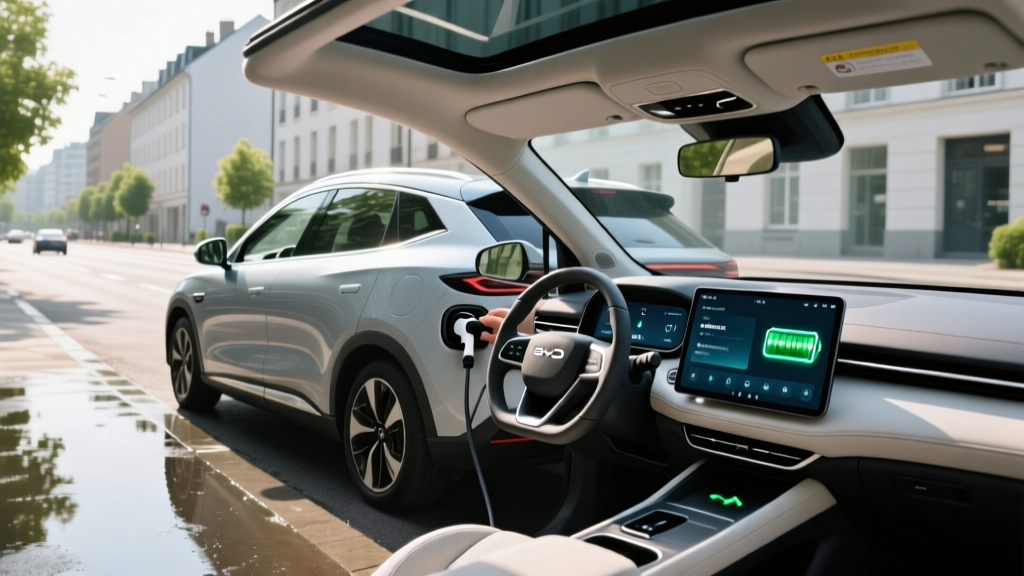
BYD's Atto 3 — known as the Yuan Plus in China — is the compact crossover at the center of the automaker's aggressive global push. While byd europe sales growth has dominated headlines, with the brand capturing significant market share across Germany, Sweden, the Netherlands, and the UK, US buyers remain locked out by a 100% tariff on Chinese-built EVs enacted under Section 301. That makes this review part driving impression, part market analysis: what exactly are European buyers getting, and what does it tell us about the EV landscape American shoppers navigate?
The Atto 3 competes in the same compact electric crossover segment as the Hyundai Kona Electric, Kia Niro EV, and Volkswagen ID.4. It undercuts most rivals on price in Europe while delivering competitive range, a well-appointed interior, and BYD's proprietary Blade battery technology. Here is the full technical breakdown.
Range, Battery, and Real-World Efficiency
| Spec | Value |
|---|---|
| Battery Capacity (usable) | 58.56 kWh |
| Battery Chemistry | LFP (Lithium Iron Phosphate) — BYD Blade |
| WLTP Range | 261 miles (420 km) |
| EPA-Estimated Range (equivalent) | ~225 miles |
| Efficiency | ~30 kWh/100 mi (~112 MPGe) |
| Motor Output | 201 hp (150 kW), 229 lb-ft torque |
| Drivetrain | FWD (single front motor) |
| 0–62 mph (0–100 km/h) | 7.3 seconds |
| Cargo Volume | 15.6 cu ft (rear seats up) / 47.3 cu ft (folded) |
| Wheelbase | 106.3 in |
| Curb Weight | ~3,770 lbs |
BYD's Blade battery uses a cell-to-pack architecture with lithium iron phosphate (LFP) chemistry. The trade-off versus NMC (nickel manganese cobalt) is clear: LFP offers lower energy density (hence the modest range from a 58.56 kWh pack) but delivers superior thermal stability, longer cycle life (3,000+ full charge cycles before significant degradation), and no cobalt dependency. For daily commuters who charge at home nightly, LFP is arguably the better chemistry — you can charge to 100% regularly without the degradation concerns that plague NMC packs held at full state of charge.
Charging Speed: DC Fast, Level 2, and the Curve Reality
| Charging Level | Power / Rate | Time / Recovery |
|---|---|---|
| DC Fast Charge (peak) | 88 kW (CCS2 in Europe) | 10–80% in ~29 minutes |
| DC Sustained (20–60%) | ~70–80 kW average | ~130 miles in 30 min |
| Level 2 AC (home / public) | 11 kW (3-phase) / 7 kW (single-phase) | ~25 mi/hr (7 kW); 0–100% in ~6.5 hrs (11 kW) |
| Level 1 AC (120V household) | ~1.4 kW | ~5 mi/hr; 0–100% in ~40+ hrs |
Here is where the Atto 3 reveals its most significant competitive weakness. At a peak of 88 kW on DC fast charging, it trails the Hyundai Kona Electric (which peaks around 100+ kW on its 2024+ platform) and falls far behind 800V-architecture vehicles like the Hyundai Ioniq 5 or Kia EV6, which sustain 200+ kW. On a road trip, that 29-minute 10–80% session stretches longer when you account for the charge curve taper above 80% — a full 10–90% stop will take closer to 45 minutes.
For home charging, the 11 kW three-phase AC capability is excellent for European buyers with three-phase residential power. US homes are predominantly single-phase, meaning American owners (if the Atto 3 ever arrives) would see 7 kW Level 2 speeds — roughly 25 miles of range added per hour of charging, or a full overnight replenishment on a standard 240V/32A home charger.
Performance and Driving Dynamics
The Atto 3's 201 hp front-mounted motor delivers adequate acceleration for city and suburban driving. The 7.3-second 0–62 mph time puts it in the same ballpark as the base Volkswagen ID.4 (7.7 sec) but behind the Kia Niro EV (7.4 sec) and well behind dual-motor AWD competitors. There is no AWD variant available — a notable omission for buyers in snow-belt regions.
Driving impressions from European-market testing describe a comfortable, softly sprung ride tuned for urban compliance rather than sporty engagement. Regenerative braking offers two levels but does not enable true one-pedal driving — the vehicle will not come to a complete stop on regen alone, which disappoints EV veterans accustomed to the Nissan Leaf or Tesla Model 3's hold mode. Steering is light and low-effort, ideal for parking but vague at highway speeds.
Interior, Tech, and Cargo Practicality
BYD invested heavily in making the Atto 3's cabin feel distinct. The interior design theme — dubbed "Muscular Flow" — features gym-inspired textures on the door panels, dumbbell-shaped air vents, and guitar-string-style door pocket elastic. It is polarizing, but it gives the Atto 3 a personality that rivals' minimalist cabins lack.
Infotainment: A 12.8-inch rotating center touchscreen (landscape for navigation, portrait for climate/menus) runs BYD's custom Android-based OS. Wireless Apple CarPlay and Android Auto are standard. The 5.0-inch digital instrument cluster is small by modern standards but functional. A head-up display is not available.
Driver Assistance: The Atto 3 ships with adaptive cruise control, lane-keeping assist, blind-spot monitoring, rear cross-traffic alert, and autonomous emergency braking with pedestrian detection. This is an SAE Level 2 driver-assistance system — it does not drive itself, and the driver must maintain hands-on-wheel engagement and visual attention at all times. European NCAP awarded the Atto 3 a 5-star safety rating in 2022 testing.
Cargo and Space: With 15.6 cubic feet behind the rear seats and 47.3 cu ft with the 60/40 split folded, the Atto 3 matches the Kona Electric but trails the ID.4's class-leading 30.3 cu ft (seats up). Rear legroom is generous at approximately 38 inches, and the flat floor aids middle-seat comfort. There is no front trunk (frunk).
Pricing, Tax Credits, and the US Market Question
| Market / Trim | Price |
|---|---|
| Europe — Comfort (base) | €38,000 (~$41,500) |
| Europe — Design (top) | €40,700 (~$44,500) |
| UK — Design (top) | £37,695 |
| Australia — Superior (top) | A$47,500 (~$31,000 USD) |
| US Availability | Not sold — 100% tariff on Chinese-built EVs |
The byd europe sales growth story is partly a pricing story. In markets where BYD can sell without prohibitive tariffs, the Atto 3 undercuts the VW ID.4 and approaches Hyundai/Kona pricing while including features (panoramic sunroof, power tailgate, 360° camera) that competitors charge extra for. In Germany, BYD registered over 1,500 Atto 3 units in peak months during 2024–2025, and the brand's total European registrations grew substantially year-over-year, prompting legacy automakers to lobby for EU-level trade protections similar to the US tariff wall.
Warranty and Battery Longevity
BYD provides an 8-year / 125,000-mile (200,000 km) warranty on the Blade battery pack, guaranteeing it will retain at least 70% of its original capacity during that period. The vehicle warranty is 6 years / 93,000 miles (150,000 km) in most European markets. These terms are competitive with Hyundai's 8-year/100,000-mile battery warranty and exceed Volkswagen's 8-year/100,000-mile coverage.
The LFP Blade battery's inherent longevity is a selling point. Independent testing and BYD's own data suggest the Blade cell architecture can withstand 3,000–5,000 full charge cycles before reaching 80% state of health. At 225 EPA-equivalent miles per cycle, that translates to 675,000+ miles before hitting the 80% threshold — effectively the life of the vehicle for most owners. The cell-to-pack design also improves volumetric efficiency, though it complicates individual cell replacement if a single module fails.
Pros, Cons, and the Verdict
Pros
- LFP Blade battery — exceptional cycle life, thermal safety, 100% SoC charging OK
- Competitive pricing in tariff-free markets
- Well-equipped standard (panoramic roof, 360° camera, power tailgate)
- Euro NCAP 5-star safety rating
- Comfortable ride quality for urban/suburban use
- Generous rear-seat legroom
Cons
- 88 kW DC fast-charge peak — slowest in segment
- No AWD option available
- FWD only — limits traction in snow/ice regions
- No one-pedal driving / full regen stop
- Eccentric interior styling not universally appealing
- No US availability; 100% tariff blocks import
- Small instrument cluster; no head-up display
Decision Framework: Who Should Consider the Atto 3?
Choose the BYD Atto 3 if: You are a European-market buyer seeking a well-equipped compact EV crossover at a competitive price, you charge primarily at home (where slow DC charging is irrelevant), you value LFP battery longevity, and your driving is predominantly urban and suburban.
Look elsewhere if: You take frequent road trips requiring fast DC charging, you need AWD for winter conditions, you require maximum cargo space, or you are a US buyer (the vehicle is simply not available, and comparable alternatives like the Hyundai Kona Electric, Kia Niro EV, or Chevrolet Equinox EV offer US-market support, tax credit eligibility, and faster charging).
What BYD's European Momentum Means for the Global EV Market
The byd europe sales growth phenomenon is not solely about the Atto 3. BYD's European portfolio also includes the Dolphin (compact hatchback), Seal (Tesla Model 3 rival), and Han (executive sedan). But the Atto 3 is the volume play — the crossover that competes where most buyers actually shop. Its success signals that Chinese OEMs can deliver competent, safe, well-priced EVs that meet European regulatory and consumer expectations.
For US buyers watching from behind the tariff wall, the Atto 3 serves as a benchmark: it demonstrates what a ~$35,000 compact EV crossover could look like if competitive pressures were allowed to operate freely. The Hyundai Kona Electric, starting around $33,000 before incentives, and the Chevrolet Equinox EV, starting near $33,000, are the closest American-market analogs. Both offer faster DC charging, US-spec warranty infrastructure, and §30D tax credit eligibility — advantages that matter more than the Atto 3's interior flourishes when you are budgeting for a daily driver.
BYD has announced plans to build a factory in Hungary, which could eventually allow it to sell vehicles in Europe without being subject to EU anti-subsidy tariffs imposed in late 2024. Whether that European-built production could ever find a pathway to North America — perhaps through Mexico, though USMCA rules and additional tariff layers complicate this — remains speculative. For now, the Atto 3 is a compelling product in the markets where it is sold, and a "what if" for American EV shoppers.
Frequently Asked Questions
What is the real-world range of the BYD Atto 3?
The WLTP-rated range is 261 miles, which translates to approximately 225 miles under the US EPA equivalent test cycle. Real-world highway driving yields 190–210 miles; cold-weather driving (below freezing) drops to 160–180 miles. The LFP battery tolerates 100% daily charging better than NMC, so usable daily range is closer to the full EPA figure if you charge nightly at home.
How fast does the Atto 3 charge at home and on DC fast chargers?
DC fast charging peaks at 88 kW, delivering a 10–80% charge in approximately 29 minutes. Home Level 2 charging at 7 kW (US single-phase) adds about 25 miles per hour, fully replenishing the battery in roughly 9 hours. European three-phase 11 kW charging cuts that to about 6.5 hours.
Does the BYD Atto 3 qualify for the US federal EV tax credit?
No. The Atto 3 is not sold in the United States. Even if it were, its Chinese-manufactured battery and vehicle assembly would disqualify it under IRS §30D rules, which require North American battery component manufacturing and exclude Chinese-sourced critical minerals and battery components.
Is the BYD Atto 3 worth buying versus the Hyundai Kona Electric or Kia Niro EV?
In Europe, the Atto 3 offers strong value with more standard equipment at a competitive price. However, its 88 kW DC charging speed is the weakest in the segment. If you road-trip frequently, the Kona Electric or Niro EV charge faster. In the US, neither the Atto 3 nor the tariff situation makes this comparison relevant — buy the Kona, Niro, or Equinox EV with tax credit eligibility and domestic dealer support.
What is BYD's Blade battery, and how long will it last?
The Blade battery is BYD's proprietary LFP (lithium iron phosphate) cell-to-pack design. It offers superior thermal stability (passes nail-penetration tests without thermal runaway), 3,000–5,000 charge cycles before 80% capacity retention, and an 8-year/125,000-mile warranty. For most owners, the battery will outlast the vehicle itself.
Sources: Euro NCAP, BYD Europe official specifications, IRS §30D Clean Vehicle Credits.