Quick Verdict: A Drayage Workhorse, Not a Long-Haul Contender
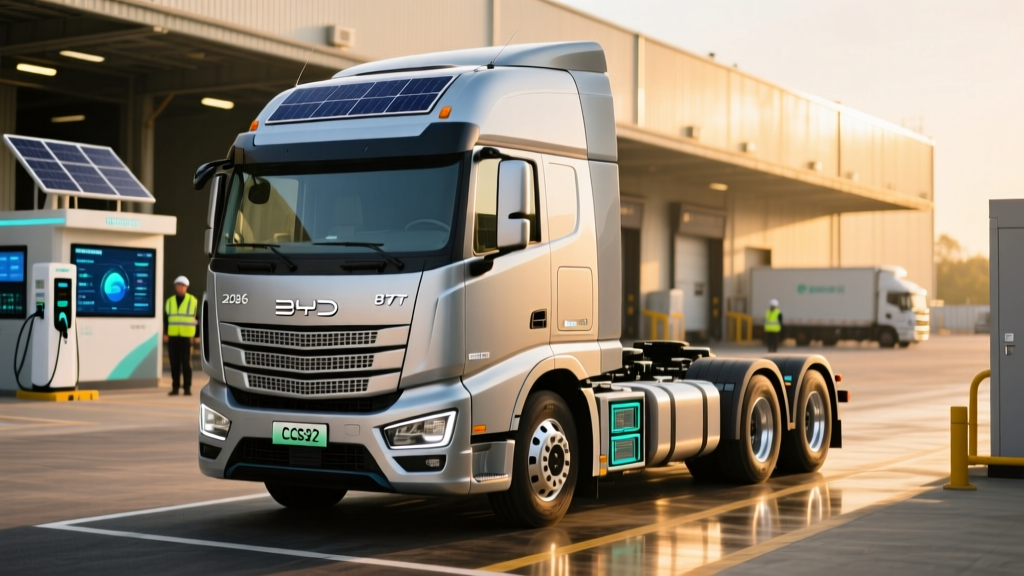
The BYD 8TT (often searched as the "BYD semi truck") is a Class 8 battery-electric day-cab tractor built for one mission: high-frequency, short-haul drayage. With an EPA-estimated range around 150 miles, a massive 435 kWh lithium iron phosphate (LFP) battery, and a price tag hovering near $240,000 before incentives, it is purpose-built for port operations, warehouse shuttling, and regional distribution loops — not cross-country freight. BYD has deployed these trucks with fleets in Southern California and other logistics hubs since the early 2020s, and the 2026 model year brings incremental powertrain refinements and updated ADAS. If your fleet runs predictable sub-120-mile daily routes with depot charging, the 8TT deserves a serious look. If you need 500-mile range, look at hydrogen fuel-cell Class 8s or wait for next-generation battery chemistries.
BYD 8TT Specifications at a Glance
| Specification | 2026 BYD 8TT (Day Cab) |
|---|---|
| EPA-Estimated Range | ~150 miles (laden, mixed cycle) |
| Battery Capacity | 435 kWh usable (LFP chemistry) |
| Peak DC Fast Charge Rate | 180 kW (CCS1) |
| 10–80% DC Charge Time | ~110 minutes (est.) |
| Level 2 AC Charge Rate | 19.2 kW (SAE J1772/CCS AC) |
| Motor Output | ~390 HP (290 kW) continuous / ~490 HP peak |
| Drivetrain | Dual-motor, rear-axle (6x4) |
| 0–60 mph (laden, 80,000 lb GCW) | ~35 seconds (est.) |
| GVWR | 80,000 lb (GCW) |
| Cab Type | Day cab (no sleeper) |
| Base MSRP | ~$240,000 (before incentives) |
| Federal Tax Credit (§30D / §45W) | Up to $40,000 under §45W (commercial clean vehicle); §30D does NOT apply to Class 8 |
| Battery Warranty | 8 years / unlimited miles (to 70% SoH) |
| Powertrain Warranty | 5 years / 500,000 miles |
Range and Efficiency: What 150 Miles Really Means in Fleet Operations
EPA-Estimated Range: ~150 miles (mixed cycle, loaded)
Real-World Expectation: Plan for 110–130 miles on highway-heavy routes at sustained 65 mph. In cold weather (below 32°F), expect 15–25% range reduction, dropping usable range to roughly 90–110 miles. Stop-and-go drayage with heavy regenerative braking can push range toward 160+ miles.
The BYD 8TT's 435 kWh LFP battery pack is enormous by passenger-car standards but appropriate for a Class 8 tractor hauling 80,000 pounds gross combination weight. Energy consumption runs approximately 2.0–2.5 kWh per mile under typical loaded highway conditions, which translates to roughly 1.8–2.2 kWh/mi in stop-and-go port environments where regenerative braking recovers significant energy on deceleration.
For fleet managers, the critical metric isn't the sticker range — it's whether your daily route profile fits within 80% of usable capacity (to preserve battery longevity). If your trucks run 90–110 miles per day and return to a depot with 6–8 hours of charging time, the 8TT's range envelope works. BYD has documented real-world fleet deployments with major logistics operators in the Ports of Los Angeles and Long Beach, where daily drayage loops average 60–100 miles.
The LFP chemistry choice is deliberate here: LFP cells tolerate daily 100% charging without the accelerated degradation that NMC cells experience at high states of charge. For a fleet vehicle that charges every night and runs hard every day, this trade-off — lower energy density for superior cycle life — makes practical sense.
Charging Speed and Depot Infrastructure
Class 8 charging operates on a different paradigm than passenger EVs. The 8TT charges via CCS1 at up to 180 kW peak DC rate. Given the 435 kWh battery, that peak rate represents roughly a 0.4C charge rate — relatively gentle on the cells, which aids longevity but means longer charge sessions.
| Charging Level | Power (kW) | Approx. Time (10–80%) | Miles Added Per Hour |
|---|---|---|---|
| Level 1 (120V) | Not applicable | N/A | N/A |
| Level 2 AC (depot) | 19.2 kW | ~16 hours (0–100%) | ~8 mi/hr |
| DC Fast Charge (CCS1) | 180 kW peak | ~110 minutes (10–80%) | ~80 mi/hr (peak) |
For most fleet operators, the primary charging strategy is overnight depot charging at 19.2 kW AC. At this rate, a fully depleted 435 kWh battery takes roughly 22–24 hours to reach 100%, but in practice, trucks return with 40–60% remaining and need only 8–12 hours to top off. This aligns with typical fleet dwell times between shifts.
The 180 kW DC fast-charge capability serves as a mid-day opportunity charger for multi-shift operations. A 30-minute DC session during a driver's break can add roughly 40–50 miles of range — enough to extend a route or handle an unexpected detour. Note that sustained charge rate tapers above 80% SoC, consistent with all large-format LFP packs. Fleet charging management software should target 85–90% SoC as a daily ceiling unless the route demands a full charge.
Depot infrastructure is the real cost story. Installing a single 19.2 kW Level 2 charger for a Class 8 truck requires 480V three-phase power, heavy-duty cabling, and commercial-grade connectors. Expect $15,000–$35,000 per charging stall including equipment, trenching, and electrical work, plus potential utility demand-charge upgrades. Fleets with 10+ trucks should engage utilities early about rate structures and potential infrastructure incentive programs.
Performance, Drivetrain, and Daily Drivability
The 8TT uses a dual-motor configuration driving the rear tandem axles (6x4 layout), producing approximately 390 HP continuous and up to 490 HP peak. Torque is substantial and instant — roughly 2,500+ lb-ft at the wheels — which gives the truck confident acceleration from stoplights and strong grade-climbing ability at port interchanges.
0–60 mph with a full 80,000 lb gross combination weight takes approximately 35 seconds. That number is irrelevant to racing but highly relevant to merging onto freeways and navigating timed traffic signals. Compared to a diesel Class 8 with a 450 HP engine and a 12-speed automated manual transmission, the 8TT eliminates shift shock and turbo lag, delivering smoother and more predictable acceleration.
The cab is a day-cab configuration with seating for the driver and one passenger. Interior dimensions are typical for a Class 8 day cab: approximately 62 inches of headroom, 42 inches of legroom, and a flat floor with a driver's seat that adjusts on multiple axes. There is no sleeper berth — this truck is designed for single-shift or double-shift operations where the driver returns home or to a break room.
Infotainment centers on a 10.1-inch touchscreen with Bluetooth, USB-C, and a basic navigation system. The instrument cluster is a 12.3-inch digital display showing state of charge, energy consumption (kWh/mi), regen level, and route range estimation. Driver-assistance features include adaptive cruise control, lane-departure warning, automatic emergency braking, and a 360-degree camera system — all SAE Level 1–2 systems requiring full driver engagement. This is not autonomous trucking; the driver must remain attentive and in control at all times.
Pricing, Incentives, and Total Cost of Ownership
The 2026 BYD 8TT carries a base MSRP of approximately $240,000. Options such as upgraded HVAC, premium seating, and enhanced telematics packages can push as-tested prices to $260,000–$275,000. This represents a significant premium over a comparable diesel Class 8 day cab, which typically lists between $130,000 and $170,000.
Federal Incentive Clarification: The BYD 8TT, as a Class 8 commercial vehicle (GVWR over 14,000 lb), does not qualify for the §30D Clean Vehicle Credit (which caps at $7,500 for light-duty vehicles under 14,000 lb GVWR). Instead, it may qualify for the §45W Commercial Clean Vehicle Credit, which provides up to $40,000 for qualifying heavy-duty commercial EVs. Eligibility depends on battery-component and critical-mineral sourcing requirements. Consult a tax professional and review current IRS §45W guidance before purchasing.
Beyond federal credits, state and local incentives can substantially reduce effective cost. California's Hybrid and Zero-Emission Truck and Bus Voucher Incentive Project (HVIP) has historically offered vouchers of $60,000–$120,000 per Class 8 electric truck, depending on fleet size and drayage designation. Air-quality management districts in port regions offer additional grants. Combined, a fleet operating in Southern California could see effective purchase prices of $100,000–$140,000 per unit — competitive with or below diesel equivalents.
Total cost of ownership (TCO) is where the 8TT makes its case. Electricity costs for commercial fleets average $0.12–$0.20 per kWh depending on utility rate structure and time-of-use. At 2.2 kWh/mi and $0.16/kWh, the 8TT costs approximately $0.35 per mile in energy. A comparable diesel at 6.5 mpg and $4.50/gallon costs approximately $0.69 per mile in fuel. Over 100,000 miles per year, that's a fuel savings of roughly $34,000 annually. Maintenance savings — no oil changes, no DPF regeneration, no transmission fluid, far fewer brake replacements due to regen — add an estimated $5,000–$8,000 per year.
Pros and Cons
Pros
- LFP battery chemistry offers excellent cycle life and tolerates daily 100% charging
- Energy cost per mile is roughly 50% less than diesel equivalent
- Zero tailpipe emissions — critical for port and urban air-quality compliance
- Smooth, quiet operation reduces driver fatigue
- Strong regenerative braking extends brake life significantly
- Eligible for substantial state vouchers (CA HVIP) and federal §45W credit
- 8-year battery warranty with 70% SoH threshold provides fleet planning certainty
Cons
- 150-mile range limits use to drayage and short regional routes only
- 110-minute 10–80% DC charge time is slow for multi-shift flexibility
- Depot charging infrastructure investment is substantial ($15K–$35K per stall)
- High base MSRP ($240K) requires incentive stacking to achieve diesel parity
- No sleeper cab — not suitable for long-haul or overnight routes
- CCS1 charging at 180 kW peak is modest vs. emerging 350+ kW megawatt charging standard
- Cold-weather range loss of 15–25% can constrain winter operations
BYD 8TT vs. Key Competitors: Who Wins Where?
The BYD 8TT competes in a growing but still limited Class 8 electric tractor segment. Its primary rivals include the Freightliner eCascadia, the Tesla Semi (where available), and the Volvo VNR Electric.
| Spec | BYD 8TT | Freightliner eCascadia | Volvo VNR Electric |
|---|---|---|---|
| Battery (kWh) | 435 (LFP) | 475 (NMC) | 375–565 (NMC) |
| EPA Range (mi) | ~150 | ~230 | ~150–275 |
| Peak DC Charge (kW) | 180 | 250 | 250 |
| 10–80% DC Time | ~110 min | ~90 min | ~60–90 min |
| Base MSRP (est.) | $240,000 | $280,000 | $270,000 |
| Battery Chemistry | LFP | NMC | NMC |
| Battery Warranty | 8 yr / unlimited mi | 10 yr / 500K mi | 5 yr / 300K mi |
The 8TT's LFP chemistry is a differentiator: it sacrifices energy density (hence the lower range per kWh) but gains cycle-life durability and thermal stability. For a fleet that charges nightly and runs predictable routes, LFP's longevity advantage can mean the battery outlasts the truck's service life. The eCascadia and VNR Electric offer more range and faster charging but at higher purchase prices and with NMC chemistry that may degrade faster under daily high-SoC cycling.
Who Should Buy the BYD 8TT?
Choose the BYD 8TT if:
- Your fleet runs drayage, port shuttling, or warehouse-to-distribution loops under 120 miles daily
- You have depot charging access or can invest in Level 2 infrastructure
- You operate in California or other states with strong Class 8 EV incentive programs
- You value LFP battery longevity over maximum range
- Your operation faces zero-emission mandates (e.g., CARB Advanced Clean Fleets rule)
Look elsewhere if:
- Your routes regularly exceed 200 miles or involve long-haul corridors
- You need mid-day fast-charging turnaround under 45 minutes
- You operate in extreme cold climates without heated depot facilities
- You need a sleeper cab for multi-day routes
Frequently Asked Questions
What is the real-world range of the BYD 8TT semi truck?
The EPA-estimated range is approximately 150 miles under mixed loaded conditions. In real-world highway operation at sustained speeds of 65 mph, expect 110–130 miles. In stop-and-go port drayage with heavy regenerative braking, range can extend to 160+ miles. Cold weather (below 32°F) reduces range by 15–25%.
How fast does the BYD 8TT charge?
At a DC fast charger (CCS1), the 8TT peaks at 180 kW, charging from 10–80% in approximately 110 minutes. At a depot Level 2 charger (19.2 kW AC), a full charge takes roughly 22–24 hours from empty, though typical overnight top-offs from 40–60% SoC require 8–12 hours.
Does the BYD 8TT qualify for the federal EV tax credit?
Not the §30D credit — that credit applies only to vehicles under 14,000 lb GVWR. The BYD 8TT is a Class 8 truck (80,000 lb GCW) and may instead qualify for the §45W Commercial Clean Vehicle Credit, which provides up to $40,000 for qualifying heavy-duty EVs. Eligibility depends on battery sourcing requirements. Check current IRS guidance and consult a tax professional.
Is the BYD 8TT worth buying vs. a diesel Class 8?
It depends on your route profile and incentive access. The 8TT costs roughly $70,000–$100,000 more upfront than a diesel equivalent, but fuel savings of $30,000–$35,000 per year and maintenance savings of $5,000–$8,000 per year can achieve payback in 2–4 years, especially with state vouchers and federal credits. For high-utilization drayage fleets, the TCO case is compelling.
What are the biggest drawbacks of the BYD 8TT?
The 150-mile range limits the truck to short-haul routes. The 180 kW DC charge rate means mid-day top-ups take over an hour. Depot charging infrastructure requires significant upfront investment. And the 8TT lacks a sleeper cab, ruling out overnight or long-haul use.
How long will the BYD 8TT battery last?
The LFP battery is warranted for 8 years with a 70% state-of-health threshold. LFP chemistry typically delivers 3,000–5,000 full charge cycles before reaching 80% capacity. In a fleet context with daily partial cycling, the battery should outlast 10+ years of service. Replacement cost for a 435 kWh LFP pack is estimated at $80,000–$120,000, though prices continue to decline.