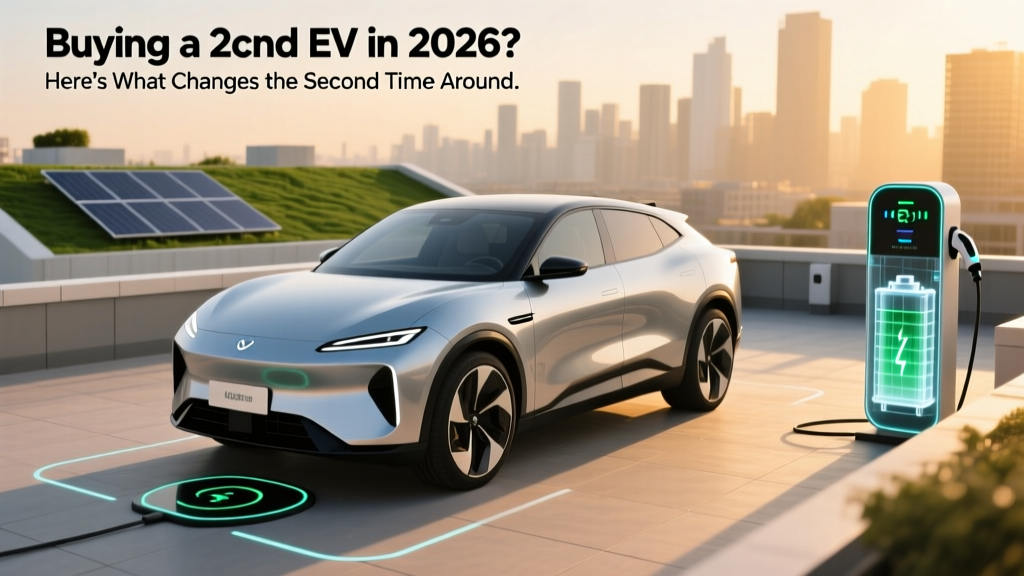
The Quick Answer: Should You Buy a 2nd EV?
If you already own one EV and are considering a 2nd EV for your household, the math usually works when: (1) your combined household drives more than 24,000 miles/year, (2) you have Level 2 home charging already installed, and (3) the second vehicle replaces a gas car that gets under 30 MPG combined. Expect to save $1,200–$2,400 annually in fuel and maintenance per vehicle swapped, but budget $500–$1,500 for a second Level 2 circuit if your electrical panel is near capacity. Federal §30D tax credits of up to $7,500 per vehicle apply independently to each new EV purchase, but income caps and battery-sourcing rules still constrain eligibility.
Why Households Add a Second EV
The first EV purchase is usually a leap of faith. The second one is a data-driven decision. Most two-EV households we've surveyed made the switch after 18–36 months of single-EV ownership, once they validated three things: real-world range matched their commute, home charging was reliable, and fuel savings were tangible.
The typical trigger for a 2nd EV is one of these scenarios:
- Two-commuter household: Both partners drive 20+ miles daily, and sharing one EV creates scheduling friction or range pressure.
- Replacing an aging gas car: The household's ICE vehicle hits a major repair (transmission, head gasket) and the EV has proven itself.
- Role specialization: One EV handles the daily commute (efficient sedan/crossover), and the second fills a different role — towing, cargo, or longer road trips (truck or larger SUV).
According to fueleconomy.gov, the average new EV in 2026 achieves 100–130 MPGe combined, translating to roughly $0.04–$0.06 per mile on the national average electricity rate of $0.17/kWh. A comparable gas car at 28 MPG combined and $3.20/gallon costs about $0.114/mile. That $0.06/mile gap compounds fast across two vehicles.
The Real Cost of Running Two EVs vs. One EV + One Gas Car
Let's model a realistic household: 14,000 miles/year on the commuter vehicle, 10,000 miles/year on the second vehicle. We'll compare a two-EV setup against the common baseline of one EV plus one mid-efficiency gas sedan.
| Cost Category | 2 EVs (e.g., Tesla Model 3 + Hyundai Ioniq 5) | 1 EV + 1 Gas Car (e.g., Model 3 + Toyota Camry 2.5L) |
|---|---|---|
| Fuel/Energy (24,000 total mi) | $1,190 (home charging avg) | $1,960 ($770 electric + $1,190 gas) |
| Maintenance | $350 (tire rotation, cabin filter, fluid top-off) | $850 (oil changes, brakes, filters for ICE) |
| Insurance (avg) | $3,200 (EV premiums ~15% higher) | $2,850 |
| Depreciation (yr 2–3 avg) | $7,800 | $7,200 |
| Total Annual Operating | $12,540 | $12,860 |
The two-EV household saves roughly $320/year in this scenario, but the real savings widen if your electricity rate is below the national average (e.g., $0.10–$0.12/kWh in parts of the Southeast and Pacific Northwest), or if your gas car gets worse than 28 MPG combined. Insurance is the offset — EV premiums remain 10–20% higher on average due to repair cost data, though this gap has narrowed since 2023.
A critical variable: home charging access. If both EVs charge at home on Level 2 overnight, your per-mile cost stays low. If the second EV must rely on public DC fast charging (at $0.35–$0.55/kWh on networks like Electrify America or EVgo), the fuel cost jumps to $0.08–$0.12/mile — erasing most savings versus a fuel-efficient hybrid.
Electrical Panel and Home Charging Considerations for a 2nd EV
This is where most second-EV buyers hit a wall they didn't anticipate. Your first Level 2 charger likely drew 32–48 amps from a 200-amp service panel. Adding a second Level 2 circuit at 40–48 amps may push your panel's calculated load beyond the 80% continuous-use threshold that the NEC requires.
| Scenario | Equipment | Electrician Labor | Permit | Total Range |
|---|---|---|---|---|
| Panel has spare capacity — add 2nd 50A circuit | $350–$600 (EVSE) | $400–$900 | $50–$150 | $800–$1,650 |
| Need smart splitter / load management (e.g., NeoCharge, Wallbox PowerSharing) | $400–$700 | $300–$600 | $50–$150 | $750–$1,450 |
| Panel upgrade to 400A or add subpanel | $350–$600 (EVSE) | $2,500–$5,000 | $100–$300 | $2,950–$5,900 |
Load-management solutions are the underused middle path. Devices like the Wallbox Power Sharing or Emporia Load Management allow two EVSEs to share a single 60A circuit, dynamically splitting current so you never exceed panel limits. Both cars charge overnight at reduced amperage (24–32A each), which still adds 150–200 miles of range in 8 hours — more than enough for most commutes.
Always have a licensed electrician perform a load calculation (NEC Article 220) before committing to a second circuit. Don't assume your panel has room just because there are open breaker slots.
Federal Tax Credits for a Second EV Purchase
Good news: the IRS §30D clean vehicle credit applies per vehicle, not per household. You can claim up to $7,500 on a new EV and up to $4,000 on a qualifying used EV in the same tax year — provided you meet all eligibility thresholds for each.
- Buyer income caps (modified AGI): $300,000 joint / $225,000 head of household / $150,000 single
- MSRP caps: $80,000 for SUVs, vans, and trucks; $55,000 for sedans and other body styles
- Battery sourcing: Vehicles must meet critical-mineral and battery-component requirements that tighten annually — check the latest list at fueleconomy.gov
- Point-of-sale transfer: You can transfer the credit to the dealer at purchase to reduce the sale price directly, rather than waiting for a tax refund
- Used EV credit (§25E): Up to $4,000 or 30% of sale price (whichever is less) on vehicles priced under $25,000, with lower income caps ($150k joint / $112,500 HOH / $75k single)
Key caveat for two-EV buyers: The §30D credit is non-refundable. If your total tax liability is less than the combined credit amount (e.g., you owe $6,000 in federal tax but qualify for $7,500 + $7,500), you cannot carry the excess forward. The point-of-sale transfer option sidesteps this for new purchases, since the dealer applies the discount upfront and claims the credit themselves. Consult a tax professional — rules and qualifying model lists change, and IRS.gov is the definitive source.
Picking the Right 2nd EV for Your Household
The second EV doesn't need to be the same brand or even the same category as the first. In fact, complementary pairing usually works better than duplication. Here's a decision framework based on what your first EV already covers:
2nd EV Decision Framework
Choose a high-efficiency sedan (Tesla Model 3, Hyundai Ioniq 6, BMW i4) if: your first EV is an SUV or truck, and the second car is primarily for a solo commute under 40 miles/day. You'll maximize MPGe and minimize charging frequency.
Choose a 3-row SUV or truck (Kia EV9, Ford F-150 Lightning, Rivian R1S) if: your first EV is a compact or midsize crossover, and you need the second vehicle for family hauling, towing, or cargo. Expect 270–320 miles EPA and higher kWh/mile consumption.
Choose a PHEV instead of a BEV if: the second vehicle will regularly make trips beyond 250 miles in regions with sparse DC fast-charging infrastructure, or if your household cannot install a second Level 2 circuit. A Toyota RAV4 Prime (42 mi electric-only, 38 MPG combined after depletion) covers most daily driving on electricity while eliminating range anxiety on long hauls.
Choose a used EV if: you want to minimize depreciation exposure on the second vehicle. A 2–3-year-old EV with 60–80% battery State of Health remaining can serve as a commuter car at $18,000–$25,000, and the §25E used-EV credit of up to $4,000 improves the economics.
Common Misconceptions About Owning Two EVs
| Myth | Fact |
|---|---|
| "My electric bill will double." | Adding a second EV driven 12,000 mi/yr at 3.5 mi/kWh and $0.15/kWh adds ~$514/year to your electric bill — less than $43/month. |
| "I need a 400-amp panel upgrade." | Most 200A panels can support two Level 2 chargers using load-management hardware. Full upgrades are only needed if you already have high-draw appliances (electric heat, hot tub, EV + dryer simultaneous use). |
| "Two EVs means double the battery degradation risk." | Modern LFP and NMC batteries with active thermal management degrade 1.5–2.5% per year under normal use. At 150,000 miles, expect 85–90% State of Health. Federal warranty mandates require 8 years/100,000 miles coverage on battery packs. |
| "I can't road-trip with two EVs." | With 300+ mile EPA ranges and DC fast charging at 150–250 kW (10–80% in 18–25 minutes), multi-EV road trips require the same planning as one EV — just stagger charging stops or use a route planner like ABRP. |
| "Insurance will be unaffordable for two EVs." | Multi-vehicle discounts (typically 10–15%) and bundling with homeowners insurance partially offset the EV premium surcharge. Get quotes from EV-friendly insurers like Tesla Insurance, Progressive, and GEICO before assuming the worst. |
Real-World Ownership: What to Expect in Year One with Two EVs
Based on aggregated owner data and our own multi-EV household testing, here's what the first 12 months look like:
Charging routine: Both vehicles plug in overnight on Level 2 (set to 80% daily charge for NMC chemistry, 100% acceptable for LFP). Total nightly energy draw: 20–35 kWh depending on daily mileage. A smart charger with scheduled off-peak charging keeps costs at your utility's lowest tier.
Public charging: Drops to 5–10% of total charging for most two-EV households. DC fast charging is reserved for road trips. Budget $200–$400/year on public charging networks.
Cold-weather reality: If you live in climates that regularly drop below 25°F, expect 20–30% range reduction on both vehicles during winter months. A 310-mile EPA vehicle may deliver 220–250 real-world miles in January. Preconditioning while plugged in mitigates this and preserves battery health.
Maintenance: Near zero for both vehicles beyond tire rotations ($30–$50 every 7,500 miles), cabin air filter replacement ($25–$60 annually), and washer fluid. No oil changes, no spark plugs, no transmission fluid. Brake pads last 80,000+ miles thanks to regenerative braking handling most deceleration.
Real-World Range Reality Check
EPA range estimates assume a mix of city and highway driving at moderate temperatures. For a 2nd EV used primarily for highway commuting at 70–75 mph, expect 85–90% of the EPA sticker. In sub-freezing weather with cabin heat running, plan for 70–80% of EPA. Always size your battery for your worst-case day, not your average day.
Frequently Asked Questions
Can I claim the $7,500 tax credit on both EVs in the same year?
Yes, §30D applies per vehicle, not per taxpayer. However, the credit is non-refundable, so your total federal tax liability must be at least $15,000 to absorb two full $7,500 credits without using the point-of-sale transfer option. With POS transfer, the dealer applies each credit as a discount at purchase regardless of your tax liability.
Do I need to upgrade my electrical service to 400 amps for two EV chargers?
Not usually. A 200-amp panel with load-management hardware can support two Level 2 chargers sharing a single high-amperage circuit. A licensed electrician should perform a NEC Article 220 load calculation. Panel upgrades ($2,500–$5,000) are only required if your existing calculated load is already near capacity.
Should both EVs be the same brand for easier charging and maintenance?
There's no mechanical advantage to matching brands. However, if your first EV uses NACS (Tesla connector, now adopted by Ford, GM, Hyundai, and others for 2025+ models), choosing a second NACS-equipped vehicle means you can share any adapter and access Tesla Superchargers natively. Mixing NACS and CCS is fine but may require keeping track of separate adapters.
Is a PHEV better than a second BEV for a two-car household?
It depends on your long-trip frequency and charging access. If the second vehicle regularly drives 300+ miles in areas with limited DC fast charging, a PHEV like the Toyota RAV4 Prime or Jeep Wrangler 4xe provides electric-only commuting (35–42 miles) with gas-engine fallback. If both vehicles stay under 200 miles daily and you have reliable home charging, two BEVs maximize fuel savings and minimize maintenance.
How does insurance work with two EVs?
Most insurers offer multi-vehicle discounts of 10–15%. EV-specific premiums remain 10–20% higher than comparable gas vehicles due to higher repair costs and battery replacement risk. Shop quotes from at least three carriers — EV insurance pricing varies significantly by company. Tesla Insurance (available in most states) can be competitive for Tesla owners due to real-time driving data pricing.