The Kia Niro EV Lease Equation: Monthly Payment vs. True Cost
Search engines are lighting up with Kia Niro EV lease specials in 2026, and it's easy to see why: advertised monthly payments in the mid-$200s make electrification look almost impulse-buy cheap. But a low lease payment is only one line item in a much longer receipt. Before you sign, you need the full arithmetic—federal tax credits, insurance premiums that run 15–30% higher than gas equivalents, home charging economics, and the Niro EV's stubborn depreciation curve.
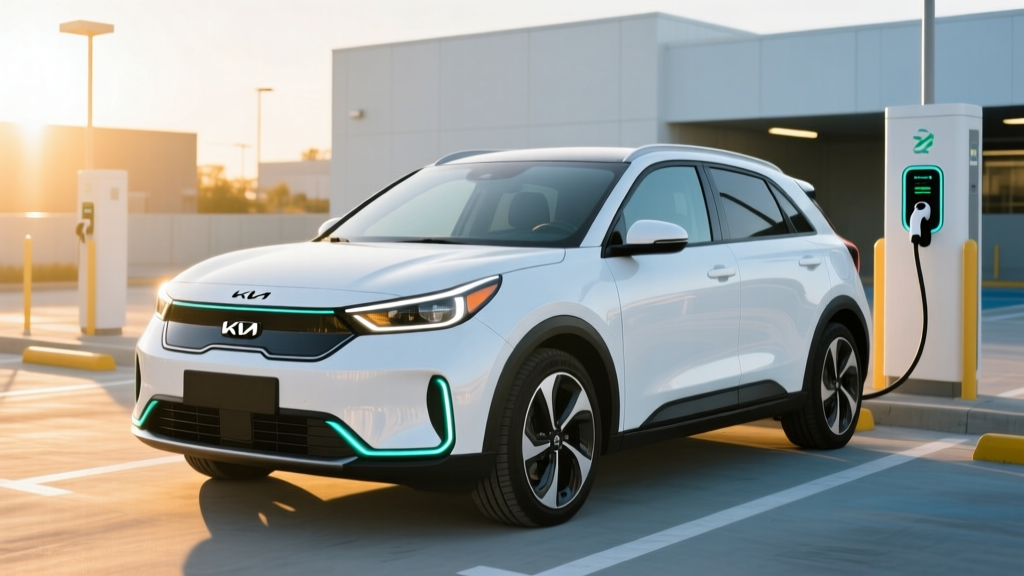
The 2026 Kia Niro EV carries a 64.8 kWh usable NMC battery pack, an EPA-estimated 239 miles of range, 201 horsepower, and a 130 kW peak DC fast-charge rate. Real-world highway range at 70 mph tends to land around 200–215 miles; drop the temperature below freezing and expect 170–185 miles. At a 150 kW DC charger, the 10–80% sprint takes roughly 44 minutes because the charge curve tapers hard past 60% state of charge. These numbers are perfectly adequate for commuting and regional travel, but they shape the Niro EV's ownership economics in ways lease ads never mention.
Federal Tax Credit Eligibility on the Niro EV
The IRS §30D clean vehicle credit offers up to $7,500, but the Kia Niro EV's eligibility depends on three moving targets that change regularly: your adjusted gross income, the vehicle's MSRP, and battery-component/critical-mineral sourcing requirements. For 2026, the Niro EV (MSRP starting around $40,875 for the Wind trim and $45,875 for the SX Touring) sits comfortably under the $55,000 SUV MSRP cap. However, the battery-sourcing rules have tightened yearly since 2023, and Kia's supply chain has shifted in response.
- Income caps: $150,000 single / $225,000 head of household / $300,000 married filing jointly (modified AGI)
- MSRP cap: $55,000 for SUVs/wagons (Niro EV qualifies at ~$40,875–$45,875)
- Battery components: Must be manufactured or assembled in North America (phased % thresholds increase annually)
- Critical minerals: Must be sourced from the US or free-trade-agreement countries (separate $3,750 half of credit)
- Point-of-sale transfer: Eligible buyers can apply the credit as a down-payment reduction at the dealer rather than waiting for tax filing
- Leasing loophole: §30D technically applies to the lessor, but many Kia dealers pass the benefit through as a capitalized-cost reduction—confirm in writing before signing
Source: IRS.gov §30D guidance. Rules are subject to change; consult a tax professional for your specific situation.
Here's the nuance that lease advertisers bury: when you lease an EV, the federal credit technically belongs to the leasing company (the vehicle's legal owner). Many manufacturers, including Kia through its captive lender, have been passing this benefit to lessees as a cap-cost reduction, effectively lowering the monthly payment. But this is not guaranteed by law—it's a competitive concession. Always verify with the dealer's F&I office that the $7,500 (or partial amount, if sourcing rules only qualify the Niro for $3,750) is being applied to your specific lease contract.
5-Year Total Cost of Ownership: Niro EV vs. Gas Compact Crossover
To evaluate whether those Kia Niro EV lease specials actually save money, we need a side-by-side comparison against a natural cross-shop rival: the gasoline Kia Seltos (a similarly sized, front-wheel-drive compact crossover). The numbers below assume 15,000 miles/year, 5-year ownership, $0.14/kWh home charging, $3.40/gallon regular unleaded, and the Niro EV qualifying for the full $7,500 credit.
| Cost Category (5 Years) | 2026 Niro EV (Wind) | 2026 Kia Seltos (Gas) |
|---|---|---|
| Purchase/Lease (net of credit) | $33,375 | $28,500 |
| Fuel / Electricity | $3,150 | $8,500 |
| Insurance | $10,400 | $7,800 |
| Maintenance & Repairs | $1,800 | $4,200 |
| Depreciation (estimated) | $18,500 | $11,200 |
| Total 5-Year Cost | $67,225 | $60,200 |
| Cost Per Mile | $0.896 | $0.803 |
The Niro EV trails by roughly $7,000 over five years in this scenario. That gap is driven almost entirely by depreciation and insurance—two costs that lease specials never show you. The fuel and maintenance savings are real and significant ($5,350 + $2,400 = $7,750 combined), but they don't fully offset the higher upfront cost, steeper depreciation, and elevated insurance premiums. If you keep the vehicle for 8–10 years, the math flips in the EV's favor. If you trade every three years, the gas crossover wins on pure economics.
Charging vs. Gasoline: The Per-Mile Fuel Math
The Niro EV's efficiency is one of its strongest ownership arguments. The EPA rates it at 113 MPGe combined, which translates to roughly 30 kWh per 100 miles. At a national-average residential electricity rate of $0.14/kWh, that's $0.042 per mile. A comparable gas crossover averaging 29 MPG combined at $3.40/gallon costs $0.117 per mile. That's nearly a 3:1 advantage for electrons over gasoline.
- Niro EV (home charging, $0.14/kWh): $0.042/mi → $630/year
- Niro EV (public DC fast charging, $0.40/kWh avg): $0.12/mi → $1,800/year
- Gas crossover (29 MPG, $3.40/gal): $0.117/mi → $1,755/year
Key insight: The Niro EV's fuel-cost advantage collapses if you rely primarily on public DC fast charging. Home Level 2 charging is where the economics work.
This is the hidden variable in every EV cost calculator: where you charge determines whether you save money or break even. If your home electrical panel supports a Level 2 charger installation ($500–$1,500 typical, depending on panel capacity and conduit runs), the Niro EV will cost roughly $1,125 less per year to fuel than a gas equivalent. Over a 36-month lease, that's $3,375 in fuel savings—roughly equivalent to the value of a few months' lease payments.
For EPA efficiency data on the Niro EV, the combined 113 MPGe figure is one of the best in the compact EV crossover segment, trailing only the Hyundai Kona Electric and Tesla Model Y in efficiency-per-mile.
Maintenance Savings: Where EVs Quietly Win
Internal-combustion maintenance costs compound over time in ways most owners don't track. The Niro EV eliminates oil changes, spark plugs, timing belts, fuel filters, and exhaust-system repairs. Its regenerative braking system handles most deceleration, extending brake pad life to 80,000–100,000 miles in typical driving—roughly triple the lifespan of pads on a gas crossover.
| Maintenance Item (5 yr / 75k mi) | Niro EV | Gas Crossover |
|---|---|---|
| Oil Changes (×10–15) | $0 | $750 |
| Brake Pads (1–2 sets) | $0–$350 | $800 |
| Transmission Fluid/Service | $0 | $300 |
| Engine Air Filter | $0 | $150 |
| Coolant / Spark Plugs | $0 | $450 |
| Tire Rotation / Cabin Filter | $600 | $600 |
| EV-Specific (battery check, thermal) | $250 | $0 |
| Total Estimated | ~$1,200 | ~$3,050 |
Kia backs the Niro EV's battery with a 10-year/100,000-mile warranty (capacity retention threshold: 70% of original capacity). That warranty covers the single largest potential repair cost in EV ownership, though it's worth noting that battery replacements outside warranty currently run $12,000–$18,000—a figure that matters if you plan to keep the vehicle past the warranty window.
The Insurance Premium Reality
Here's the line item that catches most first-time EV lessees off guard: insurance. The Niro EV typically costs 18–28% more to insure than its gasoline counterpart. National-average premiums run roughly $2,080/year for the Niro EV versus $1,560/year for the gas Seltos, though your actual rate depends on ZIP code, driving record, and coverage levels.
Why the premium? Three factors: (1) EVs have higher repair costs after collisions because battery-pack damage often triggers total-loss declarations even in moderate impacts; (2) the Niro EV's MSRP is higher than comparable gas crossovers, raising comprehensive/collision exposure; and (3) the specialized training and equipment required for high-voltage system repairs limits the number of approved body shops, driving up labor rates. Some insurers now offer EV-specific policies or discounts for vehicles with advanced driver-assistance systems (the Niro EV's Highway Driving Assist 2 is a Level 2 system), so it pays to quote at least three carriers before signing a lease.
Depreciation: The Silent Cost That Favors Gas (For Now)
EV depreciation has been volatile since 2022. A wave of manufacturer price cuts, rapidly improving battery technology, and shifting federal-credit rules have compressed used-EV values. The Niro EV is projected to retain roughly 42–48% of its MSRP after five years, compared to 58–62% for a comparable gas crossover. On a $40,875 Niro EV, that means an estimated $18,500–$21,000 in depreciation over five years versus $11,200–$13,500 for the gas alternative.
This gap is the single biggest reason the 5-year TCO tilts against the EV in our table above. However, there's a silver lining for lessees: if the leasing company (Kia Finance) sets the residual value too optimistically, the lessee benefits because they're only paying for the difference between MSRP and residual. If the lease residual is set at 50% and the Niro EV actually depreciates 55%, you've effectively gotten a discount. This is why lease specials can sometimes mask favorable economics that wouldn't exist in a purchase scenario.
- California: CVRP rebate up to $2,000 (income-dependent), plus utility rebates for home charger installation ($500–$1,500 from PG&E, SCE, SDG&E)
- Colorado: State tax credit up to $5,000 for EVs under $80,000 MSRP
- New York: Drive Clean Rebate up to $2,000 at point of sale
- Utility rebates: Many municipal utilities offer $250–$750 rebates for Level 2 charger purchase and off-peak charging rate plans
- HVAC/panel upgrades: Some utilities bundle EV charger rebates with electrical-panel upgrade assistance (check your local provider)
Incentive availability changes frequently. Check AFDC's state incentive database and your local utility's EV programs for current offerings.
Lease Specials vs. Purchase: A Decision Framework
The 2026 Kia Niro EV lease specials make sense for a specific buyer profile—and only that profile. Here's how to self-sort:
Choose the lease if:
- You drive 10,000–15,000 miles/year (within typical lease limits)
- You have reliable home Level 2 charging access
- The dealer confirms the $7,500 federal credit is applied as a cap-cost reduction
- You prefer swapping vehicles every 3 years and staying under warranty
- You live in a state with additional EV rebates that stack with federal credits
Choose to purchase (or skip the EV) if:
- You plan to keep the vehicle 7+ years (depreciation hurts less over time)
- You drive over 15,000 miles/year (lease penalties and battery wear add up)
- You lack home charging and would rely on public DC fast charging
- Your insurance quotes come back more than 35% above your current gas vehicle
- You cannot verify the federal credit is passing through to your contract
Frequently Asked Questions
How much does it really cost to own a Kia Niro EV over 5 years?
Approximately $67,225 over five years at 15,000 miles/year, including purchase price (net of $7,500 federal credit), electricity, insurance, maintenance, and depreciation. That works out to roughly $0.90/mile all-in. A comparable gas crossover costs about $60,200 over the same period ($0.80/mile). The gap narrows significantly if you keep the EV for 8+ years or benefit from strong state incentives.
Do I qualify for the $7,500 federal tax credit on the Niro EV?
Eligibility depends on your modified AGI (under $150K single / $300K joint), the vehicle's MSRP (under $55K for SUVs—Niro qualifies), and battery-sourcing compliance with current-year critical-mineral and component-manufacturing rules. The credit can be transferred at point of sale as a down-payment reduction. When leasing, the credit technically belongs to the lessor; confirm with the dealer that Kia is passing the full benefit through to your lease contract. Always check IRS.gov for the most current rules.
How much do I save on fuel and maintenance with the Niro EV?
Fuel savings run roughly $1,125/year ($3.30/gallon gas vs. $0.14/kWh home electricity at 15,000 miles/year), totaling $5,625 over five years. Maintenance savings add another $2,400 over the same period, driven by eliminated oil changes, extended brake-pad life from regenerative braking, and no engine-related service items. Combined, that's approximately $8,000 in operational savings—significant, but not enough to fully offset the higher purchase price and insurance premiums in a 5-year window.
Are EVs more expensive to insure than gas cars?
Yes, typically 18–28% more for the Niro EV versus a gas compact crossover. Higher collision-repair costs (battery-pack sensitivity), elevated MSRP, and specialized repair requirements drive the premium. Expect quotes around $2,080/year for the Niro EV versus $1,560/year for a gas equivalent, though rates vary significantly by ZIP code and driver profile. Always quote three or more insurers, including those offering EV-specific or ADAS-discount programs.
How well does the Kia Niro EV hold its value?
Projected 5-year retention is 42–48% of MSRP—below the 58–62% retention of comparable gas crossovers. On a $40,875 Niro EV, expect $18,500–$21,000 in depreciation over five years. This is the largest single cost disadvantage in EV ownership today. However, for lessees, favorable lease-residual settings can partially shield you from this depreciation if the leasing company overestimates the vehicle's future value.
What happens if the Niro EV battery degrades during my lease?
Kia's 10-year/100,000-mile battery warranty (70% capacity retention threshold) covers the full term of any standard 36-month lease. Normal degradation over three years is typically 5–8%, well above the warranty threshold. You won't face battery-replacement costs as a lessee unless the vehicle sustains physical damage to the pack (which would be covered under your collision/comprehensive insurance).
Is home charging installation included in Kia Niro EV lease specials?
Generally no. Most lease specials cover only the vehicle itself. Home Level 2 charger installation typically costs $500–$1,500 depending on your electrical panel capacity and conduit run length. Some Kia dealerships partner with charger-installation networks and offer bundled deals, and many utilities offer $250–$750 rebates. Factor installation into your total first-year cost.
Data sources: EPA Fuel Economy, IRS §30D Clean Vehicle Credits, Kia Motors America spec sheets. All pricing, efficiency, and incentive figures reflect 2026 model-year data and are subject to change. Consult a tax professional for credit-eligibility confirmation.