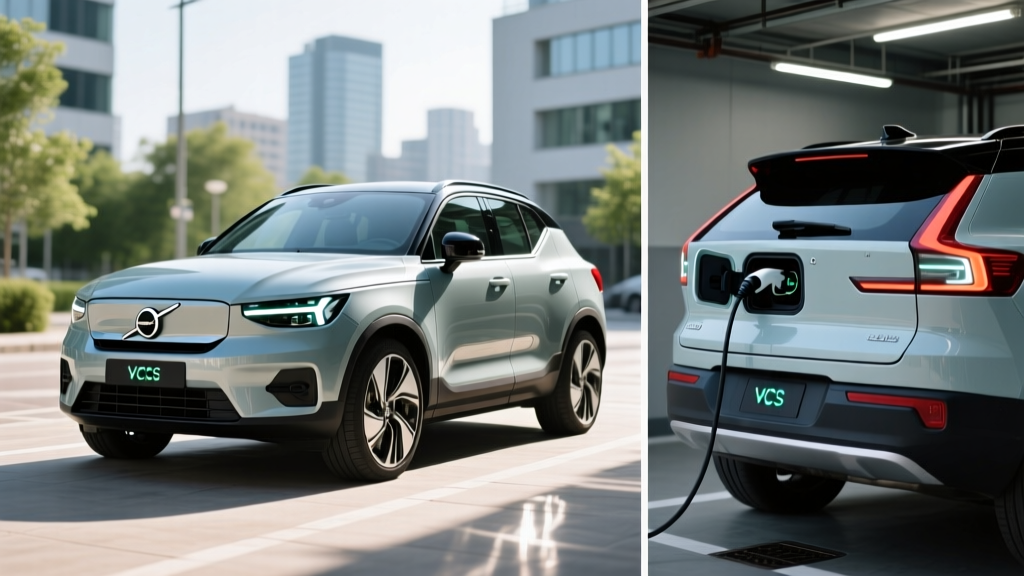
If you head to Volvo's configurator today to build a Volvo XC40 Recharge, you will face a deceptively simple set of choices: single-motor rear-wheel drive or twin-motor all-wheel drive, and one of three trim tiers. But behind those choices sit meaningful differences in EPA range, charging speed, federal tax-credit eligibility, and real-world usability. This guide walks through every spec that matters before you lock in your order.
| Spec | Single Motor (RWD) | Twin Motor (AWD) |
|---|---|---|
| EPA Range | 293 mi | 254 mi |
| Battery (usable) | 82 kWh, NMC | 82 kWh, NMC |
| Horsepower | 248 hp | 402 hp |
| 0–60 mph | 6.9 sec | 4.5 sec |
| Peak DC Fast Charge | 200 kW | 200 kW |
| 10–80% DCFC Time | ~28 min | ~28 min |
| Level 2 Home Charge (kW) | 11 kW | 11 kW |
| Combined MPGe | 97 MPGe | 87 MPGe |
| Drivetrain | RWD | AWD (dual-motor) |
| Battery Warranty | 8 yr / 100,000 mi | 8 yr / 100,000 mi |
Real-World Range vs. EPA Sticker
Real-world expectation: 240–265 mi highway (RWD); 205–230 mi highway (AWD). In sub-freezing temps, subtract another 15–25%.
The EPA numbers on the window sticker assume a mix of city and highway driving at moderate temperatures. In our experience with the 82 kWh NMC pack, highway-heavy trips at 70–75 mph push consumption up to roughly 34–37 kWh/100 mi in the Twin Motor variant, translating to about 220 miles before you hit a comfortable 10% buffer. The Single Motor RWD model does measurably better — around 30–32 kWh/100 mi at highway speeds — because it sheds the weight and drag of the front motor.
Cold weather is the bigger wildcard. Volvo's heat pump (standard on the Recharge) mitigates cabin-heating energy draw, but lithium-ion chemistry itself becomes less efficient below freezing. Plan for 15–25% range reduction in sustained 20–30°F conditions, meaning the AWD model may dip below 200 miles of usable range on a frigid January road trip. Preconditioning the battery while plugged in — using the Volvo Cars app to warm the pack before departure — recovers a meaningful portion of that loss.
Charging Speed: DC Fast Charge and Home Level 2
The XC40 Recharge uses a CCS1 connector (CCS2 in Europe) and supports a peak DC fast-charge rate of 200 kW. On a 350 kW Electrify America or Ionity station with a good thermal precondition, the pack ramps quickly to about 150–170 kW and sustains that through the 40–60% state-of-charge window before tapering. The result: a 10–80% charge in approximately 28 minutes under favorable conditions.
Above 80% SoC, the charge curve drops sharply — a characteristic of NMC chemistry protecting long-term cell health. Charging from 80–100% can add another 20+ minutes, so road-trip strategy favors shorter, more frequent stops between 10% and 80% rather than topping off completely.
| Charging Level | Power (kW) | Miles of Range per Hour | Typical Use Case |
|---|---|---|---|
| Level 1 (120V) | ~1.4 kW | ~4 mi/hr | Overnight trickle, emergencies |
| Level 2 (240V, 48A) | 11 kW | ~33 mi/hr | Home daily charging |
| DC Fast Charge | Up to 200 kW | ~150+ mi in 15 min | Road trips, highway stops |
At home on a Level 2 wallbox (such as the ChargePoint Home Flex or Wallbox Pulsar Plus wired to a 60A circuit), the onboard 11 kW charger replenishes the full 82 kWh pack in roughly 8 hours — easily enough for overnight top-ups. Most XC40 Recharge owners report 20–40 miles of daily driving, meaning a nightly Level 2 session uses only a fraction of the battery and keeps the pack in its healthiest 20–80% SoC window.
Trims, Pricing, and How to Build Yours
Volvo offers the 2026 XC40 Recharge in three trims. Here is what you are choosing between when you build a Volvo XC40 Recharge on the configurator:
| Trim | Drivetrain | Base MSRP | Key Additions |
|---|---|---|---|
| Core | RWD or AWD | $53,550 (RWD) / $56,050 (AWD) | Google built-in, 12" digital cluster, Pilot Assist |
| Plus | RWD or AWD | $56,550 (RWD) / $59,050 (AWD) | Panoramic roof, 360° camera, wireless phone charging pad |
| Ultimate | AWD only | $62,350 | Harman Kardon audio, head-up display, pixel LED headlights |
The $1,195 destination charge applies across all trims. A fully loaded Ultimate with metallic paint and the Climate Package (heated rear seats, heated steering wheel) lands around $64,800 out the door before incentives. The sweet spot for value is the Plus Bright RWD at roughly $57,745 delivered — it captures the longest-range powertrain and the most-requested comfort features without pushing into luxury-SUV pricing territory.
Federal Tax Credit Eligibility (§30D Rules)
| Factor | Requirement | XC40 Recharge Status |
|---|---|---|
| MSRP Cap (SUVs) | ≤ $80,000 | ✅ All trims qualify |
| Buyer AGI Limit | $150K single / $300K joint | Varies by buyer |
| Battery Component Sourcing | North American assembly threshold | ⚠️ Partial — check current-year IRS guidance |
| Critical Minerals | Sourcing from FTA partners | ⚠️ Partial — may qualify for $3,750 or full $7,500 |
| Point-of-Sale Transfer | Dealer-applied at purchase | Available if credit applies |
The XC40 Recharge is assembled in Ghent, Belgium. Under current IRS §30D sourcing rules, this can limit the credit to $3,750 (meeting one of the two sourcing thresholds) or potentially the full $7,500 depending on the model year's battery-mineral supply chain. The MSRP cap for SUVs is $80,000 — every XC40 Recharge trim clears that. Income caps ($300,000 joint / $150,000 single) apply to the buyer.
Critical caveat: Battery-sourcing requirements tighten annually. Always verify your specific VIN's credit eligibility on the IRS qualified-vehicles list before signing a purchase agreement. The credit can now be transferred to the dealer at point of sale, reducing your out-of-pocket cost immediately rather than waiting for a tax refund.
Performance and Driving Dynamics
The Twin Motor AWD variant delivers 402 horsepower and 494 lb-ft of torque, reaching 60 mph in 4.5 seconds. That is genuinely quick for a compact luxury crossover and makes highway merging and passing effortless. The Single Motor RWD model produces 248 hp and 361 lb-ft, hitting 60 mph in 6.9 seconds — adequate for daily commuting but noticeably less urgent when you need a burst of acceleration.
Ride quality is firm but controlled, typical of Volvo's Scandinavian tuning philosophy. The low center of gravity from the floor-mounted battery pack keeps body roll in check through corners. Regenerative braking offers a one-pedal driving mode that is strong enough to bring the car to a complete stop in traffic, though it lacks the adjustable regen levels found in Hyundai/Kia EVs. The steering is light and precise — ideal for urban maneuvering but somewhat detached on winding back roads.
Interior, Cargo, and Tech
Inside, the XC40 Recharge seats five with 40.9 inches of front legroom and 36.1 inches in the rear — competitive with the BMW iX1 and slightly tighter than the Tesla Model Y's second row. Cargo volume behind the rear seats is 16.0 cubic feet, expanding to 47.2 cu ft with the 60/40 split rear seats folded. There is a modest front trunk (frunk) offering about 1.1 cu ft — enough for charging cables and a small bag.
The infotainment system runs Google built-in (Android Automotive OS), meaning Google Maps, Google Assistant, and the Play Store are native to the car. Navigation with real-time charge-point routing is excellent, automatically preconditioning the battery when a DC fast charger is set as your destination. Apple CarPlay is supported wirelessly. The 12-inch digital instrument cluster and 9-inch center touchscreen are responsive, though the reliance on touchscreen controls for climate and seat heating can be distracting while driving.
Driver assistance comes via Volvo's Pilot Assist, a Level 2 system providing adaptive cruise control with lane centering. It works well on highways but requires hands on the wheel and does not support hands-free operation like GM's Super Cruise or Ford's BlueCruise. The XC40 Recharge also includes run-off-road protection, intersection auto-braking, and a 360° surround-view camera (Plus trim and above).
Who Should Buy the XC40 Recharge?
Choose the Twin Motor AWD if: You need all-weather traction, tow occasionally (up to 2,000 lbs rated), or want the 4.5-second 0–60 performance for highway merging.
Look elsewhere if: You need 300+ miles of real-world highway range (consider the Tesla Model Y Long Range or Hyundai Ioniq 5), want hands-free highway driving (Ford Mustang Mach-E with BlueCruise), or require third-row seating.
The XC40 Recharge is strongest as a premium urban and suburban daily driver. Its compact footprint makes it easy to park, its Google-native infotainment is among the best in the segment, and Volvo's safety engineering is industry-leading. It is less ideal for cross-country road trippers who need maximum range or for families who have outgrown a compact crossover.
Pros and Cons at a Glance
- Premium Scandinavian interior with excellent material quality
- Google built-in infotainment is fast and intuitive
- 200 kW DC fast charging is competitive for the segment
- Top IIHS safety ratings; standard Pilot Assist L2 features
- Heat pump standard — better cold-weather range retention
- Point-of-sale tax credit transfer reduces upfront cost
- AWD range (254 mi EPA) falls short of key rivals
- Rear-seat legroom is tighter than Model Y or Ioniq 5
- No hands-free driving mode (only hands-on Pilot Assist)
- Belgian assembly may limit federal tax credit to $3,750
- Touchscreen-heavy climate controls distract while driving
- Frunk is tiny (1.1 cu ft) — barely fits charge cables
Frequently Asked Questions
What is the real-world range of the Volvo XC40 Recharge?
The EPA rates the Single Motor RWD at 293 miles and the Twin Motor AWD at 254 miles. In real-world highway driving at 70–75 mph, expect roughly 240–265 miles from the RWD and 205–230 miles from the AWD. Cold weather (below 32°F) can reduce those figures by an additional 15–25%. Preconditioning the battery while plugged in helps recover some of that loss.
How fast does the XC40 Recharge charge at home and on the road?
On a DC fast charger, the XC40 Recharge peaks at 200 kW and charges from 10–80% in approximately 28 minutes under optimal conditions. At home on a Level 2 wallbox (11 kW / 48A), a full charge takes about 8 hours, or roughly 33 miles of range per hour of charging. A standard 120V outlet adds only about 4 miles per hour — suitable for emergencies or very low-mileage drivers.
Does the Volvo XC40 Recharge qualify for the $7,500 federal tax credit?
It depends on your income, the specific model year's battery sourcing, and the IRS's current qualified-vehicle list. The XC40 Recharge's MSRP is well under the $80,000 SUV cap, but Belgian assembly and battery-mineral sourcing may limit the credit to $3,750 rather than the full $7,500. Income limits ($300K joint / $150K single) also apply. Check the IRS qualified clean vehicles page for the latest eligibility by VIN before purchasing.
How much does a fully loaded XC40 Recharge cost?
A 2026 XC40 Recharge Ultimate AWD with metallic paint and the Climate Package comes in around $64,800 including destination. After a potential $3,750–$7,500 federal credit (depending on eligibility), the effective price drops to roughly $57,300–$61,050. State and local incentives may reduce this further — check fueleconomy.gov for current incentive data.
Is the XC40 Recharge worth buying vs. the Tesla Model Y or Hyundai Ioniq 5?
The XC40 Recharge wins on interior luxury, build quality, and safety credentials. The Tesla Model Y Long Range offers significantly more EPA range (310+ mi), more cargo space, and access to the Supercharger network (though Volvo now supports NACS adapters). The Hyundai Ioniq 5 charges faster (up to 350 kW on 800V architecture) and offers more rear-seat room. If premium materials and Volvo's safety reputation matter most, the XC40 Recharge is a strong choice. If range and charging speed are your top priorities, test-drive the Ioniq 5 and Model Y first.
What is the battery warranty on the XC40 Recharge?
Volvo covers the high-voltage battery and electric powertrain for 8 years or 100,000 miles, whichever comes first. The warranty guarantees that the battery will retain at least 70% of its original capacity during that period. Volvo's NMC cells have demonstrated moderate degradation in real-world use — most owners report 5–8% capacity loss over the first 60,000 miles, well within warranty thresholds.