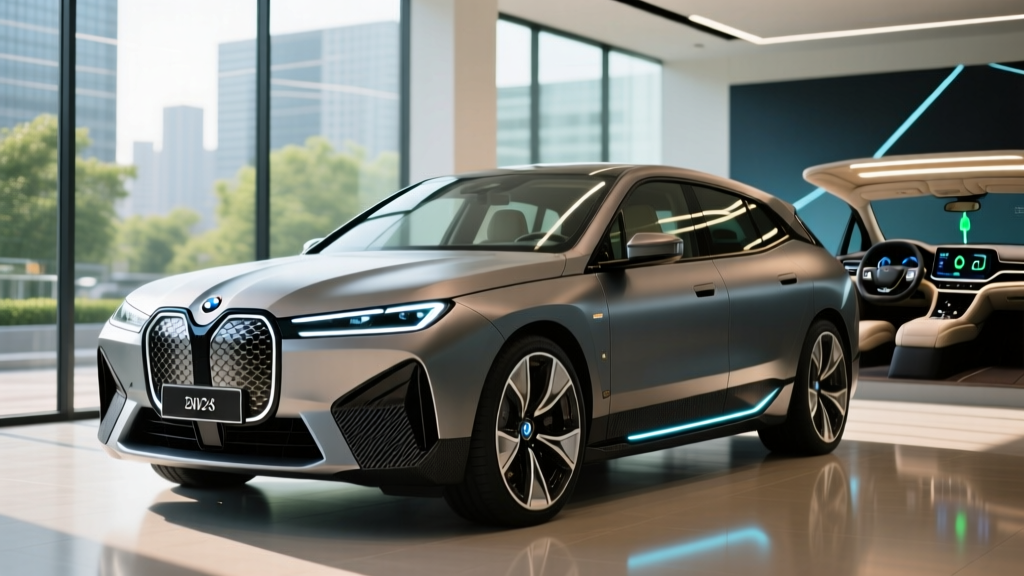
If you've landed on BMW's configurator and started clicking through paint swatches and wheel options, you already know the 2026 BMW iX is a tech-dense luxury electric SUV. But before you finalize your build, you need hard data on what each trim actually delivers in range, charging speed, and out-the-door cost after incentives. This guide walks through every meaningful decision in the build BMW iX process — from battery chemistry to federal tax credit eligibility — so your configuration matches your real-world driving needs.
2026 BMW iX Lineup: Trim-by-Trim Breakdown
BMW restructured the iX lineup for the 2026 model year, introducing the xDrive45 as a more accessible entry point while retaining the high-volume xDrive50 and the performance-oriented M60. All three use variations of BMW's fifth-generation eDrive architecture with dual-motor all-wheel drive, but the battery packs and motor outputs differ significantly.
| Specification | xDrive45 | xDrive50 | M60 |
|---|---|---|---|
| Drivetrain | Dual-motor AWD | Dual-motor AWD | Dual-motor AWD |
| Horsepower | 402 hp | 516 hp | 610 hp |
| 0–60 mph | 4.9 sec | 4.4 sec | 3.6 sec |
| Battery (usable) | ~100 kWh (NMC) | ~105.2 kWh (NMC) | ~105.2 kWh (NMC) |
| EPA Range | 312 mi | 324 mi (20" wheels) | 288 mi (21" wheels) |
| MPGe (combined) | 87 MPGe | 86 MPGe | 78 MPGe |
| Max DC Fast Charge | 195 kW | 195 kW | 195 kW |
| 10–80% DC Time | ~34 min | ~34 min | ~34 min |
| Level 2 Rate (11 kW) | ~31 mi/hr | ~31 mi/hr | ~31 mi/hr |
| Base MSRP | $87,250 | $92,450 | $111,500 |
The battery chemistry across the lineup is NMC (nickel manganese cobalt), not LFP. This gives the iX higher energy density — important in a heavy luxury SUV — but means BMW recommends keeping daily charge limits around 80–90% for longevity, reserving 100% for road trips. BMW's battery management system includes a top-end buffer to protect against overcharge degradation.
Real-World Range: What the EPA Sticker Doesn't Tell You
xDrive50 (20" wheels): EPA 324 mi → Expect ~275–295 mi on highway-heavy trips at 70–80 mph; ~240–260 mi in freezing temperatures (below 32°F) with cabin heating.
M60 (21" wheels): EPA 288 mi → Expect ~245–260 mi highway; ~210–230 mi in cold weather.
xDrive45: EPA 312 mi → Expect ~265–280 mi highway; ~230–250 mi cold.
Source: fueleconomy.gov
The iX is a heavy vehicle — curb weight exceeds 5,600 lbs across all trims — and that mass shows up most at sustained highway speeds and in cold weather. The heat pump (standard on 2026 models) mitigates cold-weather range loss compared to resistive heating, but you should still budget 20–25% range reduction when temperatures drop below freezing. If your commute is primarily city driving with frequent regenerative braking opportunities, you'll land closer to or even slightly above the EPA combined figure.
Wheel choice matters enormously in your build. The xDrive50's 324-mile EPA rating applies to the standard 20-inch Aero wheels. Selecting 21- or 22-inch sport wheels drops that figure by 10–20 miles. For maximum range, resist the urge to upgrade wheels.
Charging Speed: DC Fast Charging and Home Level 2
BMW equips every 2026 iX with a CCS1 charge port (with NACS adapter availability through BMW's charging partnership expanding through 2026). The DC fast-charging peak is 195 kW — competitive but not class-leading. Here's what that means in practice:
| Charging Level | Power (kW) | Speed (miles of range per hour) | Typical Use Case |
|---|---|---|---|
| Level 1 (120V household) | 1.4 kW | ~4 mi/hr | Emergency / overnight trickle |
| Level 2 (240V, 48A home charger) | 11 kW | ~31 mi/hr | Daily home charging — full charge in ~10 hrs |
| DC Fast Charge (peak) | 195 kW | ~550 mi/hr (at peak) | Road trips — 10–80% in ~34 min |
The 195 kW peak is not sustained across the entire charging session. Like all EVs, the iX follows a charging curve that tapers significantly above 80% State of Charge. You'll see the highest charge rates between roughly 10–50% SoC, where the battery can absorb close to peak power. Above 80%, charging slows dramatically to protect the NMC cells — a 10–90% session will take considerably longer than 10–80%. For road trips, plan your stops around the 10–80% window for maximum efficiency.
At home on a Level 2 Wallbox or BMW Wallbox Professional (11 kW / 48 amps), a full overnight charge adds roughly 310 miles in about 10 hours — more than enough for daily replenishment. If your home electrical panel supports a 60-amp circuit (required for a 48-amp continuous charger), expect installation costs between $800 and $2,000 depending on run length and whether a panel upgrade is needed.
Pricing, Configuration Costs, and Federal Tax Credit Eligibility
When you build a BMW iX, options add up fast. Here's the pricing landscape before incentives:
| Trim | Base MSRP | Destination | Typical As-Tested |
|---|---|---|---|
| xDrive45 | $87,250 | $995 | $92,000–$98,000 |
| xDrive50 | $92,450 | $995 | $98,000–$108,000 |
| M60 | $111,500 | $995 | $115,000–$130,000 |
Popular options that inflate the build price include the Premium Package (~$3,400), Driving Assistance Professional (~$2,500), Bowers & Wilkins Diamond Surround Sound (~$4,400), and 22-inch wheels (~$2,300). A fully optioned xDrive50 can easily cross $110,000.
Federal Tax Credit: Does the iX Qualify for §30D?
This is where the build gets complicated. Under the IRS §30D Clean Vehicle Credit rules effective for 2026, new EV eligibility hinges on three gates:
- MSRP Cap: SUVs must be at or below $80,000 MSRP. The iX xDrive45 starts at $87,250 — above the cap.
- Battery Component & Critical Mineral Sourcing: Increasingly strict percentages of battery components must be manufactured or assembled in North America, and critical minerals must be sourced from the U.S. or FTA partners.
- Buyer Income Limits: Modified AGI must not exceed $150,000 (single), $225,000 (head of household), or $300,000 (joint filing).
As of the 2026 model year, no BMW iX trim qualifies for the full $7,500 federal tax credit at purchase because the base MSRP on every trim exceeds the $80,000 SUV cap. The IRS §30D rules are firm on this threshold. However, the used EV credit (up to $4,000 under §25E) may apply if you purchase a qualifying pre-owned iX from a dealer, subject to a $25,000 used-sale-price cap and lower income thresholds. Always verify current eligibility with a tax professional before relying on credit assumptions.
Interior Space, Cargo, and Daily Practicality
The iX sits on BMW's dedicated EV platform, which means a flat floor and generous cabin dimensions. Here's what you get:
- Front legroom: 40.2 inches
- Rear legroom: 38.5 inches — comfortably fits adults on long trips
- Cargo behind rear seats: 35.5 cu ft
- Cargo with rear seats folded: 77.9 cu ft
- Frunk: None — the iX does not offer a front trunk, a missed opportunity given the dedicated EV platform
The cabin is a standout. The curved BMW iDrive display (14.9" touchscreen + 12.3" instrument cluster running iDrive 8.5) dominates the dash, and the hexagonal steering wheel, panoramic electrochromic roof, and available Shy Tech (hidden speakers and vents that appear only when activated) make the interior feel genuinely next-generation. Rear seat comfort is excellent, with available heated and ventilated outboard seats.
One practicality note: the iX does not have a frunk. If front-trunk storage is a priority (for charging cables, groceries, or luggage), competitors like the Rivian R1S and Ford Mustang Mach-E offer this.
Driver Assistance and Standout Technology
The BMW iX's Driving Assistance Professional package provides hands-off-capable highway driving at speeds up to 85 mph on divided highways (with driver eye monitoring). This is SAE Level 2 — the driver must remain attentive and ready to take over at any time. This is not autonomous or "self-driving" capability.
Beyond the ADAS suite, the iX packs notable technology:
- BMW iDrive 8.5: Quick-select interface, wireless Apple CarPlay/Android Auto, over-the-air updates
- Augmented Reality Navigation: Overlays directional arrows on a live camera feed of the road ahead
- Parking Assistant Professional: Automated parking with remote maneuver assist (move the car in/out of tight spots via smartphone)
- Highway Assistant: Hands-off driving up to 85 mph on qualifying divided highways with eye-tracking confirmation
- IconicSounds Electric: Hans Zimmer-composed drive soundscapes (optional — and polarizing)
The Highway Assistant is genuinely impressive for long interstate slogs, but its limitations are real: it disengages in construction zones, on non-divided roads, and when lane markings degrade. Treat it as a fatigue-reducer, not a replacement for attention.
How the BMW iX Stacks Up Against Key Competitors
| Attribute | BMW iX xDrive50 | Mercedes EQE SUV 350+ | Audi Q8 e-tron Prestige | Rivian R1S Dual-Motor |
|---|---|---|---|---|
| EPA Range | 324 mi | 305 mi | 285 mi | 352 mi |
| 0–60 mph | 4.4 sec | 6.4 sec | 5.4 sec | 5.0 sec |
| Max DC Charge | 195 kW | 170 kW | 170 kW | 200+ kW |
| Base MSRP | $92,450 | $79,050 | $78,400 | $82,700 |
| Cargo (rear up) | 35.5 cu ft | 52.0 cu ft | 28.5 cu ft | 46.7 cu ft (frunk + rear) |
| 3rd Row | No | No | No | Yes (optional) |
| §30D Credit Eligible | No (MSRP cap) | Potentially* | Potentially* | Yes (some configs)* |
*Credit eligibility depends on battery sourcing, buyer income, and exact MSRP of configured trim. Verify at IRS.gov and fueleconomy.gov.
The iX wins on charging speed, acceleration, and interior technology. It loses on cargo volume (the EQE SUV's hatch is far larger), third-row availability (Rivian only), and tax credit eligibility. If your build budget is firm below $80,000 and you want the §30D credit, the iX is eliminated on price alone.
Warranty Coverage and Long-Term Ownership
BMW backs the 2026 iX with its standard EV warranty package:
- Battery warranty: 8 years / 100,000 miles (capacity retention threshold: 70% of original)
- Powertrain warranty: 8 years / 100,000 miles
- Bumper-to-bumper: 4 years / 50,000 miles
- Complimentary maintenance: 3 years / 36,000 miles
The 70% battery capacity retention guarantee is industry-standard (matching Tesla, Ford, and Hyundai). Real-world NMC degradation data from earlier iX models suggests most owners will retain 90%+ capacity through the first 50,000 miles with normal charging habits — avoiding frequent DC fast charging above 90% SoC and minimizing prolonged storage at 100%.
Insurance costs run higher than average for the segment. Expect annual premiums between $2,400 and $3,800 depending on your profile and state, driven by the iX's repair costs and parts pricing. Get quotes before signing a purchase agreement.
- Class-leading interior quality and technology
- 324-mile EPA range on xDrive50 is competitive
- 195 kW DC charging — faster than EQE and Q8 e-tron
- Refined ride quality with adaptive air suspension
- Highway Assistant (hands-off Level 2) up to 85 mph
- Spacious rear seat with flat floor
- No trim qualifies for §30D federal tax credit (MSRP cap)
- No frunk — unusual for a dedicated EV platform
- Cargo space trails EQE SUV and Rivian R1S
- Controversial exterior styling (large kidney grille)
- High starting price; options push xDrive50 past $110K
- NMC battery requires mindful charging habits for longevity
Who Should Build a BMW iX?
Skip the iX if: You need three rows, you're counting on the $7,500 federal credit, you regularly haul large cargo (consider the EQE SUV), or you frequently drive in extreme cold where the 324-mile range drops to ~240 miles.
The ideal iX buyer is a two-adult household (or young family) with a daily commute under 80 miles, access to home Level 2 charging, and the budget to absorb the premium without relying on incentives. The xDrive50 with 20-inch Aero wheels is the sweet-spot build: maximum range, strong acceleration, and a reasonable as-tested price around $100,000.
Frequently Asked Questions
What is the real-world range of the 2026 BMW iX?
The xDrive50 carries a 324-mile EPA rating with 20-inch wheels. In real-world highway driving at 70–80 mph, expect 275–295 miles. In freezing temperatures with cabin heat, plan for 240–260 miles. City driving with regenerative braking can approach or slightly exceed the EPA figure.
How fast does the BMW iX charge at home and on the road?
On a DC fast charger, the iX peaks at 195 kW and charges from 10–80% in approximately 34 minutes. At home on a Level 2 charger (11 kW / 48A), it adds roughly 31 miles of range per hour, completing a full charge in about 10 hours.
Does the 2026 BMW iX qualify for the $7,500 federal EV tax credit?
No. Under current IRS §30D rules, SUVs must have an MSRP at or below $80,000 to qualify. Every 2026 iX trim starts above $87,000, making it ineligible for the new-vehicle credit. A used iX may qualify for the up-to-$4,000 §25E credit if the sale price is $25,000 or below and buyer income limits are met.
Is the BMW iX worth buying over the Mercedes EQE SUV or Rivian R1S?
The iX leads in interior technology, charging speed, and acceleration. The EQE SUV offers substantially more cargo volume and a lower starting price. The R1S provides a third row, more range, and potential tax credit eligibility. Your priority — tech and refinement vs. space and value — determines the winner.
What battery chemistry does the BMW iX use?
All 2026 iX trims use NMC (nickel manganese cobalt) lithium-ion cells with a usable capacity of approximately 100–105 kWh depending on trim. NMC provides high energy density but benefits from daily charge limits of 80–90% to maximize long-term health.
Does the iX have a front trunk (frunk)?
No. Despite riding on a dedicated EV platform, BMW did not include a frunk in the iX. Charging cables and accessories must be stored in the rear cargo area.
Sources: EPA fueleconomy.gov, IRS §30D Credit Amounts, BMW USA iX