Is Buick Going Electric? Here's What Buyers Need to Know
Buick's electric lineup for 2026 centers on the Electra E5 (a midsize SUV) and the Electra E4 (a coupe-styled variant), both built on GM's Ultium platform. The Electra E5 delivers an EPA-estimated 303 miles of range, DC fast charging up to ~150 kW (10–80% in approximately 28 minutes), and starts at roughly $38,900 MSRP. The Electra E4 offers around 285 miles EPA and starts near $34,900. Neither model currently qualifies for the full $7,500 federal §30D tax credit due to battery-sourcing requirements, though partial credits may apply depending on your income and the vehicle's critical-minerals compliance. For buyers searching "Buick electric," these two models represent the brand's full EV commitment — no more gasoline-only Buicks are being developed for future model years.
The 2026 Buick Electric Lineup: Electra E5 and E4 at a Glance
Buick has staked its future on electrification. After discontinuing the Encore GX as a long-term strategy and pivoting toward the Electra nameplate, the brand now offers two dedicated battery-electric vehicles (BEVs) for the U.S. market. Both ride on the same GM Ultium architecture that underpins the Cadillac Lyriq and Chevrolet Blazer EV, meaning you're getting proven hardware beneath Buick's quieter, more comfort-oriented tuning.
| Spec | Electra E5 (Preferred / Avenir) | Electra E4 (Preferred / Sport Touring) |
|---|---|---|
| EPA Range | 303 mi (FWD) / 280 mi (AWD) | 285 mi (FWD) / 260 mi (AWD) |
| Battery (usable) | ~85 kWh, NMC lithium-ion | ~79 kWh, NMC lithium-ion |
| Drivetrain / HP | FWD 201 hp / AWD 283 hp | FWD 201 hp / AWD 283 hp |
| 0–60 mph | ~7.5 s (FWD) / ~6.0 s (AWD) | ~7.3 s (FWD) / ~5.8 s (AWD) |
| DC Fast Charge (peak) | ~150 kW | ~150 kW |
| 10–80% DCFC Time | ~28 min | ~26 min |
| Level 2 AC Charge | 11.5 kW (~37 mi/hr) | 11.5 kW (~37 mi/hr) |
| MPGe (combined) | ~96 MPGe | ~100 MPGe |
| Starting MSRP | $38,900 | $34,900 |
| Battery/Powertrain Warranty | 8 yr / 100,000 mi | 8 yr / 100,000 mi |
Real-world range caveat: The EPA 303-mile figure for the E5 assumes mixed driving at moderate temperatures. In sustained highway driving at 75 mph, expect closer to 250–270 miles. In cold weather (below 30°F), range can drop 15–25%, putting realistic winter range around 225–250 miles for the FWD E5. The E4, with its slightly smaller battery, will see proportionally larger drops.
Buick Electra vs. Gas: Real Ownership Costs Over 5 Years
The most common question from Buick shoppers is whether switching from a gas SUV like the outgoing Encore or Enclave actually saves money. The answer depends on your mileage, electricity rate, and whether you can charge at home. Let's run the numbers against a comparable midsize gas crossover getting 25 MPG combined.
| Cost Category | Electra E5 (FWD) | Gas SUV (25 MPG) |
|---|---|---|
| Purchase Price (base MSRP) | $38,900 | $35,500 |
| Est. Federal Tax Credit | $0–$3,750* | $0 |
| Fuel / Energy (60k mi) | $3,600† | $8,400‡ |
| Maintenance (5 yr) | $1,200 | $3,800 |
| Insurance (avg 5 yr) | $9,500 | $7,800 |
| Est. Depreciation (5 yr) | $18,000 | $15,500 |
| Total 5-Year Cost | $51,450 | $63,200 |
*Tax credit eligibility depends on battery sourcing, buyer income caps ($150k single / $300k joint), and MSRP caps ($80k SUVs). Check IRS §30D guidelines for current rules. †Based on $0.15/kWh national average, 3.2 mi/kWh efficiency. ‡Based on $3.50/gal, 25 MPG combined.
The Electra E5 wins on energy and maintenance — electricity costs roughly half of gasoline per mile, and EVs eliminate oil changes, transmission fluid, and exhaust system repairs. However, EV insurance premiums run 15–25% higher on average, and EV depreciation has been steeper than gas vehicles in recent years, though this gap is narrowing as the used-EV market matures. Your actual savings hinge on your local electricity rates and annual mileage: the more you drive, the more the fuel savings compound.
Charging the Buick Electra: What You Actually Need at Home
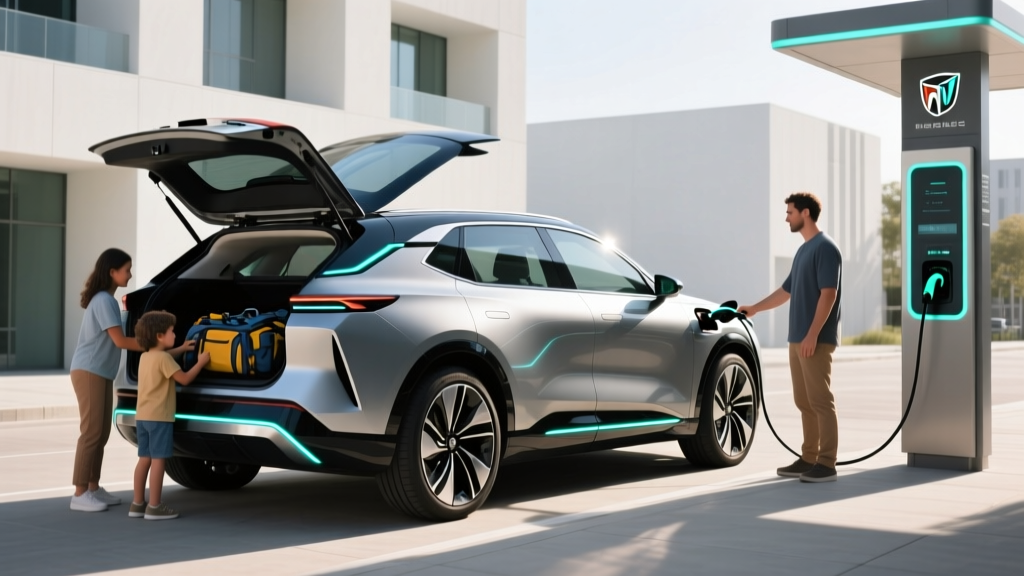
Buick Electra owners will do the vast majority of their charging at home. The onboard 11.5 kW AC charger means a properly installed Level 2 home station can add roughly 37 miles of range per hour — enough to fully replenish the E5's 85 kWh battery overnight in about 8–9 hours.
| Item | Cost Range |
|---|---|
| Level 2 Charger (hardwired, 48A) | $500–$800 |
| Electrician labor (240V/50A circuit) | $800–$2,500 |
| Permit & inspection | $100–$400 |
| Panel upgrade (if needed, 200A service) | $1,500–$4,000 |
| Total (no panel upgrade) | $1,400–$3,700 |
| Total (with panel upgrade) | $2,900–$7,700 |
Critical note: If your home has older 100-amp electrical service, you'll likely need a panel upgrade to safely add a 50-amp EV circuit. Budget for this possibility — it's the single biggest surprise cost for first-time EV buyers. A licensed electrician should perform a load calculation before installation. For the final spec and permit requirements, always defer to your electrician and local code.
On the road, the Electra's 150 kW peak DC fast-charging rate is adequate but not class-leading. Competitors like the Hyundai Ioniq 5 (240 kW peak) and Tesla Model Y (250 kW peak) charge noticeably faster. In practice, the Electra's charging curve tapers significantly above 80% state of charge (SoC), meaning the last 20% can take as long as the first 80%. For road trips, plan stops around the 10–80% window for the best time efficiency.
The Electra E5 and E4 come equipped with the NACS (Tesla-style) charging port as of the 2025 model year, giving access to Tesla's Supercharger network — a major advantage for public charging reliability. See fueleconomy.gov for official efficiency data.
Buick Electra vs. Competitors: Where It Stands in the Electric SUV Market
The Electra E5 competes in the crowded midsize electric SUV segment. Here's how it stacks up against the models Buick shoppers typically cross-shop:
| Model | EPA Range | Peak DCFC | 10–80% | Starting MSRP |
|---|---|---|---|---|
| Buick Electra E5 FWD | 303 mi | 150 kW | ~28 min | $38,900 |
| Hyundai Ioniq 5 (Std Range) | 303 mi | 240 kW | ~18 min | $42,600 |
| Tesla Model Y (LR) | 320 mi | 250 kW | ~20 min | $44,990 |
| Cadillac Lyriq | 314 mi | 190 kW | ~24 min | $49,990 |
| Chevrolet Blazer EV (2LT) | 279 mi | 190 kW | ~24 min | $44,600 |
| VW ID.4 (Pro S) | 291 mi | 175 kW | ~28 min | $43,700 |
Where the Electra wins: Price. At $38,900, the E5 undercuts most competitors by $4,000–$11,000 while matching or exceeding their range. Buick's ride quality and cabin quietness also outperform most rivals in this segment — the brand's traditional comfort-first tuning translates well to an EV powertrain.
Where the Electra falls short: Charging speed. The 150 kW peak rate means longer stops on road trips compared to the Ioniq 5's 800V architecture or Tesla's Supercharger optimization. If you frequently drive 300+ mile trips, this matters. The Electra also lacks the frunk (front trunk) that some competitors offer, and its infotainment system, while improved, doesn't match Tesla's or Hyundai's responsiveness.
Federal Tax Credits and Incentives: What Electra Buyers Actually Qualify For
The federal §30D clean vehicle credit is the single most confusing aspect of EV buying. Here's the current landscape for the Buick Electra:
- Maximum credit: Up to $7,500, split into $3,750 for critical-minerals sourcing and $3,750 for battery-component sourcing
- MSRP cap: Vehicle MSRP must not exceed $80,000 for SUVs — both Electra models qualify
- Buyer income cap: AGI must not exceed $150,000 (single) or $300,000 (married filing jointly)
- Battery sourcing: As of 2026, stringent critical-minerals and battery-component requirements mean many GM vehicles qualify for only the partial $3,750 credit or none at all, depending on supply-chain shifts
- Point-of-sale transfer: You can transfer the credit to the dealer at purchase for an immediate price reduction, rather than waiting until tax filing
Because sourcing requirements tighten annually, the exact credit amount for a 2026 Electra E5 or E4 may vary by production batch. Always verify current eligibility on the fueleconomy.gov tax credit page using the specific VIN before purchasing. A tax professional can confirm how the credit interacts with your individual return.
Real-World Ownership: What First-Time Buick EV Buyers Should Expect
| Myth | Fact |
|---|---|
| "The battery will need replacing in 5 years" | GM's Ultium batteries are warranted for 8 years/100,000 miles with a capacity-retention threshold of 60%. Industry data shows NMC batteries typically retain 85–90% capacity at 100,000 miles with normal use. |
| "I can't drive an EV in cold weather" | You can, but expect 15–25% range loss below 30°F. The Electra's heat pump (standard on Avenir trims) mitigates this. Preconditioning the battery while plugged in preserves range and improves charging speed. |
| "Public charging is unreliable everywhere" | With the NACS port, Electra owners access Tesla Superchargers — consistently the most reliable U.S. DC fast-charging network. Electrify America and EVgo reliability has also improved, though rural gaps persist. |
| "EVs cost more to insure, always" | EV insurance is 15–25% higher on average, but the gap varies by state, driver profile, and insurer. Shop quotes from EV-friendly carriers before purchasing. |
| "I need a special electrical panel for any EV" | Only if your home has 100A service or insufficient spare breaker slots. Many modern 200A panels can accommodate a 50A EV circuit without upgrade. |
Driving-pattern reality check: If your daily commute is under 60 miles round-trip and you can install a Level 2 charger at home, the Electra E5 will feel effortless — you'll start every morning with a full "tank" and rarely visit a public charger. If you regularly drive 200+ miles in a single trip, plan your route around Supercharger or reliable DCFC locations, and accept that charging stops will add 25–35 minutes each. If you lack home charging access entirely (apartment dwellers, street-parkers), an EV remains viable but requires discipline around public charging — assess your nearest reliable stations before committing.
Decision Framework: Should You Buy a Buick Electra?
Choose the Buick Electra E5 if:
- You want a comfortable, quiet midsize electric SUV under $40,000
- Your daily driving is under 80 miles and you have home charging access
- You value ride comfort over sporty handling or cutting-edge tech
- You want Supercharger network access via NACS without an adapter
- You're upgrading from a Buick Encore, Envision, or Enclave and want to stay in the brand
Choose the Buick Electra E4 if:
- You prefer a lower, sportier roofline and slightly lower price
- You don't need maximum cargo space (E4 sacrifices rear headroom vs. E5)
- You want the most affordable Ultium-platform entry point
Look elsewhere if:
- You frequently road-trip 400+ miles and want the fastest possible charging (consider Hyundai Ioniq 5 or Tesla Model Y)
- You need three rows of seating (no Buick EV currently offers this — consider the Kia EV9 or a plug-in hybrid)
- You want the absolute longest EPA range available (Tesla Model Y Long Range and Lucid Air exceed 320 miles)
- You lack any home or workplace charging access and live in a charging-desert area
Frequently Asked Questions
Does Buick make a fully electric SUV in 2026?
Yes. Buick offers the Electra E5 (midsize SUV, 303 mi EPA range) and the Electra E4 (coupe-SUV, 285 mi EPA range). Both are fully battery-electric vehicles built on GM's Ultium platform. Buick has committed to an all-electric future and is not developing new gasoline-only models.
How much does it cost to charge a Buick Electra at home?
At the U.S. average residential rate of ~$0.15/kWh, fully charging the Electra E5's 85 kWh battery costs roughly $12.75, providing about 300 miles of range. That's equivalent to about $0.04 per mile — compared to roughly $0.14 per mile for a 25 MPG gas SUV at $3.50/gallon. Annual fuel savings for a 12,000-mile driver are approximately $1,200.
Does the Buick Electra qualify for the $7,500 federal tax credit?
Eligibility is partial and varies. As of 2026, the Electra E5 and E4 may qualify for up to $3,750 (half credit) depending on battery-component and critical-minerals sourcing for the specific VIN. Full $7,500 eligibility requires meeting both sourcing thresholds, buyer income caps, and MSRP caps. Always verify on fueleconomy.gov and consult a tax professional.
How long will the Buick Electra battery last?
GM warranties the Ultium battery for 8 years or 100,000 miles against defects and excessive capacity loss (below 60% state of health). Real-world data from similar NMC batteries suggests 85–90% capacity retention at 100,000 miles with normal charging habits. Avoid routinely charging to 100% or letting the battery sit at 0% to maximize longevity. Full battery replacement, if ever needed outside warranty, currently costs $12,000–$18,000 depending on pack size.
Can I use Tesla Superchargers with a Buick Electra?
Yes. Starting with the 2025 model year, Buick Electra models come with a native NACS charge port, meaning you can plug directly into Tesla Superchargers without an adapter. This gives access to over 20,000 Supercharger stalls across the U.S. — the largest and most reliable DC fast-charging network available.
Is the Buick Electra good in snow and cold weather?
The AWD variant provides confident traction, and the available heat pump (standard on Avenir) reduces cabin-heating energy draw in cold weather. Expect 15–25% range reduction in sustained sub-30°F driving. Preconditioning the battery while still plugged in — a feature available through the myBuick app — warms the pack for better efficiency and faster DC charging when you hit the road.