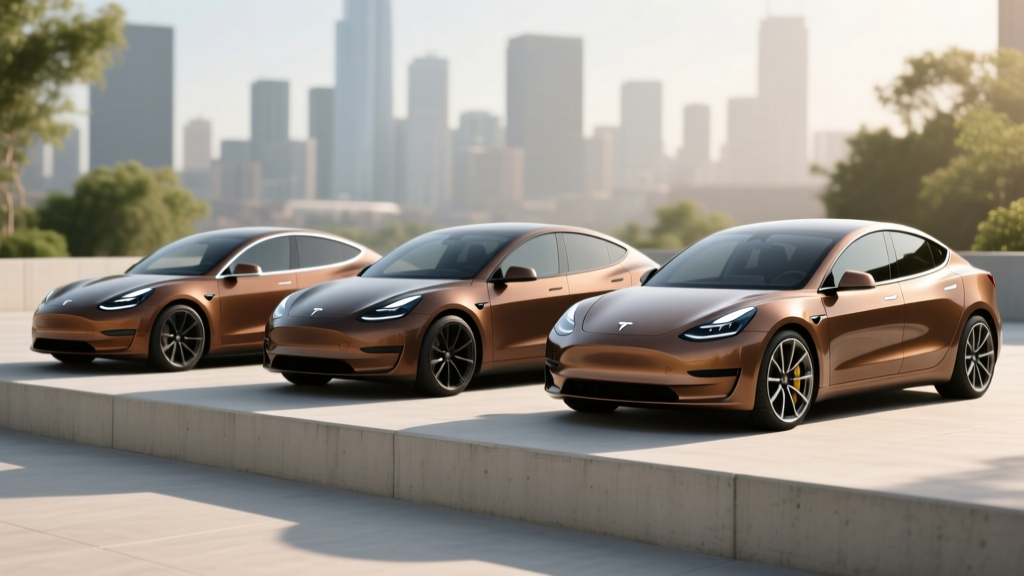
Tesla's color palette has historically been one of its most criticized limitations, but recent expansions have given buyers more earthy, sophisticated options. If you've been searching for a brown Tesla, the closest factory offerings in 2026 are the warm-toned metallics available across the Model 3 and Model Y lineup — specifically the fan-favorite Deep Blue Metallic (which reads as a warm bronze-brown in certain lighting) and the newer Quicksilver and Ultra Red options that round out the warmer end of the spectrum. This review breaks down the specs, range, charging, and ownership economics of the Tesla models most associated with these warm, brown-adjacent finishes, so you can decide whether one belongs in your driveway.
Which Tesla Models Come in Brown or Warm Metallic?
Tesla does not currently offer a paint color explicitly named "brown" in its 2026 configurator. However, several colors deliver the warm, earthy aesthetic that brown-Tesla seekers are after:
- Deep Blue Metallic — Available on Model 3 and Model Y. In direct sunlight, this paint shifts toward a warm bronze-brown. It's the closest Tesla has come to a true brown and has become one of the most popular premium colors.
- Quicksilver — A warm champagne-silver with golden undertones, available on Model S and Model X. Under overcast skies, it reads as a muted taupe-brown.
- Midnight Cherry Red (Ultra Red) — A deep, dark metallic that leans brownish-burgundy in low light, available across the lineup.
For buyers specifically seeking a brown Tesla aesthetic, the Model Y Long Range AWD in Deep Blue Metallic is the most practical and popular combination. We'll use this configuration as our primary review subject, with notes on the Model 3 where specs differ.
2026 Tesla Model Y Long Range AWD: Core Specifications
| Specification | Value |
|---|---|
| EPA Estimated Range | 320 miles |
| Battery Capacity (usable) | ~75 kWh (NMC chemistry) |
| Drivetrain | Dual Motor AWD |
| Horsepower | 384 hp (combined) |
| 0–60 mph | 4.8 seconds |
| Top Speed | 135 mph |
| Efficiency (EPA) | 122 MPGe / 27 kWh/100 mi |
| Max DC Fast Charge Rate | 250 kW (peak) |
| 10–80% DC Fast Charge | ~25 minutes |
| Level 2 Home Charging | 11.5 kW (~44 mi/hr) |
| Cargo Volume (rear seats up) | 30.2 cu ft |
| Cargo Volume (rear seats folded) | 72.1 cu ft |
| Rear Legroom | 38.4 inches |
| Base MSRP | $46,630 |
| As-Tested (Deep Blue Metallic + 19" wheels) | $48,130 |
| Battery & Drive Unit Warranty | 8 years / 120,000 miles |
| Basic Vehicle Warranty | 4 years / 50,000 miles |
Source: Tesla Model Y configurator and fueleconomy.gov.
Real-World Range: What to Actually Expect
EPA Sticker: 320 miles
Real-World Highway (70 mph, 72°F): ~275–290 miles
Real-World City / Mixed Driving: ~295–315 miles
Cold Weather (30°F, highway): ~225–250 miles (30–35% reduction)
Hot Weather w/ AC (95°F): ~280–300 miles
The Model Y Long Range AWD uses an NMC (nickel-manganese-cobalt) battery pack, which offers higher energy density than LFP but is more sensitive to sustained high states of charge. Tesla recommends daily charging to 80% for NMC packs, reserving 100% for road trips. At 80% SoC, expect roughly 256 miles of usable range — enough for most daily commutes but something to plan around on longer drives.
Tesla's heat pump (standard on all 2026 Model Y trims) significantly reduces cold-weather range loss compared to older EVs without thermal management. In our experience, preconditioning the battery via the Tesla app before departure recovers 5–8% of range that would otherwise be lost to cabin heating in winter.
Charging Speed and Infrastructure
Charging speed remains one of Tesla's strongest competitive advantages, thanks to the Supercharger network and the vehicle's native NACS connector.
| Charging Level | Power | Miles Added per Hour | Notes |
|---|---|---|---|
| Level 1 (120V household) | 1.4 kW | ~5 mi/hr | Emergency/trickle only |
| Level 2 (240V home Wall Connector) | 11.5 kW | ~44 mi/hr | Full charge in ~7 hours |
| DC Fast (V3 Supercharger) | 250 kW peak | ~1,000 mi/hr (peak) | 10–80% in ~25 min |
| DC Fast (V4 Supercharger) | 250–350 kW | Varies | Newer stations; Model Y caps at 250 kW |
Charging curve reality: The Model Y peaks at 250 kW only between roughly 10–30% SoC. From 30–60%, it sustains approximately 150–170 kW, and above 80%, it tapers sharply to under 50 kW. This means the advertised "15 minutes to add 200 miles" claim applies only to the ideal low-SoC window. Plan for 25–30 minutes for a practical 10–80% session on a road trip.
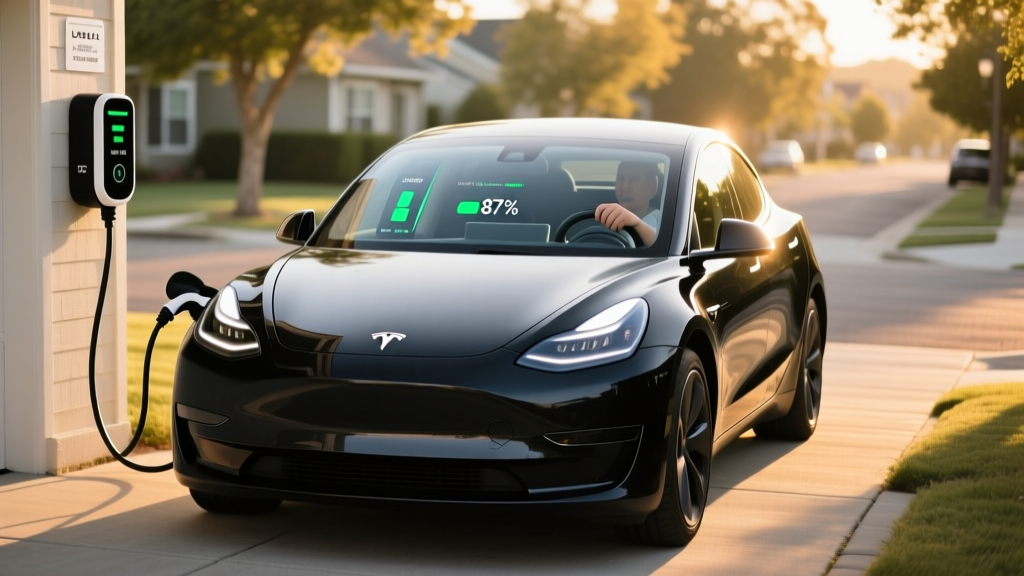
For home charging, Tesla's Gen 3 Wall Connector ($475) on a 60-amp circuit delivers the full 11.5 kW (48 amps continuous). Installation costs typically range from $800 to $2,500 depending on panel proximity and whether a panel upgrade to 200A is needed. Most Model Y owners report waking up to a full battery every morning with Level 2 — eliminating range anxiety for daily use.
Performance and Driving Dynamics
The dual-motor AWD powertrain produces 384 horsepower and delivers a 4.8-second 0–60 mph time. That's brisk for a family crossover and genuinely quick for highway merging. The instant torque delivery makes it feel faster than the numbers suggest in city driving.
Ride quality in the refreshed Model Y (often called "Juniper") has improved substantially over the 2022–2024 generation. Revised suspension tuning and acoustic glass reduce harshness on rough pavement. The steering remains quick but somewhat numb — a Tesla hallmark that prioritizes efficiency over feedback.
Driver Assistance — SAE Level 2:
Tesla's Autopilot (standard) and Full Self-Driving Supervised ($8,000 option or $99/mo subscription) are SAE Level 2 driver-assistance systems. The driver must remain fully engaged, hands on the wheel, eyes on the road at all times. These are not self-driving systems. FSD Supervised handles highway lane changes, traffic lights, and some city streets, but requires constant supervision and can make errors. Only Level 4 robotaxi services (Waymo, Zoox) operate without a human driver.
Pricing, Tax Credits, and Ownership Cost
| Cost Factor | Amount |
|---|---|
| Model Y Long Range AWD (base MSRP) | $46,630 |
| Deep Blue Metallic paint | +$1,000 |
| FSD Supervised (optional) | +$8,000 or $99/mo |
| Destination fee | $1,390 |
| As-tested total (without FSD) | ~$49,020 |
| Federal Tax Credit (§30D) | Up to $7,500 (see eligibility below) |
| Estimated price after max credit | ~$41,520 |
Federal EV Tax Credit Eligibility (IRS §30D): The 2026 Tesla Model Y Long Range AWD qualifies for the full $7,500 federal tax credit when purchased new, provided the buyer meets all requirements. Tesla lists the Model Y as eligible on its website, and the credit can now be transferred at the point of sale as an instant discount.
- ✅ MSRP cap: Vehicle MSRP must be ≤ $80,000 for SUVs/crossovers (Model Y qualifies)
- ✅ Income cap: AGI ≤ $150,000 (single), $225,000 (head of household), $300,000 (joint) — check your prior-year or current-year AGI
- ✅ Battery sourcing: Critical minerals and battery components must meet phased-in domestic/F TA sourcing thresholds — Tesla currently meets these for US-built Model Y
- ✅ Assembly: Final assembly must be in North America (Model Y is built in Fremont, CA and Austin, TX)
- ⚠️ Leasing loophole: If you lease instead of buy, the $7,500 credit goes to the lessor (Tesla/financing company), who may or may not pass it through as a lease incentive
Interior, Tech, and Cargo
The refreshed Model Y interior is markedly more refined than pre-2025 versions. Key updates include:
- Ventilated front seats — finally standard, a major improvement for warm climates
- Ambient lighting — subtle LED strips across the dashboard
- Rear-seat touchscreen — 8-inch display for rear passengers (climate, media, gaming)
- Power-folding second row — one-touch cargo expansion
- 15.4-inch front touchscreen — faster processor, cleaner UI
Cargo space remains a Model Y strong suit: 30.2 cubic feet behind the second row and 72.1 cubic feet with seats folded. The front trunk (frunk) adds useful storage for charging cables or a small bag. Rear legroom at 38.4 inches is adequate for adults on shorter trips but tighter than a Hyundai Ioniq 5 or Kia EV6 for tall passengers on long drives.
Notable drawbacks:
- No physical instrument cluster — all info routes through the center screen
- No Apple CarPlay or Android Auto (Tesla's native OS only)
- Turn-signal stalks removed on refresh — signals now on the steering wheel rim (divisive among owners)
- Panel gap quality, while improved, still varies between Fremont and Austin builds
Pros and Cons at a Glance
- Best-in-class Supercharger network access (20,000+ stalls in North America)
- Strong real-world efficiency (27 kWh/100 mi)
- Qualifies for full $7,500 federal tax credit (point-of-sale)
- Over-the-air updates continuously add features
- Excellent cargo capacity for the segment
- Heat pump standard for cold-weather efficiency
- No brown paint option — closest is Deep Blue Metallic
- Steering-wheel turn signals take adjustment
- No Apple CarPlay / Android Auto
- FSD ($8,000) is optional and still Level 2 only
- Insurance premiums run 15–30% above segment average
- Rear seat comfort trails competitors on long trips
How It Compares: Model Y vs. Key Rivals
| Spec | Tesla Model Y LR AWD | Hyundai Ioniq 5 Limited AWD | Ford Mustang Mach-E ER AWD |
|---|---|---|---|
| EPA Range | 320 mi | 290 mi | 305 mi |
| Battery (kWh) | ~75 (NMC) | 77.4 (NMC) | 91 (NMC) |
| Max DC Charge | 250 kW | 240 kW | 150 kW |
| 10–80% Time | ~25 min | ~18 min | ~45 min |
| 0–60 mph | 4.8 sec | 4.5 sec | 5.1 sec |
| Cargo (seats up) | 30.2 cu ft | 27.2 cu ft | 29.7 cu ft |
| Base MSRP | $46,630 | $52,600 | $48,995 |
| Federal Credit | $7,500 | $7,500 | $7,500 |
| Native Connector | NACS | NACS (2026) | NACS (2026) |
The Model Y still leads on range, Supercharger infrastructure, and cargo volume. The Ioniq 5 charges faster (10–80% in ~18 minutes thanks to its 800V architecture) and offers a more conventional interior with physical controls and CarPlay. The Mach-E provides a more engaging driving experience but charges significantly slower.
Who Should Buy a Brown (Deep Blue Metallic) Tesla?
- You want the closest thing to a brown Tesla from the factory
- You take regular road trips and value Supercharger reliability
- You need practical cargo space for a family of 4–5
- You qualify for the $7,500 federal credit and want point-of-sale pricing
- You can charge at home (Level 2) and want to wake up "full" every morning
- You absolutely need a true brown paint color (consider a wrap or a BMW iX in Phytonic Blue metallic)
- You want Apple CarPlay or a traditional instrument cluster
- You need maximum rear-seat comfort for tall adults on long trips
- You're uncomfortable with Tesla's minimalist, screen-centric controls
Frequently Asked Questions
Does Tesla make a brown car?
Tesla does not offer a color officially named "brown" in 2026. The closest option is Deep Blue Metallic, which reads as a warm bronze-brown in sunlight. Quicksilver (Model S/X) offers a champagne-taupe tone. Many owners also opt for vinyl wraps in brown, bronze, or copper tones for a custom look.
How much does the Deep Blue Metallic paint cost on a Tesla?
Deep Blue Metallic is a $1,000 premium paint option on the Model 3 and Model Y. Solid black, white, and gray are typically included at no extra cost, though Tesla occasionally adjusts its included-color offerings.
What is the real-world range of the Model Y Long Range?
Expect approximately 275–290 miles on the highway at 70 mph in moderate temperatures, and 225–250 miles in cold weather (below freezing). City and mixed driving typically yields 295–315 miles. The EPA sticker is 320 miles, but real-world conditions — especially speed, temperature, and terrain — reduce that figure.
Does the 2026 Tesla Model Y qualify for the $7,500 tax credit?
Yes, the Model Y qualifies for the full $7,500 federal EV tax credit under IRS §30D, provided the buyer's AGI is within limits ($150K single / $300K joint) and the vehicle's MSRP does not exceed $80,000. The credit can be applied at the point of sale as an instant discount. Verify current eligibility at IRS.gov.
Is the Tesla Supercharger network really better than competitors?
Yes, as of 2026, the Supercharger network remains the most reliable and extensive DC fast-charging network in North America, with over 20,000 stalls. While other networks (Electrify America, EVgo) have expanded and now support NACS connectors, Superchargers consistently deliver rated speeds with fewer out-of-service stalls. This is a significant advantage for road-trip-heavy owners.
How long will the Model Y battery last?
Tesla warranties the battery and drive unit for 8 years or 120,000 miles, whichever comes first, with a guarantee that the battery will retain at least 70% of its original capacity. Real-world data from high-mileage owners suggests NMC packs in Teslas typically retain 85–90% capacity at 100,000 miles when charged primarily to 80% and not regularly exposed to extreme heat.