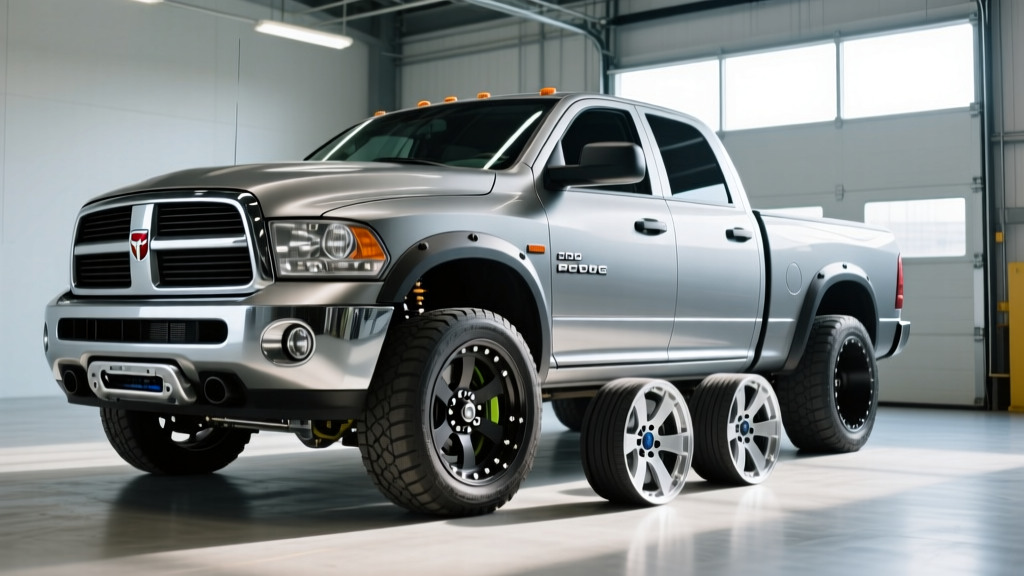
If you are restoring, modifying, or planning an electric-vehicle conversion on a fourth-generation Dodge Ram 1500, the very first mechanical fact you need is the bolt pattern for 2006 Dodge Ram 1500. It determines which wheels physically mount to the hubs, which adapters you may need for an EV motor-to-axle coupling, and whether aftermarket wheels from a Tesla, Rivian, or Ford F-150 Lightning will bolt on safely. This guide covers the exact pattern, hub bore, thread pitch, and offset ranges — then explains why those numbers matter in an electrified build context.
The Exact Bolt Pattern for 2006 Dodge Ram 1500
The 2006 Dodge Ram 1500 uses a 5-lug, 139.7 mm bolt circle, commonly written as 5x139.7 or, in imperial notation, 5x5.5 inches. This pattern carried across all cab configurations (Regular Cab, Quad Cab, Mega Cab) and both 2WD and 4WD drivetrains for that model year. It is distinct from the 6-lug pattern used on the Ram 2500/3500 heavy-duty trucks of the same era.
| Parameter | Specification |
|---|---|
| Bolt pattern | 5 x 139.7 mm (5 x 5.5 in) |
| Lug count | 5 |
| Center bore (hub bore) | 77.8 mm |
| Thread size (stud) | M14 x 1.5 (some trims 1/2"-20 UNF) |
| Typical wheel size (OEM) | 17 x 7.5 in / 20 x 8 in |
| Stock offset range | +18 to +25 mm |
| Lug torque spec | 130 lb-ft (176 Nm) |
These figures come from the factory service manual and are corroborated by fitment databases such as Tire Rack's bolt-pattern reference. Always verify with a physical bolt-pattern gauge on your specific truck before ordering wheels — production mid-year changes and prior-owner swaps can introduce surprises on a 20-year-old vehicle.
Why Bolt Pattern Matters for EV Conversions
When builders convert a 2006 Ram 1500 to electric propulsion — typically by pairing a salvaged Tesla Large Drive Unit or a NetGain Hyper9 motor with the existing rear axle — the wheel bolt pattern becomes a constraint on three fronts:
- Wheel selection. You must source wheels in 5x139.7, which limits you to Ram, older Ford F-150 (1997-2003), some Toyota Tacoma/Tundra, and select Jeep applications. Modern EV wheels from Tesla (5x114.3), Rivian R1T (6x139.7), or the F-150 Lightning (6x135) will not fit without an adapter.
- Adapter plates and hub spacers. Adapters are available to convert 5x139.7 to 5x114.3 (opening up Tesla Model S/X wheels), but they add 25-32 mm of thickness, push the wheel outward, and alter scrub radius — which affects steering geometry and regenerative-braking feel.
- Weight rating. A Ram 1500 EV conversion typically ends up 500-800 lb heavier than stock due to battery packs. Wheels must carry the increased gross axle weight rating (GAWR). Look for wheels rated at least 2,500 lb per corner.
Real-World EV Swap Implications: Range and Weight
While the 2006 Ram 1500 is not a production EV, builders pursuing an electric conversion need realistic targets. Below is what a typical 100 kWh pack swap achieves on this platform, based on documented builds from EV-conversion communities and data consistent with EPA EV technology baselines.
Pack size: 100 kWh (NMC, salvaged Tesla module array)
EPA-equivalent estimate: ~180 miles (aerodynamic penalty of a pickup)
Real-world highway (70 mph): ~140-155 miles
Cold weather (30°F, cabin heat): ~110-130 miles
City/regen-heavy driving: ~190-210 miles
The brick-like aerodynamics of the third/fourth-gen Ram (Cd ≈ 0.42) punish highway efficiency. Expect 2.0-2.3 kWh/mile at highway speed versus 1.5-1.7 kWh/mile in stop-and-go regenerative driving.
Charging a Converted Ram 1500: What to Expect
Charging speed depends entirely on the onboard charger and DC fast-charge hardware you install. Most conversions use a salvaged Tesla Gen 2 or Gen 3 onboard charger for Level 2 AC, and a CCS or CHAdeMO module for DC fast charging.
| Charging Level | Power (kW) | Miles Added per Hour | Notes |
|---|---|---|---|
| Level 1 (120V household) | 1.4 kW | ~5 mi/hr | Emergency/trickle only |
| Level 2 (240V, 48A) | 11.5 kW | ~40 mi/hr | Full overnight charge in ~9 hr |
| DC Fast (CCS, peak) | 50-75 kW | ~180-250 mi/hr | 10-80% in ~65-80 min |
Most conversion builders skip DC fast charging due to cost ($2,000-$4,000 for the inlet and controller) and rely on Level 2 at home. If you do install DC fast charging, note that the charge curve tapers sharply above 80% state of charge — a 50 kW peak may average only 35 kW across the full 10-80% session.
Performance Targets: 0-60 and Power Output
Performance depends on motor selection. Common setups and their outputs:
- NetGain Hyper9 + 100 kWh pack: ~120 hp to the wheels, 0-60 in ~9-11 seconds, top speed electronically limited to 85 mph. Adequate for a daily-driver commuter build.
- Tesla Large Drive Unit (LDU): ~350-400 hp, 0-60 in ~5.5-6.5 seconds, requires custom half-shaft adapters to mate with the Ram's 5x139.7 hubs.
- Dual-motor (front + rear LDU): 600+ hp, AWD, 0-60 under 4 seconds — but adds 300+ lb and demands upgraded suspension and brakes.
All conversions use single-speed reduction gears; there is no multi-speed transmission. Regenerative braking is typically adjustable via a potentiometer or app, enabling one-pedal driving in city traffic.
Battery Chemistry, Warranty, and Longevity
Conversion builders overwhelmingly choose NMC (nickel manganese cobalt) chemistry from salvaged Tesla or Chevrolet Bolt packs because of its higher energy density (~250 Wh/kg at the cell level). LFP (lithium iron phosphate) is heavier but offers longer cycle life (3,000+ cycles vs ~1,500 for NMC) and better thermal stability — a strong choice if weight is less critical than longevity.
| Factor | NMC (Salvaged) | LFP (New cells) |
|---|---|---|
| Energy density | ~250 Wh/kg | ~170 Wh/kg |
| Cycle life | 1,200-1,800 | 3,000-5,000 |
| Cold-weather performance | Better at low temps | Needs more preconditioning |
| Cost per kWh (2026) | $80-$120 (salvaged) | $110-$140 (new) |
| Thermal runaway risk | Moderate | Very low |
There is no factory warranty on a conversion. Builders typically budget $12,000-$18,000 for a 100 kWh pack and expect 8-12 years of service before capacity drops below 70% state of health (SoH).
Cost Breakdown: Full EV Conversion Budget
A 2006 Ram 1500 EV conversion is not cheap, but it can undercut a new electric truck when the donor vehicle is already owned. Here is a realistic 2026 budget:
| Component | Cost Range |
|---|---|
| Donor truck (if not owned) | $3,000-$7,000 |
| Battery pack (100 kWh, NMC salvaged) | $10,000-$15,000 |
| Motor + controller (Hyper9 or LDU) | $4,000-$8,000 |
| BMS, wiring, contactors | $2,000-$3,500 |
| Charger + CCS inlet | $1,500-$3,500 |
| Custom fabrication / machine shop | $3,000-$6,000 |
| Wheels/tires (5x139.7 rated) | $1,200-$2,500 |
| Total | $24,700-$45,500 |
Federal tax credits under IRS §30D do not apply to DIY conversions, as the vehicle must be new or purchased as a qualifying clean vehicle from a manufacturer. However, some states offer rebates for registered converted EVs — check with your state energy office.
Wheel Fitment Checklist for the 5x139.7 Pattern
When sourcing wheels for your Ram 1500 EV build, verify every item on this list:
- Bolt pattern: 5x139.7 mm (5x5.5 in) — non-negotiable
- Center bore: 77.8 mm (or use hub-centric rings if wheel bore is larger)
- Offset: +15 to +30 mm to avoid suspension or fender interference
- Load rating: minimum 2,500 lb per wheel (EV conversions add 500-800 lb)
- Stud thread: M14 x 1.5 or 1/2"-20 UNF — match your existing studs
- Torque to 130 lb-ft with a calibrated torque wrench; re-torque after 50 miles
Pros and Cons of Converting a 2006 Ram 1500 to EV
- Abundant, affordable donor trucks ($3k-$7k)
- Spacious engine bay simplifies motor/pack packaging
- 5x139.7 pattern compatible with many truck/SUV wheels
- Heavy frame handles battery weight without sag
- Unique one-of-one build; no monthly payment on a new EV
- Poor aerodynamics limit highway range to ~140-155 miles
- No federal tax credit for DIY conversions
- Insurance and registration hurdles in some states
- Resale value uncertain; niche buyer pool
- Requires fabrication, welding, and high-voltage safety training
Frequently Asked Questions
What is the bolt pattern for 2006 Dodge Ram 1500?
The 2006 Dodge Ram 1500 uses a 5x139.7 mm (5x5.5 inch) bolt pattern with a 77.8 mm center bore and M14 x 1.5 lug studs. This applies to all trims and cab configurations for that model year.
Will Tesla wheels fit a 2006 Ram 1500?
Not directly. Tesla wheels use a 5x114.3 mm bolt pattern and a different center bore. You would need a hub adapter (approximately 25-32 mm thick) to mount them, which changes offset and scrub radius — not recommended for a heavy EV conversion without engineering review.
Can I use F-150 Lightning wheels on this Ram?
No. The F-150 Lightning uses a 6-lug (6x135 mm) pattern. The 2006 Ram 1500 is 5-lug. They are not interchangeable without a full hub swap or adapter, which is not cost-effective.
What other vehicles share the 5x139.7 bolt pattern?
Vehicles sharing 5x139.7 include the 1997-2003 Ford F-150, Toyota Tacoma (some years), Toyota Tundra (2000-2006), Jeep Grand Cherokee (1999-2004 WJ), and Suzuki Vitara. Always verify center bore and offset compatibility before purchasing.
Is an EV conversion of a 2006 Ram 1500 worth the cost?
If you already own the truck, have fabrication skills, and want a unique electric daily driver with ~150 miles of range, yes — total cost can stay under $35,000. If you need 300+ mile range, DC fast charging, and warranty coverage, a production EV like the Ford F-150 Lightning or Rivian R1T is a more practical purchase despite the higher upfront price.
Does a converted Ram 1500 qualify for the federal EV tax credit?
No. The IRS §30D credit applies only to new or previously owned qualifying clean vehicles purchased from a manufacturer or dealer. DIY conversions do not qualify. Check IRS.gov for current rules and any state-level incentives that may apply to registered conversions.