Quick Answer: The 2026 BMW iX5 electric does not exist as a production model. BMW's current electric SUV lineup consists of the iX (mid-size flagship, starting ~$87,250) and the iX3 (compact, not sold in the U.S.). If you're searching for a mid-size BMW electric SUV, the iX xDrive50 delivers an EPA-estimated 324 miles of range, a 105.2 kWh (usable ~105 kWh) NMC battery, and DC fast charging up to 195 kW (10–80% in ~31 minutes). If you need a smaller, more affordable BMW EV, the closest U.S. option is the i4 Gran Coupe starting around $52,200. Below, we break down what BMW actually offers, real ownership costs, and how to decide if a BMW electric SUV fits your budget and driving needs.
What Is the BMW iX5 Electric? Clearing Up the Confusion
There is no official BMW model called the "iX5." This naming confusion typically stems from two things: BMW's numerical naming conventions (where the X5 is a popular gas-powered mid-size SUV) and early speculation that BMW would slot an electric SUV between the iX3 and the larger iX. As of the 2026 model year, BMW has not released an iX5 for any market.
Here's what BMW's electrified SUV lineup actually looks like for U.S. buyers:
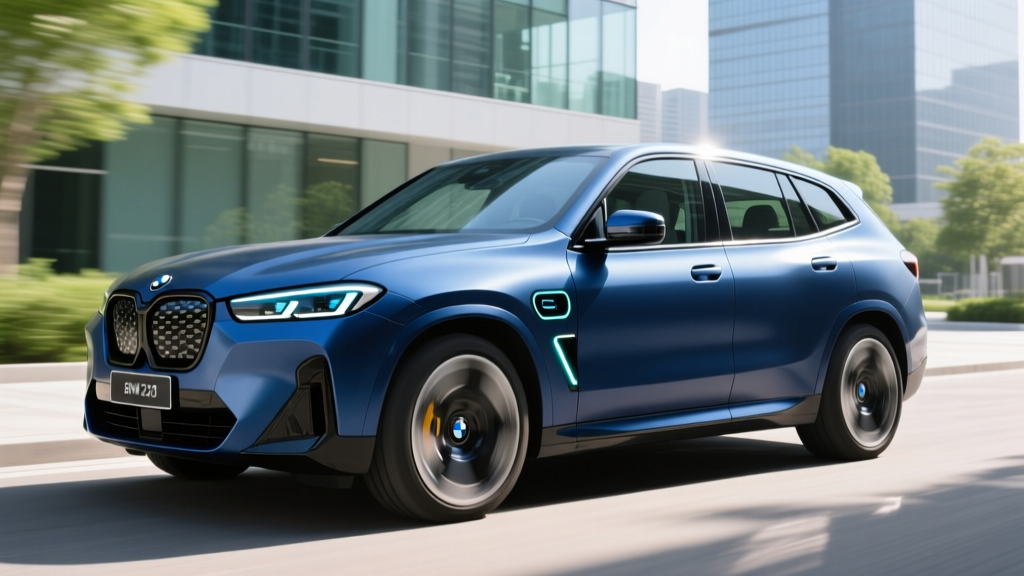
- BMW iX xDrive50 — Mid-size electric SUV, 516 hp, EPA 324 mi range, ~$87,250 MSRP
- BMW iX M60 — Performance variant, 610 hp, EPA 296 mi range, ~$111,500 MSRP
- BMW iX3 — Compact electric SUV, not available in the U.S. (sold in Europe/Asia)
- BMW X5 xDrive50e — Plug-in hybrid (PHEV), ~38 mi electric-only range, ~$72,500 MSRP
If you landed here searching for a "BMW iX5 electric," you're most likely looking for either the iX or the X5 plug-in hybrid. We'll cover both in detail below, including real costs and a decision framework to help you choose.
BMW iX xDrive50: Full EV Specs and Real-World Performance
| Spec | iX xDrive50 | iX M60 |
|---|---|---|
| Battery (usable) | ~105 kWh (NMC) | ~105 kWh (NMC) |
| EPA Range | 324 mi | 296 mi |
| Real-World Highway (~70 mph) | ~260–280 mi | ~235–255 mi |
| Cold-Weather Range (below 32°F) | ~225–260 mi | ~205–235 mi |
| Horsepower | 516 hp | 610 hp |
| 0–60 mph | 4.4 sec | 3.6 sec |
| Max DC Fast Charge | 195 kW | 195 kW |
| 10–80% DC Charge Time | ~31 min | ~31 min |
| Level 2 (240V / 48A) Rate | 11 kW (~30 mi/hr) | 11 kW (~30 mi/hr) |
| Efficiency (MPGe) | 86 MPGe combined | 82 MPGe combined |
| Base MSRP | ~$87,250 | ~$111,500 |
| Battery/Powertrain Warranty | 8 yr / 100,000 mi | 8 yr / 100,000 mi |
Real-World Range Reality: The iX xDrive50's EPA 324-mile rating assumes a mix of city and highway driving in moderate temperatures. On a sustained 70 mph highway run in 75°F weather, expect roughly 260–280 miles before needing a charge. In sub-freezing conditions (20°F or below), battery chemistry and cabin heating demands can reduce range by 20–30%, dropping real-world range to approximately 225–260 miles. The iX uses a heat pump for improved cold-weather efficiency, but physics still applies. Plan road-trip charging stops accordingly — check the EPA's official figures at fueleconomy.gov.
Charging Curve Reality
The iX peaks at 195 kW on a DC fast charger, but that peak only holds between roughly 10–40% state of charge. Above 60%, the charge rate tapers significantly — typical of NMC chemistry. A 10–80% session takes about 31 minutes at a 200+ kW station (like an Electrify America or Tesla Supercharger V4 stall with CCS/NACS adapter). From 80–100%, add another 25–30 minutes. On road trips, charge to 80% and keep moving unless you need the full battery for your destination.
At home on a Level 2 charger (11.5 kW / 48A), a full 0–100% charge takes roughly 11 hours. Most owners plug in nightly and wake up with a full battery — the practical advantage of home charging.
BMW X5 PHEV: The Plug-In Hybrid Alternative
If the iX's $87,000+ price tag or charging logistics don't fit, the BMW X5 xDrive50e plug-in hybrid offers a bridge. It pairs a turbocharged inline-six with an electric motor and a ~25.7 kWh battery pack (usable ~22 kWh), delivering about 38 miles of electric-only range per the EPA.
| Attribute | BMW iX xDrive50 (BEV) | BMW X5 xDrive50e (PHEV) |
|---|---|---|
| Powertrain | Dual-motor AWD, fully electric | Turbo I-6 + electric motor, AWD |
| Electric-Only Range | 324 mi (EPA) | ~38 mi (EPA) |
| Total Range | 324 mi | ~440 mi (gas + electric combined) |
| Combined Efficiency | 86 MPGe | ~56 MPGe (charge-sustaining ~25 MPG) |
| 0–60 mph | 4.4 sec | 4.6 sec |
| Base MSRP | ~$87,250 | ~$72,500 |
| Federal Tax Credit (§30D) | Not eligible (MSRP cap + sourcing) | May qualify up to $7,500 (verify sourcing) |
| Home Charging Need | Essential for daily use | Optional but maximizes savings |
| Gas Station Visits | Never | Regular (for trips beyond 38 mi) |
The X5 PHEV makes sense if your daily commute is under 35 miles round-trip and you can charge at home — you'd drive electric most weekdays and use gas only for longer weekend trips. Without regular home charging, the PHEV operates as a heavy hybrid at about 25 MPG combined, erasing most of its efficiency advantage.
5-Year Ownership Cost Breakdown: iX vs. Gas X5
Let's compare what it actually costs to own the iX xDrive50 versus a comparably equipped gas BMW X5 xDrive40i over 5 years and 75,000 miles. This is where EV ownership either shines or stumbles, depending on your electricity rates and driving patterns.
| Cost Category | BMW iX xDrive50 (BEV) | BMW X5 xDrive40i (Gas) |
|---|---|---|
| Base MSRP | $87,250 | $67,200 |
| Estimated Federal Tax Credit | $0 (exceeds §30D MSRP cap) | $0 (not eligible) |
| 5-Year Fuel/Energy (15k mi/yr) | $5,625 ($0.15/kWh avg) | $13,500 ($3.60/gal, 22 MPG avg) |
| 5-Year Maintenance | ~$2,500 | ~$5,500 |
| 5-Year Insurance (avg) | ~$14,500 | ~$11,000 |
| Estimated 5-Year Depreciation | ~$38,000 | ~$30,000 |
| Total 5-Year Cost | ~$147,875 | ~$127,200 |
| Cost Per Mile | ~$1.97 | ~$1.70 |
Key takeaways: The iX costs roughly $20,000 more over five years, driven primarily by its higher purchase price and steeper depreciation. However, energy and maintenance savings are substantial — you'll spend about $7,875 less on electricity vs. gasoline and $3,000 less on maintenance (no oil changes, fewer brake replacements due to regenerative braking). Insurance premiums run higher for EVs — typically 15–30% more than gas equivalents — due to higher repair costs and battery replacement risk. Source: IRS §30D credit rules confirm the iX does not qualify for the federal credit due to its MSRP exceeding the $80,000 SUV cap.
Real-World Ownership: What First-Time BMW EV Buyers Must Know
Home Charging Is Non-Negotiable
Public DC fast charging costs $0.35–$0.55/kWh on networks like Electrify America and EVgo, which erases most of the fuel savings versus gas. To make the iX financially rational, you need reliable Level 2 home charging. Budget $800–$2,500 for a quality 48A Level 2 charger (ChargePoint Home Flex, Wallbox Pulsar Plus, or BMW's own Wallbox) plus $500–$2,000 for electrician installation, depending on whether your panel needs an upgrade to support a 60A circuit. If you live in an apartment or lack garage/outdoor outlet access, a BEV becomes significantly less practical.
Climate Matters More Than You Think
If you live in the upper Midwest, Mountain West, or Northeast where winter temperatures regularly drop below 20°F, plan for 20–30% range reduction. The iX's heat pump helps, but it can't fully overcome lithium-ion chemistry limitations in extreme cold. Preconditioning the battery while plugged in (a feature BMW's iDrive supports via scheduled departure times) mitigates this loss and also improves charging speed when you do plug into a DC fast charger.
Charging Network Access
BMW iX models sold in the U.S. use the CCS1 connector natively. BMW has been transitioning to NACS (Tesla's connector) for newer models, and adapters are available for Supercharger access. For road trips, plan around Electrify America, EVgo, and ChargePoint DC stations. Use the NHTSA and PlugShare to check station reliability before long trips — public charger uptime varies, and a dead stall in a charging desert is a real ownership risk.
Common EV Misconceptions — Fact-Checked for BMW Buyers
| Myth | Fact |
|---|---|
| "The battery will need replacing in 5 years and cost $20,000." | BMW warranties the iX battery for 8 years / 100,000 miles against degradation below 70% capacity. Real-world NMC data shows ~10–15% degradation at 100,000 miles. Full replacements are rare and typically covered under warranty. |
| "EVs are worse in the cold — they barely run." | Range drops 20–30% in extreme cold, but EVs start instantly (no cold cranking), and heated seats/steering wheel use less energy than heating the full cabin. Preconditioning while plugged in restores most range. |
| "I'll save $7,500 on taxes when I buy the iX." | The BMW iX xDrive50's MSRP exceeds the §30D SUV cap of $80,000, making it ineligible for the federal credit regardless of income or battery sourcing. Always verify current rules at irs.gov. |
| "Public charging is just as cheap as home charging." | Home charging at $0.12–$0.18/kWh costs roughly $12–$19 for a full iX battery. Public DC fast charging at $0.40–$0.55/kWh costs $42–$58 for the same fill. Home charging is 3–4x cheaper. |
| "Regenerative braking means I never need new brake pads." | Regen dramatically reduces brake wear — many EV owners go 80,000+ miles on original pads — but brake fluid still needs periodic flushing, and rotors can corrode from underuse in humid climates. |
Decision Framework: Which BMW Electrified SUV Is Right for You?
Choose the BMW iX xDrive50 (BEV) if:
- You have reliable Level 2 home charging (garage or dedicated outdoor circuit)
- Your daily driving is under 200 miles and most road trips are under 300 miles between stops
- You want zero gas station visits and minimal maintenance
- Budget allows $87,000+ before options and you accept higher insurance costs
- You live in a moderate climate or are willing to plan around cold-weather range loss
Choose the BMW X5 xDrive50e (PHEV) if:
- Your daily commute is under 35 miles round-trip and you can charge at home nightly
- You regularly take road trips exceeding 300 miles and don't want to plan DC charging stops
- Your budget is closer to $72,000 and you want the X5's traditional cargo space and towing capacity
- You're not ready to commit to a fully electric vehicle but want to reduce gas consumption
- You live in an area with limited public DC fast charging infrastructure
Wait or look elsewhere if:
- You're specifically hoping for a "BMW iX5" — it doesn't exist and BMW has not announced one for 2026 or 2027
- You lack any form of home charging access (apartment, street parking only)
- You need a vehicle under $55,000 — consider the BMW i4 or competitors like the Hyundai Ioniq 5, Tesla Model Y, or Ford Mustang Mach-E
Frequently Asked Questions
Will BMW ever release an iX5 electric SUV?
As of early 2026, BMW has not announced an iX5 model. BMW's Neue Klasse platform, launching in production models starting in 2025–2026, will underpin future electric SUVs, but the next confirmed electric SUV additions have not been named "iX5." If BMW does slot a model between the iX3 and iX, expect an announcement no earlier than late 2026 for a 2028 model year.
Does the BMW iX qualify for the $7,500 federal EV tax credit?
No. Under current IRS §30D rules, SUVs must have an MSRP at or below $80,000 to qualify. The iX xDrive50 starts at approximately $87,250, and the M60 exceeds $111,000 — both are above the cap regardless of buyer income or battery component sourcing. Some state-level incentives may still apply; check your local DMV or energy office.
How much does it cost to charge a BMW iX at home?
With a 105 kWh usable battery and the U.S. average residential electricity rate of approximately $0.16/kWh (EIA, 2025), a full 0–100% charge costs about $16.80. A typical 20–80% daily charge (63 kWh) costs roughly $10.08. Over 15,000 miles of annual driving at 2.4 miles/kWh, you'll use about 6,250 kWh, costing approximately $1,000–$1,250 per year depending on your local rate.
Is the BMW iX all-wheel drive?
Yes. Both the xDrive50 and M60 use BMW's dual-motor eDrive all-wheel-drive system. There is no rear-wheel-drive iX variant in the U.S. market.
How does the iX compare to the Tesla Model X?
The iX xDrive50 offers comparable range (324 mi vs. Model X's ~335 mi EPA) at a lower base price ($87,250 vs. ~$98,490). The iX has a more traditional luxury interior with higher material quality, while the Model X offers faster Supercharger network access (native NACS), falcon-wing rear doors, and a larger touchscreen-centric interface. Both seat five comfortably, though the Model X offers an optional third row. Charging speeds favor the Tesla (250 kW peak vs. 195 kW), giving the Model X slightly faster road-trip stops.
What happens if the iX battery degrades significantly?
BMW covers the high-voltage battery for 8 years or 100,000 miles, whichever comes first, against capacity dropping below 70% of original. If your battery falls below that threshold within the warranty period, BMW will repair or replace modules to restore capacity above 70%. Out-of-warranty replacement costs are estimated at $15,000–$22,000 depending on module availability, but industry data shows NMC batteries typically retain 85–90% capacity at 100,000 miles with normal use patterns.
Specs and pricing reflect 2026 model year data as published by BMW of North America. Federal tax credit eligibility is subject to change — always confirm current requirements at irs.gov before purchasing. Real-world range estimates are based on independent testing and owner reports; individual results vary with driving style, climate, terrain, and tire selection. Consult a licensed electrician for home charging installation and a tax professional for credit eligibility.