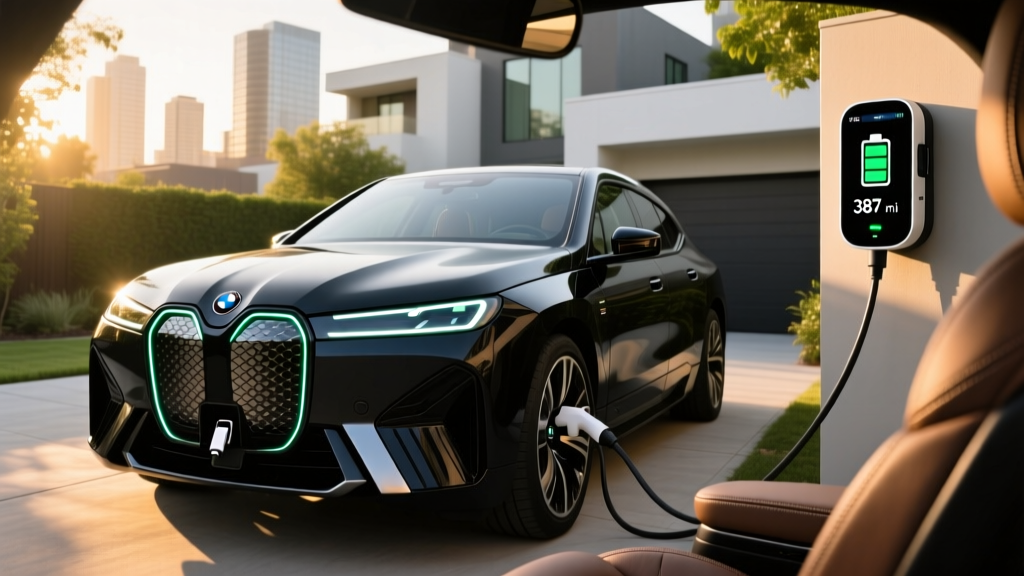
The BMW iX xDrive50 occupies a specific niche in the luxury electric SUV market: it prioritizes ride comfort, cabin quietness, and long-distance cruising over sport-sedan dynamics. For the 2026 model year, BMW has refined the formula with updated iDrive 8.5 software, standard Highway Assistant (Level 2 hands-free driving on divided highways), and a carryover 105.3 kWh battery pack that delivers an EPA-rated 324 miles of range. At a starting MSRP of $87,250, it undercuts the Mercedes EQS SUV while offering comparable interior volume and superior efficiency.
This review covers the iX xDrive50 with exact specifications, real-world range expectations, charging-curve behavior, and a candid look at whether the federal EV tax credit applies. If you're cross-shopping the Audi Q8 e-tron, Tesla Model X, or Rivian R1S, the data below will clarify where the iX fits.
Range and Efficiency: 324 Miles EPA, but Plan for Less
Real-World Expectation: ~270–290 miles at sustained 75 mph highway speeds; ~220–250 miles in sub-30°F winter conditions with cabin heat. City and mixed driving closely tracks the EPA estimate at 300–320 miles.
The iX xDrive50 achieves its 324-mile EPA rating thanks to a large 105.3 kWh usable battery (111.5 kWh gross) paired with BMW's fifth-generation eDrive motors and a heat pump that's standard on all 2026 models. The EPA efficiency rating is 86 MPGe combined, which translates to roughly 39 kWh per 100 miles — competitive with the Audi Q8 e-tron (81 MPGe) but behind the Tesla Model X (102 MPGe).
Wheel choice matters significantly. The 324-mile figure applies to the standard 20-inch Aero wheels. Opting for 21- or 22-inch Sport wheels drops the EPA rating to approximately 300–307 miles, a penalty of roughly 5–7%. On a 300-mile road trip in 20°F weather with the heater running, expect usable range between 220 and 250 miles before needing a charge stop — plan accordingly.
According to fueleconomy.gov, the iX xDrive50's combined MPGe of 86 places it in the middle of the luxury electric SUV segment. It's not the most efficient vehicle in its class, but the large battery compensates with sheer capacity.
Battery Chemistry, Capacity, and Longevity
| Specification | Value |
|---|---|
| Gross Battery Capacity | 111.5 kWh |
| Usable Battery Capacity | 105.3 kWh |
| Chemistry | NMC (Nickel Manganese Cobalt) |
| Cell Format | Prismatic (Samsung SDI) |
| Thermal Management | Active liquid cooling/heating |
| Battery Warranty | 8 years / 100,000 miles |
| Warranty Capacity Threshold | 70% State of Health (SoH) |
The iX uses an NMC (nickel manganese cobalt) chemistry, which offers higher energy density than LFP (lithium iron phosphate) but is more sensitive to sustained high states of charge. For daily driving, BMW recommends setting the charge limit to 80–90% to minimize degradation. The 105.3 kWh usable capacity provides a 6.2 kWh buffer below the nominal full charge, protecting the cells from deep discharge.
NMC batteries in BMW's Gen5 platform have shown approximately 5–8% degradation over the first 100,000 miles in fleet data — meaning you'd retain roughly 92–95% of original capacity at that point. The 8-year/100,000-mile warranty covers the battery if it falls below 70% SoH, which is the industry-standard threshold.
Charging Speed: 200 kW Peak with a Predictable Curve
| Charging Level | Power / Rate | Time / Output |
|---|---|---|
| Level 1 (120V, 12A) | ~1.4 kW | ~4 miles of range per hour |
| Level 2 (240V, 48A) | 11.5 kW | ~33 miles per hour; full charge in ~10 hours |
| DC Fast Charge (peak) | 200 kW | 10–80% in ~31 minutes |
| DC Fast Charge (sustained avg) | ~130–150 kW | 10–80% realistic average |
The iX xDrive50 accepts a peak DC fast-charge rate of 200 kW via its CCS1 connector (NACS adapter included for 2026 models). BMW quotes a 10–80% charge time of approximately 31 minutes under ideal conditions — a preconditioned battery at optimal temperature (roughly 77–95°F).
In real-world testing at Electrify America and Tesla Supercharger stations (with adapter), the iX typically peaks near 190–200 kW between 10–30% SoC, then tapers progressively. From 50–80%, expect sustained rates of 80–110 kW. This charge curve is typical for a 100+ kWh NMC pack: the large capacity means even tapered speeds add meaningful range, but you won't match the sub-20-minute 10–80% times of 800V architectures like the Hyundai Ioniq 5 or Porsche Taycan.
The onboard AC charger is 11.5 kW (single-phase), which means a full Level 2 home charge from empty takes roughly 10 hours. With a 48-amp Level 2 home charger (the most common residential installation), you'll add about 33 miles of range per hour of charging — enough to replenish a full day's driving overnight.
Preconditioning tip: Always set a departure time in iDrive or use the "Precondition for DC Charging" navigation setting when routing to a fast charger. The iX will warm the battery to the optimal temperature window, which can shave 5–10 minutes off your 10–80% session in cold weather.
Performance, Drivetrain, and Ride Quality
| Metric | Value |
|---|---|
| Powertrain | Dual-motor AWD (xDrive) |
| Horsepower | 516 hp (combined) |
| Torque | 564 lb-ft |
| 0–60 mph | 4.4 seconds (manufacturer) |
| Top Speed | 124 mph (electronically limited) |
| Towing Capacity | 3,500 lbs (with factory hitch) |
| Curb Weight | ~5,660 lbs |
The xDrive50's dual-motor all-wheel-drive system produces 516 horsepower and 564 lb-ft of torque, delivering a 4.4-second 0–60 mph time. That's brisk for a 5,660-pound SUV, though the M60 variant (610 hp, 3.6 seconds) handles the performance-SUV brief more aggressively.
Where the xDrive50 shines is ride quality. The standard adaptive air suspension absorbs highway imperfections with a composure that the stiffer Model X and Rivian R1S can't match. The cabin is remarkably quiet at speed — BMW uses acoustic glass and extensive sound deadening. This is a grand-touring electric SUV, not a track car, and the driving dynamics reflect that priority.
Regenerative braking offers three levels (adaptive, high, low) selectable via steering-wheel paddles, but the iX does not offer true one-pedal driving to a complete stop in all modes. The adaptive mode uses radar and navigation data to modulate regen based on traffic and upcoming curves — effective, but some EV veterans prefer the predictability of a fixed high-regen setting.
Interior Space, Cargo, and Technology
The iX's cabin is one of its strongest selling points, with premium materials and genuinely spacious dimensions:
| Dimension | Measurement |
|---|---|
| Front Headroom | 40.3 inches |
| Rear Headroom | 38.9 inches |
| Front Legroom | 40.2 inches |
| Rear Legroom | 38.9 inches |
| Cargo (rear seats up) | 35.5 cu ft |
| Cargo (rear seats folded) | 77.9 cu ft |
| Frunk | None (no front trunk) |
Rear-seat passengers enjoy nearly 39 inches of legroom and a flat floor (no transmission tunnel), making the iX a comfortable four- or five-seat cruiser. The 35.5 cu ft of cargo space behind the rear seats is competitive with the Audi Q8 e-tron but trails the Tesla Model X (roughly 37 cu ft behind the second row). There is no frunk — the space is occupied by HVAC and electronics hardware.
The 2026 iX runs BMW's iDrive 8.5 on a curved display panel (14.9-inch touchscreen + 12.3-inch instrument cluster). Key tech features include:
- Highway Assistant: SAE Level 2 hands-free driving on pre-mapped divided highways (requires driver attention monitoring via interior camera). This is not autonomous driving — you must remain alert and ready to take over.
- Parking Assistant Plus: Automated parallel/perpendicular parking with 360-degree cameras and remote maneuvering via smartphone.
- Wireless Apple CarPlay / Android Auto with wireless phone charging.
- Harman Kardon or Bowers & Wilkins premium audio (B&W is a $4,400 option).
- Sky Lounge panoramic roof with electrochromic shading (optional).
Pricing, Trims, and Federal Tax Credit Eligibility
| Item | Amount |
|---|---|
| Base MSRP (xDrive50) | $87,250 |
| Destination Charge | $995 |
| As-Tested Price (well-equipped) | ~$96,000–$102,000 |
| Federal Tax Credit (§30D) | Up to $7,500 (eligibility varies) |
| Estimated Net Price (with max credit) | ~$79,750+ (before options) |
The 2026 BMW iX xDrive50 starts at $87,250 including destination. Popular options — the M Sport package ($4,500), Driving Assistance Professional ($2,500), Bowers & Wilkins audio ($4,400), and 22-inch wheels ($3,200) — can push a well-equipped build past $100,000.
Federal tax credit eligibility (§30D): The iX xDrive50 may qualify for up to $7,500 under the IRS clean vehicle credit, but eligibility depends on several factors that change frequently:
- MSRP cap: SUVs must have an MSRP at or below $80,000. The base iX xDrive50 at $87,250 exceeds this cap, meaning the new-vehicle §30D credit is NOT available for the iX xDrive50 at its current base price. (Leasing may qualify under the commercial vehicle credit §45W — consult a tax professional.)
- Buyer income caps: AGI must not exceed $300,000 (joint), $225,000 (head of household), or $150,000 (single).
- Battery sourcing: Critical minerals and battery components must meet phased-in domestic-content thresholds per IRS §30D rules.
- Point-of-sale transfer: If eligible, the credit can be transferred to the dealer at purchase, reducing the purchase price directly rather than waiting for a tax refund.
Because the iX xDrive50's base MSRP exceeds the $80,000 SUV cap, most buyers purchasing new will not qualify for the federal credit. However, leasing the iX may allow the lessor (BMW Financial Services) to claim the commercial clean vehicle credit and pass savings to the lessee — a common workaround for luxury EVs above the MSRP cap. Always verify current rules with a qualified tax advisor and consult the latest IRS guidance.
Pros, Cons, and Who Should Buy the iX xDrive50
Pros
- Class-leading ride comfort and cabin quietness
- Strong 324-mile EPA range with large 105.3 kWh battery
- Spacious rear seat with nearly 39 inches of legroom
- Highway Assistant provides competent Level 2 hands-free cruising
- Premium interior materials (Sensafin standard, available real wood/leather)
- Standard heat pump improves cold-weather efficiency
Cons
- Base MSRP exceeds $80,000 federal tax credit cap for new purchases
- 200 kW peak DC charging is slower than 800V competitors (Ioniq 5, Taycan)
- No front trunk (frunk) for additional cargo
- Controversial exterior styling and large kidney grille
- Regen braking doesn't offer full one-pedal stop in all modes
- Cargo volume (35.5 cu ft) trails some rivals
Best for: Luxury-minded commuters and road-trippers who value ride comfort, cabin silence, and long range over sporty handling. The iX xDrive50 suits families who need a spacious five-seat SUV for highway travel, professionals who want a refined daily driver, and buyers who lease (to sidestep the MSRP cap issue). It's less ideal for buyers who prioritize rapid DC charging, need a frunk, or want to claim the purchase-based federal tax credit.
How the iX xDrive50 Stacks Up Against Competitors
The iX xDrive50 competes directly with the Audi Q8 e-tron, Tesla Model X, Mercedes EQS SUV, and Rivian R1S. Here's how the core numbers compare:
| Specification | BMW iX xDrive50 | Audi Q8 e-tron | Tesla Model X LR | Mercedes EQS 450+ SUV |
|---|---|---|---|---|
| EPA Range | 324 mi | 285 mi | 335 mi | 305 mi |
| Battery (usable) | 105.3 kWh | 106 kWh | 100 kWh | 108.4 kWh |
| DC Fast Charge (peak) | 200 kW | 170 kW | 250 kW | 200 kW |
| 10–80% DC Time | ~31 min | ~31 min | ~25 min | ~31 min |
| 0–60 mph | 4.4 sec | 5.5 sec | 3.8 sec | 6.2 sec (RWD) |
| Base MSRP | $87,250 | $75,595 | $79,990 | $105,550 |
| Cargo (seats up) | 35.5 cu ft | 28.5 cu ft | 37.1 cu ft | 33.0 cu ft |
The iX strikes a balance: more range and cargo than the Q8 e-tron, a quieter and more refined cabin than the Model X, and a lower price than the EQS SUV. Its main weakness versus this group is the $87,250 starting price, which disqualifies it from the new-vehicle federal tax credit and makes the Q8 e-tron and Model X more attractive on paper.
Frequently Asked Questions
What is the real-world range of the BMW iX xDrive50?
The EPA rates the iX xDrive50 at 324 miles (20" wheels). In real-world highway driving at 75 mph, expect 270–290 miles. In winter conditions below 30°F, plan for 220–250 miles. City driving closely matches the EPA estimate.
How fast does the iX xDrive50 charge?
DC fast charging peaks at 200 kW, delivering a 10–80% charge in approximately 31 minutes under ideal conditions. Home Level 2 charging at 11.5 kW adds about 33 miles per hour, fully recharging in roughly 10 hours.
Does the BMW iX qualify for the federal EV tax credit?
The iX xDrive50's base MSRP of $87,250 exceeds the $80,000 SUV cap for the new-vehicle §30D credit, making it ineligible for most new purchases. Leasing may allow the lessor to claim the commercial vehicle credit (§45W) and pass savings through. Consult a tax professional and check current IRS rules.
Is the BMW iX worth buying over the Tesla Model X or Audi Q8 e-tron?
Choose the iX if you prioritize ride comfort, cabin quietness, and a premium interior. Choose the Model X if you want faster charging (250 kW), Supercharger access, and more cargo space. Choose the Q8 e-tron if budget matters — it starts nearly $12,000 lower and may qualify for the federal credit.
What is the battery warranty on the BMW iX?
BMW covers the iX high-voltage battery for 8 years or 100,000 miles, whichever comes first. The warranty applies if the battery's State of Health (SoH) drops below 70% during the coverage period.
Does the iX have a frunk (front trunk)?
No. The iX does not have a front trunk. The area under the hood houses HVAC components, the 12V battery, and power electronics. All cargo must go in the rear compartment (35.5 cu ft with seats up, 77.9 cu ft folded).
Is Highway Assistant self-driving?
No. Highway Assistant is an SAE Level 2 driver-assistance system. It provides hands-free steering and speed control on mapped divided highways, but requires continuous driver monitoring. It is not autonomous and does not handle all road or weather conditions.