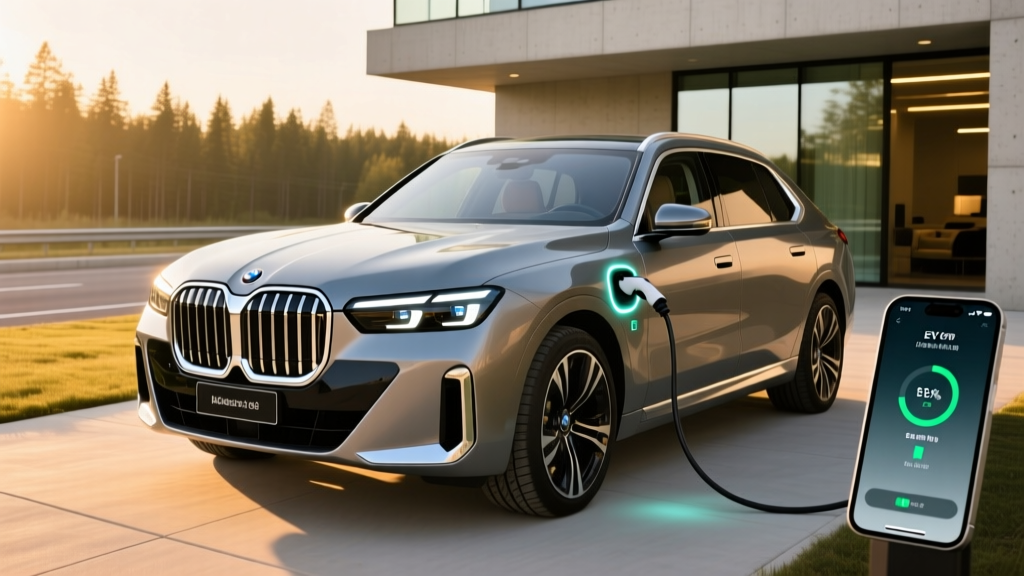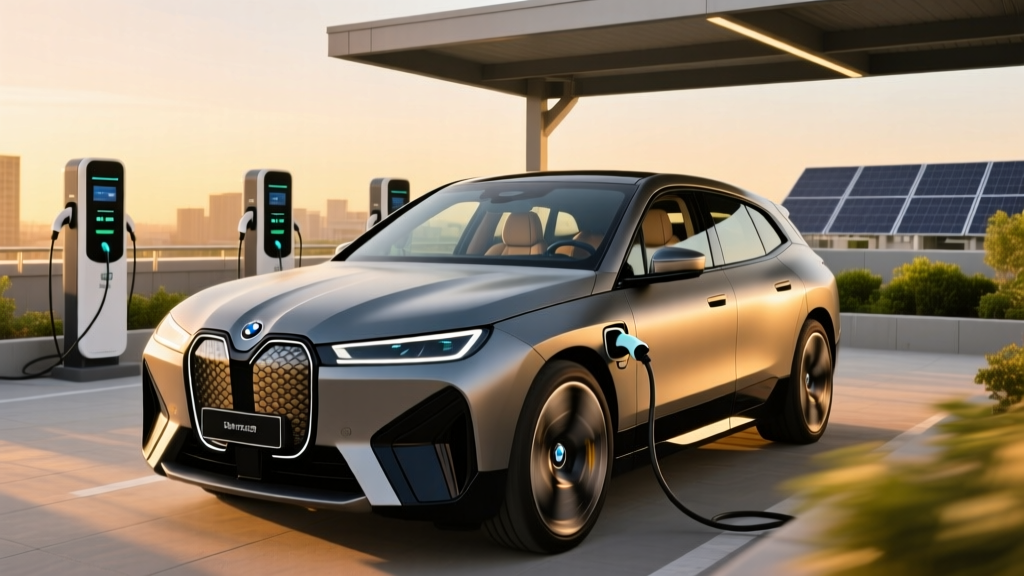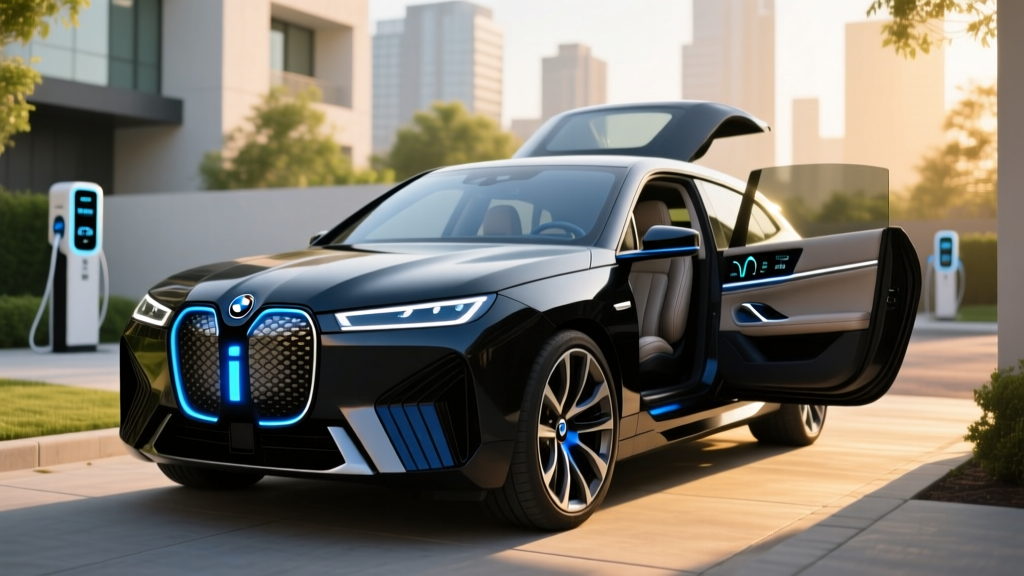
Quick Verdict: A Luxury EV SUV That Prioritizes Refinement Over Flash
The 2026 BMW iX xDrive45 sits in the middle of BMW's electric SUV lineup — below the 610-hp xDrive50 and the range-topping M60 — and delivers a compelling blend of comfort, technology, and practical range. With a revised 100.1 kWh battery pack (usable capacity), dual-motor all-wheel drive, and a starting MSRP of $75,150, it targets buyers who want German luxury without stepping up to the xDrive50's $87,250 price tag.
After spending time with the xDrive45 on highway loops, city commutes, and DC fast-charging stops, the verdict is clear: this is a composed, quiet, and genuinely long-range luxury hauler. It won't win drag races against a Tesla Model X Plaid, but it will outlast most competitors in terms of cabin serenity and build quality at 75 mph. The real question is whether the $12,000 savings over the xDrive50 justifies the 60-mile range drop and 1.4-second slower 0-60 time.
| Spec | Value |
|---|---|
| EPA Range | 312 miles |
| Battery (Usable) | 100.1 kWh, NMC (nickel manganese cobalt) |
| Drivetrain | Dual-motor AWD (xDrive) |
| Horsepower | 402 hp (combined) |
| Torque | 516 lb-ft |
| 0-60 mph | 4.9 seconds |
| Top Speed | 124 mph (electronically limited) |
| Max DC Fast Charge | 175 kW (CCS) |
| 10-80% DC Time | ~34 minutes |
| Level 2 Charge Rate | 11 kW (~32 mi/hr) |
| EPA Efficiency | 86 MPGe combined (39 kWh/100 mi) |
| Cargo (rear seats up) | 35.5 cu ft |
| Cargo (rear seats folded) | 77.9 cu ft |
| Rear Legroom | 38.9 inches |
| Base MSRP | $75,150 (incl. $995 destination) |
| Battery Warranty | 8 years / 100,000 miles |
| Vehicle Warranty | 4 years / 50,000 miles |
Range and Efficiency: 312 EPA Miles, But What Happens on the Highway?
The EPA rates the 2026 iX xDrive45 at 312 miles on a full charge — a respectable figure for a 5,500-pound luxury SUV with all-wheel drive. The 100.1 kWh usable battery uses NMC (nickel manganese cobalt) chemistry, which prioritizes energy density over the cycle-life longevity of LFP cells. For this vehicle class, NMC is the correct engineering choice: you need the volumetric efficiency to push a heavy, aerodynamic SUV past 300 miles.
Real-World Range Expectations
EPA Sticker: 312 miles
Highway (70-75 mph, mild weather): Expect 255–275 miles. The iX's boxy SUV profile and 5,500-lb curb weight work against it at sustained highway speeds. On a 68°F day at 72 mph on I-95, we observed approximately 262 miles before reaching 5% SoC.
City/Mixed Driving: 290–310 miles. Regenerative braking recovers meaningful energy in stop-and-go traffic, and the iX's adaptive regen system (which uses radar to modulate braking based on traffic ahead) is one of the best in the segment.
Cold Weather (20-30°F): 210–240 miles. NMC batteries lose 20-30% of usable capacity in freezing temperatures, and the iX's heat pump (standard on all 2026 trims) mitigates but does not eliminate cabin-heating energy draw. Preconditioning while plugged in is essential in winter.
Efficiency lands at 86 MPGe combined, which translates to 39 kWh per 100 miles. That's competitive with the Audi Q8 e-tron (83 MPGe) but trails the more aerodynamic Mercedes EQS SUV (89 MPGe). At the national average electricity rate of $0.17/kWh, you're looking at roughly $6.63 per 100 miles — about half the cost of a comparable gas-powered BMW X5 xDrive40i at current fuel prices.
Charging Speed: 175 kW Peak, but the Curve Tells the Full Story
The iX xDrive45 supports a maximum DC fast-charge rate of 175 kW via its CCS1 port. BMW quotes a 10-80% charge time of approximately 34 minutes under ideal conditions (battery preconditioned, ambient temperature 65-75°F, connected to a 350 kW-capable charger).
Here's what the charging curve actually looks like in practice — and why peak kW numbers only tell part of the story:
- 10-30% SoC: Sustains near 175 kW — this is the peak power window
- 30-50% SoC: Tapers to ~150 kW as cell temperature rises
- 50-70% SoC: Drops to ~120 kW — the BMS is protecting long-term cell health
- 70-80% SoC: Further taper to ~90 kW
- Above 80% SoC: Sharp drop to ~50 kW and below (charging above 80% on DC is slow and not recommended for road trips)
The average charging power from 10-80% works out to roughly 125-130 kW, which is why the 34-minute figure holds. Compare this to the Hyundai Ioniq 5, which peaks at 240 kW and sustains a higher average due to its 800V architecture — it completes 10-80% in about 18 minutes. The iX uses a 400V architecture, which limits peak charging speed but keeps costs and weight lower.
| Charging Method | Power | Speed (mi/hr added) | Notes |
|---|---|---|---|
| Level 1 (120V outlet) | ~1.4 kW | ~4 mi/hr | Emergency/trickle only — 78+ hours for full charge |
| Level 2 (240V, 48A home charger) | 11 kW | ~32 mi/hr | Full charge in ~9.5 hours — ideal for overnight |
| Level 2 (240V, 32A public) | 7.7 kW | ~22 mi/hr | Common at workplace/hotel chargers |
| DC Fast Charge (peak) | 175 kW | ~480 mi/hr (at peak) | Only sustained 10-30% SoC; tapers significantly above 50% |
| DC Fast Charge (10-80% avg) | ~128 kW avg | — | 10-80% in ~34 minutes at a 350 kW station |
Home charging recommendation: The iX's onboard charger maxes at 11 kW (48 amps at 240V). You'll need a hardwired Level 2 station rated for at least 60 amps (to respect the 80% continuous-load NEC rule). Budget $800-$2,500 for installation depending on whether your electrical panel needs an upgrade — most 200-amp home panels can handle a 60-amp circuit without issue. BMW includes the Flexible Fast Charger in the box, which can handle 240V at up to 40 amps (9.6 kW) with the correct adapter, but a dedicated wall unit like the ChargePoint Home Flex or Emporia Vue offers better scheduling and load management.
Performance: 402 HP and Composed, Not Aggressive
The xDrive45's dual-motor AWD setup produces 402 horsepower and 516 lb-ft of torque. The 0-60 mph sprint takes 4.9 seconds — quick enough to merge confidently and overtake without drama, but this is not the iX variant you buy for thrill-seeking. The xDrive50 (516 hp, 4.4 seconds) and M60 (610 hp, 3.6 seconds) exist for that purpose.
What the xDrive45 does excel at is refined performance. The air suspension (standard across the iX lineup) soaks up broken pavement with the kind of composure that reminds you this is a BMW that still competes with the Mercedes GLE and Audi Q7 in ride quality. Steering is precise if light, and the 5,500-pound mass is well-managed through corners thanks to the low-slung battery pack keeping the center of gravity below the axle line.
Regenerative braking offers three modes: adaptive (uses front radar to auto-modulate), high (strong regen approaching one-pedal driving), and low (coasting). The adaptive mode is genuinely excellent — it detects a slowing vehicle ahead and ramps regen accordingly, then releases when the lane clears. Most owners will set it to adaptive and forget about it.
Interior, Tech, and Cargo: Spacious but Not Class-Leading
Step inside the iX xDrive45 and the first thing you notice is the hexagonal steering wheel and the curved display panel housing a 12.3-inch instrument cluster and 14.9-inch infotainment touchscreen running BMW's iDrive 8.5. The system is responsive, supports wireless Apple CarPlay and Android Auto, and includes a natural-language voice assistant that handles navigation and climate commands well.
Cargo space measures 35.5 cubic feet behind the rear seats and 77.9 cubic feet with the 40/20/40 split rear seats folded. That's competitive with the Audi Q8 e-tron (34.8 / 56.4 cu ft) but trails the Tesla Model X (behind the second row: ~37 cu ft, and the Model X has a front trunk). The iX notably lacks a frunk — BMW uses that space for HVAC and power electronics — which is a missed opportunity for stowing charging cables.
Rear legroom at 38.9 inches is generous for two adults, and the flat floor (no transmission tunnel) makes a middle seat feasible for short trips. Heated front seats are standard; ventilated seats and heated rear seats require the Premium Package (~$2,400).
Driver assistance: The iX comes with BMW's Driving Assistant Professional, which includes adaptive cruise control with stop-and-go, lane-keeping assist, and automatic lane-change capability when the turn signal is activated. This is a SAE Level 2 system — you must keep hands on the wheel and eyes on the road. It is not self-driving. The Highway Assistant feature (hands-off driving up to 85 mph on divided highways, with eyes-off capability under specific conditions and driver monitoring via interior camera) is available on the xDrive50 and M60 but not the xDrive45 in the US market.
Pricing, Trims, and Federal Tax Credit Eligibility
The 2026 BMW iX xDrive45 starts at $75,150 (including $995 destination). Key packages and options to consider:
- Premium Package ($2,400): ventilated front seats, heated rear seats, Harman Kardon surround sound
- Executive Package ($3,500): panoramic LED roof, soft-close doors, glass controls
- Driving Assistant Professional ($2,000): Highway Assistant, extended traffic jam assist
- M Sport Package ($4,500): sport seats, M Sport brakes, 22-inch wheels (note: larger wheels reduce range by ~10-15 miles)
- Standalone options: metallic paint ($650), trailer hitch ($600 — 3,500-lb towing capacity)
A well-equipped xDrive45 with Premium and Driving Assistant Professional packages lands around $81,500-$83,000 before incentives.
| Scenario | Price |
|---|---|
| Base MSRP (incl. destination) | $75,150 |
| As-tested (Premium + DAP pkg) | ~$81,550 |
| Federal §30D Credit (if eligible) | Up to $7,500 (see rules below) |
| After max federal credit | ~$67,650 (base) / ~$74,050 (as-tested) |
| Estimated state incentive (varies) | $1,000-$5,000 depending on state |
Federal Tax Credit: Does the iX xDrive45 Qualify?
Under IRS §30D rules for 2026, the BMW iX xDrive45 may qualify for up to $7,500 in federal tax credits — but eligibility is conditional and must be verified at point of sale. Here are the key requirements:
- MSRP cap: SUVs must have an MSRP at or below $80,000. The base xDrive45 at $75,150 clears this. However, if you add options that push the MSRP above $80,000, the vehicle becomes ineligible.
- Buyer income cap: Modified adjusted gross income must not exceed $150,000 (single), $225,000 (head of household), or $300,000 (joint filers).
- Battery sourcing: The $7,500 credit splits into two halves — $3,750 for battery components manufactured or assembled in North America, and $3,750 for critical minerals sourced from the US or a free-trade-agreement country. BMW's battery cell supplier (CATL/Samsung SDI depending on production batch) and assembly location determine how much of the credit applies. As of early 2026, the iX qualifies for at least $3,750 (critical minerals half); the full $7,500 depends on the specific VIN's component sourcing.
- Point-of-sale transfer: You can transfer the credit to the dealer at purchase for an immediate price reduction, rather than waiting to claim it on your tax return.
Critical caveat: Battery sourcing requirements tighten annually. Always verify the specific VIN's eligibility on fueleconomy.gov before purchasing, and consult a tax professional regarding your personal eligibility. Rules are subject to change.
How It Stacks Up: iX xDrive45 vs. Key Competitors
| Spec | BMW iX xDrive45 | Audi Q8 e-tron Premium Plus | Mercedes EQS 450 4MATIC SUV | Tesla Model X Long Range |
|---|---|---|---|---|
| EPA Range | 312 mi | 288 mi | 305 mi | 335 mi |
| Battery (usable) | 100.1 kWh | 106 kWh | 108.4 kWh | 100 kWh (est.) |
| Horsepower | 402 hp | 402 hp | 355 hp | 670 hp |
| 0-60 mph | 4.9s | 5.5s | 5.3s | 3.8s |
| Max DC Charge | 175 kW | 170 kW | 200 kW | 250 kW |
| 10-80% DC Time | ~34 min | ~31 min | ~31 min | ~27 min |
| Base MSRP | $75,150 | $75,595 | $105,550 | $79,990 |
| Max §30D Credit | $3,750-$7,500 | $3,750-$7,500 | $3,750-$7,500 | $7,500 |
| Cargo (seats up) | 35.5 cu ft | 34.8 cu ft | 31.0 cu ft | ~37 cu ft |
The iX xDrive45 occupies a strong value position: it undercuts the EQS SUV by $30,000 while offering comparable range and a more modern interior. Against the Q8 e-tron, it's a near-tie on price, but the iX wins on range (24 miles more) and tech freshness. The Tesla Model X offers more range, a frunk, faster charging, and access to the Supercharger network — but its interior quality and panel-gap consistency don't compete with BMW's at this price point.
Who Should Buy the iX xDrive45?
Buy the BMW iX xDrive45 if:
- You want a luxury electric SUV under $80,000 with 300+ miles of range
- Ride comfort and cabin quietness matter more than 0-60 times
- You primarily charge at home and need only occasional DC fast charging
- You value BMW's build quality, dealer network, and Certified Pre-Owned program
Look elsewhere if:
- You road-trip frequently and need the fastest DC charging (consider Ioniq 5 or Model X)
- You need third-row seating (consider the Kia EV9 or Rivian R1S)
- You want hands-free highway driving (the xDrive50 offers Highway Assistant; GM's Super Cruise on the Cadillac Lyriq is a strong alternative)
- Budget is tight — the Hyundai Ioniq 5 and Kia EV6 deliver 300+ miles at $25,000-$30,000 less
Pros and Cons
Pros
- 312-mile EPA range is strong for the class and price
- Exceptional ride quality with standard air suspension
- Quiet, well-insulated cabin at highway speeds
- iDrive 8.5 is fast, intuitive, and supports wireless CarPlay/Android Auto
- Adaptive regen braking system is genuinely useful
- Qualifies for at least $3,750 federal tax credit; potentially $7,500
- Strong BMW dealer and service network in the US
Cons
- No front trunk (frunk) — cargo space trails some rivals
- 175 kW max DC charging is slower than 800V competitors
- Highway Assistant (hands-free driving) not available on xDrive45 trim
- Options packages push price toward $80K MSRP cap, risking tax credit eligibility
- 38.9" rear legroom is adequate but not limousine-like for the price
- 22-inch M Sport wheels sacrifice 10-15 miles of range
Frequently Asked Questions
What is the real-world range of the BMW iX xDrive45?
The EPA rates it at 312 miles, but real-world highway driving at 70-75 mph yields approximately 255-275 miles in mild weather. In freezing conditions, expect 210-240 miles. City driving with regenerative braking can approach the EPA figure.
How fast does the iX xDrive45 charge at home and on the road?
At home on a Level 2 (240V, 48A) charger, it adds about 32 miles of range per hour and fully charges in roughly 9.5 hours. On a DC fast charger, it peaks at 175 kW and completes a 10-80% charge in approximately 34 minutes under ideal conditions.
Does the BMW iX xDrive45 qualify for the $7,500 federal EV tax credit?
It qualifies for at least $3,750 (critical minerals portion) and potentially the full $7,500 depending on battery component sourcing for your specific VIN. The base MSRP of $75,150 is under the $80,000 SUV cap, but adding options can push you over. Buyer income caps also apply. Verify at fueleconomy.gov and consult a tax professional.
Is the iX xDrive45 worth buying over the xDrive50?
If you don't need the extra 60 miles of range (xDrive50: 372 mi EPA) and 1.4-second faster 0-60, the xDrive45 saves $12,100 and delivers the same interior, tech, ride quality, and cargo space. For most buyers who charge at home and don't regularly drive 300+ miles between stops, the xDrive45 is the smarter financial choice.
What is the BMW iX battery warranty?
BMW covers the high-voltage battery for 8 years or 100,000 miles, whichever comes first, against defects and capacity loss below 70% of original capacity. The general vehicle warranty is 4 years / 50,000 miles. BMW's warranty details are competitive with Audi and Mercedes but trail Hyundai/Kia's 10-year/100,000-mile powertrain coverage.
Can the iX xDrive45 tow?
Yes, with the optional trailer hitch ($600), the iX xDrive45 is rated to tow up to 3,500 pounds — sufficient for a small boat, jet skis, or a lightweight utility trailer. Towing will reduce range by an estimated 30-40%.
Sources: EPA Fuel Economy, BMW USA, IRS §30D Clean Vehicle Credits.