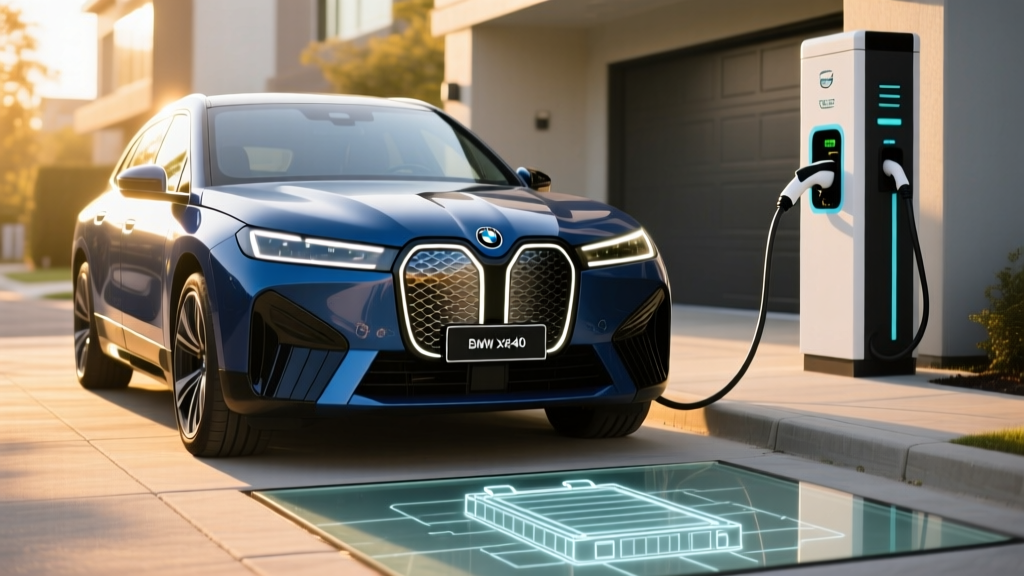
The BMW iX xDrive40 occupies a specific niche in the luxury electric SUV segment: it pairs BMW's most refined EV architecture with a price point that undercuts the performance-oriented xDrive50 and M60 variants. For 2026, the xDrive40 remains the volume entry into the iX lineup, trading some horsepower and range for a more accessible MSRP — while still delivering the platform's signature ride quality, cabin materials, and technology suite.
This review covers the 2026 BMW iX xDrive40 with exact figures for range, charging speed, efficiency, cargo space, and total cost. We'll also address federal tax credit eligibility under current IRS §30D rules, which have tightened battery-sourcing requirements significantly since the credit's restructuring.
2026 BMW iX xDrive40: Key Specifications
| Spec | Value |
|---|---|
| EPA Range | 307 miles |
| Battery (usable) | 105.2 kWh, NMC chemistry |
| Drivetrain | Dual-motor AWD (xDrive) |
| Horsepower | 335 hp (combined) |
| 0–60 mph | 5.8 seconds |
| Max DC Fast Charge | 150 kW (peak) |
| 10–80% DC Charge Time | ~34 minutes |
| Level 2 Charge Rate | 11 kW (~30 mi/hr) |
| Efficiency | 86 MPGe combined / 39 kWh/100 mi |
| Cargo Volume | 35.5 cu ft (rear seats up) / 77.9 cu ft (folded) |
| Rear Legroom | 38.9 inches |
| Battery Warranty | 8 years / 100,000 miles |
| Base MSRP | $87,250 (incl. destination) |
Range and Real-World Efficiency
The 2026 iX xDrive40 carries an EPA-estimated 307 miles of range from its 105.2 kWh usable battery pack. That puts it squarely in the competitive set with the Audi Q8 e-tron (285 mi), Mercedes EQE SUV (279 mi), and below the Tesla Model X Long Range (348 mi) and the iX xDrive50 (324 mi).
Real-World Range Expectations
EPA Sticker: 307 miles
Highway (70–80 mph, moderate temps): ~255–275 miles
Cold Weather (below 32°F, highway): ~210–240 miles
City / mixed commuter driving: ~290–310 miles (regen-friendly)
The iX xDrive40's large battery provides a comfortable buffer, but its aerodynamic profile (Cd 0.25) and substantial curb weight (~5,600 lbs) mean highway efficiency drops noticeably above 75 mph. The standard heat pump helps mitigate cold-weather losses compared to EVs without one, but expect a 20–25% range reduction in sustained sub-freezing conditions.
Efficiency lands at 86 MPGe combined, or roughly 39 kWh per 100 miles, according to fueleconomy.gov. That's average for a large luxury electric SUV — the iX prioritizes comfort and power delivery over hypermiling efficiency. For context, the lighter Tesla Model X achieves 102 MPGe combined, while the heavier Mercedes EQS SUV sits at 81 MPGe.
Charging Speed: DC Fast and Home Level 2
Charging is where the iX xDrive40 shows its age relative to newer 800V architectures. The platform uses a 400V electrical system, limiting peak DC fast-charging to 150 kW. That's adequate but not class-leading — the Hyundai Ioniq 5 and Kia EV9 both peak above 230 kW on 800V systems.
2026 BMW iX xDrive40 Charging Breakdown
| Charging Level | Power | Speed / Time | Notes |
|---|---|---|---|
| Level 1 (120V) | ~1.4 kW | ~4 mi/hr | Emergency/trickle only |
| Level 2 (240V, 48A) | 11 kW | ~30 mi/hr; full charge ~10.5 hr | Home / workplace standard |
| DC Fast Charge | 150 kW peak | 10–80% in ~34 min | Tapers significantly above 80% |
The charge curve is the practical reality behind the peak number. The iX xDrive40 sustains close to 150 kW from roughly 10% to 40% State of Charge, then progressively steps down — dropping to ~100 kW around 55% and falling below 50 kW past 80%. This is typical of NMC chemistry on a 400V architecture with BMW's conservative thermal management strategy, which prioritizes long-term battery health over maximum charge speed.
For home charging, the onboard 11 kW AC charger means a full 0–100% charge takes approximately 10.5 hours on a Level 2 wallbox. Most owners charging overnight from 20–80% daily will see a full replenishment in about 6 hours — comfortably within a single overnight window. BMW includes a Flexible Fast Charger with the vehicle that handles both 120V and 240V outlets, though a dedicated hardwired Level 2 station (like a ChargePoint Home Flex or BMW Wallbox) is strongly recommended for consistent daily use.
The iX uses the CCS1 connector for DC fast charging. With the industry's ongoing transition to NACS (Tesla's connector), BMW has committed to NACS adoption on future models, and current iX owners can use NACS-to-CCS adapters at Tesla Superchargers where supported.
Performance and Drivetrain
The xDrive40 is the comfort-oriented entry in the iX range, and its powertrain reflects that positioning. Dual electric motors — one on each axle — produce a combined 335 horsepower and 369 lb-ft of torque, routed through BMW's xDrive all-wheel-drive system. The 0–60 mph sprint takes 5.8 seconds, which is brisk but deliberately a step below the xDrive50's 4.4 seconds (516 hp) and the M60's 3.6 seconds (610 hp).
In practice, the xDrive40's acceleration is more than adequate for highway merging and passing. The instant torque delivery characteristic of dual-motor EVs means the car feels quicker than its 5.8-second time suggests in real-world 20–50 mph roll-on scenarios. BMW's adaptive suspension (standard on the iX) provides excellent ride compliance, and the low center of gravity from the underfloor battery pack keeps body roll well-controlled despite the vehicle's mass.
Regenerative braking offers multiple levels selectable through the iDrive system, including an adaptive mode that uses radar and navigation data to modulate regen based on traffic and upcoming road conditions. One-pedal driving is available via the B (Brake) mode on the gear selector, though BMW's implementation is slightly less aggressive than competitors like Nissan or Chevrolet — some drivers will appreciate the more gradual deceleration feel.
Interior, Cargo, and Technology
The iX cabin is one of BMW's most ambitious interior designs, featuring a minimalist dashboard dominated by the curved BMW iDrive display — a 14.9-inch touchscreen merged with a 12.3-inch instrument cluster on a single curved panel. The hexagonal steering wheel, open-pore wood or microfiber trim options, and available SensaTec or Merino leather create a genuinely premium environment that justifies the luxury price point.
Passenger space is generous. Front occupants enjoy 40.2 inches of legroom, while rear passengers get 38.9 inches — competitive with midsize luxury SUVs and significantly more than the Tesla Model Y's 37.4 inches in the second row. The flat floor (no transmission tunnel) makes the center rear seat usable for adults on shorter trips.
Cargo capacity measures 35.5 cubic feet behind the second row and 77.9 cubic feet with the 40/20/40 split rear seats folded. There is no front trunk (frunk) — BMW uses that space for power electronics and the HVAC system. For comparison, the Tesla Model X offers more total cargo volume but less premium cabin execution.
The iDrive 8.5 infotainment system includes wireless Apple CarPlay and Android Auto, BMW's Intelligent Personal Assistant voice control, over-the-air update capability, and the available Driving Assistance Professional Package — BMW's Level 2 driver-assist suite with adaptive cruise, lane centering, and automatic lane change on highways. Note: this is a SAE Level 2 system requiring continuous driver supervision; it is not autonomous driving.
Pricing, Trims, and Federal Tax Credit Eligibility
The 2026 BMW iX xDrive40 starts at $87,250 including destination. Key trims and options include:
- xDrive40 (base): $87,250 — 307 mi range, 335 hp, dual-motor AWD
- xDrive50: $92,250 — 324 mi range, 516 hp
- M60: $111,500 — 296 mi range, 610 hp, M Performance tuning
Common option packages that push the as-tested price higher include the Premium Package ($2,400), Executive Package ($4,100 with soft-close doors, massaging seats, panoramic roof shade), and the Driving Assistance Professional Package ($2,500). A well-equipped xDrive40 typically lands between $93,000 and $98,000 before incentives.
Federal Tax Credit Eligibility (IRS §30D)
| Requirement | iX xDrive40 Status (2026) |
|---|---|
| MSRP Cap (SUVs: ≤$80,000) | ❌ Exceeds cap at $87,250 |
| Buyer Income Cap (Joint: ≤$300K AGI) | Varies by buyer |
| Battery Component Sourcing (N. America) | Partial — BMW battery assembly in Germany |
| Critical Minerals Sourcing | Partial compliance |
| Estimated Credit | $0 — MSRP cap disqualifies all iX trims |
Source: IRS §30D Clean Vehicle Credit rules. The BMW iX exceeds the $80,000 MSRP cap for SUVs under current federal law, making all trims ineligible for the new-vehicle credit regardless of battery sourcing. State and local incentives may still apply — check your jurisdiction. Tax rules change; consult a tax professional for your specific situation.
This is a critical purchase consideration: the iX's MSRP disqualifies it from the $7,500 federal new-vehicle tax credit. Buyers seeking a luxury electric SUV that qualifies should investigate the Cadillac Lyriq (base MSRP under $60,000), certain Tesla Model X configurations (though most also exceed the cap), or the Lincoln Navigator's electric successor when pricing is confirmed. Leasing may offer a workaround — the commercial clean vehicle credit (§45W) can sometimes be passed through as a lease incentive, though this depends on the leasing company and current IRS guidance.
Warranty and Long-Term Ownership
BMW backs the iX with its standard new-vehicle warranty of 4 years / 50,000 miles, plus the federally mandated battery and powertrain warranty of 8 years / 100,000 miles. The battery warranty guarantees the pack will retain at least 70% of its original capacity during the coverage period — consistent with industry norms from Mercedes, Audi, and Tesla.
The 105.2 kWh NMC battery pack uses BMW's fifth-generation eDrive technology with integrated liquid cooling and heating. BMW's thermal management system is designed to limit degradation by keeping cells within an optimal temperature window during both driving and charging. Long-term degradation data for the iX platform (introduced for 2022) is still accumulating, but early reports from European high-mileage owners suggest approximately 5–7% capacity loss over the first 60,000 miles — within expected NMC parameters.
Maintenance costs are minimal compared to internal-combustion BMW SUVs. There are no oil changes, spark plugs, or transmission fluid services. The primary recurring costs are cabin air filter replacement, brake fluid checks (regenerative braking significantly extends pad life), tire rotation, and windshield washer fluid. BMW includes 3 years / 36,000 miles of complimentary scheduled maintenance.
Pros and Cons
✅ Pros
- Exceptional ride quality and cabin quietness — best-in-class NVH for a luxury EV SUV
- Premium interior materials and build quality that exceed Tesla and rival Mercedes
- Spacious rear seat (38.9" legroom) and usable cargo area (35.5 cu ft)
- Standard heat pump reduces cold-weather range loss
- Adaptive regen with radar-based intelligence is genuinely useful in traffic
- Over-the-air updates keep the vehicle current post-purchase
❌ Cons
- 150 kW peak DC charging is below rivals with 800V architectures
- No federal tax credit eligibility — MSRP exceeds $80,000 SUV cap
- No front trunk (frunk) for additional cargo
- Hexagonal steering wheel is polarizing and partially obstructs the instrument cluster
- iDrive 8.5 touchpad and menu structure has a learning curve
- High starting price ($87,250) with options easily pushing past $95,000
Who Should Buy the BMW iX xDrive40?
Buy the iX xDrive40 if:
- You prioritize ride comfort, cabin luxury, and brand prestige over maximum range or fastest charging
- Your daily commute is under 80 miles and you charge at home overnight
- You need a spacious rear seat for family or executive transport
- You value BMW's dealer network and included maintenance program
- Road trips are occasional, not weekly — the 34-minute 10–80% charge is manageable but not ideal for frequent long-distance travel
Look elsewhere if:
- Federal tax credit eligibility is a dealbreaker — consider the Cadillac Lyriq or Rivian R1S (dual-motor, under cap)
- You need fastest-possible DC charging — the Hyundai Ioniq 5, Kia EV9, or Porsche Macan EV charge significantly faster
- You want maximum range per dollar — the Tesla Model X or Rivian R1S Max Pack offer more miles
- You frequently tow — the iX is rated for only 3,500 lbs, below the Rivian R1S (7,700 lbs)
Frequently Asked Questions
What is the real-world range of the BMW iX xDrive40?
The EPA rates the iX xDrive40 at 307 miles. In real-world highway driving at 70–80 mph in moderate temperatures, expect approximately 255–275 miles. In cold weather (below 32°F), highway range drops to roughly 210–240 miles. City driving with regenerative braking can match or slightly exceed the EPA estimate.
How fast does the iX xDrive40 charge at home and on the road?
On a Level 2 home charger (240V, 48A), the iX charges at up to 11 kW, adding roughly 30 miles of range per hour and completing a full charge in about 10.5 hours. On DC fast chargers, it peaks at 150 kW and charges from 10% to 80% in approximately 34 minutes. The charge rate tapers significantly above 80% to protect battery longevity.
Does the BMW iX qualify for the federal EV tax credit?
No. Under current IRS §30D rules, the iX xDrive40's MSRP of $87,250 exceeds the $80,000 cap for SUVs, disqualifying all trims from the $7,500 new-vehicle credit regardless of buyer income or battery sourcing. Lease arrangements may offer indirect savings through the commercial vehicle credit (§45W), depending on the lessor. State and utility incentives may still apply.
Is the BMW iX xDrive40 worth buying over the Audi Q8 e-tron or Mercedes EQE SUV?
The iX xDrive40 offers more range (307 mi vs. the Q8 e-tron's 285 mi and the EQE SUV's 279 mi), a more spacious rear seat, and arguably the best ride quality in the segment. The Q8 e-tron charges faster (up to 170 kW) and has a lower starting price. The EQE SUV offers a more performance-oriented driving feel. If cabin luxury and comfort are your top priorities, the iX leads; if charging speed or price matters more, the Q8 e-tron is compelling.
What is the battery warranty on the BMW iX?
BMW provides an 8-year / 100,000-mile warranty on the high-voltage battery and electric powertrain, guaranteeing at least 70% capacity retention during the coverage period. The standard new-vehicle warranty covers 4 years / 50,000 miles, and BMW includes 3 years of complimentary scheduled maintenance.
Can the BMW iX use Tesla Superchargers?
Current iX models use the CCS1 connector. BMW has committed to NACS adoption on future vehicles. In the meantime, iX owners can access Tesla Superchargers that support CCS vehicles using a NACS-to-CCS adapter, though compatibility and availability vary by station. The Electrify America, EVgo, and ChargePoint networks remain the primary DC fast-charging options for CCS-equipped BMWs.