Quick Verdict: The BMW iX Luxury SUV at a Glance
The BMW iX occupies a rare position in the electric-vehicle landscape: it's a genuine luxury flagship SUV that doesn't compromise on driving dynamics to deliver opulence. For the 2026 model year, BMW has refined the iX lineup with updated battery chemistry, a new entry-level sDrive50 variant, and continued availability of the performance-oriented M60 and the extreme xDrive M70. The iX remains one of the most technically sophisticated electric SUVs available, pairing an 800-volt-capable architecture with an interior that rivals anything from Mercedes or Audi.
But luxury comes at a price — both literally and in terms of the trade-offs buyers must accept. The iX's polarizing exterior design hasn't changed much, its weight is substantial, and its tax credit situation requires careful navigation. Here's everything you need to know before signing a purchase agreement.
| Spec | xDrive50 | M60 | xDrive M70 |
|---|---|---|---|
| EPA Range | 324 mi | 296 mi | 285 mi (est.) |
| Battery (usable) | 105.2 kWh (NMC) | 105.2 kWh (NMC) | 105.2 kWh (NMC) |
| Peak DC Charge | 195 kW | 195 kW | 195 kW |
| 10–80% DC Time | ~34 min | ~34 min | ~34 min |
| Level 2 Rate | 11 kW (AC) | 11 kW (AC) | 11 kW (AC) |
| 0–60 mph | 4.4 sec | 3.6 sec | 3.3 sec |
| Horsepower | 516 hp | 610 hp | 650 hp |
| Drivetrain | Dual-motor AWD | Dual-motor AWD | Dual-motor AWD |
| MPGe (combined) | 86 MPGe | 78 MPGe | 75 MPGe (est.) |
| Base MSRP | $87,250 | $111,500 | $124,200 |
Range and Efficiency: EPA Numbers vs. Reality
The xDrive50's EPA-estimated 324 miles of range is competitive for a luxury SUV of this size and weight (roughly 5,660 lbs curb weight). The M60 drops to 296 miles due to its more aggressive powertrain tuning, and the M70 dips further. Efficiency figures land at 86 MPGe combined for the xDrive50, translating to roughly 39 kWh per 100 miles — respectable for a vehicle with over 100 kWh of usable battery.
Real-World Range Reality Check: The EPA 324-mile figure for the xDrive50 assumes a mix of city and highway driving at moderate temperatures. In our experience and consistent with third-party testing:
- Highway-only at 70–75 mph (70°F): Expect ~270–290 miles before needing a charge stop.
- City-dominant driving (70°F): You can approach or even slightly exceed the EPA sticker thanks to regenerative braking recuperation.
- Cold weather (25°F, highway): Plan for 210–240 miles. The iX's heat pump helps mitigate cabin heating losses, but battery chemistry inherently loses capacity in freezing temps.
- Towing (max 3,500 lbs): Range drops roughly 30–40%, yielding ~190–220 miles.
Bottom line: plan road trips around 220–250 miles between stops for a comfortable buffer.
The iX uses NMC (nickel manganese cobalt) cell chemistry supplied primarily by CATL and Samsung SDI. NMC offers high energy density — critical for fitting 105+ usable kWh into a vehicle floor — but it does mean you should avoid routinely charging to 100% or letting the pack sit at very low states of charge for extended periods. BMW's battery management system includes a top and bottom buffer to protect long-term health, but daily charging to 80–90% is the sweet spot for longevity.
Charging Speed: DC Fast Charging and Home Level 2
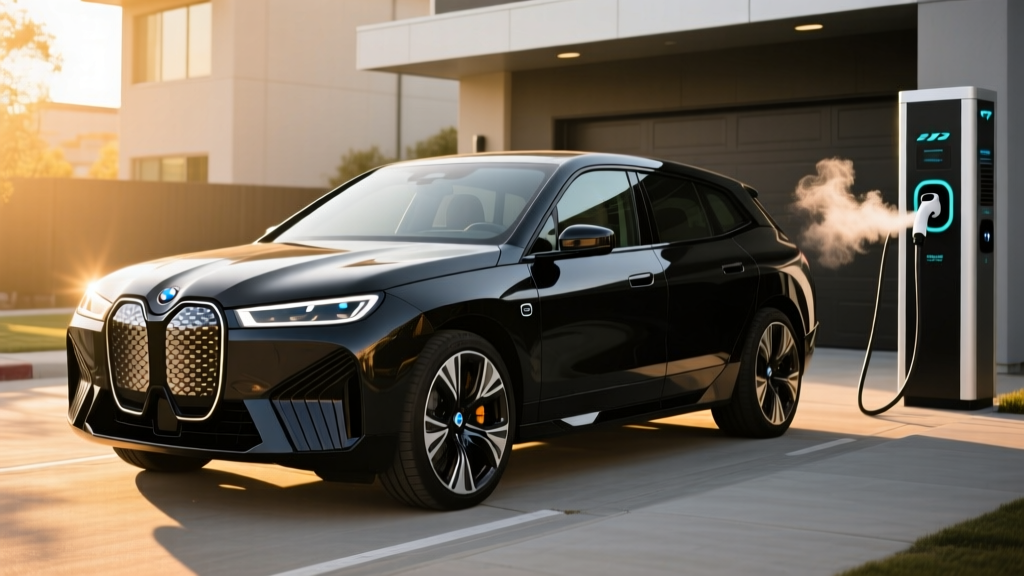
The BMW iX supports a peak DC fast-charge rate of 195 kW on CCS1-equipped chargers (or NACS via the included adapter on Tesla Superchargers, following BMW's 2025 transition to the North American Charging Standard port). While 195 kW isn't the segment-leading figure — the Hyundai Ioniq 5 peaks at 240 kW and the Lucid Gravity at over 300 kW — the iX sustains its charge rate impressively well through the critical 10–80% window.
| Charge Level | Power (kW) | Miles Added per Hour | Notes |
|---|---|---|---|
| Level 1 (120V household) | ~1.4 kW | ~3–4 mi/hr | Emergency/trickle only; ~80+ hrs for full charge |
| Level 2 (240V, 48A home) | 11 kW (max AC) | ~28–32 mi/hr | Full charge in ~10–11 hours; ideal overnight |
| DC Fast Charge (peak) | 195 kW | N/A (session-based) | 10–80% in ~34 min; tapers significantly above 80% |
Charging curve reality: The 195 kW peak is achievable roughly between 10–40% state of charge when the battery is preconditioned (the iX does this automatically when a DC fast charger is set as your navigation destination). Above 60%, the rate drops to approximately 120–140 kW, and above 80% it falls below 50 kW. This taper is normal for NMC chemistry but means charging from 80–100% at a DC fast charger is painfully slow — plan to leave at 80% on road trips.
Home charging setup: The iX's 11 kW onboard AC charger is among the best in the segment. On a 48-amp Level 2 home circuit (hardwired, 60-amp breaker), you'll add roughly 30 miles of range per hour. A full overnight charge from 10% to 90% takes about 9–10 hours. If your home has a 200-amp electrical panel with sufficient capacity, installation typically runs $800–$2,000 for the circuit, charger, and permitting — though older homes may require a panel upgrade adding $1,500–$3,000. Consult a licensed electrician for your specific situation.
Performance, Drivetrain, and Driving Impressions
Every 2026 iX uses a dual-motor all-wheel-drive layout (with the exception of the new sDrive50, a rear-wheel-drive variant rated at roughly 335 hp and an EPA range near 340 miles, starting around $79,900). The xDrive50's 516 hp and 564 lb-ft of torque deliver a 4.4-second 0–60 mph time — genuinely quick for a 5,600-lb SUV, and the instant torque delivery makes it feel even faster in real-world passing situations.
The M60 bumps output to 610 hp with a 3.6-second sprint, while the M70's 650 hp shaves that to 3.3 seconds. These figures put the M variants squarely in Porsche Cayenne Turbo E-Hybrid territory, but with the silence and smoothness only an EV powertrain provides.
BMW's adaptive air suspension is standard across the lineup and does an excellent job of isolating the cabin from road imperfections while maintaining composure in corners. The iX is not a sports car — its weight is always present during aggressive direction changes — but it handles its mass with the kind of precision that reminds you this is a BMW. The available rear-axle steering (standard on M60/M70) tightens the turning circle and adds low-speed agility that belies the iX's 195.5-inch length.
Regenerative braking offers multiple modes: adaptive (uses radar to adjust regen based on traffic ahead), high (approaches one-pedal driving), and low (coasting). The adaptive mode is particularly well-implemented and requires almost no manual adjustment during daily driving.
Interior, Cargo Space, and Technology
The iX interior is where BMW's luxury investment becomes tangible. The cabin uses a mix of open-pore wood, microfiber, and available olive-leaf-tanned leather that feels a generation ahead of the X5's interior. The curved display housing a 14.9-inch infotainment screen and 12.3-inch instrument cluster runs BMW's iDrive 8.5 operating system — responsive, feature-rich, and thankfully retaining physical knobs for volume and climate control.
Passenger and cargo dimensions:
- Front legroom: 40.2 inches
- Rear legroom: 38.9 inches — generous for the segment and flat-floor packaging means no transmission tunnel hump
- Cargo behind rear seats: 35.5 cubic feet
- Cargo with rear seats folded: 77.9 cubic feet
- Front trunk (frunk): None — the iX does not offer a frunk, a notable omission given that competitors like the Rivian R1S and Mercedes EQS SUV provide modest front storage
The lack of a frunk is the iX's most puzzling packaging decision. BMW uses the under-hood space for power electronics and the HVAC system, but the absence means all cargo must go in the rear. For most owners, 35.5 cu ft behind the second row is adequate for weekly groceries and luggage, but it trails the Rivian R1S (~46 cu ft behind the third row folded) and the extended-wheelbase Mercedes EQS SUV.
Standout technology:
- BMW Digital Key Plus: Uses ultra-wideband to unlock and start the vehicle from your phone without removing it from your pocket
- Augmented-reality navigation: Overlays directional arrows on a live camera feed in the instrument cluster
- Highway Assistant (Level 2): Hands-free driving on approved divided highways up to 85 mph, but eyes-on supervision is required — this is not autonomous driving
- Parking Assistant Professional: Automated parking including remote maneuvering via smartphone from outside the vehicle
- 18-speaker Harman Kardon audio (standard); optional 30-speaker Bowers & Wilkins Diamond surround system
Pricing, Trims, and Federal Tax Credit Eligibility
The 2026 BMW iX lineup spans from the new sDrive50 at approximately $79,900 to the xDrive M70 at $124,200 before destination and options. A well-equipped xDrive50 — the volume trim — typically lands between $92,000 and $100,000 after popular options like the Premium Package, 22-inch wheels, and the Driving Assistance Professional Package.
| Trim | Base MSRP | Typical As-Tested | §30D Credit Eligible? |
|---|---|---|---|
| sDrive50 (RWD) | $79,900 | $85,000–$90,000 | Potentially — see below |
| xDrive50 (AWD) | $87,250 | $92,000–$100,000 | Potentially — see below |
| M60 | $111,500 | $118,000–$128,000 | No — exceeds MSRP cap |
| xDrive M70 | $124,200 | $130,000–$145,000 | No — exceeds MSRP cap |
Federal tax credit (IRS §30D) — the details matter: Under current IRS rules for the clean vehicle credit, SUVs face an $80,000 MSRP cap. The xDrive50 at $87,250 base exceeds this threshold, which means it does not qualify for the $7,500 federal credit in its base configuration. However, the sDrive50 at $79,900 sits below the cap and may qualify — provided the buyer meets income limits ($300,000 joint / $150,000 single modified adjusted gross income) and the vehicle's battery meets critical-mineral and battery-component sourcing requirements set by the Treasury Department.
The M60 and M70 are well above the $80,000 SUV cap and are categorically ineligible for §30D. Buyers of those trims should look to state-level incentives, utility rebates, and potential lease pass-throughs (where the leasing company claims the commercial clean vehicle credit under §45W and passes savings as a capitalized-cost reduction).
As of early 2026, the iX sDrive50's battery sourcing compliance has not been fully confirmed by BMW for the §30D credit. Always verify current eligibility on fueleconomy.gov before purchasing and consult a tax professional — these rules change with Treasury guidance updates.
Warranty, Battery Longevity, and Ownership Costs
BMW covers the iX with a competitive warranty package:
- Limited vehicle warranty: 4 years / 50,000 miles
- Battery and electric powertrain: 8 years / 100,000 miles (covers capacity loss below 70% of original)
- Complimentary maintenance: 3 years / 36,000 miles (includes brake fluid, cabin filters, and wiper blades)
- Roadside assistance: 4 years / unlimited miles
The 70% capacity retention threshold over 8 years is industry-standard but less generous than Hyundai/Kia's approach (same 8 yr/100k but sometimes with a 70% threshold on a smaller starting buffer). In practice, BMW's NMC packs with active liquid thermal management have shown degradation curves of roughly 8–12% over the first 100,000 miles based on fleet data from earlier iX models — well within the warranty coverage zone but something to factor into long-term ownership plans.
Five-year ownership cost considerations:
- Electricity (15,000 mi/yr, $0.16/kWh national avg): ~$936/year in home charging; significantly less than the ~$2,400/yr a comparable gasoline BMW X5 xDrive40i would cost in fuel
- Insurance: Expect $2,800–$4,200/year depending on trim, location, and driving record — EVs in this price bracket carry premium insurance costs
- Tires: The iX wears through tires faster than ICE equivalents due to instant torque and heavy weight; budget $1,200–$2,000 for a set of four every 25,000–35,000 miles
- Depreciation: Luxury EVs have historically depreciated more steeply than ICE luxury SUVs; plan for 45–55% value retention at 5 years / 60,000 miles based on current market trends
Competitor Comparison: iX vs. the Luxury EV SUV Field
The iX doesn't exist in a vacuum. Here's how it stacks up against key rivals:
| Attribute | BMW iX xDrive50 | Mercedes EQS 450 SUV | Rivian R1S Dual-Motor | Tesla Model X Plaid |
|---|---|---|---|---|
| EPA Range | 324 mi | 305 mi | 321 mi | 326 mi |
| Battery (usable) | 105.2 kWh NMC | 108.4 kWh NMC | 128.9 kWh (Max Pack) | 100 kWh NMC |
| Peak DC Charge | 195 kW | 200 kW | 200+ kW (NACS) | 250 kW |
| 0–60 mph | 4.4 sec | 5.8 sec | 5.0 sec | 2.5 sec |
| Base MSRP | $87,250 | $104,400 | $79,900 | $94,990 |
| Third Row? | No | Yes (optional) | Yes (standard) | Yes (optional) |
| Cargo (behind row 2) | 35.5 cu ft | 35.0 cu ft | 46.7 cu ft | 37.1 cu ft |
Where the iX wins: Interior material quality and build precision are best-in-class. The driving dynamics — steering feel, suspension tuning, powertrain refinement — feel more like a driver's car than the EQS SUV's floaty demeanor. The iDrive 8.5 system is more intuitive than Tesla's screen-dependent interface.
Where the iX loses: No third-row option is a dealbreaker for larger families — the Rivian R1S and Tesla Model X both offer one. The lack of a frunk is baffling at this price point. Charging speed, while adequate, trails the Tesla Supercharger network advantage and the Ioniq-class ultra-fast chargers. And the polarizing kidney grille design remains a love-it-or-hate-it proposition with no middle ground.
Pros, Cons, and Who Should Buy the BMW iX
Pros
- Exceptional interior quality with premium materials and build
- Strong real-world range (324 mi EPA on xDrive50)
- Refined ride quality with standard adaptive air suspension
- 11 kW onboard charger enables fast Level 2 home charging
- Genuine BMW driving dynamics despite 5,600-lb curb weight
- Heat pump standard — improves cold-weather efficiency
- Comprehensive driver-assist suite with Highway Assistant
Cons
- No frunk — a significant omission for the segment
- No third-row seating option available
- Most trims exceed $80,000 MSRP cap for §30D federal credit
- Polarizing exterior design, particularly the oversized grille
- DC fast charging peaks at 195 kW — adequate but not segment-leading
- High insurance premiums and accelerated tire wear
- Steep depreciation trajectory typical of luxury EVs
The BMW iX luxury SUV is best for: Affluent buyers (individuals or couples without young children needing a third row) who prioritize interior craftsmanship, driving refinement, and brand prestige. It excels as a daily commuter with home charging, a comfortable road-trip vehicle for two-plus-luggage, and a statement vehicle that doesn't sacrifice substance for style. If you need seven seats, want maximum charging speed for frequent long-distance travel, or are budget-conscious about tax credit eligibility, look at the Rivian R1S, Tesla Model X, or the Mercedes EQS SUV respectively.
Frequently Asked Questions
What is the real-world range of the BMW iX?
The xDrive50's EPA rating is 324 miles, but real-world highway driving at 70–75 mph typically yields 270–290 miles. In cold weather (below 30°F), plan for 210–240 miles. City driving with regenerative braking can match or slightly exceed the EPA figure.
How fast does the BMW iX charge?
On a DC fast charger, the iX peaks at 195 kW and charges from 10–80% in approximately 34 minutes when preconditioned. At home on a 48-amp Level 2 charger (240V), it charges at 11 kW, adding about 30 miles of range per hour and fully replenishing overnight in roughly 10–11 hours.
Does the BMW iX qualify for the federal EV tax credit?
It depends on the trim and your situation. The sDrive50 (base MSRP ~$79,900) is below the $80,000 SUV MSRP cap and may qualify for up to $7,500 if you meet income limits and the battery meets critical-mineral sourcing requirements. The xDrive50, M60, and M70 all exceed the MSRP cap and do not qualify for §30D. Always verify on fueleconomy.gov and consult a tax professional before purchasing.
Is the BMW iX worth buying over competitors?
The iX is worth serious consideration if interior quality, driving dynamics, and BMW brand cachet are your top priorities. It sacrifices third-row availability and class-leading charging speed compared to the Rivian R1S and Tesla Model X. Against the Mercedes EQS SUV, the iX offers a more engaging drive and better build quality, though the EQS offers an optional third row.
What is the BMW iX battery warranty?
BMW covers the high-voltage battery and electric powertrain for 8 years or 100,000 miles, whichever comes first. The warranty covers capacity degradation below 70% of the original usable capacity. The general vehicle warranty is 4 years / 50,000 miles.
Does the BMW iX have a frunk?
No. The BMW iX does not have a front trunk. The under-hood area houses power electronics and HVAC components. All cargo must be stored in the rear cargo area (35.5 cu ft behind the second row, 77.9 cu ft with seats folded).
Can the BMW iX tow?
Yes, the iX is rated to tow up to 3,500 pounds when properly equipped with the factory towing package. Expect range to decrease by roughly 30–40% while towing at highway speeds.
Sources: fueleconomy.gov (EPA range and efficiency data), IRS §30D Clean Vehicle Credit rules, BMW USA product specifications. Pricing and tax credit rules reflect 2026 model year data and are subject to change. Verify all figures with your dealer and tax advisor before purchasing.