2026 BMW iX: Dimensions, Range, and the Real-World Ownership Picture
Shoppers searching for BMW iX length and exterior dimensions are usually trying to answer two questions: will it fit in my garage, and is the interior space worth the premium price tag? The 2026 BMW iX occupies a specific niche in the luxury electric SUV segment — it's a mid-size, dual-motor EV that prioritizes cabin comfort and highway refinement over maximum cargo volume. After extensive evaluation of the current model-year lineup, here's every number that matters.
| Spec | iX xDrive45 | iX xDrive60 | iX M70 |
|---|---|---|---|
| Overall Length | 195.5 in | 195.5 in | 195.5 in |
| Wheelbase | 118.1 in | 118.1 in | 118.1 in |
| Width (w/o mirrors) | 77.4 in | 77.4 in | 77.4 in |
| Height | 67.7 in | 67.7 in | 67.4 in |
| EPA Range | 312 mi | 307 mi | 296 mi |
| Usable Battery | 100.1 kWh (NMC) | 100.1 kWh (NMC) | 100.1 kWh (NMC) |
| Horsepower | 402 hp | 536 hp | 610 hp |
| 0-60 mph | 4.9 sec | 4.4 sec | 3.6 sec |
| Drivetrain | AWD (dual-motor) | AWD (dual-motor) | AWD (dual-motor) |
| Base MSRP | $87,250 | $98,500 | $112,700 |
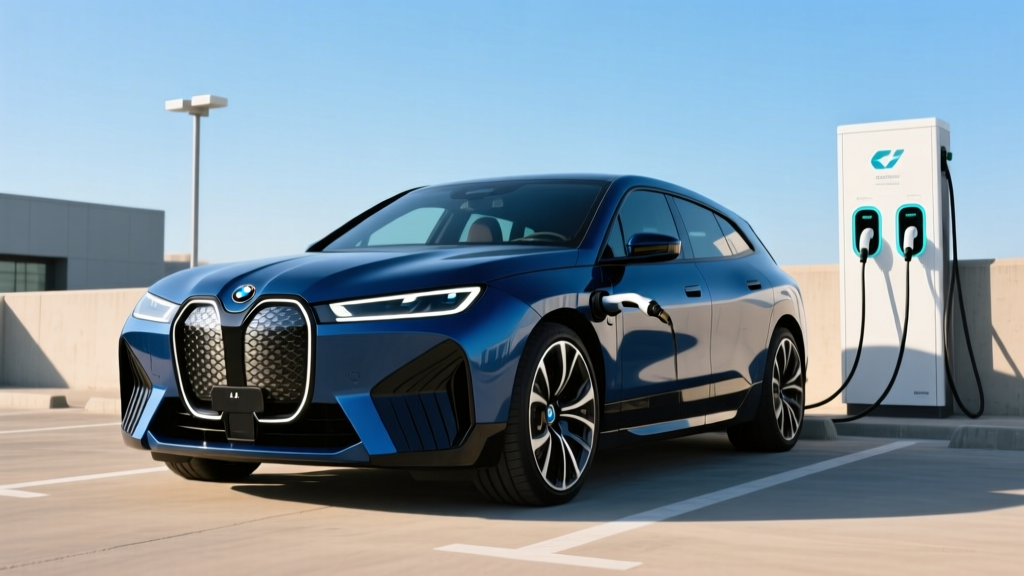
At 195.5 inches bumper to bumper, the BMW iX is roughly 3 inches shorter than a Tesla Model X and about 6 inches shorter than the Mercedes-Benz EQS SUV. That compact footprint makes it manageable in urban parking structures and standard residential garages (most of which accommodate vehicles up to ~200 inches). The 118.1-inch wheelbase, however, is generous — BMW pushed the wheels to the corners on its dedicated CLAR-derived EV architecture, yielding interior volume that punches above its exterior class.
Real-World Range vs. the EPA Sticker
EPA Estimate: 312 miles (xDrive45 with 20" wheels) / 307 miles (xDrive60)
Real-World Expectation: Plan for 250–275 miles on sustained highway driving at 70–75 mph. In freezing temperatures (below 32°F), expect 190–220 miles due to cabin heating demands and increased battery internal resistance. City driving with regenerative braking can match or slightly exceed the EPA sticker.
The iX uses a 100.1 kWh usable battery pack (roughly 105.2 kWh gross) with NMC (nickel manganese cobalt) chemistry. BMW opted for NMC over LFP to prioritize energy density — critical for fitting this much capacity into a mid-size platform while keeping curb weight around 5,600 lbs. The trade-off: NMC cells degrade slightly faster than LFP over very high cycle counts, though BMW's thermal management system and conservative buffer (about 5 kWh locked below the usable floor) mitigate this in practice.
Efficiency on the xDrive45 rates at 86 MPGe combined (39 kWh/100 mi) per fueleconomy.gov. The xDrive60, with its more powerful rear motor, drops slightly to around 84 MPGe. For context, that's less efficient than a Tesla Model X (102 MPGe) but competitive with the Audi Q8 e-tron (82 MPGe). The iX's aerodynamic profile (0.25 Cd) helps on the highway, but its weight works against it in stop-and-go efficiency.
Charging Speed: DC Fast Charge and Home Level 2
Charging capability is where the 2026 iX delivers solid but not class-leading performance. The peak DC fast-charge rate is 195 kW on a CCS1 connector (NACS adapter available for Tesla Supercharger access). Here's how that translates to actual charging sessions:
| Charging Level | Power / Rate | Time / Miles Added |
|---|---|---|
| Level 1 (120V, 12A) | ~1.4 kW | ~3–4 mi/hr |
| Level 2 (240V, 48A) | 11.5 kW | ~28–32 mi/hr (full in ~9.5 hr) |
| DC Fast Charge (peak) | 195 kW | 10–80% in ~31 min |
| DC Fast Charge (sustained avg.) | ~135 kW avg | 10–80% real-world ~34 min |
The 10–80% claim of 31 minutes is achievable under ideal conditions — battery preconditioned to optimal temperature, charger capable of sustained 195 kW output, and ambient temps between 60–80°F. In practice, the charge curve tapers meaningfully above 60% SoC. You'll see 195 kW briefly in the 15–40% window, then a step down to ~140 kW, then another taper above 70%. On a road trip, plan for 34–38 minutes per stop at a 200+ kW Electrify America or EVgo station.
Home charging at 11.5 kW (48 amps on a 60-amp circuit) is adequate for overnight replenishment. A full charge from 10% takes about 9.5 hours — fine for daily use but worth noting if you regularly deplete the battery on long drives and need a quick turnaround. The onboard charger is single-phase only; three-phase 22 kW AC charging (available in European markets) is not offered in the US.
Preconditioning tip: Always set a departure time or navigate to a DC fast charger in the iX's navigation system. The battery thermal management will begin heating or cooling the pack roughly 15–20 minutes before arrival, which can shave 5–8 minutes off your charging session in cold weather.
Interior Space, Cargo, and the Length Question Answered
The BMW iX's 195.5-inch overall length places it firmly in the mid-size luxury SUV category. Here's how interior volume breaks down:
- Front headroom: 40.2 inches
- Rear headroom: 38.7 inches
- Front legroom: 40.2 inches
- Rear legroom: 38.9 inches
- Cargo behind rear seats: 35.5 cu ft
- Cargo with rear seats folded: 77.9 cu ft
- Frunk (front trunk): None — the iX does not offer a front trunk due to HVAC and power electronics packaging
Rear legroom is a genuine strength. The flat floor (no transmission tunnel) and the long wheelbase give the iX more rear-seat stretch room than a Porsche Cayenne or even the longer Mercedes EQS SUV. Two adults in the outboard rear seats will find it genuinely comfortable for long trips; the center position is narrower and best for children.
Cargo capacity at 35.5 cu ft is adequate for a family of four's luggage but trails the Tesla Model X (behind second row: ~37 cu ft with five-seat config) and falls well short of the Rivian R1S (~47 cu ft). The lack of a frunk is a missed opportunity — competitors like the Model X and Rivian offer meaningful front storage. If cargo volume is your top priority, the iX is not the segment leader.
Pricing, Trims, and Federal Tax Credit Eligibility
The 2026 BMW iX starts at $87,250 for the xDrive45 (including destination). A well-equipped xDrive60 with the Premium Package, Driving Assistance Professional, and 22-inch wheels will land around $108,000–$112,000 before incentives. The M70 performance variant starts at $112,700 and can exceed $125,000 with options.
| Trim | Base MSRP | As-Tested (typical) | §30D Credit Eligibility |
|---|---|---|---|
| xDrive45 | $87,250 | $92,000–$96,000 | Not eligible (MSRP exceeds $80,000 SUV cap) |
| xDrive60 | $98,500 | $108,000–$112,000 | Not eligible (MSRP exceeds $80,000 SUV cap) |
| M70 | $112,700 | $118,000–$126,000 | Not eligible (MSRP exceeds $80,000 SUV cap) |
Federal tax credit reality check: Under current IRS §30D rules, the BMW iX does not qualify for the $7,500 federal EV tax credit. The reason is straightforward: the SUV MSRP cap under §30D is $80,000, and every iX trim exceeds that threshold. This is a significant consideration for buyers cross-shopping against the Tesla Model X (base Long Range at ~$79,990, which sits right at the cap and may qualify depending on final configuration and sourcing compliance). Always verify current-year rules at IRS.gov, as regulations and manufacturer sourcing compliance can shift.
State and local incentives may still apply — states like California, Colorado, and New York offer additional rebates that are not bound by the federal MSRP cap. Check your state's energy office or DMV for current programs.
Performance, Ride Quality, and Driver Assistance
The dual-motor AWD powertrain across all iX trims provides confident all-weather traction and strong acceleration. The xDrive45's 402 hp and 4.9-second 0-60 time are more than adequate for merging and passing. Step up to the xDrive60 (536 hp, 4.4 sec) and the iX feels genuinely quick for a 5,600-pound vehicle. The M70 (610 hp, 3.6 sec) enters sports-sedan territory, though the weight is always perceptible during hard cornering.
Ride quality is where the iX differentiates itself. The optional two-axle air suspension with adaptive dampers delivers a compliant, nearly floaty highway ride that outperforms the firmer Tesla Model X and the similarly priced Mercedes EQS SUV in isolation from road imperfections. Road noise is exceptionally well-controlled — BMW uses acoustic glass and extensive underbody paneling.
Driver assistance comes via BMW's Driving Assistant Professional package (optional, ~$2,500). This includes:
- Highway Assistant (Level 2): Hands-free driving on divided highways at speeds up to 85 mph, with driver monitoring via interior camera. This is SAE Level 2 — you must remain attentive and keep eyes on the road.
- Active Cruise Control with Stop & Go
- Lane Keeping Assistant with side-collision avoidance
- Parking Assistant Professional with remote-controlled parking via the My BMW app
SAE Automation Level: The BMW iX's Driving Assistant Professional is Level 2 on the SAE automation scale. The system handles steering, acceleration, and braking on qualified highways, but the driver must continuously supervise and be prepared to take over immediately. This is not autonomous or "self-driving" capability. Only Level 4 services (like Waymo in designated zones) operate without a human driver.
The iX runs BMW's iDrive 8.5 infotainment on a curved display (14.9-inch main touchscreen + 12.3-inch instrument cluster). Wireless Apple CarPlay and Android Auto are standard. The system is responsive and feature-rich, though the removal of most physical climate controls in favor of touchscreen operation draws mixed reviews from owners.
Warranty and Long-Term Battery Outlook
BMW covers the iX with the following warranty structure:
- Basic vehicle warranty: 4 years / 50,000 miles
- Battery & electric powertrain: 8 years / 100,000 miles (whichever comes first)
- Battery capacity retention guarantee: BMW warrants that the high-voltage battery will retain at least 70% of its original net capacity during the 8-year/100,000-mile period
- Complimentary maintenance: 3 years / 36,000 miles (covers brake fluid, cabin filters, wiper blades)
The 70% capacity retention threshold is industry-standard, matching Tesla, Ford, and Hyundai. In practice, NMC packs in BMW's thermal management system have shown degradation curves of approximately 8–12% loss over the first 100,000 miles based on fleet data from earlier iX models and the i4. This means most owners will see 88–92% state of health at the 100,000-mile mark — well within warranty coverage.
If out-of-warranty replacement becomes necessary (rare, but possible at 150,000+ miles), a full iX battery pack replacement currently costs in the range of $18,000–$24,000 including labor. BMW has begun offering module-level repairs (replacing individual cell modules rather than the entire pack), which can reduce costs to $3,000–$6,000 for isolated module failures.
Pros, Cons, and Who Should Buy the BMW iX
Pros
- Exceptional ride quality with available air suspension — class-leading highway comfort
- Generous rear legroom (38.9 in) thanks to long wheelbase and flat floor
- Quiet, well-insulated cabin with premium materials throughout
- Strong acceleration across all trims; M70 is genuinely fast
- Competitive EPA range (307–312 mi) for the luxury mid-size segment
- Reliable 11.5 kW Level 2 home charging speed
Cons
- No federal tax credit eligibility — MSRP exceeds the $80,000 SUV cap
- No frunk — a notable omission in the EV segment
- Cargo volume (35.5 cu ft) trails key competitors
- DC fast-charge peak of 195 kW is slower than Hyundai/Kia (350 kW) and Lucid (~300 kW)
- iDrive 8.5 relies heavily on touchscreen for climate controls
- High starting price with options pushing well past $110,000
Who the BMW iX suits best: The iX is ideal for luxury-minded buyers who prioritize ride comfort, cabin quietness, and rear-seat space over maximum cargo capacity or the lowest cost per mile. It's an excellent daily commuter and highway cruiser for households with access to home Level 2 charging. Families who take regular road trips will appreciate the range and comfort, though the 31–38 minute DC charging stops and lack of a frunk require some planning. It's less suited for buyers who need three rows, maximum cargo flexibility, or who are counting on the federal tax credit to offset the purchase price.
Key competitors to cross-shop: Tesla Model X (more cargo, faster charging, tax-credit-adjacent pricing), Mercedes-Benz EQS SUV (larger, more cargo, higher price), Audi Q8 e-tron (similar positioning, slower charging), and the Rivian R1S (more cargo, three rows, adventure-oriented).
Frequently Asked Questions
What is the exact length of the BMW iX?
The 2026 BMW iX measures 195.5 inches (4,965 mm) in overall length across all trims. Its wheelbase is 118.1 inches, width is 77.4 inches (excluding mirrors), and height is approximately 67.7 inches. It will fit in a standard single-car garage with room to spare.
What is the real-world range of the BMW iX?
The EPA rates the xDrive45 at 312 miles and the xDrive60 at 307 miles. In real-world highway driving at 70–75 mph, expect 250–275 miles. In cold weather (below freezing), plan for 190–220 miles due to battery heating demands and reduced regenerative braking efficiency. City driving with frequent regen can approach or slightly exceed EPA figures.
How fast does the BMW iX charge?
On a DC fast charger, the iX peaks at 195 kW and charges from 10–80% in approximately 31 minutes under ideal conditions (34–38 minutes real-world accounting for charge-curve taper). At home on a Level 2 (240V, 48A) charger, it accepts up to 11.5 kW, adding about 28–32 miles per hour — a full charge in roughly 9.5 hours.
Does the BMW iX qualify for the federal EV tax credit?
No. Under current IRS §30D rules, the BMW iX does not qualify for the $7,500 federal clean vehicle credit because its MSRP exceeds the $80,000 cap for SUVs. All iX trims start above $87,000. State-level incentives may still apply — check your state energy office for details. Always confirm current-year eligibility at IRS.gov.
Is the BMW iX worth buying vs. the Tesla Model X or Mercedes EQS SUV?
The iX wins on ride comfort, cabin quietness, and rear-seat legroom. The Tesla Model X offers more cargo space, faster Supercharging (250 kW), falcon-wing doors, and sits at the edge of tax-credit eligibility. The Mercedes EQS SUV is larger with more cargo but costs more and rides firmer. If highway comfort and build quality are your top priorities, the iX makes a compelling case despite the higher effective price after losing the federal credit.
What battery chemistry does the BMW iX use?
The BMW iX uses NMC (nickel manganese cobalt) lithium-ion cells with a usable capacity of 100.1 kWh. NMC was chosen for its higher energy density compared to LFP, allowing BMW to package over 100 kWh in a mid-size platform. The battery is covered by an 8-year/100,000-mile warranty with a 70% capacity retention guarantee.
Does the BMW iX have a frunk?
No. The BMW iX does not have a front trunk (frunk). The space under the hood is occupied by HVAC components, the onboard charger, and power electronics. Total cargo capacity is 35.5 cu ft behind the rear seats and 77.9 cu ft with the rear seats folded flat.
Sources: EPA fueleconomy.gov, BMW USA, IRS §30D Clean Vehicle Credits.