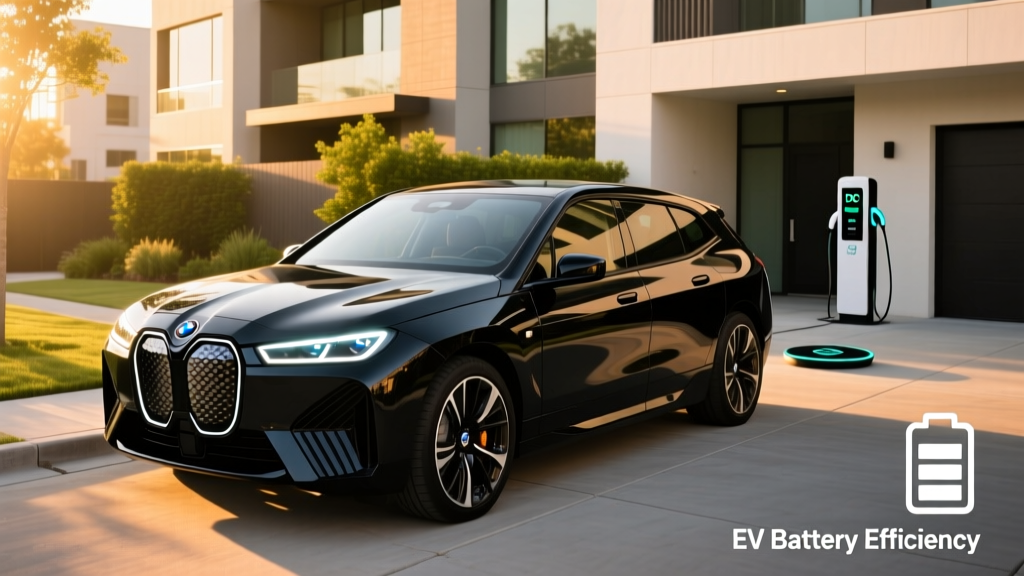
The BMW iX remains one of the most compelling luxury electric SUVs on the market, blending Bavarian engineering with serious EV credentials. But with a starting MSRP pushing past $87,000, many buyers are turning to leasing as the smartest path into the driver's seat. A BMW iX lease can insulate you from depreciation risk, wrap in maintenance, and — crucially — let the dealer apply the $7,500 federal EV tax credit as a capitalized cost reduction, even if your personal tax situation wouldn't otherwise qualify you for the full credit at purchase.
This guide covers the 2026 BMW iX lineup: the xDrive50, the performance-oriented M60, and the newly refreshed trim structure. We'll give you exact EPA range figures, real-world expectations, charging speeds, and the tax-credit mechanics that make leasing this SUV particularly attractive right now.
2026 BMW iX Lineup: Trims, Pricing, and Lease Positioning
The 2026 iX carries over the dual-motor, all-wheel-drive architecture that has defined the nameplate since its U.S. launch, with meaningful updates to battery management and infotainment. Here's how the lineup stacks up:
| Specification | iX xDrive50 | iX M60 |
|---|---|---|
| Base MSRP | $87,250 | $111,500 |
| EPA Range | 324 miles | 296 miles |
| Battery (usable) | 105.2 kWh (NMC) | 105.2 kWh (NMC) |
| Horsepower | 516 hp | 610 hp |
| 0–60 mph | 4.4 seconds | 3.6 seconds |
| Drivetrain | Dual-motor AWD | Dual-motor AWD |
| Max DC Fast Charge | 200 kW | 200 kW |
| 10–80% DC Time | ~34 minutes | ~34 minutes |
| Level 2 Charge Rate | 11 kW (~35 mi/hr) | 11 kW (~35 mi/hr) |
| EPA Efficiency | 86 MPGe (2.0 kWh/mi) | 78 MPGe (2.3 kWh/mi) |
| Battery Warranty | 8 yr / 100,000 mi | 8 yr / 100,000 mi |
Both trims share the same 105.2 kWh usable nickel-manganese-cobalt (NMC) battery pack. BMW opted for NMC over LFP to prioritize energy density and cold-weather performance — a deliberate choice for a luxury SUV expected to perform in northern climates. The trade-off is slightly faster calendar degradation compared to LFP packs, though BMW's 8-year/100,000-mile battery warranty (covering capacity below 70%) provides a solid backstop.
Real-World Range: What the EPA Sticker Doesn't Tell You
iX xDrive50: EPA 324 miles — Expect ~275–290 miles in mixed highway driving at 70+ mph; ~230–250 miles in sub-freezing winter conditions with cabin heat.
iX M60: EPA 296 miles — Expect ~245–260 miles highway; ~210–225 miles in cold weather.
The iX xDrive50's 324-mile EPA rating is competitive with the Mercedes EQE SUV (305 mi) and slightly behind the Tesla Model X Long Range (335 mi). But EPA numbers are generated under controlled lab conditions that don't fully reflect sustained highway speeds or winter driving.
In real-world testing, the iX xDrive50 typically delivers between 2.0 and 2.2 kWh per mile at highway speeds in moderate temperatures, translating to roughly 275–290 miles before you'd want to find a charger. Push it to 80 mph on a flat interstate in summer, and you'll see closer to 260 miles. In winter conditions (below 32°F), battery heating demands and cabin climate draw can reduce range by 20–30%, bringing usable range down to 230–250 miles for the xDrive50. The heat pump — standard on the 2026 iX — helps mitigate this loss compared to resistive heating, but physics still wins in deep cold.
The M60's additional power and sportier tuning cost it about 28 miles of EPA range. If your commute is under 60 miles round-trip and you charge at home, this is largely academic. For road-trippers, the xDrive50 is the range-optimized pick.
Charging Speed: DC Fast Charging and Home Level 2
Charging speed is where luxury EV buyers have every right to expect excellence, and the iX delivers solidly — though not at the bleeding edge of what competitors like the Hyundai Ioniq 5 or Lucid Air offer.
| Charging Level | Power / Rate | Time / Miles Added |
|---|---|---|
| Level 1 (120V household) | ~1.4 kW | ~4–5 miles per hour |
| Level 2 (240V home/public) | 11 kW max | ~35 miles per hour; full charge in ~10 hours |
| DC Fast Charge (CCS) | 200 kW peak | 10–80% in ~34 min; ~200 mi in 20 min |
The iX uses the CCS1 connector standard (not NACS, though BMW has confirmed NACS adoption for future models). On a 200 kW-capable DC fast charger — available at many Electrify America and EVgo stations — the iX peaks near 200 kW but, like all EVs, doesn't sustain that rate across the full session. The charge curve tapers noticeably above 50% state of charge, and drops sharply above 80%. This is why BMW quotes 10–80% in approximately 34 minutes rather than a full 0–100% time.
Practical road-trip insight: On a 300-mile trip, you'd start fully charged, drive roughly 270 highway miles (leaving a comfort buffer), then stop for a 20–25 minute charge to reach ~75% — adding about 200 miles. That's enough to finish most single-day drives with one stop. The iX's preconditioning feature, activated when you set a charger as your navigation destination, warms the battery to optimal temperature for faster charging upon arrival. Always use this — skipping preconditioning in cold weather can add 10+ minutes to your charge session.
At home, the 11 kW onboard charger means a full Level 2 charge (from near-empty) takes roughly 10 hours on a 48-amp circuit. Most owners will plug in nightly and never need a full 0–100% charge, waking to a full battery every morning. A BMW-recommended Level 2 home charger (such as the BMW Wallbox or a ChargePoint Home Flex) costs $500–$700 for equipment, plus $500–$2,000 for professional installation depending on your electrical panel.
Performance, Efficiency, and Daily Drivability
The iX xDrive50's 516 horsepower and 4.4-second 0–60 time place it firmly in performance-SUV territory — quicker than a base Porsche Cayenne and comparable to the Audi Q8 e-tron. The M60's 610 hp and 3.6-second sprint are genuinely thrilling for a vehicle that weighs over 5,600 pounds.
Efficiency is respectable for the segment. The xDrive50 achieves 86 MPGe combined (roughly 2.0 kWh per mile), which translates to about $600–$750 per year in electricity costs for 15,000 miles of driving, depending on your local utility rates. The M60 drops to 78 MPGe (2.3 kWh/mi), adding roughly $100–$150 annually.
Regenerative braking in the iX is well-calibrated. BMW offers three regen modes plus an adaptive mode that uses radar and navigation data to modulate coasting vs. braking based on traffic ahead. One-pedal driving is possible in the strongest regen setting, though it doesn't quite bring the car to a full stop without touching the brake pedal — a choice some EV veterans find frustrating, but one that mirrors BMW's philosophy of keeping driving dynamics familiar.
Interior, Cargo, and Technology
The iX cabin is where BMW justifies its luxury positioning. The minimalist design — anchored by a curved display running BMW iDrive 8.5 — features a 14.9-inch central touchscreen and a 12.3-inch digital instrument cluster. Materials are premium: standard SensaTec upholstery with available Vernasca leather, open-pore wood trim, and a hexagonal steering wheel that takes some getting used to.
Passenger and cargo dimensions:
- Front legroom: 40.2 inches
- Rear legroom: 38.9 inches — generous for the class, with a flat floor (no transmission tunnel)
- Cargo behind rear seats: 35.5 cubic feet
- Cargo with rear seats folded: 77.9 cubic feet
- Front trunk (frunk): None — the iX does not offer a frunk, which is a notable omission versus the Tesla Model X or Rivian R1S
On the driver-assistance front, the iX comes equipped with BMW's Driving Assistant Professional, which includes adaptive cruise control with stop-and-go, lane-keeping assist, and automatic lane-change capability on highways. This is a SAE Level 2 system — it requires continuous driver supervision and does not make the iX a self-driving vehicle. The available Parking Assistant Professional adds automated parking maneuvers and a surround-view camera system.
One standout feature: the iX offers available 5G connectivity and over-the-air updates that have meaningfully improved the vehicle since launch, including enhanced route planning and battery preconditioning algorithms.
Lease Pricing, Tax Credits, and Total Cost
Here's where the BMW iX lease becomes particularly interesting from a financial perspective. Under current IRS §30D rules, the federal EV tax credit offers up to $7,500 for qualifying new EVs — but eligibility is constrained by:
- MSRP cap: SUVs must have an MSRP at or below $80,000. The iX xDrive50 starts at $87,250, which exceeds this cap for outright purchase.
- Buyer income limits: Modified AGI must not exceed $300,000 (joint), $225,000 (head of household), or $150,000 (single).
- Battery sourcing: Critical minerals and battery components must meet phased-in domestic/free-trade-partner sourcing requirements (see IRS §30D guidance for current-year thresholds).
The lease loophole: When you lease an EV, the $7,500 commercial clean vehicle credit (§45W) goes to the leasing company (the legal owner), not the lessee. However, most luxury automakers — BMW included — pass this credit through as a capitalized cost reduction, effectively lowering your lease price by $7,500 regardless of your personal income or the vehicle's MSRP. This means a BMW iX lease can capture the full $7,500 benefit even though the xDrive50 exceeds the $80,000 MSRP cap that would disqualify it for a purchase credit.
| Cost Factor | iX xDrive50 | iX M60 |
|---|---|---|
| Base MSRP | $87,250 | $111,500 |
| Federal Credit (via lease) | −$7,500 | −$7,500 |
| Effective Cap Cost | $79,750 | $104,000 |
| Est. Monthly Lease (36 mo, $5k down) | ~$1,050–$1,200 | ~$1,400–$1,550 |
| BMW Maintenance Included | 3 yr / 36,000 mi | 3 yr / 36,000 mi |
Actual lease payments vary by dealer, money factor, residual value, and any manufacturer-to-dealer incentives. BMW Financial Services typically sets residuals for the iX around 52–56% at 36 months, which is reasonable for a luxury EV but reflects the segment's depreciation reality. As-tested pricing with options (Executive Package, Bowers & Wilkins audio, 22-inch wheels) can push the xDrive50 past $97,000 MSRP — factor this into your lease negotiation.
BMW includes 3 years/36,000 miles of scheduled maintenance with every new vehicle, and the high-voltage battery is warranted for 8 years/100,000 miles against capacity loss below 70%. Since most leases run 36–48 months, you'll be well within the battery warranty period, eliminating long-term degradation risk during your ownership.
How the BMW iX Compares to Key Rivals
- You prioritize cabin refinement, ride quality, and driving dynamics over maximum range
- You want a luxury badge with strong dealer support and included maintenance
- The lease tax-credit pass-through is central to your financial decision
- You need a flat rear floor and generous rear-seat legroom for family use
- Tesla Model X: You need a frunk, faster Supercharger access, or more cargo space (82 cu ft max)
- Mercedes EQE SUV: You want a lower starting price (~$78K) and don't mind less rear legroom
- Audi Q8 e-tron: You prefer a more traditional luxury aesthetic and slightly lower pricing
- Rivian R1S: You need three-row seating, off-road capability, or a frunk
The iX occupies a specific niche: it's the driver's luxury electric SUV. The steering feel, chassis tuning, and cabin isolation are a cut above the Tesla Model X, which trades refinement for tech and Supercharger convenience. Against the EQE SUV and Q8 e-tron, the iX offers more interior space and a more modern infotainment system, though the Audi undercuts it on price. If towing matters, the iX is rated for 3,500 pounds — adequate for a small trailer but well behind the Rivian R1S (7,700 lb).
Pros, Cons, and Final Verdict
- 324-mile EPA range (xDrive50) is competitive for the luxury EV SUV class
- Refined ride quality with adaptive air suspension standard
- Lease structure captures $7,500 federal credit despite MSRP cap
- Generous rear-seat space with flat floor — excellent for families
- 200 kW DC fast charging with effective battery preconditioning
- 3 years of included maintenance reduces ownership friction
- iDrive 8.5 is responsive, well-organized, and regularly updated OTA
- No frunk — a surprising omission for a dedicated EV platform
- CCS connector limits access to Tesla Supercharger network (without adapter)
- Base MSRP exceeds $80K purchase tax-credit cap (lease workaround required)
- Hexagonal steering wheel polarizes — try it before committing
- 3,500-lb tow rating trails body-on-frame electric competitors
- 200 kW peak charge rate lags behind 800V-architecture rivals (350 kW)
- Cargo space (35.5 cu ft) is mid-pack; no third-row option
The verdict: A 2026 BMW iX lease makes strong financial and practical sense for luxury SUV buyers who want a refined, well-equipped electric daily driver without assuming long-term depreciation risk. The xDrive50 is the sweet spot — 324 miles of EPA range, 516 hp, and the full $7,500 lease credit pass-through bring the effective monthly cost into territory that competes with loaded gas-powered luxury SUVs once you factor in fuel and maintenance savings. The M60 is a thrill but harder to justify on value. If you can charge at home and your daily driving stays under 80 miles, the iX delivers one of the most effortless luxury EV ownership experiences available today.
Frequently Asked Questions
What is the real-world range of the BMW iX?
The iX xDrive50 carries an EPA rating of 324 miles, but expect roughly 275–290 miles in real-world highway driving at 70+ mph, and 230–250 miles in sub-freezing winter conditions. The M60 delivers about 245–260 miles highway and 210–225 in cold weather.
How fast does the BMW iX charge at home and on the road?
On a DC fast charger, the iX peaks at 200 kW and charges from 10–80% in approximately 34 minutes. At home on a Level 2 (240V, 48-amp) charger, it adds about 35 miles of range per hour, with a full charge taking roughly 10 hours.
Does the BMW iX qualify for the federal EV tax credit?
For outright purchase, the iX xDrive50 exceeds the $80,000 MSRP cap for SUVs under IRS §30D, making it ineligible. However, when leased, the $7,500 commercial clean vehicle credit goes to the leasing company, and BMW Financial Services typically passes this through as a capitalized cost reduction — effectively lowering your lease price by $7,500 regardless of your income or the vehicle's MSRP.
How much does a BMW iX lease cost per month?
With the $7,500 federal credit applied as a cap cost reduction, a 36-month iX xDrive50 lease with $5,000 due at signing typically runs $1,050–$1,200 per month, depending on dealer, money factor, and options. The M60 runs $1,400–$1,550 under similar terms.
Is the BMW iX worth leasing over buying?
Leasing is arguably the optimal path for the iX. You capture the $7,500 credit that would be unavailable on purchase (due to MSRP caps), avoid long-term battery degradation risk, benefit from included maintenance during the lease term, and sidestep the steep luxury-EV depreciation curve. If you drive under 15,000 miles annually and want to upgrade every 3 years, leasing is the clear winner.
What are the biggest drawbacks of the BMW iX?
The most notable omissions are the lack of a front trunk (frunk), CCS-only charging (no native NACS/Supercharger access), a 3,500-lb tow rating that trails competitors, and a hexagonal steering wheel that not everyone loves. The 200 kW peak charge rate also falls short of 800V-architecture rivals capable of 350 kW.
Who is the BMW iX best suited for?
The iX is ideal for luxury-minded families and professionals who want a refined daily-driver EV with strong real-world range, premium cabin materials, and excellent rear-seat comfort. It excels as a commuter and weekend road-tripper for households that can install a Level 2 home charger. It's less suited for buyers who need three-row seating, serious towing capacity, or off-road capability.