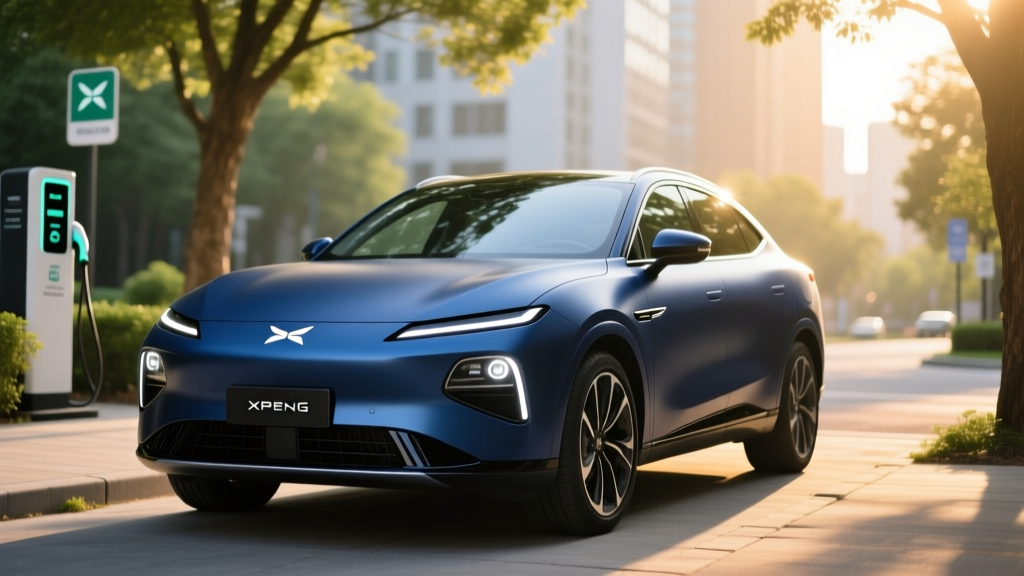
The midsize electric SUV segment is crowded, but the XPeng G6 arrives with a proposition that's hard to ignore: 800-volt architecture, sub-20-minute fast charging, and a coupe-SUV silhouette at a price point that undercuts established rivals. Originally launched in China in 2023 and expanding into select European and Asia-Pacific markets through 2025, the G6 represents XPeng's bid to become a global EV player. Here's what the numbers actually look like — and where this SUV fits (and doesn't) for real buyers.
Claimed WLTP range: up to 354 miles (570 km) on the Long Range RWD variant with the 87.5 kWh battery.
Real-world expectation: Expect approximately 280–310 miles in mixed driving at moderate temperatures. Highway-only driving at 75+ mph drops this to roughly 250–270 miles. In cold weather (below 32°F / 0°C), plan for a 20–30% reduction, bringing usable range to around 200–240 miles depending on cabin heating demand and whether you precondition.
Note: The XPeng G6 has not received official EPA certification as of early 2026. WLTP figures tend to run 10–15% higher than EPA estimates. We'll update this review when EPA data becomes available via fueleconomy.gov.
Specs at a Glance: XPeng G6
| Specification | Standard Range RWD | Long Range RWD | Long Range AWD (Performance) |
|---|---|---|---|
| Battery (usable) | 66 kWh (LFP) | 87.5 kWh (NMC) | 87.5 kWh (NMC) |
| WLTP Range | ~267 mi (430 km) | ~354 mi (570 km) | ~335 mi (540 km) |
| Est. EPA Range* | ~225–235 mi | ~295–310 mi | ~280–295 mi |
| Motor / Drivetrain | Single motor RWD | Single motor RWD | Dual motor AWD |
| Horsepower | 255 hp (190 kW) | 286 hp (210 kW) | 473 hp (350 kW) |
| 0–60 mph (est.) | ~6.6 sec | ~6.2 sec | ~3.9 sec |
| Max DC Fast Charge | ~215 kW (peak) | ~280 kW (peak) | ~280 kW (peak) |
| 10–80% DC Charge | ~20 min | ~20 min | ~20 min |
| Level 2 AC Charge | 11 kW (onboard charger) | 11 kW | 11 kW |
| Length × Width × Height | 187.4 × 75.2 × 65.4 in (4,753 × 1,920 × 1,650 mm) | ||
| Wheelbase | 112.2 in (2,890 mm) | ||
| Cargo Volume (rear seats up) | ~20.3 cu ft (571 L) | ||
| Cargo Volume (rear seats folded) | ~54.7 cu ft (1,548 L) | ||
*Estimated EPA range based on typical WLTP-to-EPA conversion ratios for vehicles in this class. Official EPA figures pending U.S. certification.
Battery and Powertrain: LFP Meets NMC on an 800V Platform
XPeng builds the G6 on its SEPA 2.0 (Smart Electric Platform Architecture) with an integrated 800-volt electrical system — the same architecture found in the flagship G9. This is significant because 800V systems enable substantially faster DC charging and improved efficiency compared to legacy 400V platforms still used by many competitors.
The Standard Range model uses a 66 kWh LFP (lithium iron phosphate) battery pack. LFP chemistry trades some energy density for excellent cycle life, thermal stability, and the ability to charge routinely to 100% without accelerating degradation. If you're a daily commuter who can plug in at home every night, LFP is arguably the better chemistry for long-term ownership.
The Long Range variants step up to an 87.5 kWh NMC (nickel manganese cobalt) pack, which offers higher energy density — essential for achieving the 354-mile WLTP figure. The trade-off: NMC batteries generally prefer you keep daily charge limits around 80–90% and only charge to 100% for longer trips. XPeng's battery management system includes a buffer to protect against extreme SoC states, but following the 80% daily rule will extend pack life.
Both battery options use cell-to-body (CTB) integration, where cells are bonded directly to the vehicle floor structure. This reduces weight, lowers the center of gravity, and improves structural rigidity — all contributing to the G6's composed ride quality.
Charging Speed: Where the 800V Architecture Pays Off
The headline number is up to 280 kW peak DC fast-charging on the Long Range models, enabled by the 800V system. XPeng claims a 10–80% charge in approximately 20 minutes at a compatible high-power charger (350 kW class, such as Electrify America or Ionity stations).
| Charging Method | Power / Rate | Time / Range Added |
|---|---|---|
| DC Fast Charge (peak, 350 kW station) | Up to 280 kW | 10–80% in ~20 min; ~185 mi added in 10 min (Long Range) |
| DC Fast Charge (150 kW station) | ~150 kW sustained | 10–80% in ~30 min |
| Level 2 Home / Public AC | 11 kW (onboard charger) | ~30 mi/hr; full charge in ~9 hr (87.5 kWh pack) |
| Level 1 (120V household) | ~1.4 kW | ~4 mi/hr; emergency/top-up only |
Charging curve reality: As with all EVs, the 280 kW figure is a peak, not a sustained rate. Expect peak power between roughly 10–40% SoC, after which the curve tapers progressively. From 80–100%, charging slows dramatically to protect battery health — plan for an additional 15–20 minutes if you need a full pack. For road trips, the 10–80% window is what matters, and ~20 minutes there puts the G6 in the top tier of charging speed alongside the Hyundai Ioniq 5 and Porsche Taycan.
Home charging: The 11 kW onboard AC charger is competitive. On a 48-amp Level 2 home circuit (the most common residential install), you'll add roughly 30 miles of range per hour of charging. An overnight session (8–10 hours) will fully replenish even the 87.5 kWh pack.
Performance and Driving Dynamics
The dual-motor AWD Performance variant is the enthusiast pick, delivering 473 hp and a 0–60 mph time of approximately 3.9 seconds. That's firmly in sports-sedan territory, and the instant torque delivery makes the G6 feel even quicker in real-world passing situations than the stopwatch suggests.
The single-motor RWD models are less dramatic but entirely adequate for daily driving. The Long Range RWD's 286 hp and ~6.2-second 0–60 time feel relaxed and confident for highway merging and overtaking. XPeng tunes the regenerative braking with multiple levels, including a strong one-pedal driving mode that can handle most stop-and-go commuting without touching the brake pedal.
Ride quality benefits from the low center of gravity inherent to the CTB battery layout. The suspension is tuned toward comfort rather than sportiness — the G6 absorbs road imperfections well but isn't trying to be a corner-carving performance SUV. For its target buyer, that's the right call.
Interior, Technology, and Driver Assistance
XPeng's Xmart OS infotainment runs on a 14.96-inch central touchscreen with a Qualcomm Snapdragon 8155 processor. The interface is responsive, supports over-the-air updates, and integrates navigation, media, and vehicle settings into a single pane. A 10.2-inch digital instrument cluster sits behind the steering wheel.
Standout tech features:
- XPILOT ADAS: XPeng's advanced driver-assistance suite includes adaptive cruise control, lane-centering, automated lane changes, and navigation-guided driving on supported highways. This is an SAE Level 2 system — the driver must remain engaged and hands-on (or eyes-on, depending on market configuration) at all times.
- Memory parking: The G6 can learn and repeat specific parking routes, such as navigating a multi-level garage to your assigned spot.
- V2L (Vehicle-to-Load): Select trims support powering external devices (camping gear, tools) from the traction battery via an adapter.
- Panoramic glass roof: A large fixed glass panel opens up the cabin, though it lacks a physical shade — a concern in hot climates.
Notable drawbacks:
- No Apple CarPlay or Android Auto in most markets — XPeng relies on its native infotainment ecosystem.
- The coupe-style roofline cuts into rear headroom for taller passengers (those over 6'1" may notice it).
- Cargo volume at 20.3 cu ft behind the rear seats trails boxier competitors like the Tesla Model Y (30.2 cu ft) and Hyundai Ioniq 5 (27.2 cu ft).
- No front trunk (frunk) — the space is consumed by HVAC and power electronics.
Pricing, Tax Credits, and Ownership Costs
Pricing varies significantly by market. In China, the G6 starts at approximately ¥209,900 (~$29,000 USD) for the Standard Range RWD. In European markets (UK, Germany, Netherlands), pricing at launch ranges from approximately €40,000–€52,000 (~$43,000–$56,000 USD) depending on trim and local taxes.
U.S. availability: As of early 2026, XPeng has not officially launched in the United States. The G6 is not available for purchase from U.S. dealers, and there is no confirmed timeline for American market entry. If and when the G6 reaches the U.S., federal tax credit eligibility under IRS §30D would depend on several factors:
- MSRP cap: SUVs must have an MSRP at or below $80,000 to qualify — the G6 would comfortably clear this bar.
- Buyer income cap: Adjusted gross income must not exceed $150,000 (single), $225,000 (head of household), or $300,000 (joint filers).
- Battery sourcing requirements: Critical minerals and battery components must meet escalating domestic-content and "FEOC-free" (foreign entity of concern) thresholds. Given XPeng's Chinese supply chain, meeting these requirements would be challenging under current rules. This is the most uncertain variable.
- Point-of-sale transfer: Eligible buyers can apply the credit as an immediate price reduction at the dealer rather than waiting to claim it on their tax return.
Consult a tax professional and the IRS clean vehicle credit page for current-year eligibility details. Rules change frequently.
Warranty Coverage
XPeng provides the following warranty structure in most markets (exact terms vary by region):
- Vehicle limited warranty: 5 years / 120,000 km (~75,000 miles)
- Battery and drive unit warranty: 8 years / 160,000 km (~100,000 miles), with a capacity retention threshold typically set at 70% of original capacity
- Roadside assistance: 5 years in most markets
The 8-year/100,000-mile battery warranty aligns with industry norms and matches what Tesla, Hyundai, and Ford offer on their EVs. The 70% capacity retention threshold is standard — if your battery degrades below that level within the warranty period, XPeng will repair or replace it.
How It Compares: G6 vs. Key Rivals
In the markets where it's sold, the XPeng G6 competes most directly with the Tesla Model Y, Hyundai Ioniq 5, and Volkswagen ID.4. Here's how the numbers stack up:
| Attribute | XPeng G6 LR RWD | Tesla Model Y LR AWD | Hyundai Ioniq 5 LR RWD |
|---|---|---|---|
| Battery | 87.5 kWh NMC | ~75 kWh NMC | 77.4 kWh NMC |
| WLTP / EPA Range | 354 mi WLTP (~300 mi EPA est.) | 320 mi EPA | 303 mi EPA |
| Max DC Charge | 280 kW | 250 kW | 240 kW |
| 10–80% DC Time | ~20 min | ~25 min | ~18 min |
| 0–60 mph | ~6.2 sec | 4.8 sec | 7.0 sec |
| Cargo (rear up) | 20.3 cu ft | 30.2 cu ft | 27.2 cu ft |
| Price (approx.) | ~$48,000 (EU) | ~$48,000 (US) | ~$52,000 (US) |
The G6 holds its own on range and charging speed. Its weakness is cargo practicality — the coupe roofline looks sleek but costs you roughly 10 cubic feet versus the Model Y. If you regularly haul gear, pets, or child seats, the difference is meaningful.
- Class-leading 800V fast-charging speed (~20 min, 10–80%)
- Strong real-world range on the 87.5 kWh Long Range variant
- LFP option for buyers who want daily 100% charging without degradation worry
- Competitive pricing in markets where available
- Comfortable ride quality with low cabin noise
- XPILOT ADAS is capable for highway driving (SAE Level 2)
- Not available in the U.S. market as of 2026
- Cargo volume significantly trails Tesla Model Y and Hyundai Ioniq 5
- No frunk
- Lack of Apple CarPlay / Android Auto frustrates some buyers
- Coupe roofline limits rear headroom for tall passengers
- Glass roof without shade can cause cabin heat in summer
- Uncertain U.S. tax credit eligibility due to battery sourcing rules
Who the XPeng G6 Is For
- You live in a market where it's sold (Europe, UK, Australia, Southeast Asia, China) and want a stylish midsize EV SUV with top-tier charging speed.
- Your daily commute is under 60 miles and you value fast road-trip charging over maximum cargo space.
- You prefer the LFP battery option for worry-free daily charging to 100%.
- You want a tech-forward cabin with strong ADAS capabilities and OTA updates.
- You're shopping in the U.S. — the G6 isn't available, and U.S. entry is unconfirmed.
- You need maximum cargo capacity for family hauling — the Model Y or Ioniq 5 wins decisively.
- You rely on Apple CarPlay or Android Auto and don't want to learn a proprietary infotainment system.
- Regular towing is part of your use case — the G6 is not positioned as a tow vehicle.
Frequently Asked Questions
What is the real-world range of the XPeng G6?
The Long Range RWD variant achieves approximately 354 miles on the WLTP cycle. In real-world mixed driving at moderate temperatures, expect 280–310 miles. Highway driving at sustained high speeds reduces this to roughly 250–270 miles, and cold weather (below freezing) can drop range by 20–30%, yielding around 200–240 miles depending on conditions.
How fast does the XPeng G6 charge?
On a 350 kW-class DC fast charger, the Long Range G6 peaks at approximately 280 kW and charges from 10–80% in about 20 minutes. At home on an 11 kW Level 2 charger, expect roughly 30 miles of range per hour, with a full charge taking about 9 hours for the 87.5 kWh pack.
Does the XPeng G6 qualify for the U.S. federal EV tax credit?
The G6 is not currently sold in the United States. If it enters the U.S. market, eligibility for the §30D credit (up to $7,500) would depend on MSRP caps (likely met), buyer income limits, and battery component/critical-mineral sourcing requirements — the last of which would be challenging given XPeng's Chinese supply chain under current rules. Always verify current eligibility on irs.gov.
Is the XPeng G6 worth buying over a Tesla Model Y?
If you're in a market where both are available, the G6 offers comparable range, faster peak charging, and a lower starting price in some regions. The Model Y counters with substantially more cargo space, access to the Supercharger network (in markets where it remains proprietary), a more mature software ecosystem, and proven long-term reliability data. For pure cargo practicality, the Model Y wins. For charging speed and value, the G6 is competitive.
What is the battery warranty on the XPeng G6?
XPeng covers the battery and drive unit for 8 years or 160,000 km (~100,000 miles), whichever comes first, with a capacity retention threshold of approximately 70%. This aligns with industry-standard EV battery warranties from Tesla, Hyundai, and Ford.
Does the XPeng G6 have a frunk?
No. The G6 does not include a front trunk. The space under the hood is occupied by HVAC components and power electronics.
Is XPILOT a self-driving system?
No. XPILOT is an SAE Level 2 driver-assistance system. It can manage steering, acceleration, and braking on supported highways, but the driver must remain fully attentive and ready to take over at any moment. It is not a self-driving or autonomous system.