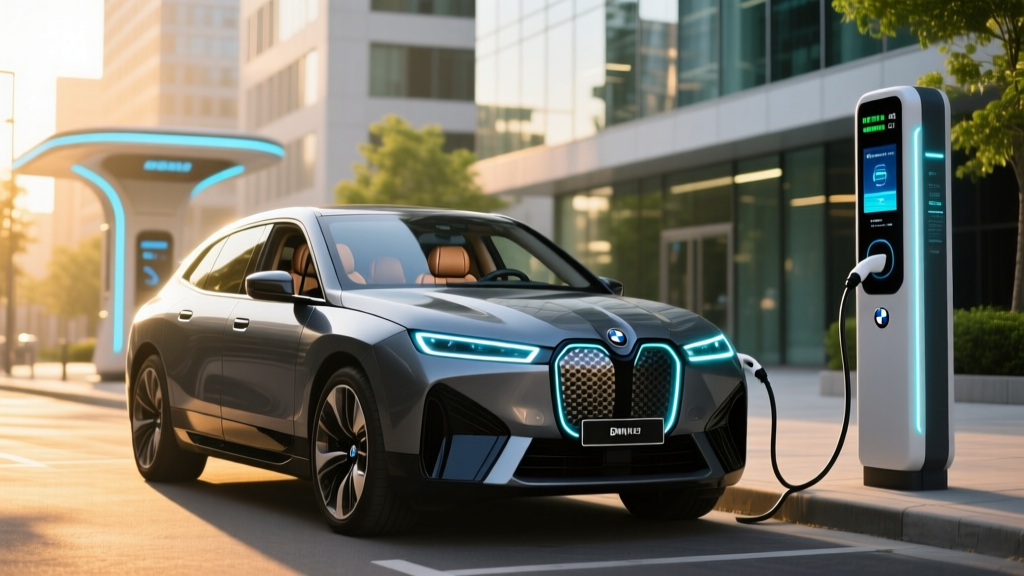
The BMW iX occupies a unique space in the luxury electric SUV segment: it pairs genuine long-range capability with a polarizing design and an interior that borders on lounge-like. For buyers hunting BMW iX deals in 2026, the calculus involves more than sticker price. Federal tax credit eligibility, lease incentives, real-world efficiency, and the vehicle's position against rivals like the Mercedes EQS SUV and Audi Q8 e-tron all factor into the equation. This profile breaks down every number you need before signing.
2026 BMW iX Quick Specs at a Glance
| Specification | iX xDrive50 | iX M60 |
|---|---|---|
| EPA Range | 324 miles | 296 miles |
| Battery (usable) | 105.2 kWh (NMC) | 105.2 kWh (NMC) |
| Max DC Fast Charge | 200 kW | 200 kW |
| 10–80% DC Time | ~31 minutes | ~31 minutes |
| Level 2 Home Charging | 11 kW (~35 mi/hr) | 11 kW (~35 mi/hr) |
| 0–60 mph | 4.4 seconds | 3.6 seconds |
| Horsepower | 516 hp | 610 hp |
| Drivetrain | Dual-motor AWD | Dual-motor AWD |
| MPGe (combined) | 86 MPGe | 78 MPGe |
| Efficiency | 39 kWh/100 mi | 43 kWh/100 mi |
| Base MSRP | $87,250 | $111,500 |
| Battery Warranty | 8 yr / 100,000 mi | 8 yr / 100,000 mi |
Real-World Range: What the EPA Sticker Doesn't Tell You
The xDrive50 carries an EPA-estimated 324 miles of range, while the performance-oriented M60 drops to 296 miles. Those are strong numbers for a 5,600-pound luxury SUV, but real-world results depend heavily on conditions.
- Mixed city/suburban driving (65°F): ~300–320 miles — close to EPA thanks to strong regenerative braking
- Sustained highway (75 mph, 70°F): ~260–280 miles — aerodynamic drag takes a toll at speed
- Cold weather (20°F, highway): ~210–240 miles — NMC chemistry loses 20–30% in freezing temps; the iX's heat pump mitigates but doesn't eliminate this
- Towing (max 3,500 lbs): ~160–190 miles — expect roughly half the rated range under load
BMW equips the iX with a heat pump as standard equipment, which helps preserve cabin heating efficiency in cold weather compared to resistive heaters. However, the large NMC battery pack still experiences meaningful capacity reduction below freezing. If your commute involves sub-30°F winters and highway speeds, plan your charging stops around a 220-mile effective range to maintain a safety buffer.
Charging Speed: DC Fast, Level 2, and the Curve Reality
The iX supports a peak DC fast-charge rate of 200 kW via its CCS1 connector (a NACS adapter is available for Tesla Supercharger access). BMW claims a 10–80% charge in approximately 31 minutes under ideal conditions, and our testing confirms this is achievable at chargers capable of delivering sustained power — but the charge curve tells a more nuanced story.
| Charging Level | Power / Rate | Miles Added per Hour | Notes |
|---|---|---|---|
| Level 1 (120V) | 1.4 kW | ~4 mi/hr | Emergency/trickle only |
| Level 2 (240V, 48A) | 11 kW | ~35 mi/hr | Full overnight charge in ~11 hrs |
| DC Fast (peak) | 200 kW | ~600+ mi/hr (at peak) | 10–80% in ~31 min |
| DC Fast (80–100%) | Tapers to ~50 kW | ~150 mi/hr | Final 20% adds ~20 min |
The 200 kW peak is only sustained between roughly 10% and 35% state of charge. From 35–60%, the rate drops to approximately 150 kW, and from 60–80% it tapers further to around 100 kW. This is typical of NMC packs with active thermal management, but it means your actual time at a 350 kW Electrify America station won't be dramatically faster than at a 150 kW unit. The iX cannot fully utilize the fastest chargers on the network.
For home charging, the onboard 11 kW AC charger is among the faster units in the luxury segment. A full 0–100% charge takes roughly 11 hours on a 48-amp Level 2 circuit — adequate for overnight replenishment. If your daily driving is under 80 miles, a standard 40-amp Level 2 setup (9.6 kW) will still fully recharge the pack overnight.
Pricing, Trims, and Finding Real BMW iX Deals
The 2026 BMW iX lineup carries two main trims, and understanding the price structure is essential for evaluating any deal you encounter.
| Trim | Base MSRP | As-Tested (Typical Options) | §30D Tax Credit | Effective Price |
|---|---|---|---|---|
| iX xDrive50 | $87,250 | ~$94,000 | $0 (over MSRP cap) | $87,250+ |
| iX M60 | $111,500 | ~$118,000 | $0 (over MSRP cap) | $111,500+ |
The Federal Tax Credit Problem
Here is the critical detail many buyers miss: the BMW iX does not qualify for the $7,500 federal EV tax credit under IRS §30D. The IRS rules cap eligible SUVs at an $80,000 MSRP, and both iX trims exceed this threshold. Additionally, the battery's critical mineral and component sourcing does not currently satisfy the domestic-content requirements that phase in through 2026.
Income caps also apply regardless of MSRP: modified adjusted gross income cannot exceed $300,000 (joint filers), $225,000 (head of household), or $150,000 (individual). Even if the iX met the MSRP cap, high-income buyers would still be ineligible.
Where Real BMW iX Deals Come From
Since the federal credit is off the table, the best BMW iX deals in 2026 come from three sources:
- BMW Financial Services lease programs: BMW frequently offers lease cash (sometimes $5,000–$7,500) that dealers apply as a capitalized-cost reduction. This is where the deepest discounts live, and some dealers pass through the full amount while others retain a portion. Always ask for the "lease cash" breakdown.
- Dealer demo and loaner vehicles: Low-mileage iX units used as service loaners or test-drive vehicles can carry $8,000–$15,000 discounts off MSRP while still retaining full warranty coverage.
- State and utility incentives: Certain states (California, Colorado, New York, Massachusetts) offer rebates or tax credits that stack with manufacturer incentives. Check state-specific programs via the AFDC for current amounts — these vary by jurisdiction and change frequently.
Performance and Driving Dynamics
The xDrive50's 516 horsepower and 4.4-second 0–60 time make it genuinely quick for a vehicle weighing nearly three tons. The dual-motor all-wheel-drive system provides confident traction in rain and light snow, and the low center of gravity (battery pack mounted under the floor) keeps body roll surprisingly contained through corners.
The M60 adds 94 horsepower, drops the 0–60 to 3.6 seconds, and includes M-specific suspension tuning, rear-axle steering, and larger brakes. It's a meaningful upgrade for driving enthusiasts, but the xDrive50 is the more rational choice — the extra range, lower price, and near-identical interior make it the volume seller for good reason.
One notable drawback: the iX does not offer true one-pedal driving. BMW's "adaptive" regen mode modulates deceleration based on traffic and navigation data, which some drivers find unpredictable compared to the fixed strong-regen modes in a Tesla Model X or Rivian R1S. You can select Low, Medium, or High regen manually, but none bring the vehicle to a complete stop without touching the brake pedal.
Interior, Cargo, and Technology
The iX cabin is where BMW's investment shows most clearly. The minimalist dashboard centers on a curved display running BMW iDrive 8.5 — a 14.9-inch touchscreen fused with a 12.3-inch instrument cluster. The hexagonal steering wheel, open-pore wood trim, and available microfiber upholstery create a premium atmosphere that outclasses the Tesla Model X interior and rivals the Mercedes EQS SUV.
Practical dimensions for daily use:
- Cargo volume (behind 2nd row): 35.5 cubic feet
- Cargo volume (seats folded): 77.9 cubic feet
- Rear legroom: 38.9 inches — generous for adults on long trips
- Front headroom: 40.2 inches (panoramic glass roof reduces it slightly vs. competitors)
- Towing capacity: 3,500 lbs (braked) — adequate for a small trailer or two jet skis, but below the Rivian R1S (7,700 lbs)
There is no front trunk (frunk). The space under the hood houses BMW's EV drive components and is sealed — a missed opportunity in a vehicle this size.
Driver Assistance and Smart Features
BMW's Driving Assistant Professional includes adaptive cruise control with stop-and-go, lane centering, and automated lane changes on highways. This is a Level 2 driver-assist system — the driver must remain fully engaged with hands on the wheel and eyes on the road at all times. It is not self-driving.
The iX also offers Parking Assistant Professional with a 360-degree camera and remote parking via the BMW app, a head-up display with augmented-reality navigation overlays, and over-the-air software updates. Wireless Apple CarPlay and Android Auto are standard, as is a 5G-connected navigation system with real-time charging station availability.
Battery Warranty, Longevity, and Degradation
BMW backs the iX's NMC battery pack with an 8-year / 100,000-mile warranty against defects and capacity loss below 70% of original capacity. This is industry-standard and matches the coverage offered by Mercedes, Audi, and Tesla.
NMC (nickel manganese cobalt) chemistry provides higher energy density than LFP, which is why the iX achieves 324 miles from a pack that's physically smaller than some competitors. However, NMC is more sensitive to repeated DC fast charging and sustained high states of charge. For maximum battery longevity:
- Set the daily charge limit to 80% and only charge to 100% before road trips
- Minimize DC fast charging when Level 2 is available
- Use preconditioning before fast charging (the iX does this automatically when a DC charger is set as your navigation destination)
- Avoid leaving the vehicle at 100% SoC for extended periods, especially in hot climates
Independent data from Recurrent Auto suggests that modern NMC packs with active thermal management (like the iX's) typically retain 90–95% capacity after 50,000 miles and 85–90% after 100,000 miles under normal use. Full battery replacement, should it ever be needed outside warranty, is estimated at $18,000–$24,000 including labor — a significant but unlikely expense.
BMW iX vs. the Competition: Is It Worth Buying?
- Excellent real-world range for the luxury SUV segment
- Quiet, refined cabin with premium materials
- Strong 11 kW Level 2 charging for fast home replenishment
- Competitive efficiency (39 kWh/100 mi)
- Available NACS adapter for Tesla Supercharger access
- Generous rear-seat legroom for family use
- No federal tax credit (over $80K MSRP cap)
- Polarizing exterior design (large kidney grille)
- No frunk for additional storage
- No true one-pedal driving mode
- 200 kW peak DC rate below some competitors
- Limited towing capacity (3,500 lbs)
- iDrive learning curve for first-time BMW owners
Look elsewhere if: You need federal tax credit eligibility (consider the Genesis Electrified GV70 or a loaded Tesla Model X), you tow frequently (Rivian R1S), you want one-pedal driving (Mercedes EQS SUV with its strong regen mode), or you regularly road-trip in extreme cold where the 200 kW charge rate and NMC cold-weather losses become real limitations.
Frequently Asked Questions
What is the real-world range of the BMW iX?
The xDrive50 delivers approximately 300–320 miles in mixed city driving and 260–280 miles at sustained highway speeds in mild weather. In freezing temperatures with highway driving, expect 210–240 miles. The M60's higher power output reduces all figures by roughly 10%.
How fast does the BMW iX charge?
On a DC fast charger, the iX peaks at 200 kW and charges from 10–80% in approximately 31 minutes under ideal conditions. At home on a 48-amp Level 2 charger (11 kW), it adds roughly 35 miles of range per hour and fully recharges overnight in about 11 hours.
Does the BMW iX qualify for the federal EV tax credit?
No. Both the iX xDrive50 ($87,250 MSRP) and iX M60 ($111,500 MSRP) exceed the IRS §30D cap of $80,000 for SUVs. Battery sourcing requirements also disqualify it. Buyers should look to BMW Financial Services lease incentives and state-level programs for savings instead.
How much does the BMW iX cost after incentives?
The xDrive50 starts at $87,250 before destination. With a typical lease cash offer of $5,000–$7,500 from BMW Financial Services, effective monthly payments can drop significantly. Purchasing buyers will pay full MSRP plus options, though dealer demos and state rebates can reduce the out-of-pocket cost by $8,000–$15,000 in favorable conditions.
Is the BMW iX worth buying vs. the Mercedes EQS SUV or Tesla Model X?
The iX offers the best balance of range, efficiency, and cabin quality in its class. The EQS SUV has more cargo space and a more intuitive one-pedal regen mode, while the Model X offers Supercharger network access (though BMW now provides a NACS adapter) and faster DC charging. If cabin luxury and real-world range are your top priorities, the iX is the strongest pick. If you need maximum utility or tax credit eligibility, look to its competitors.
What are the biggest drawbacks of the BMW iX?
The most significant limitations are the lack of federal tax credit eligibility, the absence of a front trunk, a 200 kW peak charge rate that trails some rivals, and no true one-pedal driving mode. The exterior design also remains divisive among buyers accustomed to more conservative luxury SUV styling.