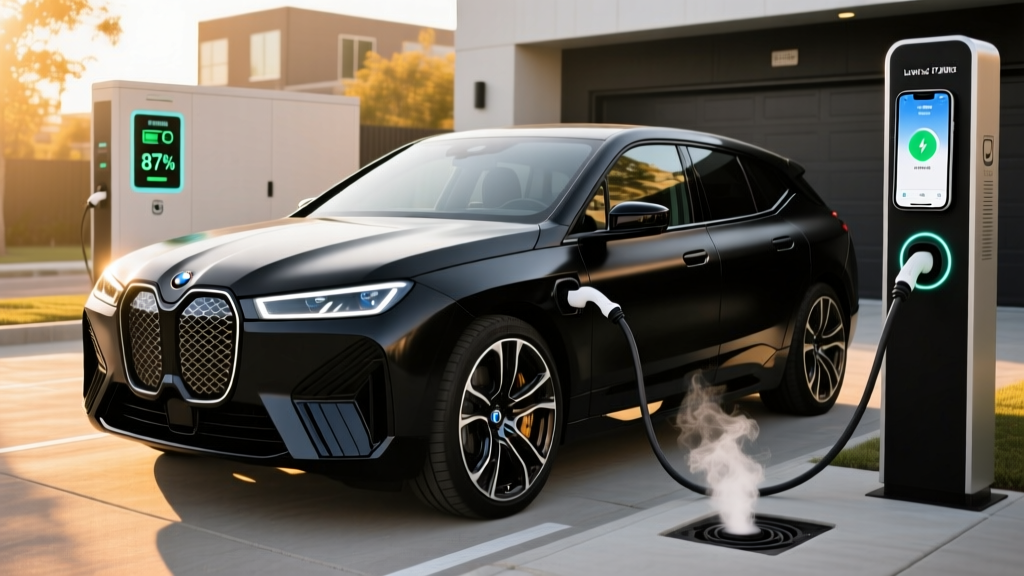
The BMW iX has always occupied a peculiar space in the luxury EV segment: a tech-dense, design-polarizing electric SUV that prioritizes driving refinement over outright range-per-dollar. The Black Edition (officially BMW's "Black Vermilion" or M Sport appearance package depending on market and model year) layers aggressive aesthetic upgrades onto an already compelling platform. But beneath the darkened trim and 22-inch wheels lies a serious electric machine with real engineering credentials — and real compromises. Here's everything you need to know before putting one in your garage.
EPA Range vs. Reality
EPA Estimated Range: 307–324 miles (depending on trim and wheel configuration)
Real-World Expectation: 255–285 miles on sustained highway driving (70–80 mph); expect 220–250 miles in sub-30°F cold weather. The larger 22-inch Black Edition wheels reduce EPA range by approximately 15–20 miles compared to the base 20-inch Aero setup.
Range, Battery, and Efficiency
The 2026 BMW iX xDrive50 — the volume variant most commonly spec'd with the Black appearance package — carries a usable battery capacity of 105.2 kWh from a gross pack rated at 111.5 kWh. BMW uses an NMC (nickel-manganese-cobalt) chemistry supplied primarily by CATL and Samsung SDI, chosen for its high energy density over the cycle-life advantages of LFP. This matters: NMC delivers more range per kilogram but degrades slightly faster if routinely charged to 100% or subjected to frequent DC fast-charging at peak rates.
Efficiency lands at 86 MPGe combined (EPA), translating to roughly 39 kWh per 100 miles in mixed driving. On the highway, expect closer to 42–45 kWh/100mi. For context, that's less efficient than the Tesla Model X (102 MPGe) but comparable to the Audi Q8 e-tron (83 MPGe). The iX's aerodynamic efficiency (Cd of 0.25) helps offset its 5,600-pound curb weight at speed, but physics still wins — this is a heavy vehicle moving a lot of air.
| Specification | Value |
|---|---|
| Usable Battery Capacity | 105.2 kWh (NMC) |
| Gross Battery Capacity | 111.5 kWh |
| EPA Range (20" Aero wheels) | 324 miles |
| EPA Range (22" Black Edition) | ~307 miles |
| MPGe Combined | 86 MPGe |
| Energy Consumption | 39 kWh/100mi (mixed) |
| Thermal Management | Active liquid cooling + heat pump (standard) |
The heat pump is standard on all 2026 iX models — a critical feature for cold-climate buyers. BMW's thermal management system preconditions the battery automatically when a DC fast charger is set as the navigation destination, reducing cold-weather charge-time penalties significantly.
Charging Speed: DC Fast and Home Level 2
BMW quotes a peak DC fast-charge rate of 200 kW on the iX xDrive50, with a 10–80% charge time of approximately 31 minutes under ideal conditions (warm battery, compatible 350 kW station). In practice, the charge curve tells a more nuanced story: the iX sustains roughly 175–195 kW between 10–40% SoC, then tapers progressively through the 60–80% window, dropping to approximately 90–110 kW. This is typical NMC behavior but means your actual average charge rate across the full session is closer to 140 kW.
| Charge Method | Power / Rate | Time or Miles Added |
|---|---|---|
| DC Fast Charge (Peak) | 200 kW | 10–80% in ~31 minutes |
| DC Fast Charge (Sustained Avg) | ~140 kW | 10–90% in ~48 minutes |
| Level 2 (Home, 48A / 11.5 kW) | 11.5 kW | ~23 miles per hour of charging |
| Level 2 (Home, 32A / 7.7 kW) | 7.7 kW | ~15 miles per hour of charging |
| Level 1 (120V household) | 1.4 kW | ~3 miles per hour |
| Connector Standard | CCS1 (NACS adapter available) | Tesla Supercharger access via adapter |
The onboard AC charger is rated at 11 kW (48 amps on a hardwired Level 2 circuit). For a full 0–100% home charge, budget roughly 10.5 hours — meaning overnight charging from a typical daily-driving SoC of 30% is effortless. Home installation of a 48-amp Level 2 charger (such as the ChargePoint Home Flex or BMW's Wallbox) typically runs $800–$2,200 including equipment and electrician labor, though a 200-amp panel upgrade can add $1,500–$3,000 if your home electrical service is older.
BMW now includes a NACS (Tesla) adapter with new iX purchases, granting access to the Supercharger network — currently the most reliable public charging infrastructure in the U.S. This significantly improves road-trip viability for iX owners who previously relied solely on Electrify America or EVgo networks.
Performance and Drivetrain
The iX xDrive50 pairs dual electric motors — one front, one rear — for a standard all-wheel-drive configuration producing 516 horsepower and 564 lb-ft of torque. BMW's xDrive system can fully decouple the front motor under light-load cruising to improve efficiency, a trick not all dual-motor EVs employ.
The 0–60 mph sprint clocks in at 4.4 seconds (BMW's claim; independent testing often records 4.2–4.3 seconds). That's genuinely quick for a 5,600-pound SUV, though the Mercedes EQE SUV 580 and Tesla Model X Plaid both outpace it. The M60 variant (610 hp, 0–60 in 3.6 seconds) exists for those who want supercar acceleration, but the xDrive50 hits the sweet spot for most buyers.
Regenerative braking offers three modes: adaptive (auto-adjusts based on traffic and terrain), high (near one-pedal driving), and low (coasting). The adaptive mode is impressively predictive — it reads navigation data and radar to modulate regen before you'd reach for the brake pedal. One-pedal purists will want to select the high-regen setting manually, as the iX does not come to a complete stop in adaptive mode.
Interior, Cargo, and Technology
The iX cabin is where BMW's design team took the biggest swings — and where opinions diverge most sharply. The Black Edition amplifies the drama with darkened trim, anthracite headliner, and available M Sport seats with illuminated perforation patterns.
The curved display panel houses a 14.9-inch infotainment screen running BMW iDrive 8.5 (with iDrive 9 rolling out across the 2026 lineup). Wireless Apple CarPlay and Android Auto are standard, as is a 5G-capable Wi-Fi hotspot. The hexagonal steering wheel is a love-it-or-hate-it design choice; ergonomically, it works but takes adjustment.
| Measurement | Value |
|---|---|
| Front Legroom | 40.2 inches |
| Rear Legroom | 38.5 inches |
| Cargo (behind 2nd row) | 35.5 cu ft |
| Cargo (2nd row folded) | 77.9 cu ft |
| Front Trunk (Frunk) | None (no front trunk) |
| Seating Capacity | 5 passengers |
| Towing Capacity | 3,500 lbs (with factory hitch) |
The absence of a frunk is a frequent complaint — BMW uses the under-hood space for power electronics. Cargo volume is competitive with the Audi Q8 e-tron (34.8 cu ft) but trails the Tesla Model X (44.1 cu ft behind the second row). For families, the iX works well for daily school runs and weekend gear but gets tight on extended road trips with five occupants and full luggage.
Driver assistance comes via BMW's Driving Assistant Professional package, which includes adaptive cruise with stop-and-go, lane-centering, and automatic lane-change on highways (with driver confirmation). This is a SAE Level 2 system — it requires continuous driver supervision and is not autonomous. The system is competent but not class-leading; Tesla's Autopilot and GM's Super Cruise both offer more polished highway assistance, though Super Cruise remains geofenced to mapped roads.
SAE Automation Level: Level 2
BMW's Driving Assistant Professional is a Level 2 driver-assist system. You must keep your hands on the wheel (or respond to prompts) and remain fully engaged. It does not replace the driver. No production BMW currently offers Level 3 or higher autonomy in the U.S. market.
Pricing, Trims, and Federal Tax Credit
The 2026 BMW iX lineup starts at $87,250 MSRP for the xDrive50 (before destination). The Black Edition / M Sport appearance package adds approximately $4,000–$6,500 depending on included options, pushing a well-equipped Black Edition to the $93,000–$102,000 range. The high-performance M60 starts at $111,500.
| Trim | Base MSRP | §30D Federal Credit | Effective Price (if eligible) |
|---|---|---|---|
| xDrive50 (base) | $87,250 | $0 (above MSRP cap) | $87,250 |
| xDrive50 Black Edition | $93,000–$96,000 | $0 (above MSRP cap) | $93,000–$96,000 |
| M60 | $111,500 | $0 (above MSRP cap) | $111,500 |
Here's the critical tax-credit reality: the BMW iX does NOT qualify for the §30D federal EV tax credit. Under current IRS rules, SUVs must have an MSRP at or below $80,000 to be eligible, and every iX trim exceeds this cap. Additionally, the iX's battery sourcing (primarily CATL cells manufactured in China) may fail the critical-minerals and battery-component requirements even if pricing were within limits. Buyers should not factor a $7,500 credit into their purchase math. Some state-level incentives may still apply — check your local DMV or energy office for details.
For full §30D eligibility rules including income caps ($150,000 single / $300,000 joint AGI), MSRP limits, and battery-sourcing requirements, see the IRS clean vehicle credits page.
Warranty and Long-Term Ownership
BMW provides a 4-year/50,000-mile limited warranty and a 8-year/100,000-mile high-voltage battery warranty. The battery warranty guarantees retention of at least 70% of original capacity — industry-standard but not class-leading (Hyundai/Kia offer 10-year/100,000-mile coverage).
NMC batteries in the iX platform have shown moderate degradation in early fleet data: approximately 5–8% capacity loss over the first 60,000 miles, with the curve flattening significantly thereafter. Realistic 200,000-mile capacity retention is estimated at 82–88% based on current degradation modeling. BMW's thermal management system — with its active liquid cooling and preconditioning — is a key factor in this longevity.
Maintenance costs are lower than ICE BMWs (no oil changes, fewer brake replacements due to regen), but insurance premiums run 15–25% higher than comparable gas-powered BMW X5 models. Budget approximately $2,800–$3,600 annually for insurance depending on your state and driving record.
Pros, Cons, and the Competition
Pros
- Refined ride quality with adaptive air suspension standard
- Strong 200 kW DC fast-charging capability
- Premium interior materials and unique design
- Heat pump standard (cold-climate efficiency)
- NACS adapter included for Tesla Supercharger access
- Quiet cabin with excellent NVH isolation
- Competitive 307-mile real-world range (Black Edition)
Cons
- No federal §30D tax credit eligibility (MSRP too high)
- No front trunk (frunk)
- Polarizing exterior and interior design
- Heavy at 5,600 lbs — impacts tire wear and efficiency
- Driving Assistant Pro lags Tesla/GM in polish
- 22" Black Edition wheels reduce range ~15–20 miles
- Higher insurance premiums than ICE equivalents
Against the Tesla Model X, the iX trades range and Supercharger-native convenience for build quality, cabin quietness, and suspension refinement. The Audi Q8 e-tron is its closest rival — similar price, similar range, but the Audi charges slightly slower (170 kW peak) and feels less distinctive. The Mercedes EQE SUV undercuts on price but sacrifices cargo space. For buyers who value driving dynamics and interior ambiance over maximum range-per-dollar, the iX makes a compelling case.
Who Should Buy the BMW iX Black Edition?
Choose the iX if: You want a luxury electric SUV with genuine driving refinement, premium interior quality, and don't depend on federal tax credits. Ideal for two-car households with home charging who commute 40–80 miles daily and take 2–3 road trips per year.
Look elsewhere if: You need maximum range (Tesla Model X Long Range: 348 mi EPA), you require a third row, you're counting on the $7,500 federal credit, or you prioritize autonomous-style highway driving (GM Super Cruise or Tesla FSD Supervised).
Frequently Asked Questions
What is the real-world range of the BMW iX Black Edition?
The EPA rates the iX xDrive50 with 22-inch wheels at approximately 307 miles. In real-world highway driving (70–80 mph, moderate temperatures), expect 255–285 miles. In cold weather (below 30°F), plan for 220–250 miles. Preconditioning the battery and using the heat pump can recover 10–15 miles of cold-weather range.
How fast does the BMW iX charge at home and on the road?
On a 48-amp Level 2 home charger (11.5 kW), the iX gains approximately 23 miles of range per hour — a full charge takes about 10.5 hours from empty. On DC fast charging, it peaks at 200 kW and charges from 10–80% in approximately 31 minutes under optimal conditions. Average real-world DC sessions (10–90%) take closer to 48 minutes due to charge-curve taper above 60%.
Does the BMW iX qualify for the federal EV tax credit?
No. The iX's MSRP exceeds the §30D SUV cap of $80,000, and its battery sourcing likely fails critical-mineral requirements. No 2026 iX trim qualifies for the $7,500 federal credit. Check your state's incentive programs — some states (California, Colorado, New York) offer additional rebates that may partially offset this.
Is the BMW iX worth buying over the Tesla Model X or Audi Q8 e-tron?
The iX wins on ride quality, cabin materials, and NVH (noise/vibration/harshness) isolation. The Model X wins on range, Supercharger-native charging, and third-row availability. The Q8 e-tron is the closest value alternative but trails on charging speed and interior distinctiveness. If build quality and driving refinement matter more than maximum range or tax-credit savings, the iX is the stronger choice.
What is the BMW iX battery warranty?
BMW covers the high-voltage battery for 8 years or 100,000 miles, whichever comes first, guaranteeing at least 70% capacity retention. Real-world degradation data suggests 82–88% capacity retention at 200,000 miles with normal use patterns (avoiding routine 100% charges and excessive DC fast charging).
Sources: fueleconomy.gov (EPA range and efficiency data), IRS §30D Clean Vehicle Credits, BMW USA official specifications.