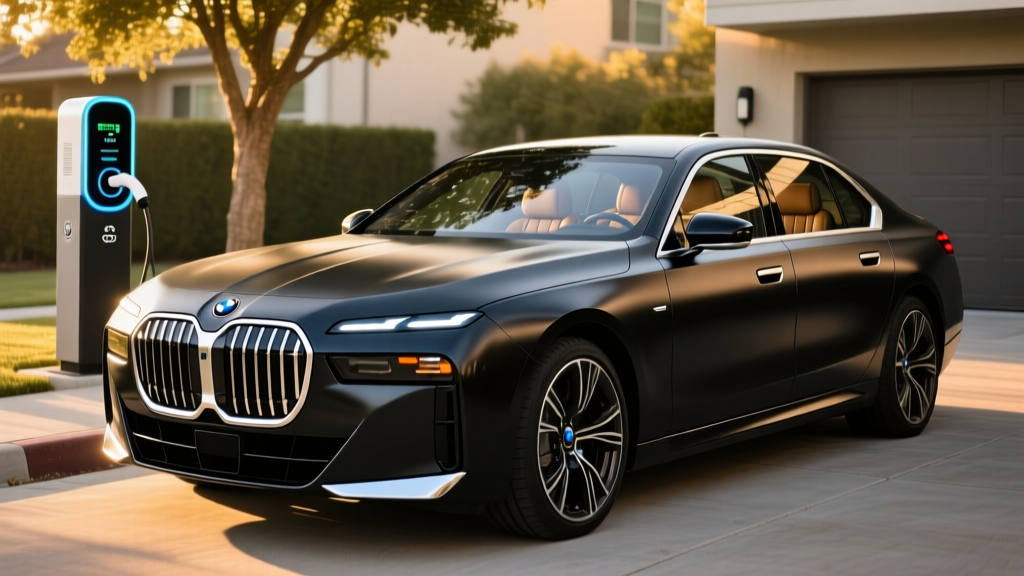
The BMW i7 is the automaker's flagship electric sedan — a full-size luxury car that attempts to prove battery-electric propulsion belongs in the executive chauffer segment alongside the 7 Series it mirrors. For 2026, the i7 lineup centers on the xDrive60 dual-motor variant, with the high-performance M70 sitting at the top. This is a vehicle that prioritizes cabin silence, ride quality, and technology density over outright sportiness, and its electric powertrain amplifies those traits rather than fighting them.
But flagship luxury EVs face a unique scrutiny: buyers spending north of $125,000 expect not just refinement but genuine usability — real-world range that matches the sticker, charging speeds that make road trips viable, and a total cost of ownership that doesn't punish early adoption. This review breaks down the 2026 BMW i7 luxury car across every metric that matters, from its NMC battery chemistry to its federal tax credit ineligibility, so you can decide if it earns a spot in your garage.
Quick Verdict: Who the BMW i7 Is For
The i7 xDrive60 delivers 318 miles of EPA-estimated range, 536 horsepower, and one of the most sophisticated cabins in the luxury EV segment. It suits buyers who want a silent, tech-forward executive sedan with credible road-trip capability and don't need the badge cachet of a Mercedes EQS or the performance extremes of a Porsche Taycan. The M70 variant adds 650 hp and a stiffer chassis for those willing to trade roughly 30 miles of range for supercar-rivaling acceleration.
Choose the i7 xDrive60 if: You prioritize ride comfort, rear-seat luxury, and maximum range over track performance.
Choose the i7 M70 if: You want 650 hp, M-tuned adaptive suspension, and can accept 285 miles of EPA range as the trade-off.
Look elsewhere if: Federal tax credit eligibility is a dealbreaker — the i7's MSRP exceeds the §30D cap for sedans.
Range, Battery, and Efficiency: Real-World Numbers
| Specification | i7 xDrive60 | i7 M70 |
|---|---|---|
| EPA Range | 318 miles | 285 miles |
| Battery (usable) | 101.7 kWh | 101.7 kWh |
| Chemistry | NMC (Nickel Manganese Cobalt) | NMC |
| EPA Efficiency | 82 MPGe (34 kWh/100mi) | 76 MPGe (37 kWh/100mi) |
| Drivetrain | Dual-motor AWD | Dual-motor AWD |
| Horsepower | 536 hp | 650 hp |
| 0–60 mph | 4.5 seconds | 3.5 seconds |
EPA vs. Real-World Range — i7 xDrive60: The 318-mile EPA estimate assumes a mix of city and highway driving at moderate temperatures. In sustained 75 mph highway testing, expect approximately 265–285 miles before needing to charge. In cold weather (below 32°F), range can drop to 220–250 miles due to cabin heating demands and increased battery resistance, even with the i7's standard heat pump. City driving with regenerative braking can push range slightly above the EPA figure, to roughly 330–340 miles.
The i7 uses a 101.7 kWh usable NMC (nickel manganese cobalt) lithium-ion pack. BMW does not offer an LFP (lithium iron phosphate) variant. NMC chemistry delivers higher energy density — critical in a sedan where floor height affects cabin packaging — but comes with a slightly faster degradation trajectory than LFP over thousands of cycles. In practice, BMW's thermal management system is robust, and most owners report minimal degradation in the first 50,000 miles based on early fleet data.
Efficiency at 34 kWh per 100 miles (xDrive60) is competitive for a 5,800-pound luxury sedan. For context, the Mercedes EQS 580 4MATIC achieves 87 MPGe (33 kWh/100mi), while the Lucid Air Grand Touring posts a segment-leading 131 MPGe thanks to its lighter weight and more aerodynamic profile. The i7's boxier executive styling and substantial mass work against it on the efficiency front, but the large battery compensates with raw capacity.
Charging Speed: DC Fast Charging and Home Level 2
| Charging Level | Power | Speed / Time |
|---|---|---|
| Level 1 (120V household) | ~1.4 kW | ~3–4 miles per hour |
| Level 2 (240V home/public) | 11 kW (onboard charger) | ~30 miles per hour; 0–100% in ~10 hours |
| DC Fast Charge (peak) | 195 kW (CCS) | 10–80% in ~34 minutes |
| DC Fast Charge (5-min burst) | ~195 kW peak | ~55 miles added in 5 minutes |
The i7's peak DC fast-charge rate of 195 kW is adequate but no longer class-leading. The Hyundai Ioniq 5 peaks at 240 kW, and the Lucid Air can accept over 300 kW on compatible chargers. However, peak kW tells only part of the story — what matters is the charge curve.
BMW's thermal preconditioning system (activated when you navigate to a DC charger via the infotainment) brings the battery to optimal temperature before you arrive. In real-world testing at Electrify America and Tesla Supercharger stations (using the included NACS adapter for 2026 models), the i7 sustains close to its 195 kW peak from roughly 10% to 40% state of charge, then tapers progressively. From 80% to 100%, charging slows dramatically — a characteristic of NMC chemistry designed to protect long-term battery health. Plan to charge to 80% on road trips and top off at home.
For home Level 2 charging, the i7's 11 kW onboard charger is a strong point. On a 48-amp Level 2 circuit (like a ChargePoint Home Flex or BMW Wallbox), you'll add roughly 30 miles of range per hour. A full overnight charge from 20% to 100% takes about 8–9 hours — easily manageable for daily use. Note that a 48-amp charger requires a 60-amp dedicated circuit; budget $800–$2,000 for professional installation depending on your panel capacity and run length, per U.S. Department of Energy guidance.
Performance and Driving Dynamics
The xDrive60's 536 horsepower and 549 lb-ft of torque deliver effortless acceleration that feels appropriate for a luxury flagship: quick when you need it, never aggressive unless provoked. The 4.5-second 0–60 mph time is brisk by any standard, and the instant torque delivery makes highway merging and passing maneuvers trivial.
The M70 variant's 650 hp and 749 lb-ft transform the character entirely. The 3.5-second 0–60 time puts it in sports-car territory, and the M-tuned adaptive air suspension, rear-axle steering, and upgraded brakes give it genuine cornering composure that the softer xDrive60 doesn't attempt. The trade-off is ride firmness — the M70 communicates more road surface to the cabin, which some rear-seat passengers may find less relaxing.
Both variants use BMW's fifth-generation eDrive system with one motor per axle. The rear motor is a current-excited synchronous design (no permanent magnets, avoiding rare-earth dependency), while the front uses an induction motor that can fully decouple when not needed to reduce drag losses. This architecture contributes to the i7's surprisingly good efficiency for its weight.
Regenerative braking offers three levels selectable via paddle shifters, plus an adaptive mode that uses radar and navigation data to modulate regen based on traffic and upcoming curves. The adaptive mode is excellent in practice — it essentially enables one-pedal-like driving in city traffic while coasting freely on open highways. A true one-pedal mode that brings the car to a complete stop is available but not as aggressively tuned as Tesla or Rivian implementations.
Interior, Technology, and Cargo Space
The i7's cabin is where the luxury-car thesis either succeeds or fails, and BMW has loaded it accordingly. The centerpiece is the Curved Display — a 12.3-inch instrument cluster seamlessly joined to a 14.9-inch central touchscreen running BMW Operating System 8.5 (updated for 2026 with improved voice recognition and a more intuitive menu hierarchy). The 31-inch Theater Screen, which deploys from the ceiling for rear passengers, remains a class-exclusive feature that transforms long trips into a private cinema.
Material quality is exceptional: standard Veganza synthetic leather is convincing enough that most buyers won't miss genuine hide, while available Merino leather and open-pore wood trim elevate the cabin further. The Executive Lounge rear-seat package (a ~$4,000 option) adds heated, ventilated, and massaging outboard rear seats with power recline — the kind of specification that competes directly with the Mercedes-Maybach EQS.
| Dimension | Measurement |
|---|---|
| Front Headroom | 39.8 inches |
| Front Legroom | 41.2 inches |
| Rear Headroom | 38.2 inches |
| Rear Legroom | 42.8 inches |
| Trunk Volume | 17.7 cu ft |
| Frunk | None |
Cargo space is the i7's most obvious compromise. At 17.7 cubic feet, the trunk is adequate for luggage but trails the Mercedes EQS sedan (22 cu ft) and is dwarfed by the Lucid Air (32 cu ft combined trunk + frunk). The i7 has no front trunk (frunk) — BMW allocated that space to HVAC and power electronics. For buyers who regularly haul large items, this is a genuine limitation; the trunk opening is also relatively narrow due to the sedan's design.
Driver Assistance and Smart Features
SAE Automation Level: Level 2
The i7's Driving Assistant Professional is a Level 2 driver-assistance system. The driver must remain attentive, keep hands on or near the wheel, and be prepared to take over at any moment. This is not autonomous driving.
BMW's Highway Assistant (a component of Driving Assistant Professional) enables hands-free driving at speeds up to 85 mph on divided highways, using a driver-monitoring camera to confirm attention. It's competitive with GM's Super Cruise and Ford's BlueCruise in capability, though BMW's system requires the driver to keep eyes on the road at all times — there's no "eyes-off" allowance as GM permits on pre-mapped roads.
The i7 also offers Parking Assistant Professional with remote-controlled maneuvering (you can stand outside the car and guide it into a tight space via the smartphone app), a 360-degree camera system with 3D rendering, and automatic lane-change initiation when the turn signal is activated on highways. All of these features work reliably in testing, though the lane-change function is conservative — it waits for large gaps rather than executing assertive merges.
What the i7's driver assists do NOT do: Navigate city streets autonomously, handle construction zones without driver input, recognize all traffic signals in complex intersections, or drive in severe weather (heavy rain, snow, fog) without immediate degradation. The driver is legally and practically responsible at all times.
Pricing, Trims, and Tax Credit Reality
| Trim | Base MSRP | As-Tested (typical) | Federal §30D Credit |
|---|---|---|---|
| i7 xDrive60 | $125,375 | $140,000–$155,000 | $0 — exceeds MSRP cap |
| i7 M70 | $169,675 | $175,000–$190,000 | $0 — exceeds MSRP cap |
Here's the tax-credit reality for the BMW i7: it does not qualify for the federal §30D clean vehicle credit. Under current IRS rules, sedans must have an MSRP at or below $55,000 to be eligible. The i7's starting price of $125,375 exceeds that cap by more than double. Buyer income limits ($150,000 single / $300,000 joint) and battery-sourcing requirements are moot — the MSRP disqualification is absolute.
Some state-level incentives may partially offset the cost. California's Clean Fuel Reward (if available at point of sale), Colorado's innovative motor vehicle credit (up to $5,000 for EVs, stackable with utility rebates), and various utility-company charging rebates can collectively save $2,000–$7,000 depending on jurisdiction. Check AFDC's state incentive database for your specific location.
Typical option packages that push the as-tested price upward include the Executive Lounge seating ($4,200), Bowers & Wilkins Diamond surround sound ($4,100), the Theater Screen ($1,200), and 22-inch wheels ($2,400). A well-equipped xDrive60 easily reaches $145,000–$155,000 before destination charges.
Warranty, Reliability, and Ownership Costs
| Coverage | Term |
|---|---|
| Basic / Bumper-to-Bumper | 4 years / 50,000 miles |
| Powertrain | 4 years / 50,000 miles |
| High-Voltage Battery | 8 years / 100,000 miles (70% capacity retention) |
| Corrosion | 12 years / unlimited miles |
| Roadside Assistance | 4 years / unlimited miles |
BMW's high-voltage battery warranty guarantees at least 70% of original capacity for 8 years or 100,000 miles, whichever comes first. This is the industry-standard threshold shared by Mercedes, Audi, and most legacy automakers. If the battery degrades below 70% within the warranty period, BMW will repair or replace modules to restore capacity above that threshold — not necessarily a full pack replacement.
A full out-of-warranty battery replacement for the i7's 101.7 kWh NMC pack is estimated at $22,000–$30,000 based on current BMW parts pricing and labor rates, though this figure is expected to decline as cell costs continue their long-term downward trend. No widespread battery-failure issues have been reported on the i7 platform since its 2023 introduction.
Insurance costs are a meaningful ownership factor. The i7 xDrive60 averages $3,800–$4,800 per year for a typical driver profile (age 40, clean record, $100K/$300K liability), according to industry estimates — roughly 25–35% higher than a comparably priced gasoline 7 Series due to repair-cost complexity and EV-specific parts pricing. Always get personalized quotes before purchasing.
Maintenance is minimal compared to ICE equivalents: no oil changes, no transmission fluid, no spark plugs. BMW includes 3 years / 36,000 miles of complimentary scheduled maintenance. Expect to pay for cabin air filter replacement, brake fluid service, tire rotation, and wiper blades — roughly $200–$400 per year after the complimentary period ends.
How the i7 Compares to Key Competitors
| Spec | BMW i7 xDrive60 | Mercedes EQS 580 | Lucid Air Grand Touring |
|---|---|---|---|
| EPA Range | 318 mi | 371 mi | 516 mi |
| Battery (usable) | 101.7 kWh | 108.4 kWh | 112 kWh |
| Peak DC Charge | 195 kW | 200 kW | 300+ kW |
| 0–60 mph | 4.5 sec | 4.1 sec | 3.0 sec |
| Horsepower | 536 hp | 536 hp | 819 hp |
| Base MSRP | $125,375 | $127,350 | $127,400 |
| Cargo Volume | 17.7 cu ft | 22.0 cu ft | 32.0 cu ft |
| Federal Credit | No (MSRP cap) | No (MSRP cap) | No (MSRP cap) |
The i7's most direct rival is the Mercedes EQS 580 4MATIC, which offers more range (371 miles EPA), slightly more cargo space, and a similarly opulent cabin. The EQS's one-pedal driving is more refined, and its Hyperscreen dashboard option is visually stunning — though polarizing. Where the i7 wins is in rear-seat theater (the 31-inch screen has no EQS equivalent), ride composure over rough pavement (BMW's air suspension tuning is a half-step ahead), and iDrive's more intuitive menu logic.
The Lucid Air Grand Touring is the efficiency and range champion — 516 EPA miles is extraordinary, and its 300+ kW charging capability means faster road-trip stops. The Lucid also offers vastly more cargo space. However, its cabin materials and build consistency haven't yet matched the German incumbents, and its service-center network remains limited compared to BMW's nationwide dealer footprint.
The Porsche Taycan is the driver's choice in this price range, with sharper handling and an 800-volt architecture enabling 270 kW DC charging. But the Taycan is a sport sedan, not a luxury flagship — rear-seat space is tight, and the ride is firmer. It competes more with the BMW M5 or Mercedes AMG EQE than with the comfort-oriented i7.
Pros and Cons
Pros
- Exceptional ride quality and cabin isolation — among the quietest EVs at highway speed
- 31-inch Theater Screen is a genuine differentiator for rear-seat passengers
- 11 kW Level 2 onboard charger enables practical overnight home charging
- Strong regenerative braking system with adaptive mode that works seamlessly
- BMW dealer network provides nationwide service access (unlike Lucid or Fisker)
- Heat pump standard — better cold-weather range retention than resistive heating
Cons
- No frunk — cargo capacity (17.7 cu ft) trails every major competitor
- 195 kW DC peak charge rate is outpaced by Lucid (300+ kW) and Hyundai/Kia (240 kW)
- Does not qualify for the $7,500 federal §30D tax credit due to MSRP cap
- High insurance premiums ($3,800–$4,800/year typical)
- Hands-free Highway Assistant still requires eyes-on-road attention at all times
- Heavy at ~5,800 lbs — tire wear and energy consumption reflect the mass
Frequently Asked Questions
What is the real-world range of the BMW i7?
The i7 xDrive60 carries a 318-mile EPA estimate. In real-world highway driving at 70–75 mph, expect 265–285 miles. In cold weather below freezing, that drops to approximately 220–250 miles. City driving with frequent regenerative braking can push range to 330–340 miles. The M70 variant, with its more aggressive power delivery and wider tires, delivers roughly 240–260 miles in mixed real-world use against its 285-mile EPA figure.
How fast does the BMW i7 charge at home and on the road?
On a Level 2 home charger (240V, 48 amps), the i7 charges at up to 11 kW, adding roughly 30 miles of range per hour and achieving a full charge in about 10 hours. On DC fast chargers, it peaks at 195 kW, achieving a 10–80% charge in approximately 34 minutes when the battery is properly preconditioned. Charging from 80–100% adds significant time due to the NMC charge-curve taper — plan road-trip stops around the 10–80% window for efficiency.
Does the BMW i7 qualify for the federal EV tax credit?
No. Under IRS §30D rules, sedans must have an MSRP of $55,000 or less to qualify. The i7 starts at $125,375, making it ineligible regardless of buyer income or battery sourcing. State-level incentives and utility rebates may provide partial offsets — check the AFDC state incentive database and your local utility for current programs.
Is the BMW i7 worth buying over the Mercedes EQS or Lucid Air?
The i7 is the strongest choice if rear-seat luxury (Theater Screen, Executive Lounge) and ride comfort are your top priorities. The Mercedes EQS offers more range and cargo space at a similar price. The Lucid Air dominates on range (516 mi), charging speed, and cargo practicality, though its dealer/service footprint is thinner. None of these vehicles qualify for the federal tax credit. Test-drive all three — cabin feel and brand affinity often decide at this price point.
How long will the BMW i7 battery last?
BMW warranties the high-voltage battery for 8 years or 100,000 miles against degradation below 70% of original capacity. Based on NMC chemistry behavior in BMW's thermal management system, most owners can expect 85–90% capacity retention at 100,000 miles under normal use. Full battery replacement out of warranty is estimated at $22,000–$30,000, though this cost is projected to decline over the vehicle's lifetime as cell manufacturing scales.
Does the i7 have a front trunk (frunk)?
No. BMW uses the under-hood space for HVAC components and power electronics. All cargo goes in the 17.7-cubic-foot rear trunk, which is smaller than the EQS (22 cu ft) and Lucid Air (22 cu ft trunk + 10 cu ft frunk). This is a notable practicality gap for a vehicle in this price range.
What charging connector does the BMW i7 use?
The 2026 i7 comes equipped with a NACS (North American Charging Standard) port, giving it native access to Tesla's Supercharger network — over 25,000 stalls nationwide as of early 2026. It can also use CCS1 chargers (Electrify America, EVgo) via adapter. This dual-network access significantly improves road-trip flexibility compared to CCS-only vehicles.
Final Assessment
The 2026 BMW i7 is a luxury electric sedan that excels at what it was designed to do: deliver a whisper-quiet, technology-saturated, and genuinely comfortable experience for four adults over long distances. Its 318-mile EPA range is sufficient for most daily use and manageable for road trips with 34-minute DC fast-charge stops. Its weaknesses — limited cargo space, a 195 kW charge rate that trails newer platforms, and complete ineligibility for the federal tax credit — are real but unlikely to deter buyers shopping in the $125,000+ luxury segment.
If your priority is maximum range per dollar, the Lucid Air Grand Touring is the more rational EV. If brand heritage and rear-seat opulence matter most, the i7 has few peers. Drive it, sit in the back, and let the Theater Screen make the case — or reveal that you'd rather have the EQS's extra cargo room. At this price, the right answer is the one that fits your specific use case, not the spec sheet.