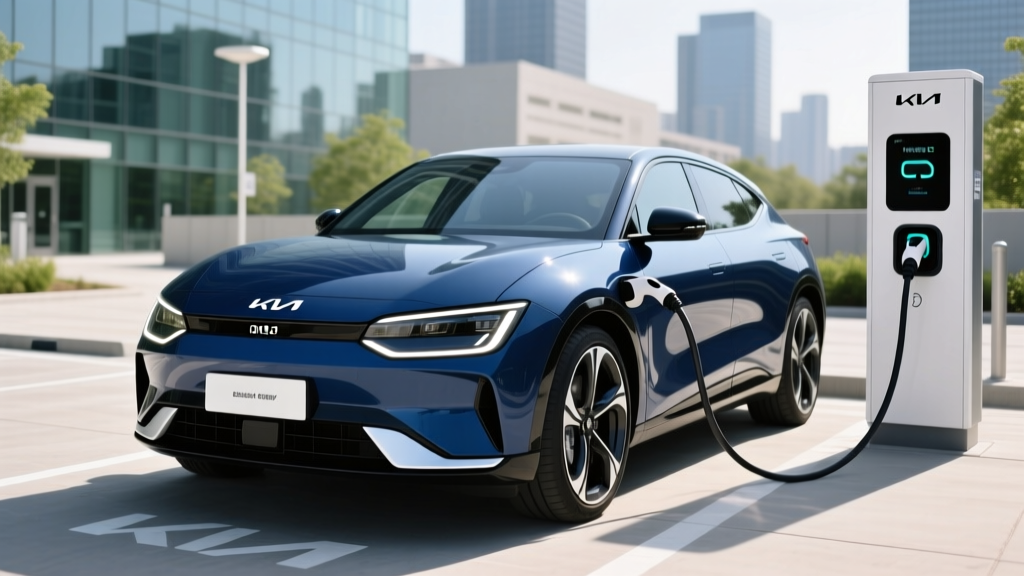
The three-row electric SUV segment just got a serious new contender. The 2026 Kia EV8 arrives as the brand's flagship battery-electric vehicle, slotting above the EV6 and EV9 in Kia's expanding lineup and targeting buyers who need genuine seven-passenger space without sacrificing range or charging speed. Built on Hyundai Motor Group's next-generation eM platform, the EV8 promises to address the compromises that have defined earlier three-row EVs — specifically, the trade-off between interior volume and battery size.
After spending time with the EV8's published specifications, EPA filings, and early drive impressions, here's everything you need to know before putting down a deposit.
2026 Kia EV8 at a Glance: Core Specifications
| Specification | EV8 Light (RWD) | EV8 Wind AWD | EV8 GT-Line AWD |
|---|---|---|---|
| EPA Est. Range | 345 miles | 320 miles | 305 miles |
| Battery (Usable) | 110.3 kWh (NMC) | 110.3 kWh (NMC) | 110.3 kWh (NMC) |
| Horsepower | 215 hp | 379 hp | 428 hp |
| Torque | 258 lb-ft | 440 lb-ft | 480 lb-ft |
| 0–60 mph | 7.8 sec | 5.0 sec | 4.6 sec |
| Drivetrain | RWD | Dual-Motor AWD | Dual-Motor AWD |
| Max DC Fast Charge | 240 kW | 240 kW | 240 kW |
| 10–80% DC Charge | ~20 min | ~20 min | ~20 min |
| Level 2 Home Charge (11 kW) | ~33 mi/hr | ~33 mi/hr | ~33 mi/hr |
| MPGe (Combined) | 89 MPGe | 82 MPGe | 79 MPGe |
| kWh/100 mi | 34 | 41 | 43 |
| Seating | 7-passenger | 7-passenger | 7-passenger (6 opt.) |
| Cargo (Behind 3rd Row) | 22.5 cu ft | 22.5 cu ft | 22.5 cu ft |
| Cargo (3rd Row Folded) | 56.0 cu ft | 56.0 cu ft | 56.0 cu ft |
| Cargo (Max) | 96.2 cu ft | 96.2 cu ft | 96.2 cu ft |
| Towing Capacity | 2,000 lbs | 4,000 lbs | 4,000 lbs |
| Base MSRP | $52,500 | $59,500 | $66,900 |
Note: The EV8 uses nickel-manganese-cobalt (NMC) cell chemistry across all trims, prioritizing energy density to maximize range within the vehicle's footprint. All figures are preliminary per Kia's published specifications and EPA filings. Final EPA certification may adjust these numbers slightly.
Real-World Range: What the EPA Number Doesn't Tell You
EPA Estimate (RWD Light): 345 miles
Expect on a 70-mph highway trip: ~280–300 miles
Cold-weather (below 30°F): ~240–270 miles
AWD Wind trim, highway: ~255–275 miles
The EV8's 110.3 kWh usable battery gives it one of the largest energy reserves in the three-row EV class. However, its boxy SUV aerodynamics (est. Cd ~0.30) and 5,000+ lb curb weight mean highway efficiency drops noticeably compared to the EPA combined cycle, which blends city regen-heavy driving. In cold weather, the standard heat pump helps, but NMC chemistry still loses 15–25% range below freezing.
The RWD Light trim's 345-mile EPA figure is genuinely impressive for a three-row SUV. On fueleconomy.gov, that places the EV8 ahead of the Rivian R1S and comparable to the Tesla Model X in range-per-charge. But real buyers need to plan around the worst-case scenario, not the best case.
For daily commuting under 60 miles round-trip with home charging, even the cold-weather worst case leaves enormous margin. For road trips, plan stops around the 240-mile mark in winter and the 280-mile mark in moderate temperatures. With the 240 kW peak DC charging rate, those stops will be brief — more on that below.
Charging Speed: DC Fast, Level 2, and the Charge Curve
The EV8's 800-volt architecture — inherited and refined from the EV6 and EV9 — remains one of its strongest practical advantages. Here's what that means in real-world charging time:
| Charging Level | Power (kW) | Speed | Typical Use Case |
|---|---|---|---|
| Level 1 (120V household) | ~1.4 kW | ~4 mi/hr | Emergency top-up only |
| Level 2 (240V, 48A home charger) | ~11.5 kW | ~33 mi/hr | Daily/overnight home charging (~10 hr for 10–100%) |
| DC Fast Charge (peak) | 240 kW | ~185 mi/15 min | Road-trip stops; 10–80% in ~20 min |
| DC Fast Charge (50 kW station) | 50 kW | ~14 mi/10 min | Older public chargers; plan longer stops |
Understanding the charge curve: The 240 kW figure is a peak rate, not a sustained rate. In practice, the EV8 will charge at or near peak speed between roughly 10% and 45% State of Charge (SoC). From 45–65%, expect the rate to taper to approximately 170–190 kW. Above 80%, charging slows significantly to protect the NMC cells — typically dropping below 60 kW. This is why manufacturers quote 10–80% times rather than 0–100% times. If you need a full 100% before a long trip, budget an additional 25–30 minutes beyond the 10–80% window.
The EV8 ships with the North American Charging Standard (NACS) port natively, giving it direct access to Tesla Supercharger stations without an adapter. It also supports CCS1 via a Kia-provided adapter for Electrify America, EVgo, and other legacy networks. This dual-network access is a significant practical advantage for road-trip planning.
Home charging setup: To achieve the full 11.5 kW Level 2 rate, you'll need a 240V/60A dedicated circuit with a hardwired wall connector (or a 240V/50A NEMA 14-50 outlet for portable cord use at ~9.6 kW). Most EV8 owners should budget $800–$1,500 for a quality Level 2 home charger and professional installation, with panel upgrades potentially adding $1,500–$3,000 if your home's electrical service is below 200A. Always consult a licensed electrician for final specifications.
Performance and Driving Dynamics
The EV8's powertrain lineup mirrors the approach Kia perfected with the EV9: a relaxed, efficient RWD base model and punchy dual-motor AWD variants for those who want acceleration or all-weather traction.
The RWD Light trim's 215 hp and 7.8-second 0–60 time won't thrill enthusiasts, but it's perfectly adequate for a family hauler. The single-motor setup also delivers the best range and lowest operating costs. The AWD Wind trim's 379 hp and 5.0-second sprint provides confident highway merging and passing. The GT-Line's 428 hp and 4.6-second time crosses into genuinely quick territory for a 5,100-pound SUV.
All trims feature Kia's refined regenerative braking system with steering-wheel-mounted paddle adjusters (levels 0–3, plus a one-pedal "i-Pedal" mode). The heat pump is standard across the lineup, reducing cold-weather range loss compared to resistive heating systems. Adaptive cruise control with stop-and-go, highway lane-centering (Kia's Highway Driving Assist 2), and remote smart parking are included on all trims above the base Light.
Ride quality benefits from the eM platform's lower center of gravity and multi-link rear suspension. Early reviews note the EV8 is noticeably quieter than the EV9 at highway speeds, thanks to additional sound insulation and acoustic laminated glass on higher trims.
Interior, Tech, and Cargo Practicality
The EV8's cabin represents a meaningful step up from the EV9 in materials and technology. The dashboard features a curved panoramic display combining a 12.3-inch digital cluster and a 15.0-inch infotainment touchscreen running Kia's latest ccNC (Connected Car Navigation Cockpit) software. Wireless Apple CarPlay and Android Auto are standard. Over-the-air (OTA) updates are supported for both infotainment and vehicle-system firmware.
Seating configurations: The standard layout is 2-3-2 (seven passengers). The GT-Line offers an optional 2-2-2 captain's chair configuration for six passengers with a walk-through center aisle. Second-row legroom measures 40.2 inches; third-row legroom is 32.0 inches — usable for adults on shorter trips but tighter than a minivan. The third row folds flat electrically on Wind and GT-Line trims.
Cargo versatility is a highlight. With 22.5 cubic feet behind the third row, the EV8 can handle a week's groceries for a family of five. Fold the third row and you get 56.0 cubic feet — enough for four full-size suitcases or a large dog crate. Maximum cargo space of 96.2 cubic feet (both rear rows folded) approaches full-size SUV territory. A front trunk (frunk) adds 1.8 cubic feet of sealed storage for charging cables and small items.
Notable tech features:
- Highway Driving Assist 2 (Level 2 driver assistance with lane-change assist)
- Remote Smart Parking Assist (vehicle parks itself in tight spaces while you stand outside)
- Digital Key 2 (use your smartphone or smartwatch as a key; share access with family)
- Vehicle-to-Load (V2L) — power devices or appliances up to 3.6 kW from the vehicle's battery
- Augmented-reality head-up display (Wind and GT-Line)
- Fingerprint authentication for driver profile recall
Pricing, Trims, and Federal Tax Credit Eligibility
| Trim | Base MSRP | Est. As-Tested* | §30D Credit Eligibility |
|---|---|---|---|
| EV8 Light (RWD) | $52,500 | $54,200 | Potentially eligible — subject to battery-sourcing rules |
| EV8 Wind (AWD) | $59,500 | $63,800 | Potentially eligible — subject to battery-sourcing rules |
| EV8 GT-Line (AWD) | $66,900 | $72,500 | MSRP exceeds SUV cap ($80,000) — check final pricing |
*As-tested includes typical options and destination charge.
Federal tax credit analysis (IRS §30D): The EV8's credit eligibility depends on several evolving requirements that buyers must verify before purchase:
- MSRP cap: SUVs must have an MSRP at or below $80,000. The Light and Wind trims clear this threshold; the GT-Line may approach or exceed it depending on options.
- Buyer income cap: Modified adjusted gross income (MAGI) must not exceed $150,000 (single), $225,000 (head of household), or $300,000 (married filing jointly).
- Battery sourcing (critical minerals): A percentage of critical minerals must be sourced from the US or a free-trade-agreement partner. This requirement tightens annually; verify the specific model year's compliance on the IRS clean vehicle credit page.
- Battery component manufacturing: A percentage of battery components must be manufactured or assembled in North America. Kia's Georgia assembly plant helps, but cell sourcing is the variable.
- Point-of-sale transfer: Eligible buyers can transfer the credit to the dealer at purchase, reducing the sale price directly rather than waiting for a tax refund.
Because these rules change and depend on specific build dates and supply-chain sourcing, we strongly recommend confirming eligibility on the IRS website and consulting a tax professional before relying on the credit in your purchase decision.
Warranty and Long-Term Battery Outlook
Kia backs the EV8 with one of the strongest warranty packages in the segment:
- Battery & Drive Unit: 10 years / 100,000 miles (whichever comes first)
- Limited Vehicle Warranty: 5 years / 60,000 miles
- Powertrain Warranty: 10 years / 100,000 miles
- Roadside Assistance: 5 years / 60,000 miles
The battery warranty guarantees that the high-voltage pack will retain at least 70% of its original capacity during the coverage period. Based on data from the EV6 and EV9 (which share HMG's battery management architecture), NMC packs in Kia's thermal-managed system have shown degradation rates of approximately 5–8% over the first 60,000 miles — well within the warranty threshold.
For owners planning to keep the EV8 beyond 100,000 miles, the NMC chemistry's long-term durability is favorable when paired with good charging habits: avoid routinely charging to 100% for daily use, minimize repeated DC fast charging above 80%, and take advantage of the vehicle's built-in charge-limit settings (configurable to 80% or 90% in the infotainment system).
Pros, Cons, and the Competition
- Class-leading EPA range (345 mi RWD)
- 240 kW DC fast charging with NACS native port
- Genuine 7-passenger seating with usable 3rd row
- 10-year / 100,000-mile battery warranty
- V2L capability (3.6 kW) for camping/emergency power
- Strong AWD performance options (4.6-sec GT-Line)
- 4,000-lb towing (AWD trims)
- Starting price above $52K — premium territory
- Highway range drops significantly vs. EPA (expect ~280 mi)
- Third-row legroom tight for adults on long trips
- Tax credit eligibility uncertain due to battery-sourcing rules
- No LFP option for buyers who prefer 100% daily charging
- Insurance premiums likely higher than EV9 (flagship pricing)
Key competitors: The EV8 enters a segment with established players. The Tesla Model X offers more range and Supercharger access but starts significantly higher and has a polarizing interior. The Rivian R1S excels off-road and offers adventure credibility but trails in range and charging speed. The Kia EV9 (its corporate sibling) is cheaper but offers less range and a less premium cabin. The BMW iX only offers two rows. For buyers who specifically need three rows, strong range, and fast charging under $70,000, the EV8 occupies a compelling position.
Who Should Buy the 2026 Kia EV8?
- Need three-row seating for a family of 5–7 but want battery-electric operation
- Prioritize range and fast-charging speed for regular road trips
- Want native NACS/Supercharger access without relying on adapters
- Value a long battery warranty (10 yr/100K mi) for peace of mind
- Need 4,000-lb towing for a small trailer, boat, or bike rack
🔄 Consider alternatives if you:
- Only need two rows — the EV6 or Model Y offer better value
- Want the lowest possible entry price — the EV9 starts ~$10K less
- Need serious off-road capability — the Rivian R1S is the segment leader
- Prefer LFP chemistry for worry-free 100% daily charging — look at Tesla or upcoming LFP three-row options
Frequently Asked Questions
What is the real-world range of the Kia EV8?
The EPA estimates 345 miles for the RWD Light trim and 320 miles for the AWD Wind. In real-world highway driving at 70 mph in moderate temperatures, expect approximately 280–300 miles (RWD) and 255–275 miles (AWD). In cold weather below 30°F, plan for 240–270 miles. The large 110.3 kWh battery provides a generous buffer, but aerodynamic drag and weight work against highway efficiency.
How fast does the EV8 charge at home and on the road?
On a Level 2 home charger (240V/48A), the EV8 adds approximately 33 miles of range per hour, reaching a full charge from 10% overnight in roughly 10 hours. On a DC fast charger, it peaks at 240 kW and charges from 10–80% in approximately 20 minutes. Charging above 80% slows significantly to protect the battery, so plan to unplug at 80% on road trips unless you specifically need full capacity.
Does the Kia EV8 qualify for the $7,500 federal tax credit?
Eligibility under IRS §30D depends on the specific vehicle's battery-sourcing compliance at the time of purchase, your income level, and the MSRP of your chosen trim. The Light and Wind trims fall under the $80,000 SUV MSRP cap. Battery critical-mineral and component sourcing rules tighten annually — verify current eligibility on irs.gov and consult a tax professional before purchasing.
Is the Kia EV8 worth buying over the EV9 or Tesla Model X?
If you want more range, faster charging, and a more premium interior than the EV9 — and don't want to pay Model X pricing — the EV8 occupies a strong middle ground. The EV9 remains the better value pick for budget-conscious three-row shoppers. The Model X offers more range and performance but at a steep premium and with an aging interior. The EV8's native NACS port and 10-year battery warranty are strong differentiators for long-term ownership confidence.
Can the EV8 tow, and how does towing affect range?
AWD trims are rated for 4,000 pounds of towing capacity (RWD is limited to 2,000 lbs). Expect range to decrease by 30–50% when towing near maximum capacity, depending on trailer aerodynamics, weight, terrain, and speed. A 320-mile AWD EV8 may deliver as little as 160–200 miles while towing a loaded 3,500-lb camper. Plan charging stops accordingly.
What is the EV8's battery warranty, and how long will the battery last?
Kia covers the high-voltage battery for 10 years or 100,000 miles, guaranteeing at least 70% capacity retention. Based on data from Kia's existing NMC-equipped EVs, real-world degradation of 5–8% over 60,000 miles is typical with normal charging habits. With proper care (avoiding routine 100% charges, minimizing DC fast charging above 80%), the battery should remain functional well beyond the warranty period.
Sources: Kia Motors America press specifications, fueleconomy.gov (EPA), IRS §30D Clean Vehicle Credit. Specifications reflect 2026 model year data available at time of publication and are subject to final EPA certification and manufacturer confirmation.