Quick Verdict: The Electric 7 Series That Refuses to Compromise
The 2025 BMW i7 is the automaker's flagship electric sedan — a 5,800-pound statement that luxury EV buyers cross-shop against the Mercedes EQS, Lucid Air, and Tesla Model S. With up to 318 miles of EPA-estimated range, a 101.7 kWh (usable) NMC battery, and peak DC fast-charging at 195 kW, the i7 xDrive50 delivers genuine long-distance capability wrapped in BMW's most advanced cabin technology. The M70 variant trades some range for 651 horsepower and a 3.5-second 0-60 sprint.
But flagship luxury EVs live and die by execution details: real-world highway range, charging-curve behavior, whether the federal tax credit actually applies, and whether the back seat justifies the six-figure price tag. This review covers every spec, cost, and ownership variable a serious buyer needs.
| Spec | xDrive50 | M70 |
|---|---|---|
| EPA Range | 318 mi (w/ 19" wheels) | 295 mi |
| Battery (usable) | 101.7 kWh, NMC | 101.7 kWh, NMC |
| Horsepower | 536 hp | 651 hp |
| 0-60 mph | 4.5 sec | 3.5 sec |
| Drivetrain | Dual-motor AWD | Dual-motor AWD |
| Peak DC Charge | 195 kW | 195 kW |
| 10-80% DC Time | ~34 min | ~34 min |
| Level 2 Rate | 11 kW (AC) | 11 kW (AC) |
| MPGe (combined) | 82 MPGe | 76 MPGe |
| Base MSRP | $106,695 | $142,795 |
| Federal Tax Credit | Not eligible (MSRP cap + sourcing) | Not eligible |
Range and Efficiency: EPA vs. Real-World Miles
EPA Estimate: 318 miles (19" all-season tires) / 295 miles (21" performance tires)
Real-World Highway (70-80 mph): Expect ~255-275 miles
Cold Weather (below 32°F): Expect ~220-245 miles (30-35% reduction typical for large NMC packs without aggressive preconditioning)
Efficiency: 82 MPGe combined / 41 kWh per 100 mi (xDrive50)
The i7 xDrive50 achieves its 318-mile EPA rating on the smaller 19-inch wheel package. Opt for the available 21-inch or 22-inch wheels, and that number drops to approximately 295 miles due to increased rolling resistance and aerodynamic drag — a common trade-off across luxury EVs where buyers prioritize stance over range.
In real-world highway driving at sustained 70-80 mph speeds, large luxury sedans like the i7 typically return 80-87% of their EPA combined figure. The i7's heavy mass (curb weight exceeds 5,800 lbs) and frontal area work against highway efficiency. On a 250-mile interstate trip in moderate temperatures (55-75°F), plan for roughly 255-275 usable miles before needing a charge stop.
Cold weather compounds the penalty. BMW equips the i7 with a heat pump for cabin heating — which helps — but the large NMC battery still loses capacity in freezing temperatures. Expect a 25-35% range reduction in sustained sub-freezing conditions, bringing real-world winter range to approximately 220-245 miles. Preconditioning the battery while plugged in mitigates some of this loss and is essential before DC fast-charging in cold weather.
For comparison, the EPA's fueleconomy.gov listing confirms the 82 MPGe combined rating for the xDrive50, translating to 41 kWh consumed per 100 miles driven. That's roughly $0.06-$0.08 per mile at average US residential electricity rates ($0.16/kWh), versus $0.14-$0.17 per mile for a comparable gasoline 7 Series at $3.80/gallon.
Charging Speed: DC Fast, Level 2, and the Curve
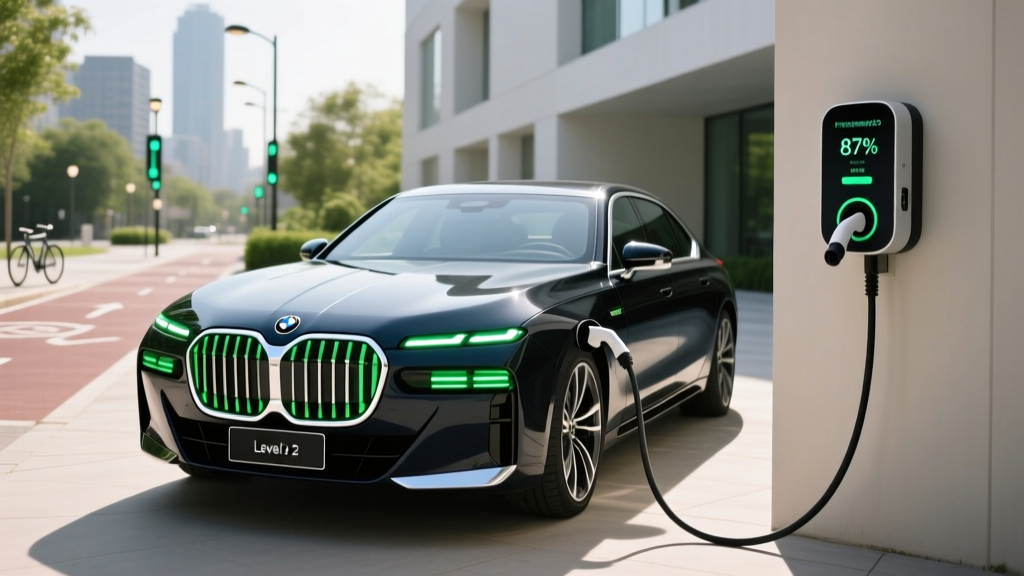
The 2025 BMW i7 supports DC fast-charging at up to 195 kW via its CCS1 connector (NACS adapter availability varies by model year and region — BMW has committed to NACS adoption for future models, but 2025 i7s ship with CCS). On a compatible 350 kW charger (Electrify America, EVgo, or Tesla Supercharger with the Magic Dock CCS adapter), the i7 can add approximately 10-80% state of charge in roughly 34 minutes under ideal thermal conditions.
| Charging Level | Power (kW) | Rate (mi/hr added) | Full Session Time |
|---|---|---|---|
| Level 1 (120V, 12A) | ~1.4 kW | ~3 mi/hr | ~72 hr (0-100%) |
| Level 2 (240V, 48A) | 11 kW (max AC) | ~25 mi/hr | ~10 hr (0-100%) |
| DC Fast (peak) | 195 kW | ~650 mi/hr (at peak) | ~34 min (10-80%) |
The charging curve matters more than peak kW. The i7 hits 195 kW only in a narrow state-of-charge window (roughly 10-25% SoC) at optimal battery temperature. By 50% SoC, the rate typically tapers to 120-140 kW. Above 80%, charging slows dramatically to protect the NMC cells — often dropping below 50 kW. This is normal behavior for all lithium-ion packs, but buyers should understand that the "195 kW" figure is a peak, not a sustained rate across the full session.
For home charging, the i7's onboard AC charger accepts up to 11 kW on a 240V/48A Level 2 circuit (such as a BMW Wallbox or ChargePoint Home Flex). At 11 kW, you'll recover roughly 25 miles of range per hour of charging, meaning an overnight session (8-10 hours) easily replenishes a full day's driving. Installation of a 48A Level 2 charger typically requires a 60A dedicated circuit; total installation costs range from $800-$2,500 depending on panel capacity and conduit run distance.
Battery preconditioning activates automatically when you navigate to a DC fast-charger in the iDrive system. This warms the battery to its optimal charging temperature (~77-95°F internally), which is critical for achieving peak charge rates — especially in cold weather where an un-preconditioned battery may limit charging to 50-75 kW until it self-heats.
Performance: Two Flavors of Electric Luxury
The 2025 i7 lineup offers two powertrain configurations, both dual-motor all-wheel-drive:
i7 xDrive50: 536 horsepower and 549 lb-ft of torque from its front and rear electric motors. The 0-60 mph sprint takes 4.5 seconds — brisk for a full-size luxury sedan and more than adequate for highway merging and passing. Top speed is electronically limited to 149 mph.
i7 M70: 651 horsepower (with Launch Control engaged) and 749 lb-ft of torque. BMW claims a 3.5-second 0-60 time, placing it in genuine sports-sedan territory despite the i7 M70's 6,000+ lb curb weight. The M70 also adds rear-axle steering, M Sport brakes, and a stiffer adaptive suspension tune.
Both variants use a single-speed reduction gear — no multi-speed transmission — and deliver instant torque from zero RPM. Regenerative braking is adjustable via steering-wheel paddles (three levels plus an adaptive mode that uses radar and navigation data to modulate regen automatically). The adaptive regen mode is the strongest one-pedal driving experience in the lineup, though BMW stops short of offering a true one-pedal "hold to stop" mode like Nissan or Chevrolet.
Interior, Cargo, and Standout Technology
The i7's cabin is where BMW justifies its flagship pricing. The centerpiece is BMW Curved Display — a 12.3-inch instrument cluster fused with a 14.9-inch infotainment touchscreen running iDrive 8.5. The system supports wireless Apple CarPlay and Android Auto, 5G connectivity, and over-the-air updates.
The most talked-about feature: the available 31.3-inch BMW Theater Screen — an 8K display that deploys from the headliner for rear-seat passengers, complete with built-in Amazon Fire TV and a Bowers & Wilkins Diamond Surround Sound system (36 speakers, 1,965 watts). It's a genuine differentiator no competitor currently matches.
Passenger space:
- Front headroom: 39.8 in / legroom: 41.2 in
- Rear headroom: 38.3 in / legroom: 42.0 in (executive-lounge rear seats available with power recline and calf rests)
Cargo volume: 17.7 cubic feet (trunk only — the i7 has no frunk/front trunk, which is a notable omission at this price point and a consequence of packaging the HVAC and power electronics under the hood).
On the driver-assistance front, the i7 comes standard with BMW Driving Assistant Professional, which includes adaptive cruise control with stop-and-go, lane-keeping assist, and automatic emergency braking. The available Highway Assistant (part of the Driving Assistant Professional package) enables hands-free driving at speeds up to 85 mph on divided highways — but this is an SAE Level 2 system requiring continuous driver supervision. It is not autonomous driving.
Pricing, Trims, and Federal Tax Credit Reality
| Trim | Base MSRP | As-Tested (typical options) | Federal §30D Credit |
|---|---|---|---|
| xDrive50 | $106,695 | $115,000-$125,000 | Not eligible |
| M70 | $142,795 | $150,000-$165,000 | Not eligible |
Neither the i7 xDrive50 nor the M70 qualifies for the $7,500 federal EV tax credit. Two disqualifying factors apply:
1. MSRP Cap: §30D limits the credit to sedars priced below $55,000 MSRP. The i7 starts at $106,695 — well above the cap.
2. Battery Sourcing: Even if the MSRP qualified, the i7's battery cell sourcing and critical-mineral supply chain do not meet the 2025 domestic-content thresholds set by the IRS under §30D.
Buyers should not factor any federal credit into their i7 purchase budget. State and local incentives may still apply — check your jurisdiction's energy office for current programs.
Destination charges add $995 to all trims. Popular option packages include the Executive Package ($3,600 — rear heated/cooled/ventilated seats, rear sunshades, glass controls), the Premium Package ($2,800 — Parking Assistant Professional, panoramic LED roof), and the M Sport Professional Package on the M70 ($3,100).
A well-equipped xDrive50 typically lands between $115,000-$125,000 before taxes and fees. The M70, with its performance hardware and standard M-specific interior appointments, regularly pushes past $150,000 when optioned.
Battery Warranty and Long-Term Ownership
BMW provides the following warranty coverage for the 2025 i7:
- High-voltage battery: 8 years / 100,000 miles (whichever comes first), warrantied against capacity loss below 70% of original usable capacity (approximately 71.2 kWh of the 101.7 kWh usable)
- Powertrain (electric motors, reduction gear): 8 years / 100,000 miles
- New vehicle limited warranty: 4 years / 50,000 miles
- Corrosion perforation: 12 years / unlimited miles
- Complimentary maintenance: 3 years / 36,000 miles
The 70% capacity retention threshold is industry-standard and matches what most competitors offer. In practice, NMC batteries in thermally managed packs (like the i7's liquid-cooled system) typically degrade 8-15% over the first 100,000 miles based on current fleet data from similar BMW iX and i4 owners. Reaching the 70% warranty threshold within 8 years would require unusually harsh usage patterns — frequent 100% charges combined with regular DC fast-charging in extreme heat, for example.
For long-term ownership beyond the warranty period, a full high-voltage battery replacement for the i7 would likely cost $20,000-$30,000+ based on current BMW parts pricing for comparable packs. However, module-level repair (replacing individual degraded cell modules rather than the entire pack) may reduce out-of-warranty costs as the i7 ages and independent EV shops gain access to BMW's diagnostic tools.
Who Should Buy the 2025 BMW i7 — and Who Shouldn't
✓ The i7 Is Right for You If:
- You want a full-size electric luxury sedan with genuine rear-seat executive comfort
- 300+ mile EPA range and DC fast-charging are non-negotiable for road trips
- You value BMW's driving dynamics and steering feel over pure range-per-dollar
- Home Level 2 charging is available (essential for any large-battery EV)
- The Theater Screen and cabin technology are selling points for family or chauffeured use
✗ Look Elsewhere If:
- Federal tax credit eligibility matters — the i7 doesn't qualify at any trim
- You need a frunk or more than 17.7 cu ft of cargo space
- Budget is a primary concern (Lucid Air Pure starts at ~$70K with 419 mi range)
- You want Level 3+ autonomous driving (no production car offers this yet)
- Cold-climate range is critical — the i7's real-world winter range drops to ~220 mi
How the i7 Stacks Up Against Key Competitors
| Attribute | BMW i7 xDrive50 | Mercedes EQS 450+ | Lucid Air Pure |
|---|---|---|---|
| EPA Range | 318 mi | 390 mi | 419 mi |
| Battery | 101.7 kWh NMC | 107.8 kWh NMC | 88 kWh NMC |
| HP | 536 | 355 | 430 |
| 0-60 mph | 4.5 sec | 5.9 sec | 5.0 sec |
| Peak DC Charge | 195 kW | 200 kW | 220 kW |
| Base MSRP | $106,695 | $105,550 | $69,900 |
| Federal Credit | No | No | No (2025 rules) |
| Cargo Space | 17.7 cu ft | 22.0 cu ft | 32.0 cu ft |
The EQS 450+ (rear-wheel-drive) wins on range and cargo space but gives up significant power — its 355 hp feels modest in a $100K+ sedan. The Lucid Air Pure is the efficiency and range champion, offering 419 miles for $37,000 less than the i7, but its service network is far smaller and the cabin materials don't match BMW's fit and finish. The i7 occupies a specific niche: buyers who prioritize driving engagement, rear-seat technology, and brand prestige above raw range-per-dollar.
Frequently Asked Questions
What is the real-world range of the 2025 BMW i7?
The EPA rates the i7 xDrive50 at 318 miles (19" wheels) and the M70 at 295 miles. In real-world highway driving at 70-80 mph, expect 255-275 miles from the xDrive50 in moderate temperatures. In freezing weather, plan for 220-245 miles. These figures assume typical climate-control usage and no towing.
How fast does the BMW i7 charge at home and on the road?
At a DC fast-charger, the i7 peaks at 195 kW and reaches 10-80% in approximately 34 minutes under ideal conditions (preconditioned battery, warm ambient temperature, compatible 350 kW station). At home on a 240V/48A Level 2 charger, it accepts up to 11 kW AC, adding roughly 25 miles per hour — enough for a full overnight charge.
Does the 2025 BMW i7 qualify for the federal EV tax credit?
No. The i7 does not qualify for the $7,500 federal §30D tax credit. It exceeds the $55,000 MSRP cap for sedans, and its battery sourcing does not meet current domestic-content requirements. Per IRS guidelines, both conditions must be met. Check your state for possible local incentives.
Is the BMW i7 worth buying over the Mercedes EQS or Lucid Air?
The i7 is the right choice if you prioritize driving dynamics, rear-seat technology (the Theater Screen is unmatched), and BMW brand ownership. Choose the EQS if maximum range and cargo volume matter most. Choose the Lucid Air Pure if budget and efficiency-per-dollar are your top criteria. None of these three vehicles qualify for the federal tax credit under 2025 rules.
What are the biggest drawbacks of the BMW i7?
The most common criticisms: no front trunk (frunk), which is unusual for an EV at this price; the MSRP eliminates any federal tax credit benefit; real-world winter range drops significantly; and the 17.7 cu ft trunk is smaller than both the EQS (22 cu ft) and Lucid Air (32 cu ft). The iDrive 8.5 system also has a learning curve for users accustomed to physical buttons.
How long will the BMW i7 battery last?
BMW warranties the high-voltage battery for 8 years/100,000 miles against capacity loss below 70%. Based on data from similar BMW EVs (iX, i4) with comparable NMC packs and liquid thermal management, expect 85-92% capacity retention at 100,000 miles under normal charging habits (avoiding daily 100% charges, minimizing DC fast-charging in extreme heat).