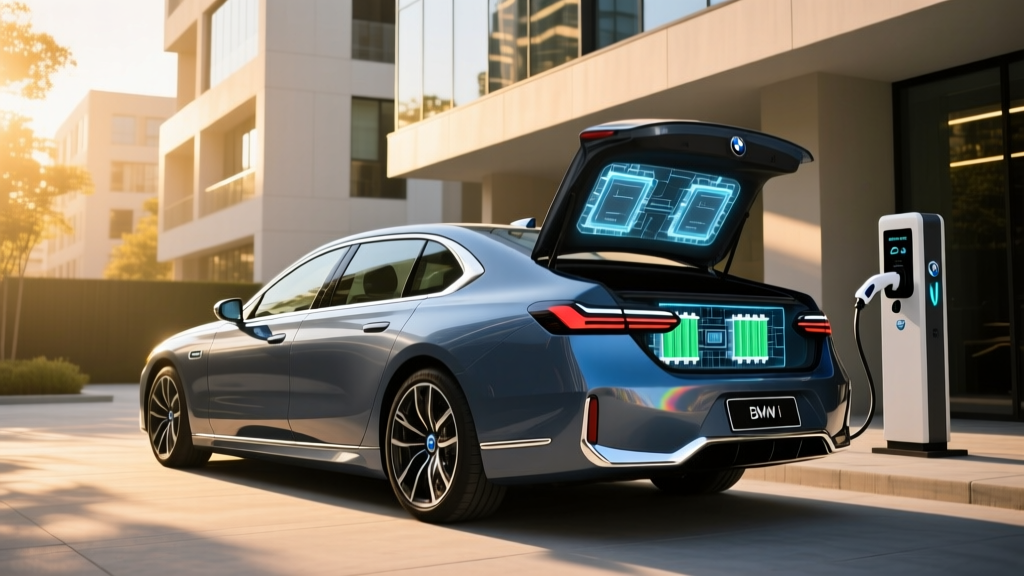
The BMW i7 arrived as the brand's flagship electric sedan, promising 7 Series luxury with a fully electrified powertrain. For 2024, the i7 xDrive60 pairs a 101.7 kWh battery with dual-motor all-wheel drive, aiming to prove that large luxury sedans can transition to battery power without compromise. But with an MSRP well above the federal tax credit cap and real-world range that falls short of its EPA sticker under highway and cold-weather conditions, the i7 demands a closer look before you sign the lease or purchase agreement.
We've examined the 2024 BMW i7 across every metric that matters to EV buyers — from sustained DC fast-charging curves to back-seat dimensions and total cost of ownership. Here's what the numbers actually say.
2024 BMW i7 Core Specifications at a Glance
| Specification | Value |
|---|---|
| EPA Estimated Range | 318 miles (19" wheels) / 296 miles (21" wheels) |
| Battery Capacity (Usable) | 101.7 kWh (gross ~105.7 kWh) |
| Battery Chemistry | NMC (Nickel Manganese Cobalt) |
| Drivetrain | Dual-motor AWD (xDrive) |
| Horsepower | 536 hp |
| 0–60 mph | 4.5 seconds (BMW est.) |
| Max DC Fast Charge Rate | 195 kW (peak) |
| 10–80% DC Fast Charge Time | ~34 minutes (BMW est.) |
| Level 2 Home Charge Rate | 11 kW (AC onboard charger) |
| EPA Efficiency (Combined) | 82 MPGe / 41 kWh/100 mi |
| Cargo Volume (Trunk) | 17.7 cu ft |
| Rear Legroom | 43.2 inches |
| Base MSRP (xDrive60) | $119,300 (incl. destination) |
| As-Tested Price (M70) | $168,000+ |
| Battery/Powertrain Warranty | 8 years / 100,000 miles |
| Federal Tax Credit (§30D) | Not eligible (exceeds MSRP cap) |
Range and Real-World Efficiency: What the EPA Sticker Doesn't Tell You
EPA Estimated: 318 miles (19" wheels)
Real-World Highway (70–80 mph): Expect ~250–275 miles
Real-World Cold Weather (below 32°F): Expect ~220–250 miles
Best-Case City/Commute: ~300–310 miles
Large luxury sedans with heavy curb weights and wide tires lose efficiency more aggressively at highway speeds than lighter EVs. The i7's 5,975-lb curb weight and 41 kWh/100 mi combined rating reflect this physics reality.
The 2024 BMW i7 xDrive60 carries an EPA range rating of 318 miles when equipped with the standard 19-inch wheel and tire package. Opt for the available 21-inch wheels, and that figure drops to 296 miles — a meaningful 22-mile reduction driven by increased rolling resistance and aerodynamic drag from the wider rubber.
Under the hood of that EPA number sits a 101.7 kWh usable battery (approximately 105.7 kWh gross) using NMC (nickel manganese cobalt) cell chemistry. BMW provides a top and bottom buffer to protect long-term battery health, which is standard practice but means you'll never access the full gross capacity.
In real-world driving, the i7's efficiency story splits depending on conditions. On a 70–80 mph highway run in moderate temperatures (60–75°F), expect to see roughly 250 to 275 miles of practical range before needing to charge. The combination of the i7's substantial mass, frontal area, and AWD drivetrain losses means highway efficiency suffers more than in lighter EVs like the BMW i4 or Tesla Model S.
Cold weather compounds the issue. At temperatures below freezing, lithium-ion batteries experience increased internal resistance, and cabin heating demands significant energy (the i7 uses a heat pump, which helps, but doesn't eliminate the loss). Plan for 220 to 250 miles of range in winter conditions — a roughly 20–30% reduction from the EPA combined figure. This is consistent with industry-wide cold-weather EV behavior documented by fueleconomy.gov and independent testing organizations.
The i7's combined efficiency rating of 82 MPGe (41 kWh per 100 miles) places it in the mid-pack among large luxury EVs. For comparison, the Mercedes-Benz EQS 450+ achieves 97 MPGe combined thanks to its RWD configuration and lower curb weight, while the Porsche Taycan Turbo S rates at 68 MPGe. If efficiency-per-mile is a priority, the i7 is not the segment leader.
Charging Speed: DC Fast Charging and Home Level 2 Reality
| Charging Level | Power | Connector | Speed / Time |
|---|---|---|---|
| Level 1 (120V Household) | ~1.4 kW | J1772 (with adapter) | ~3–4 miles per hour |
| Level 2 (240V Home/Public) | Up to 11 kW | J1772 (CCS1 combo) | ~25–30 miles per hour; 0–100% in ~11 hours |
| DC Fast Charging | Up to 195 kW (peak) | CCS1 | 10–80% in ~34 minutes |
The i7's DC fast-charging capability peaks at 195 kW on a CCS1 connector. BMW estimates a 10–80% charge in approximately 34 minutes under ideal conditions — meaning a battery preconditioned to optimal temperature and connected to a charger capable of sustaining that power level.
Here's where real-world charging-curve knowledge matters: the 195 kW figure is a peak, not a sustained rate. Like all modern EVs, the i7's battery management system tapers charge speed as the battery fills to protect cell health. You'll see the highest charge rates between roughly 10–40% state of charge, with a significant taper beginning around 60–70% and a steep drop above 80%. This is why manufacturers quote 10–80% times rather than 0–100% — charging from 80% to full on DC fast charging can take as long as the 10–80% portion.
Compared to competitors, the i7's 195 kW peak is competitive but not class-leading. The Porsche Taycan can accept up to 270 kW (with 800V architecture), and the Lucid Air peaks at around 250 kW. However, 195 kW is sufficient for practical road-trip charging — adding roughly 150–180 miles of range in a 20-minute stop.
For home charging, the i7's onboard AC charger handles up to 11 kW on a Level 2 (240V) connection. This translates to approximately 25–30 miles of range per hour of charging, or a full 0–100% charge in about 11 hours. A 48-amp or 60-amp dedicated Level 2 home charger (hardwired, NEMA 14-50 or direct-wired) is the practical setup for daily ownership. Installation costs for a home Level 2 charger typically range from $800 to $2,500 depending on your electrical panel capacity and the run distance from panel to garage — factor this into your purchase budget.
The i7 uses the CCS1 connector standard. As of 2024, BMW has not adopted the Tesla NACS connector for the i7, though the broader industry is shifting toward NACS. CCS1 compatibility means access to Electrify America, EVgo, ChargePoint DC fast chargers, and other CCS networks. A CCS-to-NACS adapter (expected from BMW) will eventually open Tesla Supercharger access, but confirm availability for your model year before relying on it.
Performance and Driving Dynamics
The 2024 i7 xDrive60 produces 536 horsepower and 549 lb-ft of torque from its dual-motor all-wheel-drive powertrain. BMW estimates a 0–60 mph time of 4.5 seconds — brisk for a 5,975-pound sedan, though not supercar territory. The instant torque delivery characteristic of electric motors makes the i7 feel quicker in around-town driving than the 0–60 number alone suggests.
The higher-performance i7 M70 variant (a separate trim that shares the platform) bumps output to 650 hp and drops the 0–60 time to an estimated 3.5 seconds, at a significant price premium starting around $168,000. For most buyers, the xDrive60's 4.5-second sprint is more than adequate for highway merging and confident passing.
Ride quality is where the i7 justifies its flagship positioning. Standard adaptive air suspension with automatic self-leveling, rear-wheel steering (Integral Active Steering), and available Executive Drive Pro with active roll stabilization deliver the isolated, wafting ride quality expected in this segment. The i7's weight, while an efficiency penalty, contributes to a planted, substantial highway feel that lighter EVs can't replicate.
Interior Space, Technology, and Standout Features
The i7's cabin seats five, with the rear seat offering 43.2 inches of legroom — limousine-grade space that matches or exceeds the gas-powered 7 Series. The trunk provides 17.7 cubic feet of cargo volume. Notably, there is no front trunk (frunk); the space under the hood is occupied by power electronics and the HVAC system. This is a missed opportunity for additional storage that competitors like the Lucid Air and Tesla Model S provide.
The centerpiece of the i7's interior technology is BMW's iDrive 8.5 infotainment system, displayed across a curved panel that combines a 12.3-inch digital instrument cluster and a 14.9-inch central touchscreen. The system supports wireless Apple CarPlay and Android Auto, 5G connectivity, and BMW's Intelligent Personal Assistant voice control.
The available Theater Screen — a 31.3-inch 8K display that deploys from the headliner for rear-seat passengers — is the i7's most dramatic tech feature. Paired with the available Bowers & Wilkins Diamond surround sound system (36 speakers, 1,965 watts), it transforms the rear seat into a mobile cinema. This is a genuine differentiator in the luxury EV sedan segment.
On the driver-assistance front, the i7 comes standard with BMW Driving Assistant Professional, which includes adaptive cruise control with stop-and-go, lane-keeping assist, and automatic lane-change capability. This is a SAE Level 2 system — the driver must remain attentive, keep hands on or near the wheel, and is fully responsible for vehicle operation at all times. It is not autonomous driving. The system is competent for highway cruising but requires active supervision.
Additional technology highlights include:
- Automatic parking assistant with remote control via smartphone
- Head-up display with augmented reality navigation overlay
- Over-the-air (OTA) software updates for vehicle systems
- Available automatic doors with proximity sensors
- Highway Assistant (hands-off driving up to 85 mph on approved highways — still Level 2, eyes-on required)
Pricing, Trims, and Federal Tax Credit Eligibility
The 2024 BMW i7 is offered in two primary configurations:
| Trim | Base MSRP (incl. destination) | Federal Tax Credit (§30D) | Effective Price After Credit |
|---|---|---|---|
| i7 xDrive60 | $119,300 | $0 (exceeds MSRP cap) | $119,300 |
| i7 M70 | $168,000+ | $0 (exceeds MSRP cap) | $168,000+ |
This is a critical point for buyers evaluating the i7's value proposition: the 2024 BMW i7 does not qualify for the $7,500 federal EV tax credit under IRS §30D. The reason is straightforward — the federal credit imposes an MSRP cap of $55,000 for sedans (and $80,000 for SUVs, vans, and trucks). At $119,300 base, the i7 xDrive60 exceeds the sedan cap by more than double. This is confirmed by current IRS guidance on clean vehicle credits.
Additionally, even if the MSRP cap were not a barrier, the §30D credit imposes buyer income limits ($150,000 single / $300,000 joint filers modified AGI) and battery component/critical mineral sourcing requirements that further restrict eligibility. The i7's battery sourcing may not satisfy current critical-mineral thresholds, though this is a secondary concern given the MSRP disqualification.
Some buyers may be eligible for state-level EV incentives depending on their jurisdiction — check your state's energy or DMV website for current programs. These vary widely and are outside the scope of federal §30D rules.
Well-optioned xDrive60 models with packages like the Executive Package, M Sport Package, and premium audio typically land in the $130,000–$145,000 range before any incentives. The M70 variant, with its 650-hp powertrain and exclusive M-specific features, starts at $168,000 and can exceed $180,000 with options.
Battery Warranty, Longevity, and Degradation
BMW covers the i7's high-voltage battery and electric powertrain with an 8-year / 100,000-mile warranty (whichever comes first). This warranty guarantees that the battery will retain at least 70% of its original capacity during the coverage period. If degradation falls below this threshold under normal use, BMW will repair or replace the battery at no cost to the owner.
The i7's NMC chemistry offers higher energy density than LFP (lithium iron phosphate) alternatives, which is why BMW selected it for a vehicle requiring 300+ miles of range in a large sedan package. However, NMC cells historically experience slightly faster capacity loss over thousands of charge cycles compared to LFP. BMW's generous buffer (approximately 4 kWh reserved above and below the usable range) helps mitigate this by preventing the cells from experiencing the extreme states of charge that accelerate degradation.
For long-term ownership, best practices include:
- Limiting daily charges to 80–90% state of charge and avoiding frequent 100% charges
- Using DC fast charging sparingly (it's fine for road trips, but daily Level 2 home charging is gentler on the cells)
- Avoiding prolonged storage at very low or very high states of charge
- Preconditioning the battery before fast charging in cold weather (the i7 supports this via navigation-routed preconditioning)
Out-of-warranty battery replacement for a 101.7 kWh NMC pack is a significant expense — industry estimates for packs of this capacity range from $15,000 to $25,000+ depending on labor and parts availability. This is a long-tail risk worth considering for buyers planning to own the i7 beyond the 8-year warranty window.
Pros, Cons, and Who the BMW i7 Is For
- Class-leading rear-seat luxury with available 31.3" Theater Screen
- Smooth, quiet ride quality with air suspension and rear-wheel steering
- Strong 318-mile EPA range (19" wheels) for a large luxury sedan
- 536 hp provides confident acceleration for the vehicle's size
- Competent Level 2 driver assistance with Highway Assistant
- 11 kW Level 2 AC charging enables overnight home replenishment
- No federal tax credit eligibility (exceeds $55K sedan MSRP cap)
- Highway and cold-weather range drops significantly below EPA sticker
- No front trunk (frunk) — wasted packaging opportunity
- 195 kW DC peak charge rate trails Porsche Taycan (270 kW) and Lucid Air
- Heavy curb weight (5,975 lbs) hurts efficiency vs. lighter competitors
- Starting price above $119K; well-optioned examples exceed $140K
Best for: Luxury sedan buyers who want a fully electric flagship with limousine-grade rear-seat comfort, cutting-edge infotainment (Theater Screen), and a brand badge with established dealer/service infrastructure. Ideal as a daily commuter and chauffeured executive vehicle with road-trip capability.
Not ideal for: Buyers prioritizing maximum range efficiency, the fastest DC charging speeds, or federal tax credit savings. If you need a frunk, want sub-$80K pricing, or regularly drive in extreme cold with long highway stretches between chargers, consider the Mercedes EQS, Lucid Air, or BMW i5 instead.
How the BMW i7 Stacks Up Against Key Competitors
The i7 competes in a small but growing segment of full-size luxury electric sedans. Here's how it compares on the metrics that matter:
| Metric | BMW i7 xDrive60 | Mercedes EQS 450+ | Lucid Air Pure | Tesla Model S |
|---|---|---|---|---|
| EPA Range | 318 mi | 352 mi | 419 mi | 405 mi |
| Battery (kWh usable) | 101.7 | 107.8 | 88 | ~95 |
| Horsepower | 536 | 355 | 430 | 670 |
| 0–60 mph | 4.5 sec | 5.9 sec | 5.0 sec | 3.1 sec |
| Peak DC Charge kW | 195 kW | 200 kW | ~220 kW | 250 kW |
| Base MSRP | $119,300 | $104,400 | $69,900 | $74,990 |
| Federal Tax Credit | No (MSRP cap) | No (MSRP cap) | No (MSRP cap) | No (MSRP cap) |
The i7 trades range and charging-speed leadership for interior luxury, ride refinement, and BMW's brand cachet. The Lucid Air Pure offers dramatically more range at a significantly lower price. The Tesla Model S is faster and charges quicker on its Supercharger network. The Mercedes EQS delivers more range with a similarly opulent cabin. The i7's case rests on its specific blend of BMW driving dynamics, the Theater Screen, and rear-seat prestige — factors that matter deeply to its target buyer.
Frequently Asked Questions
What is the real-world range of the 2024 BMW i7?
The EPA rates the i7 xDrive60 at 318 miles (19" wheels). In real-world highway driving at 70–80 mph, expect approximately 250–275 miles. In cold weather below freezing, plan for 220–250 miles. City and commute driving in moderate temperatures can approach the EPA figure at around 300–310 miles.
How fast does the BMW i7 charge at home and on DC fast chargers?
On a DC fast charger, the i7 peaks at 195 kW and charges from 10–80% in approximately 34 minutes under ideal conditions. At home on a Level 2 (240V, 11 kW) charger, expect roughly 25–30 miles of range per hour, or a full charge in about 11 hours. Level 1 (120V) trickle charging adds only 3–4 miles per hour and is impractical for daily use on a battery this large.
Does the 2024 BMW i7 qualify for the federal EV tax credit?
No. Under IRS §30D rules, the federal clean vehicle credit imposes an MSRP cap of $55,000 for sedans. The i7 xDrive60 starts at $119,300, disqualifying it entirely. Buyer income limits and battery sourcing requirements are additional barriers, though the MSRP cap alone is decisive. Check the IRS clean vehicle credit page for the latest eligibility rules.
How much does the BMW i7 cost after incentives?
With no federal tax credit available, the i7 xDrive60's effective starting price is its $119,300 MSRP. State-level incentives may apply depending on your location — check local programs. Well-optioned xDrive60 models typically range from $130,000 to $145,000. The i7 M70 starts at $168,000 and can exceed $180,000 with options.
Is the BMW i7 worth buying vs. the Mercedes EQS or Lucid Air?
The i7 is worth considering if rear-seat luxury, the Theater Screen, and BMW's driving dynamics are your top priorities. If maximum range is paramount, the Lucid Air Pure (419 mi EPA, ~$69,900) is the clear leader. The Mercedes EQS 450+ offers more range (352 mi) with comparable luxury. The i7 wins on specific interior features and brand identity, but trails on range efficiency, charging speed, and value.
What are the biggest drawbacks of the BMW i7?
The most significant cons are: no federal tax credit eligibility due to MSRP caps, real-world highway and cold-weather range falling well below the 318-mile EPA sticker, no front trunk (frunk), a 195 kW peak charge rate that trails the Porsche Taycan and Lucid Air, and a starting price above $119,000. The heavy 5,975-lb curb weight also limits efficiency compared to lighter EVs.
What is the battery warranty on the BMW i7?
BMW covers the i7's high-voltage battery and electric powertrain for 8 years or 100,000 miles (whichever comes first), guaranteeing at least 70% capacity retention during that period. Out-of-warranty battery replacement for the 101.7 kWh NMC pack is estimated at $15,000 to $25,000+.
Sources: fueleconomy.gov — 2024 BMW i7, BMW USA i7 Specifications, IRS §30D Clean Vehicle Credit Rules.