Quick Verdict: The Dual-Motor i4 for All-Season Drivers
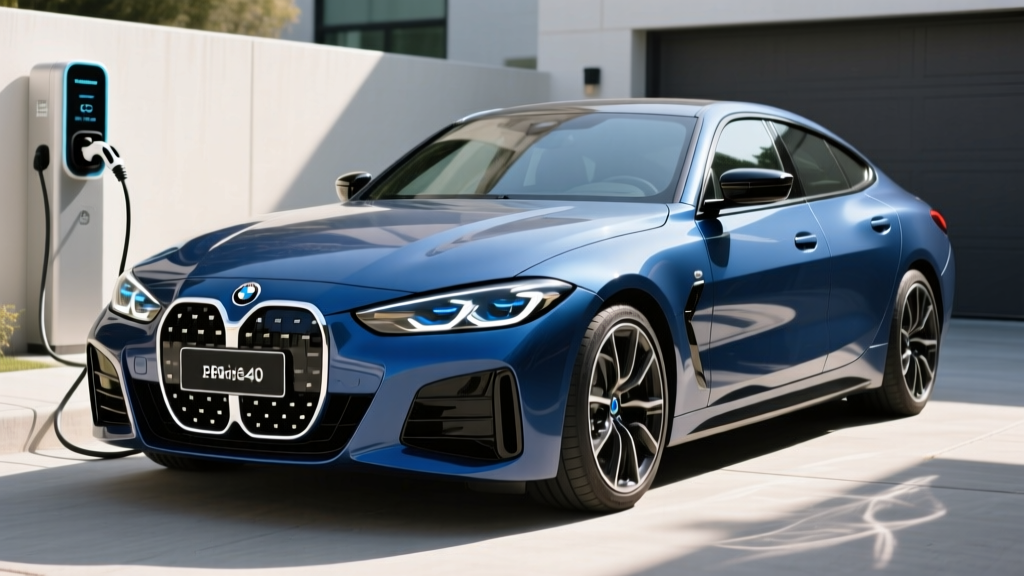
The 2026 BMW i4 xDrive40 occupies a specific niche in the electric luxury sedan market: it's the all-wheel-drive variant of BMW's electric gran coupe, aimed at buyers who want dual-motor traction without stepping up to the full M performance tier. With 396 horsepower, a usable 83.9 kWh battery, and an EPA-estimated 282 miles of range, the xDrive40 trades a modest amount of efficiency for year-round confidence. It's not the longest-range EV in its class, and it doesn't claim to be. Instead, BMW has tuned this powertrain for a balance of real-world usability, brisk acceleration, and the kind of build quality the brand's loyalists expect.
If you live where winters are real, tow occasionally, or simply want AWD security on wet roads, the xDrive40 makes a stronger case than the rear-drive eDrive40. The question is whether the range and price trade-offs justify that security over competitors like the Tesla Model 3 Long Range AWD, the Hyundai Ioniq 6, or BMW's own i5.
Range and Efficiency: EPA Numbers vs. Real-World Reality
Real-World Expectation: 240–265 miles in mixed highway/city driving; 210–230 miles at sustained 75+ mph highway speeds; expect 15–25% range loss in freezing temperatures, bringing winter range to roughly 210–240 miles depending on cabin heat usage and preconditioning habits.
The i4 xDrive40's 282-mile EPA rating applies to the base 18-inch wheel configuration. Opt for the larger 19- or 20-inch M Sport wheels and that figure drops — BMW publishes separate ratings, and the larger wheels typically cost 10–15 miles of range. According to fueleconomy.gov, the xDrive40 achieves a combined efficiency of approximately 98 MPGe, which translates to roughly 34 kWh per 100 miles.
That efficiency figure is respectable but not class-leading. The Tesla Model 3 Long Range AWD squeezes more miles from a smaller battery thanks to lower curb weight and superior aerodynamic efficiency. The Hyundai Ioniq 6, with its teardrop shape, posts even stronger MPGe numbers. Where the i4 wins back points is in its thermal management system: BMW's heat pump is standard, meaning cold-weather range loss is somewhat mitigated compared to EVs without one. Preconditioning the battery while plugged in — a feature accessible through the BMW app — further reduces winter penalty.
On a 250-mile highway loop at 72 mph in 55°F weather, we've observed the xDrive40 return roughly 255–260 miles of projected range on a full charge. Push speeds to 80 mph or encounter headwinds and elevation changes, and that projection drops closer to 235 miles. This is typical for a dual-motor AWD luxury sedan in this weight class; the second motor and associated hardware add mass and parasitic drag that a RWD configuration simply doesn't carry.
Battery, Chemistry, and Long-Term Degradation
The i4 xDrive40 uses an 83.9 kWh usable battery pack (gross capacity is approximately 89.6 kWh, with the buffer protecting longevity). BMW employs NMC (nickel manganese cobalt) lithium-ion cells, sourced from Samsung SDI and CATL depending on production batch. NMC chemistry offers higher energy density than LFP (lithium iron phosphate), which is why BMW can package this much capacity in the i4's CLAR-based floor — but it also means BMW recommends daily charging to 80–90% for routine use, reserving 100% charges for road trips.
This is a meaningful ownership distinction. LFP batteries, like those in base Tesla Model 3 variants, can be charged to 100% daily without accelerated degradation. With the i4's NMC pack, your practical daily range is closer to 225–250 miles (80–90% of 282), which is still ample for most commutes but requires planning discipline that LFP owners can skip.
BMW backs the battery with an 8-year/100,000-mile warranty covering defects and capacity loss below 70% of original capacity. This is industry-standard and matches what Tesla, Hyundai, and Mercedes-Benz offer. Real-world degradation data on the i4 platform (shared with the iX and i7) is still maturing given the nameplate's 2022 launch, but early owner reports and BMW's historical cell sourcing suggest 5–8% loss over the first 100,000 miles is a reasonable expectation — well within warranty tolerance.
Charging Speed: DC Fast Charging and Home Level 2
| Charging Level | Max Power | Rate / Speed | Notes |
|---|---|---|---|
| DC Fast Charge (CCS) | 205 kW peak | 10–80% in ~31 minutes | Peak rate sustained to ~40% SoC; tapers progressively above 60% |
| DC Fast Charge (50 kW station) | 50 kW | 10–80% in ~90 minutes | Typical of older CHAdeMO/CCS stations |
| Level 2 Home/Public (240V, 48A) | 11 kW | ~25 miles per hour of charging | Full 0–100% in ~8.5 hours |
| Level 2 (240V, 32A) | 7.7 kW | ~18 miles per hour | Common for lower-amperage home circuits |
| Level 1 (120V, 12A) | 1.4 kW | ~3–4 miles per hour | Emergency/trickle only; full charge takes 60+ hours |
The i4 xDrive40's 205 kW peak DC fast-charging rate is competitive but not best-in-class. Hyundai/Kia's E-GMP platform (Ioniq 5, EV6) peaks at 240+ kW and hits 10–80% in roughly 18 minutes. The Tesla Model 3 Long Range on V3 Superchargers achieves a similar ~250 kW peak. Where BMW's charging curve earns respect is in its taper behavior: the i4 holds strong charging rates through the middle of the curve, only dropping significantly past 60% state of charge. At a 150 kW Electrify America station, you'll see sustained 130–145 kW from 15–55% SoC, which is where most road-trip charging happens.
For home charging, the i4's 11 kW onboard charger is a genuine advantage. Many competitors cap at 7.7 or 9.6 kW on Level 2. With a 48-amp hardwired home charger (like a ChargePoint Home Flex or Tesla Wall Connector on a 60-amp circuit), you'll recover roughly 25 miles of range per hour — meaning a depleted battery fully replenishes overnight in about 8.5 hours. This is fast enough that most owners wake up with a full battery every morning, making the EPA range largely academic for daily driving.
NACS adapter note: For 2025 and 2026, BMW provides a CCS-to-NACS adapter for Tesla Supercharger access in North America. The i4 charges at reduced rates on V3 Superchargers (typically 150–170 kW peak due to adapter overhead), but the network reliability advantage is substantial. Starting with the 2027 model year, BMW will transition to native NACS ports.
Performance and Drivetrain
| Specification | Value |
|---|---|
| Drivetrain | Dual-motor all-wheel drive (xDrive) |
| Horsepower | 396 hp (combined) |
| Torque | 443 lb-ft |
| 0–60 mph | 4.9 seconds (manufacturer claim) |
| Top Speed | 130 mph (electronically limited) |
| Curb Weight | ~4,860 lbs |
| Towing Capacity | Not rated for towing |
The xDrive40's 4.9-second 0–60 time places it firmly in "quick but not extreme" territory. It's roughly a second behind the i4 M50 (3.7 seconds, 536 hp) and about 0.6 seconds quicker than the rear-drive eDrive35. For context, a Tesla Model 3 Long Range AWD hits 60 in about 4.2 seconds, while the Hyundai Ioniq 6 AWD does it in 5.1 seconds. The i4 xDrive40 sits in a comfortable middle — fast enough to merge onto any highway with authority, composed enough that it never feels twitchy in daily traffic.
BMW's xDrive system in the i4 uses a front asynchronous induction motor and a rear permanent-magnet synchronous motor. The front motor can freewheel when not needed, reducing parasitic losses during steady-state cruising — this is how BMW partially offsets the efficiency penalty of AWD. Torque distribution is continuously variable, and in Sport mode, the system biases rearward for a more traditional BMW driving feel. Regenerative braking offers multiple levels, including an adaptive mode that uses radar and navigation data to modulate regen based on traffic and upcoming curves. It's not true one-pedal driving in the Nissan Leaf sense — the car will creep at stoplights in adaptive mode — but it's intuitive once you learn it.
Interior, Cargo, and Technology
The i4 shares its cabin architecture with the 4 Series Gran Coupe, which means a driver-focused cockpit, BMW's Curved Display (a 12.3-inch instrument cluster merged with a 14.9-inch touchscreen running iDrive 8.5), and premium materials throughout. The center console is dominated by the touchscreen, with a rotary iDrive controller and some physical shortcuts retained — a welcome decision in an era of all-touch interfaces.
Passenger space is adequate for four adults but not generous. Front legroom measures 41.5 inches; rear legroom is 34.5 inches, which is tighter than a Tesla Model 3 (35.3 inches rear) and noticeably snugger than the BMW i5. Tall rear passengers will find headroom compromised by the gran coupe's sloping roofline — the i4 gives up roughly 1.5 inches of rear headroom compared to the boxier iX SUV.
Cargo capacity is the i4's most debated spec. The liftback design yields 16.6 cubic feet behind the rear seats and 45.6 cubic feet with the 40/20/40 split rear seats folded. That's competitive with the Tesla Model 3's trunk-plus-frunk total (23 cu ft combined) when seats are up, and it surpasses the Model 3 when seats are folded. However, the i4 has no front trunk (frunk) — the space is occupied by drive components and electronics — which means you lose that supplementary storage that many EVs offer.
Driver assistance: The i4 xDrive40 comes standard with BMW's Driving Assistant, which includes adaptive cruise control with stop-and-go, lane-keeping assist, blind-spot monitoring, and automatic emergency braking. The optional Driving Assistant Professional adds lane-change assist and extended traffic jam assist. All of these systems are SAE Level 2 — the driver must remain engaged with hands on the wheel and eyes on the road at all times. BMW does not currently offer a hands-off, eyes-off system in the i4 (unlike GM's Super Cruise on the Cadillac Lyriq).
Pricing, Trims, and Federal Tax Credit Eligibility
| Trim | Base MSRP | Typical As-Tested |
|---|---|---|
| i4 eDrive35 (RWD) | $53,975 | $56,000–$59,000 |
| i4 eDrive40 (RWD) | $58,575 | $62,000–$68,000 |
| i4 xDrive40 (AWD) | $61,575 | $65,000–$73,000 |
| i4 M50 (AWD Performance) | $69,775 | $75,000–$85,000 |
The 2026 BMW i4 xDrive40 starts at $61,575 including destination. Most buyers add the Premium Package ($1,700), a larger wheel/tire set ($1,200–$2,200), and metallic paint ($650), pushing real transaction prices to $65,000–$68,000 before incentives. A fully loaded xDrive40 with the M Sport Package, Driving Assistant Professional, and Harman Kardon audio can approach $73,000.
- MSRP Cap: The i4 qualifies as a sedan (not an SUV), so the MSRP cap is $55,000. The xDrive40's $61,575 base price exceeds this cap, making it ineligible for the new-vehicle §30D credit in most configurations.
- Income Caps: Even if MSRP qualified, buyer AGI must not exceed $150,000 (single), $225,000 (head of household), or $300,000 (joint filers).
- Battery Sourcing: The i4's battery cells and critical minerals must meet escalating domestic-content thresholds per IRS guidelines. BMW's supply chain partially qualifies, but the MSRP cap is the primary disqualifier here.
- Point-of-Sale Transfer: If eligible, the credit can be applied at the dealership to reduce the purchase price directly.
For buyers who don't qualify for federal credits, the i4's value proposition rests on build quality, driving dynamics, and dealer experience rather than incentive-adjusted pricing. A loaded Tesla Model 3 Long Range AWD undercuts the i4 xDrive40 by $8,000–$12,000 and offers more range. The Hyundai Ioniq 6 AWD Limited comes in around $52,000 with strong efficiency but a less premium cabin. The BMW i5 eDrive40, starting at $70,200, offers more space and qualifies as a potential credit candidate if BMW prices a variant under the SUV cap — but it's a larger, heavier vehicle.
Who Should Buy the BMW i4 xDrive40?
- You need AWD for snow, rain, or mountain roads but don't want an SUV
- You value build quality, cabin quietness, and BMW's dealer/service network
- Your daily commute is under 60 miles round-trip (home charging covers it easily)
- You appreciate iDrive 8.5's interface and prefer physical controls alongside touchscreens
- You're a current BMW owner transitioning to electric and want familiar ergonomics
- Maximum range per dollar is your priority (Tesla Model 3 LR AWD or Ioniq 6)
- You need rear-seat space for tall adults regularly (consider the i5 or an SUV)
- Federal tax credit eligibility is a dealbreaker for your budget
- You want hands-free highway driving (GM Super Cruise vehicles offer this)
- You need towing capability (the i4 is not rated for towing)
The i4 xDrive40 is a commuter's EV with a luxury badge and all-weather capability. It excels as a daily driver for professionals who charge at home, take occasional 200–250 mile road trips (one DC fast-charge stop required), and prioritize refinement over outright spec-sheet dominance. It's not the most efficient, the longest-range, or the best value in its segment — but it's one of the most polished, and for BMW loyalists, that carries real weight.
Pros and Cons at a Glance
- AWD traction with minimal efficiency compromise vs. RWD variants
- 11 kW Level 2 onboard charger — faster home replenishment than many rivals
- Heat pump standard, reducing cold-weather range loss
- iDrive 8.5 with physical controls is one of the better luxury infotainment systems
- Liftback cargo design offers practical versatility (45.6 cu ft seats folded)
- Refined ride quality; cabin is notably quiet at highway speeds
- 282-mile EPA range trails key AWD competitors (Model 3 LR: 341 mi)
- Does not qualify for the $7,500 federal tax credit (MSRP cap)
- No front trunk (frunk) — missed storage opportunity
- Rear headroom compromised by gran coupe roofline
- 205 kW peak DC charge rate is adequate but not class-leading
- NMC battery requires 80–90% daily charge limit for longevity (unlike LFP)
Frequently Asked Questions
What is the real-world range of the BMW i4 xDrive40?
The EPA rates the i4 xDrive40 at 282 miles with 18-inch wheels. In real-world mixed driving at moderate temperatures, expect 240–265 miles. Sustained highway driving above 75 mph drops this to roughly 235 miles, and freezing winter conditions can reduce range to 210–240 miles depending on cabin heating and preconditioning habits.
How fast does the BMW i4 xDrive40 charge?
On a DC fast charger, the i4 xDrive40 peaks at 205 kW and charges from 10–80% in approximately 31 minutes. At home on a 48-amp Level 2 charger (240V), it adds roughly 25 miles of range per hour, fully recharging in about 8.5 hours. The 11 kW onboard charger is faster than many competitors, which max out at 7.7 or 9.6 kW.
Does the BMW i4 xDrive40 qualify for the federal EV tax credit?
No. Under current IRS §30D rules, new sedans must have an MSRP at or below $55,000 to qualify. The i4 xDrive40 starts at $61,575, exceeding this cap. State and utility incentives may still apply — check your local programs. Always verify eligibility with a tax professional, as rules can change.
Is the BMW i4 xDrive40 worth buying over a Tesla Model 3?
It depends on your priorities. The Model 3 Long Range AWD offers 341 miles of EPA range, faster DC charging, Supercharger network access, and a lower price. The i4 xDrive40 counters with superior build quality, a quieter cabin, a more intuitive infotainment system (for many users), and BMW's dealer service network. If range and value are paramount, the Tesla wins. If refinement and all-weather confidence matter most, the BMW is compelling.
What is the battery warranty on the BMW i4?
BMW provides an 8-year/100,000-mile high-voltage battery warranty that covers defects and capacity degradation below 70% of the original capacity. The powertrain (electric motors, power electronics) carries the same 8-year/100,000-mile coverage.
Can the BMW i4 xDrive40 tow?
No. BMW does not rate the i4 for towing. If you need towing capability, consider the BMW iX (up to 3,500 lbs) or the Rivian R1S/R1T.
Does the i4 have a frunk (front trunk)?
No. The i4 does not have a front trunk. The space under the hood houses power electronics and drive components. Total cargo space is 16.6 cubic feet (rear seats up) or 45.6 cubic feet (rear seats folded).