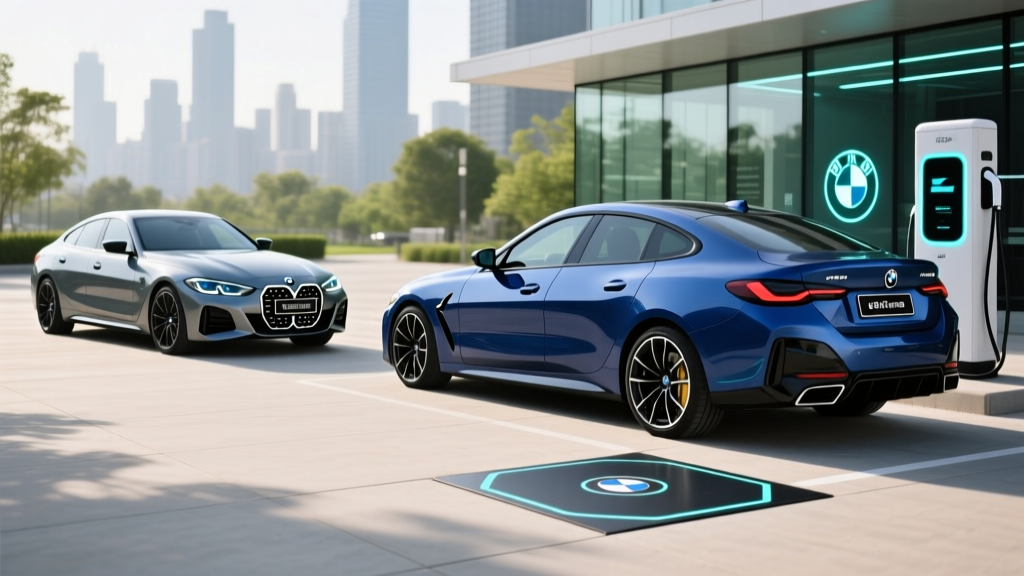
The BMW i4 remains one of the most compelling electric luxury sedans on the market, blending BMW's signature driving dynamics with a practical liftback body and a mature EV powertrain. But with three distinct trims — the single-motor eDrive40, the all-wheel-drive xDrive40, and the performance-focused M50 — choosing the right one requires understanding exactly what each delivers in range, charging speed, performance, and price.
This guide breaks down every 2026 BMW i4 trim with the exact numbers that matter: EPA range, battery capacity and chemistry, DC fast-charging curves, real-world efficiency, cargo dimensions, and IRS §30D tax credit eligibility. Whether you're cross-shopping the Tesla Model 3, Hyundai Ioniq 6, or Mercedes EQB, you'll have the data to decide which i4 fits your driving life.
2026 BMW i4 Trim Lineup at a Glance
BMW offers the i4 in three configurations for 2026, all built on the same CLAR-derived platform with a fifth-generation BMW eDrive powertrain. Here's the spec snapshot before we go deeper:
| Spec | eDrive40 | xDrive40 | M50 |
|---|---|---|---|
| Drivetrain | RWD (single motor) | AWD (dual motor) | AWD (dual motor) |
| Horsepower | 335 hp | 396 hp | 536 hp |
| 0–60 mph | 5.5 sec | 4.6 sec | 3.7 sec |
| Battery (gross / usable) | 83.9 kWh / ~81.5 kWh | 83.9 kWh / ~81.5 kWh | 83.9 kWh / ~81.5 kWh |
| Battery Chemistry | NMC (Nickel Manganese Cobalt) | NMC | NMC |
| EPA Range | 307 mi | 287 mi | 269 mi |
| Efficiency (MPGe) | 109 MPGe combined | 102 MPGe combined | 97 MPGe combined |
| Max DC Fast Charge | 205 kW | 205 kW | 205 kW |
| 10–80% DC Time | ~31 min | ~31 min | ~31 min |
| Level 2 Charge Rate | 11 kW (~37 mi/hr) | 11 kW (~37 mi/hr) | 11 kW (~37 mi/hr) |
| Base MSRP | $59,095 | $62,595 | $69,695 |
Range and Efficiency: EPA Stickers vs. Real-World Miles
EPA sticker: 307 miles. In real-world mixed driving, expect 260–280 miles on the highway at 70–75 mph. In cold weather (below 32°F / 0°C), plan for 220–245 miles — a 20–25% reduction typical of NMC chemistry without aggressive preconditioning. The xDrive40 and M50, with their lower EPA ratings (287 and 269 mi respectively), will see proportionally similar reductions.
All three i4 trims share the same 83.9 kWh gross battery pack (approximately 81.5 kWh usable), using BMW's fifth-generation NMC cells. The range difference between trims comes down to weight, drivetrain losses, and wheel/tire options. The eDrive40's single rear motor and lighter curb weight give it the efficiency edge at roughly 27 kWh/100 mi (combined), while the M50's dual motors and stickier performance rubber push consumption closer to 35 kWh/100 mi when driven hard.
According to EPA data on fueleconomy.gov, the eDrive40 achieves 109 MPGe combined — competitive with the Hyundai Ioniq 6's long-range variant but trailing the Tesla Model 3 Long Range AWD's 134 MPGe. If efficiency is your priority, the eDrive40 is the clear pick within the i4 lineup.
Wheel Size Matters More Than You Think
BMW's EPA range figures assume the standard 18-inch wheels. Opting for the available 19- or 20-inch M Sport wheels can reduce range by 10–20 miles depending on tire compound. On the M50, which comes standard with 19-inch wheels, choosing the optional 20-inch setup drops the EPA rating from 269 to approximately 245 miles. This is a meaningful difference for road-trippers.
Charging Speed: DC Fast, Level 2, and the Curve Reality
| Charging Level | Power / Rate | Miles Added per Hour | Notes |
|---|---|---|---|
| Level 1 (120V outlet) | ~1.4 kW | ~4–5 mi/hr | Emergency/trickle only |
| Level 2 (240V home) | 11 kW | ~37 mi/hr | Full charge in ~7.5 hrs |
| DC Fast Charge (CCS) | Peak 205 kW | N/A | 10–80% in ~31 min |
The i4 peaks at 205 kW on DC fast chargers, but — as with every EV — that peak is not sustained across the full charging session. BMW's charge curve holds above 150 kW from roughly 10% to 45% state of charge (SoC), then gradually tapers. By 70% SoC, you're pulling around 80–90 kW, and above 85% the rate drops sharply to protect cell longevity. This is why the 10–80% time is ~31 minutes while a 10–100% session takes closer to 50 minutes.
On a 350 kW Electrify America or Tesla Supercharger (via the Magic Dock CCS adapter), the i4 will charge at its maximum capability. However, at 150 kW stations — still common on many highway corridors — you'll see a 10–80% time closer to 40 minutes. Always check station ratings before a road trip.
Home Charging: What You Need to Know
The i4's 11 kW onboard charger means you'll want a 48-amp (hardwired) Level 2 home station on a 60-amp circuit to maximize overnight charging. At 11 kW, you'll add roughly 37 miles of range per hour, meaning a depleted battery reaches full in about 7.5 hours — ideal for overnight replenishment. Popular compatible units include the ChargePoint Home Flex, Tesla Wall Connector (with J1772 adapter or native J1772 cable), and Emporia Vue. Expect a professional installation to cost $800–$2,000 depending on your electrical panel's capacity and the run length from panel to garage.
Performance and Driving Dynamics by Trim
The i4's CLAR platform — shared with the 4 Series Gran Coupe — gives it a structural advantage over EVs built on dedicated skateboard platforms: lower center of gravity combined with BMW-tuned adaptive dampers and a near 50/50 weight distribution (slightly rear-biased on the eDrive40).
eDrive40: The Efficiency Play
With 335 hp and a 5.5-second 0–60 time, the eDrive40 is hardly slow. Rear-wheel drive delivers a more engaging feel for enthusiasts, and the single motor's instant torque makes city merging effortless. This is the trim for commuters who want luxury and range without paying for power they won't use.
xDrive40: All-Weather Confidence
The xDrive40 adds a front motor for 396 hp total and a 4.6-second sprint to 60 mph. BMW's xDrive system can shift torque front-to-rear in milliseconds, providing genuine traction advantages in snow and rain. The ~20-mile range penalty over the eDrive40 is a reasonable trade for four-season capability, especially in northern climates.
M50: M-Division Electric Performance
The M50 is the performance flagship: 536 hp, 586 lb-ft of torque, and a 3.7-second 0–60 time. It includes M Sport brakes, an adaptive M suspension, M-specific steering calibration, and IconicSounds Electric (Hans Zimmer-composed drive soundscapes). The trade-off is range — 269 miles EPA — and a $10,600 premium over the eDrive40. Against the Tesla Model 3 Performance (315 mi EPA, 2.9 sec 0–60), the M50 trades straight-line supremacy for superior ride quality and interior materials.
Pricing, Trims, and Federal Tax Credit Eligibility
| Trim | Base MSRP | Destination | Est. As-Tested* | Federal §30D Credit | After Max Credit |
|---|---|---|---|---|---|
| eDrive40 | $59,095 | $995 | $64,500–$68,000 | Up to $7,500 | ~$57,095 |
| xDrive40 | $62,595 | $995 | $68,000–$73,000 | Up to $7,500 | ~$60,595 |
| M50 | $69,695 | $995 | $76,000–$82,000 | Up to $7,500 | ~$67,695 |
*As-tested prices reflect common option packages (Premium, M Sport, larger wheels) and vary by dealer.
Federal Tax Credit: The §30D Details That Matter
The BMW i4 may qualify for up to $7,500 under the IRS §30D Clean Vehicle Credit, but eligibility is not automatic. Here's what determines your actual credit:
- MSRP cap: Sedars are capped at $55,000 MSRP under current §30D rules. The i4's base MSRP starts above this threshold, which means no i4 trim currently qualifies for the new-vehicle federal tax credit based on MSRP limits.
- Buyer income limits: Even if the MSRP cap were met, adjusted gross income must not exceed $150,000 (single), $225,000 (head of household), or $300,000 (joint).
- Battery sourcing: Critical mineral and battery component sourcing requirements phase in progressively through 2026, with foreign-entity-of-concern (FEOC) restrictions tightening annually.
- Point-of-sale transfer: For qualifying vehicles, the credit can be transferred to the dealer at purchase for an immediate price reduction rather than waiting for tax filing.
Bottom line: Because all 2026 BMW i4 trims exceed the $55,000 MSRP cap for sedans, they do not qualify for the §30D federal tax credit. Buyers should instead look to state and utility incentives — many states offer rebates or tax credits independent of federal rules. Check IRS.gov §30D guidelines for the latest eligibility criteria, and consult a tax professional before making purchase decisions based on incentive expectations.
Interior, Cargo, and Technology
The i4 shares its cabin architecture with the 4 Series Gran Coupe, featuring BMW's Curved Display — a 12.3-inch instrument cluster merged with a 14.9-inch infotainment touchscreen running BMW iDrive 8.5. Wireless Apple CarPlay and Android Auto are standard, as is a Wi-Fi hotspot and over-the-air update capability.
Passenger and Cargo Dimensions
| Measurement | Value |
|---|---|
| Front headroom | 39.1 in |
| Rear headroom | 36.6 in |
| Front legroom | 41.5 in |
| Rear legroom | 34.5 in |
| Cargo (behind rear seats) | 16.6 cu ft |
| Cargo (seats folded) | 45.6 cu ft |
The liftback design is a genuine practicality advantage over traditional sedans. The 16.6 cu ft trunk (expanding to 45.6 with 40/20/40 split seats folded) swallows luggage more easily than the Tesla Model 3's sedan trunk, though it falls short of the Hyundai Ioniq 6's 20.1 cu ft. Rear legroom at 34.5 inches is adequate for adults on shorter trips but tight for tall passengers on long drives — a common Gran Coupe compromise.
Driver Assistance and Safety
BMW's Driving Assistant Professional package (available on all trims, standard on M50) includes adaptive cruise control with stop-and-go, lane-keeping assist, evasive steering assist, and Highway Assistant — BMW's hands-free driving feature for divided highways at speeds up to 85 mph (eyes-on, SAE Level 2). The i4 has earned strong marks from IIHS, though NHTSA ratings should be verified for the 2026 model year on nhtsa.gov.
BMW's Highway Assistant and Driving Assistant Professional are SAE Level 2 systems. The driver must remain engaged, monitor the road, and be prepared to take over immediately. These are not Level 4 autonomous systems like Waymo's driverless robotaxi service.
Who Should Buy Each BMW i4 Trim?
Choose the eDrive40 if: You prioritize maximum range (307 mi), want a luxury commuter with RWD engagement, and don't need AWD. Best for mild-climate drivers covering 30–60 miles daily with home charging.
Choose the xDrive40 if: You live in a region with real winters, need all-weather traction, and can accept a 20-mile range reduction. The $3,500 premium over eDrive40 buys genuine four-season confidence.
Choose the M50 if: Performance is the priority. You want sub-4-second acceleration, M-tuned chassis dynamics, and don't mind 269 miles of range. Cross-shop against the Tesla Model 3 Performance and Porsche Taycan (at a much higher price).
Pros and Cons of the 2026 BMW i4
- Up to 307 miles EPA range (eDrive40)
- 205 kW DC fast charging, 10–80% in ~31 min
- Premium interior with iDrive 8.5 and Curved Display
- Liftback practicality (45.6 cu ft cargo max)
- Refined ride quality, especially vs. Tesla Model 3
- Strong resale value in the luxury EV segment
- No federal §30D tax credit (MSRP exceeds $55K sedan cap)
- Rear legroom is tight for a luxury sedan (34.5 in)
- CCS connector only — requires adapter for Tesla Superchargers
- M50 range drops to 269 mi with larger wheels
- Base price is steep before incentives
- Highway Assistant requires $2,500 Driving Assistant Pro package on non-M50 trims
2026 BMW i4 vs. Key Competitors
| Spec | BMW i4 eDrive40 | Tesla Model 3 LR AWD | Hyundai Ioniq 6 Limited |
|---|---|---|---|
| EPA Range | 307 mi | 341 mi | 316 mi |
| 0–60 mph | 5.5 sec | 4.2 sec | 5.1 sec |
| Max DC Charge | 205 kW | 250 kW | 240 kW |
| Base MSRP | $59,095 | $47,740 | $52,600 |
| Federal Credit | Not eligible | Up to $7,500 | Up to $7,500 |
| Cargo Volume | 16.6 cu ft | 23.0 cu ft | 12.3 cu ft |
The i4 trades range and price competitiveness for build quality, ride refinement, and BMW's dealer/service network. The Model 3 wins on efficiency, range, charging speed, and price — especially with the federal credit. The Ioniq 6 undercuts on price while offering competitive range and the fastest 800V-class charging. The i4's advantage is intangible: it drives and feels like a BMW, which matters to brand-loyal buyers who find Tesla's minimalism austere and Hyundai's badge less prestigious.
Warranty and Long-Term Ownership
BMW covers the i4 with a comprehensive warranty package:
| Basic (bumper-to-bumper) | 4 years / 50,000 miles |
| Powertrain | 4 years / 50,000 miles |
| High-voltage battery | 8 years / 100,000 miles (capacity retention ≥ 70%) |
| Corrosion perforation | 12 years / unlimited miles |
| Roadside assistance | 4 years / unlimited miles |
The 8-year/100,000-mile battery warranty with a 70% capacity retention floor is industry-standard. BMW's NMC cells have shown solid longevity in the i4 and iX fleets, with most owners reporting less than 5% degradation after 30,000 miles. A full battery replacement, if ever needed out of warranty, is estimated at $12,000–$16,000 based on current BMW parts pricing — comparable to other luxury EV platforms.
Frequently Asked Questions
What is the real-world range of the 2026 BMW i4?
The eDrive40's EPA rating is 307 miles, but real-world highway driving at 70–75 mph yields approximately 260–280 miles. In sub-freezing temperatures, expect 220–245 miles. The xDrive40 and M50 deliver proportionally less due to higher power consumption.
How fast does the BMW i4 charge at home and on DC fast chargers?
On a Level 2 home charger (240V, 48A), the i4 charges at 11 kW, adding about 37 miles of range per hour and reaching a full charge in roughly 7.5 hours. On DC fast chargers, it peaks at 205 kW and achieves a 10–80% charge in approximately 31 minutes, though sustained rates taper significantly above 70% SoC.
Does the BMW i4 qualify for the federal EV tax credit?
No. All 2026 BMW i4 trims exceed the $55,000 MSRP cap for sedans under IRS §30D rules, making them ineligible for the up-to-$7,500 federal new-vehicle credit. State and utility incentives may still apply — check your local programs.
Is the BMW i4 worth buying over the Tesla Model 3?
It depends on your priorities. The Model 3 Long Range AWD offers more range (341 mi), faster charging (250 kW), AWD, and a lower price (~$47,740) while qualifying for the federal credit. The i4 counters with superior interior materials, a quieter cabin, liftback versatility, BMW's dealer network, and more traditional driving dynamics. If luxury feel and brand matter more than spec-sheet dominance, the i4 is the stronger choice.
What are the biggest drawbacks of the BMW i4?
The most significant drawbacks are the lack of federal tax credit eligibility, tight rear legroom (34.5 in), and a CCS-only charging port that requires an adapter for Tesla Supercharger access. The M50's range (269 mi EPA, potentially ~245 mi with 20-inch wheels) may also concern road-trippers.
Does the BMW i4 have a front trunk (frunk)?
No. The i4 does not have a frunk. The space under the hood is occupied by power electronics and the HVAC system, a consequence of BMW's shared CLAR platform that also underpins ICE and hybrid 4 Series models.
What connector does the BMW i4 use?
The 2026 BMW i4 uses a CCS1 (Combined Charging System) connector for both Level 2 AC and DC fast charging. BMW has not yet transitioned the i4 to the NACS (Tesla) connector, though an adapter is available for Tesla Supercharger access at stations equipped with the Magic Dock.