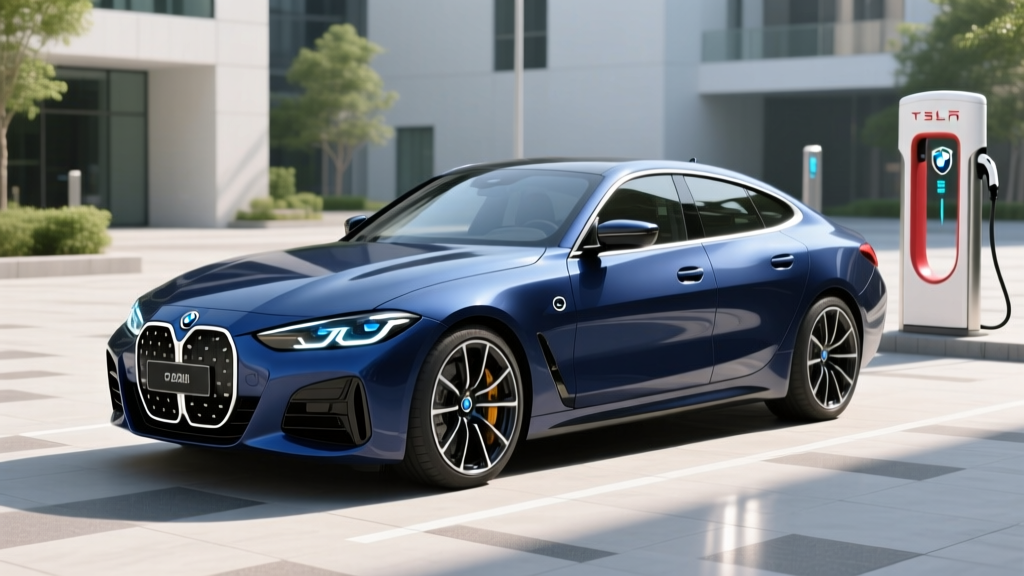
The BMW i4 has always occupied a specific niche: the electric sports sedan for buyers who want BMW driving dynamics without shouting about their electrification choices. For 2026, the i4 lineup carries over its three-tier strategy — the rear-wheel-drive eDrive35, the balanced eDrive40, and the performance-focused M50 — each targeting a different slice of the luxury EV sedan market. But with competitors like the Tesla Model 3, Hyundai Ioniq 6, and Polestar 2 pushing efficiency and charging speed forward, does the i4's specification sheet still justify its premium?
Below, we break down every critical BMW i4 specification with real-world context: not just what the EPA sticker says, but what you'll actually see on a highway road trip in January, how fast charging tapers past 80%, and whether the §30D federal tax credit actually applies to your situation.
2026 BMW i4 Core Specifications at a Glance
| Specification | eDrive35 | eDrive40 | M50 |
|---|---|---|---|
| Drivetrain | RWD | RWD | AWD (dual-motor) |
| Horsepower | 281 hp | 335 hp | 536 hp |
| 0-60 mph | 5.8 sec | 5.5 sec | 3.7 sec |
| Battery (usable) | 66.5 kWh | 81.0 kWh | 81.0 kWh |
| Battery Chemistry | NMC | NMC | NMC |
| EPA Range | 256 mi | 318 mi | 271 mi |
| EPA Efficiency (combined) | 99 MPGe | 109 MPGe | 97 MPGe |
| Max DC Fast Charge | 180 kW | 205 kW | 205 kW |
| 10-80% DC Time | ~31 min | ~31 min | ~31 min |
| Level 2 Rate (kW) | 11 kW | 11 kW | 11 kW |
| Base MSRP | $52,200 | $57,200 | $69,700 |
Range and Efficiency: EPA vs. the Real World
eDrive40 EPA: 318 miles (with 19" wheels) / 282 miles (with 20" wheels)
Real-world highway (70-80 mph, mild weather): ~255-275 miles
Real-world cold weather (below 32°F, mixed driving): ~210-240 miles
eDrive35 EPA: 256 miles | Real-world mixed: ~215-235 miles
M50 EPA: 271 miles | Real-world mixed: ~220-245 miles
The eDrive40's 318-mile EPA figure is the headline, but understanding what you'll actually extract requires looking at BMW's platform choices. The i4 rides on BMW's CLAR architecture (shared with the 4 Series Gran Coupe), which means the battery pack sits beneath the floor in a relatively thin enclosure. The 81.0 kWh usable capacity (83.5 kWh gross) in the eDrive40 and M50 uses NMC (nickel manganese cobalt) chemistry — chosen for energy density over the cycle-life advantages of LFP.
In EPA testing at fueleconomy.gov, the eDrive40 achieves 109 MPGe combined (31 kWh/100 mi), which is competitive but trails the Hyundai Ioniq 6 Long Range (140 MPGe combined). The efficiency gap shows up on road trips: at sustained 80 mph on the interstate, expect the eDrive40 to consume roughly 34-36 kWh/100 mi, yielding approximately 225-240 miles before you'd want to stop. Cold weather compounds this — below freezing, NMC batteries lose roughly 15-25% of usable range due to increased internal resistance and cabin heating demands. The i4 does include a heat pump (standard on all trims), which mitigates but doesn't eliminate cold-weather losses.
The eDrive35's smaller 66.5 kWh pack trades range for a lower entry price. If your daily commute is under 60 miles round-trip with home charging access, the 256-mile EPA range is plenty — but road trippers will feel the frequent charging stops.
Charging Speed: DC Fast Charge and Home Level 2
| Charging Level | Power (kW) | Rate | Time |
|---|---|---|---|
| Level 1 (120V household) | ~1.4 kW | ~4 mi/hr | 58+ hours (full) |
| Level 2 (240V home) | 11 kW | ~35 mi/hr | ~8.5 hours (full, 81 kWh) |
| DC Fast Charge (peak) | 205 kW (eDrive40/M50) 180 kW (eDrive35) | ~195 mi/30 min (peak) | 10-80% in ~31 min |
The i4's charging architecture uses a CCS1 connector (though BMW has confirmed NACS adoption for future models, the 2026 i4 retains CCS). The eDrive40 and M50 peak at 205 kW on DC fast chargers, while the eDrive35 tops out at 180 kW. Here's what that means in practice:
The 31-minute 10-80% time is measured under optimal conditions — battery preconditioned to approximately 77-86°F (25-30°C) and connected to a 350 kW-rated charger. The i4's charge curve holds near peak power from roughly 10% to about 45% state of charge, then progressively tapers. From 80% to 100%, expect the rate to drop below 50 kW, meaning that final 20% can add another 25-30 minutes. Practical road-trip strategy: charge from 10% to 80% and drive on. Charging above 80% at a public DC station is almost never worth the time penalty.
For home Level 2 charging, the 11 kW onboard charger is the limiting factor. On a 48-amp Level 2 home charger (the most common residential installation), you'll add roughly 35 miles of range per hour. A full overnight charge from 20% to 100% takes approximately 8-9 hours for the 81 kWh pack. If your home electrical panel supports a 60-amp circuit (allowing a 48-amp continuous draw), you'll wake up fully charged every morning. Homes with older 100-amp panels may need an electrical upgrade — budget $1,500-$3,000 for a panel upgrade if required, plus $600-$1,200 for the Level 2 charger and basic installation.
Performance and Driving Dynamics
The i4's driving character is where BMW's engineering investment becomes tangible. The CLAR platform gives the i4 a lower center of gravity than the 4 Series Gran Coupe (due to the floor-mounted battery) while maintaining the 50/50-ish weight distribution BMW is known for.
eDrive35 (281 hp, RWD): The base model delivers adequate acceleration (0-60 in 5.8 seconds) and the engaging rear-drive balance that makes BMWs fun on back roads. It's the lightest i4 variant, and that shows in cornering feel. For daily commuting and spirited canyon driving, the eDrive35 is arguably the sweet spot for driving enthusiasts on a budget.
eDrive40 (335 hp, RWD): The mid-tier trim adds 54 hp and the larger battery, but the 0-60 time only drops to 5.5 seconds due to the additional weight. The trade-off is range over acceleration — and for most buyers, that's the right call. The eDrive40's highway passing power is effortless, and the adaptive suspension (optional) smooths out rough pavement without isolating you from the road.
M50 (536 hp, AWD dual-motor): This is BMW M's electric statement. The dual-motor setup delivers 536 hp and a 3.7-second 0-60 time, with the front motor providing torque-vectoring-like grip out of corners. The M50 includes M-specific tuning for the adaptive dampers, steering, and regenerative braking. It's genuinely fast — but at $69,700 base and 271 miles of range, you're paying a premium for performance that sacrifices roughly 47 miles of EPA range compared to the eDrive40.
All trims feature BMW's standard adaptive regenerative braking, which adjusts regen intensity based on traffic and navigation data. You can also manually select high, medium, or low regen — but unlike some competitors, the i4 does not offer true one-pedal driving to a complete stop in all modes. The brake pedal feel is progressive and predictable, a common complaint in EVs that BMW has addressed well.
Interior Space, Technology, and Daily Usability
The i4 is a Gran Coupe — a five-door liftback — which gives it a practical advantage over traditional sedans. Cargo volume measures 16.6 cubic feet behind the rear seats and 45.6 cubic feet with the 40/20/40 split rear seats folded. That's competitive with the Tesla Model 3 (23 cu ft trunk, though the i4's liftback opening is more usable) and significantly more practical than the Polestar 2 (14.4 cu ft).
Passenger space is adequate but not generous. Front legroom is 42.8 inches, rear legroom is 34.7 inches — adults will fit in back for shorter trips, but the i4 is clearly optimized as a driver's car with occasional rear passengers. The battery pack raises the floor slightly, so rear-seat occupants sit with a somewhat knees-up posture compared to a conventional sedan.
The i4 runs BMW iDrive 8.5 on a curved display panel: a 12.3-inch digital instrument cluster flows into a 14.9-inch central touchscreen. The system supports wireless Apple CarPlay and Android Auto, over-the-air updates, and BMW's Intelligent Personal Assistant voice control. Navigation includes real-time charging station routing that factors in battery preconditioning — when you navigate to a DC fast charger, the car pre-warms the battery to optimize charge speed upon arrival.
Driver assistance comes via BMW's Driving Assistant Professional package (standard or available depending on trim), which includes adaptive cruise control with stop-and-go, lane-keeping assist, and automatic emergency braking. This is an SAE Level 2 system — the driver must remain engaged with hands on the wheel at all times. It is not autonomous driving. The optional Highway Assistant adds hands-free driving capability on divided highways at speeds up to 85 mph, but still requires eye monitoring via the driver-facing camera.
Pricing, Trims, and Federal Tax Credit Eligibility
| Trim | Base MSRP | As-Tested (typical options) | §30D Federal Credit | Effective Price |
|---|---|---|---|---|
| eDrive35 | $52,200 | $56,000-$58,000 | Up to $7,500* | ~$44,700-$50,500 |
| eDrive40 | $57,200 | $62,000-$66,000 | Up to $7,500* | ~$49,700-$58,500 |
| M50 | $69,700 | $74,000-$78,000 | Up to $7,500* | ~$62,200-$70,500 |
*Federal tax credit eligibility under IRS §30D is subject to multiple requirements that change periodically. Verify current rules at irs.gov.
The §30D clean vehicle credit can provide up to $7,500, but qualifying is not automatic. Key eligibility factors for the 2026 tax year include:
- MSRP cap: Sedans must have a base MSRP at or below $55,000. The eDrive35 ($52,200) clears this threshold. The eDrive40 ($57,200) and M50 ($69,700) exceed the sedan MSRP cap and do not qualify for the new-vehicle credit under current rules.
- Buyer income limits: Modified AGI must not exceed $150,000 (single), $225,000 (head of household), or $300,000 (joint filing).
- Battery sourcing requirements: The credit splits into two halves — $3,750 for meeting critical minerals requirements and $3,750 for meeting battery component sourcing requirements. BMW's battery supply chain involves Samsung SDI cells, and sourcing compliance varies by production batch. Confirm current sourcing status with your dealer at purchase.
- Point-of-sale transfer: As of 2024, you can transfer the credit to the dealer at purchase, reducing your out-of-pocket cost immediately rather than waiting for a tax refund.
The practical outcome: the eDrive35 is the only i4 trim that may qualify for the full $7,500 credit, bringing its effective starting price to approximately $44,700 — a compelling value for a luxury EV sedan with 256 miles of range. The eDrive40 and M50 buyers should explore state-level incentives, which vary by jurisdiction and may offer additional savings independent of federal rules.
Battery Warranty and Long-Term Ownership
BMW covers the i4's high-voltage battery for 8 years or 80,000 miles (whichever comes first), with a capacity retention threshold of 70%. If the battery degrades below 70% of its original capacity within the warranty period, BMW will repair or replace it to restore capacity above that threshold. The powertrain (electric motors, power electronics) is covered under the same 8-year/80,000-mile term. The basic vehicle warranty is 4 years/50,000 miles.
NMC battery chemistry in the i4 has shown predictable degradation patterns in real-world fleet data: expect approximately 5-8% capacity loss over the first 50,000 miles, with the curve flattening significantly afterward. Owners who frequently DC fast-charge to 100% and regularly drain below 10% may see accelerated degradation. BMW recommends setting a daily charge limit of 80-90% for routine use and only charging to 100% before long trips — a practice that extends NMC battery lifespan considerably.
Out-of-warranty battery replacement for the 81 kWh pack is estimated at $14,000-$18,000 based on current BMW parts pricing, though this cost is expected to decline as battery manufacturing scales. Module-level repair (replacing individual cell modules rather than the entire pack) can reduce costs to $3,000-$6,000 if only specific modules have degraded.
Competitive Positioning: i4 vs. Key Rivals
- Superior driving dynamics and steering feel
- Premium interior materials and build quality
- Liftback practicality (45.6 cu ft cargo)
- Strong resale value trajectory
- Heat pump standard (cold-weather efficiency)
- Lower efficiency than Ioniq 6 (109 vs 140 MPGe)
- CCS connector (not NACS) — limited Supercharger access
- Rear seat space tighter than Model 3
- DC charging peak (205 kW) trails 800V competitors
- eDrive40/M50 exceed §30D MSRP cap
vs. Tesla Model 3 Long Range ($47,740, 363 mi EPA): The Model 3 wins on range, efficiency, charging infrastructure (Supercharger network + NACS), and price. The i4 wins on interior quality, driving dynamics, and the liftback body style. If charging convenience and maximum range dominate your priorities, the Model 3 is the rational choice. If you want a car that feels like a BMW first and an EV second, the i4 delivers.
vs. Hyundai Ioniq 6 SE Long Range ($42,715, 361 mi EPA): The Ioniq 6's 800V architecture enables 10-80% charging in approximately 18 minutes on a 350 kW charger — significantly faster than the i4's 31 minutes. The Ioniq 6 also achieves 140 MPGe combined vs. the i4's 109 MPGe. The i4 counters with a more premium cabin, better rear cargo flexibility, and stronger brand cachet.
vs. Polestar 2 Long Range Dual Motor ($51,300, 276 mi EPA): The Polestar 2 offers standard AWD and competitive performance at a lower price point, but its 276-mile EPA range and smaller 78 kWh battery trail the i4 eDrive40. The Polestar 2's Google-based infotainment is excellent, but its trunk (14.4 cu ft) is far less practical than the i4's liftback.
Who Should Buy the 2026 BMW i4?
- You prioritize driving engagement and steering feel over maximum efficiency
- You want a luxury badge with premium interior materials and quiet cabin isolation
- You need liftback cargo flexibility (skis, furniture, large boxes) without moving to an SUV
- Your daily driving is under 80 miles with reliable home Level 2 charging
- You value BMW's dealer network and service infrastructure
- Maximum EPA range is your top priority (Model 3 LR, Ioniq 6)
- You need the fastest possible DC charging for frequent road trips (800V platforms like Ioniq 6, Taycan)
- You regularly carry rear-seat passengers on long trips (rear space is tight)
- You want NACS/Supercharger access without an adapter (Tesla, or wait for NACS-equipped BMWs)
- You need the federal tax credit and want the higher-range trims (eDrive40/M50 exceed the $55K sedan cap)
Frequently Asked Questions
What is the real-world range of the BMW i4 eDrive40?
The EPA rates the eDrive40 at 318 miles with 19-inch wheels. In real-world highway driving at 70-80 mph in moderate temperatures, expect approximately 255-275 miles. In cold weather (below 32°F), that drops to roughly 210-240 miles due to battery resistance and cabin heating. The heat pump helps but doesn't eliminate cold-weather range loss.
How fast does the BMW i4 charge at home and on the road?
On a 48-amp Level 2 home charger, the i4 adds approximately 35 miles of range per hour, fully charging the 81 kWh battery overnight in about 8.5 hours. On DC fast chargers, the eDrive40 and M50 peak at 205 kW, achieving 10-80% in approximately 31 minutes under optimal conditions (preconditioned battery, 350 kW-rated station). The eDrive35 peaks at 180 kW with a similar 10-80% time due to its smaller battery.
Does the BMW i4 qualify for the $7,500 federal EV tax credit?
Under current IRS §30D rules, only the eDrive35 (base MSRP $52,200) falls under the $55,000 sedan MSRP cap and may qualify — subject to buyer income limits, battery sourcing requirements, and point-of-sale transfer availability. The eDrive40 ($57,200) and M50 ($69,700) exceed the MSRP cap and do not qualify for the new-vehicle credit. Always verify current eligibility at irs.gov and with your dealer before purchase.
Is the BMW i4 worth buying over a Tesla Model 3?
It depends on priorities. The Model 3 Long Range offers more EPA range (363 vs. 318 miles), faster Supercharger access (NACS native), better efficiency, and a lower price. The i4 offers superior interior materials, more engaging driving dynamics, liftback cargo practicality, and BMW's service network. If you value the driving experience and premium feel, the i4 justifies its premium. If you optimize for range, charging convenience, and cost, the Model 3 wins.
What are the biggest pros and cons of the 2026 BMW i4?
Pros: Engaging driving dynamics, premium interior quality, liftback cargo versatility (45.6 cu ft), heat pump standard, strong build quality, iDrive 8.5 infotainment, available hands-free highway driving.
Cons: Efficiency trails 800V competitors, CCS connector (no native NACS/Supercharger), rear seat space is tight, 205 kW peak DC charging is slower than Hyundai/Kia/Porsche, eDrive40 and M50 don't qualify for the §30D credit, options push prices quickly above $65,000.
What battery chemistry does the BMW i4 use and how long will it last?
The i4 uses NMC (nickel manganese cobalt) lithium-ion cells supplied by Samsung SDI. NMC offers high energy density but requires more careful charge management than LFP for maximum longevity. Expect 5-8% capacity loss over the first 50,000 miles, with degradation slowing significantly afterward. BMW warrants the battery at 70% capacity retention for 8 years/80,000 miles. Setting daily charge limits to 80-90% and avoiding frequent deep discharges below 10% will maximize battery lifespan.