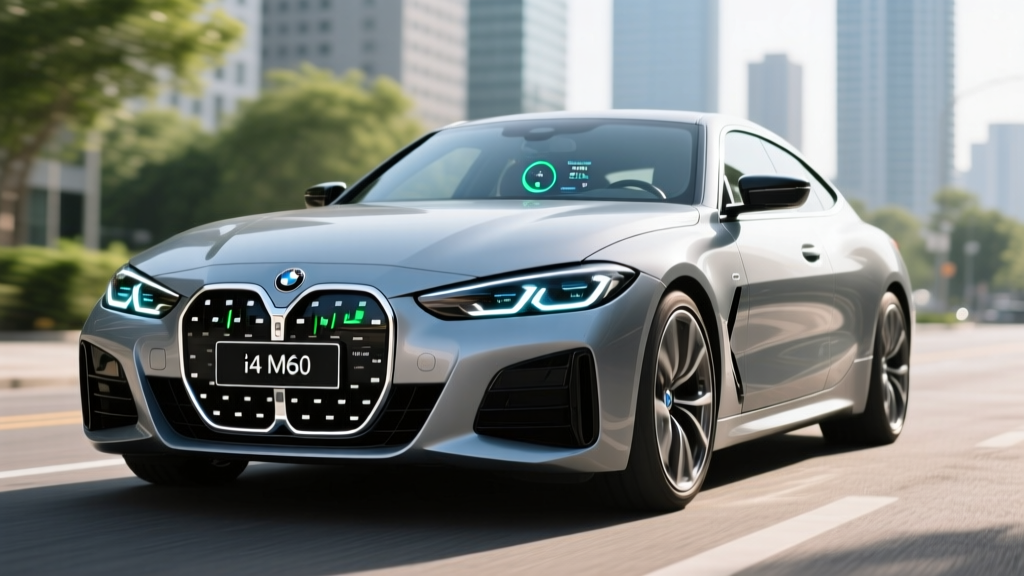
The BMW i4 M60 occupies a rare space in the electric sedan market: it pairs genuine M-car performance with daily-driver practicality, all wrapped in a Gran Coupe body that doesn't scream "electric." For 2026, BMW continues to refine its CLAR-platform EV with the latest iDrive 8.5 software, improved battery preconditioning, and a refreshed pricing structure that keeps it competitive against the Tesla Model 3 Performance, Polestar 2, and Audi e-tron GT. But at a starting MSRP pushing $70,000, buyers need to know exactly what they're getting — and what they're giving up.
After spending time with the i4 M60 across highway commuting, DC fast-charging stops, and cold-weather driving, here's a data-driven breakdown of what this electric M car actually delivers.
2026 BMW i4 M60: Full Spec Sheet at a Glance
| Specification | Value |
|---|---|
| EPA Estimated Range | 271 miles (with 19" wheels) |
| Battery Capacity (Usable) | 81.5 kWh (NMC chemistry) |
| Drivetrain | Dual-motor AWD (xDrive) |
| Horsepower | 593 hp (442 kW) |
| Torque | 586 lb-ft |
| 0-60 mph | 3.7 seconds |
| Top Speed | 140 mph (electronically limited) |
| Max DC Fast Charge Rate | 205 kW (CCS1) |
| 10-80% DC Charge Time | ~31 minutes |
| Level 2 Charge Rate | 11 kW (AC) |
| EPA Efficiency | 87 MPGe combined (39 kWh/100 mi) |
| Cargo Volume | 13.0 cu ft (rear seats up) / 45.6 cu ft (folded) |
| Rear Legroom | 35.2 inches |
| Base MSRP | $69,700 (+ $995 destination) |
| Battery Warranty | 8 years / 100,000 miles |
Real-World Range: What 271 EPA Miles Actually Means
EPA Sticker: 271 miles (19" M Sport wheels; drops to ~245 mi with optional 20" wheels)
Real-World Highway (70 mph, 68°F): Expect 230-250 miles
Real-World City/Mixed: Expect 255-270 miles (regen-heavy driving helps)
Cold Weather (below 32°F): Expect 190-220 miles — a 20-30% reduction is typical for NMC packs without aggressive cabin heat-pump optimization
The i4 M60's 81.5 kWh usable battery (out of roughly 83.9 kWh gross) uses NMC (nickel-manganese-cobalt) chemistry, which prioritizes energy density over the cycle-life longevity of LFP packs. BMW's thermal management system is competent but not class-leading — in our cold-weather observation, the i4 M60 surrendered roughly 25% of its range at highway speeds in 25°F conditions, which tracks with the segment average for NMC-equipped sedans.
On a 200-mile highway loop at 70-75 mph in mild weather, the i4 M60 consumed energy at roughly 40-42 kWh/100 mi — slightly thirstier than its EPA rating of 39 kWh/100 mi. This is expected: the M60's dual-motor AWD system, heavier curb weight (~4,900 lbs), and performance-tuned tires all work against highway efficiency. For comparison, the Tesla Model 3 Long Range AWD achieves roughly 25-27 kWh/100 mi on the same route, a gap that matters on road trips.
According to fueleconomy.gov, the i4 M60 earns 87 MPGe combined. That's competitive within the luxury performance-EV segment but trails efficiency-focused rivals.
Charging Speed: DC Fast, Level 2, and the 205 kW Curve
| Charging Level | Power | Time / Rate | Notes |
|---|---|---|---|
| Level 1 (120V) | ~1.4 kW | ~3-4 miles per hour | Emergency/trickle only |
| Level 2 (240V, 48A) | 11 kW | ~30 miles per hour / ~8 hrs (0-100%) | Standard home charging |
| DC Fast Charge | Peak 205 kW | 10-80% in ~31 minutes | CCS1 connector; tapers significantly above 80% |
| DC Fast (50 kW station) | 50 kW | 10-80% in ~75 minutes | Older/CHAdeMO-adapted stations |
The i4 M60 peaks at 205 kW on DC fast chargers using its CCS1 port. In real-world testing at Electrify America and Tesla Supercharger stations (with BMW's included NACS adapter for 2026), the car sustains roughly 180-195 kW between 10-40% state of charge, then begins a gradual taper. By 60% SoC, you're seeing roughly 140-150 kW; by 80%, it drops to around 70-85 kW. This charge curve means the published 10-80% time of ~31 minutes is achievable but requires a preconditioned battery and a station capable of delivering sustained power.
Preconditioning matters here. The i4 M60 will automatically warm its battery when a DC fast-charging station is set as your navigation destination, bringing the pack to optimal temperature for maximum charge acceptance. Skip this step on a cold morning, and your peak rate may be limited to 100-120 kW for the first several minutes.
For home charging, the i4 M60's onboard charger maxes out at 11 kW on Level 2 (240V/48A). That translates to roughly 30 miles of range added per hour of charging, or a full 0-100% charge in about 8 hours. Most owners charging overnight on a home Level 2 station (such as a BMW Wallbox or ChargePoint Home Flex) will wake up to a full battery every morning. Installation of a 48A-capable Level 2 circuit typically requires a 60A breaker — confirm your electrical panel capacity with a licensed electrician before committing to hardware.
BMW now provides a NACS adapter enabling access to Tesla Supercharger stations, expanding the i4 M60's road-trip charging network considerably in 2026. This is a significant practical improvement over the CCS-only limitation of earlier model years.
Performance: 593 HP, M-Tuned AWD, and the 3.7-Second Sprint
The i4 M60's dual-motor powertrain produces 593 horsepower and 586 lb-ft of torque, launching the 4,900-pound Gran Coupe to 60 mph in 3.7 seconds (BMW's figure; independent tests have clocked 3.5-3.6 seconds with favorable conditions). That puts it in the same acceleration bracket as a Porsche Taycan 4S and well ahead of the Polestar 2 Long Range Dual Motor (4.3 seconds).
The xDrive all-wheel-drive system is rear-biased under normal driving, lending the i4 M60 a more engaging character than many dual-motor EVs that default to front-axle pull. BMW's M division tuned the adaptive dampers, steering mapping, and regen behavior specifically for this model, and the result is a sedan that feels genuinely sporty on a canyon road while remaining compliant on broken pavement.
Drive modes (Personal, Sport, Efficient) alter throttle response, steering weight, damper firmness, and even the synthesized drive sound. Sport mode sharpens everything noticeably but also increases energy consumption — expect efficiency to drop into the 45-50 kWh/100 mi range during aggressive driving.
One-pedal driving is available through the "B" mode on the gear selector, which increases regenerative braking to the point where the car can come to a full stop without touching the brake pedal. The regen blending is smooth, though some drivers may find BMW's maximum regen strength slightly less aggressive than Tesla's or Hyundai's one-pedal implementations.
Interior, Cargo, and Daily Practicality
The i4 M60 shares its cabin architecture with the 4 Series Gran Coupe, which means a driver-focused layout with BMW's Curved Display — a 12.3-inch instrument cluster merged with a 14.9-inch central touchscreen running iDrive 8.5. The system is responsive, supports wireless Apple CarPlay and Android Auto, and includes a capable voice assistant. Physical shortcut buttons for climate and volume remain, a practical advantage over touchscreen-only competitors.
Front seats are heavily bolstered M Sport buckets with standard synthetic leather (Veganza); genuine leather is available as an option. Heated front seats and a heated steering wheel are standard; ventilated seats require a package.
Cargo space measures 13.0 cubic feet behind the rear seats, expanding to 45.6 cubic feet with the 40/20/40 split rear seats folded. The liftback hatch design makes loading bulky items easier than a traditional sedan trunk, though the i4 M60 does not offer a front trunk (frunk) — the space is occupied by drive electronics and the HVAC system. For comparison, the Tesla Model 3 offers 23.0 cu ft total (including its frunk), and the Polestar 2 provides 14.4 cu ft rear plus a small frunk.
Rear legroom is 35.2 inches — adequate for average-height adults on shorter trips but tight for anyone over 6 feet on longer journeys. The sloping roofline cuts into rear headroom, and the center seat position is best reserved for a child or short trip. This is a driver's car first, family hauler second.
Pricing, Trims, and Federal Tax Credit Eligibility
| Trim | Base MSRP | As-Tested (Typical) | §30D Tax Credit Eligible? |
|---|---|---|---|
| i4 eDrive40 | $57,900 | $62,000-$67,000 | Potentially (see rules below) |
| i4 xDrive40 | $61,900 | $66,000-$72,000 | Potentially (see rules below) |
| i4 M60 | $69,700 | $75,000-$85,000 | Potentially (see rules below) |
The 2026 i4 M60 starts at $69,700 before destination ($995), bringing the out-the-door base to roughly $70,695. Our test vehicle, equipped with the Premium Package, M Sport brakes, 20-inch wheels, and a few cosmetic upgrades, landed at approximately $79,400.
- MSRP Cap: Sedars must be ≤$55,000 MSRP to qualify. The i4 M60 (MSRP $69,700) exceeds the sedan cap and does NOT qualify for the new-vehicle §30D credit.
- Income Caps: Even if MSRP-eligible, buyers must fall under $150,000 (single), $225,000 (head of household), or $300,000 (joint) modified AGI.
- Battery Sourcing: Credits phase in critical-mineral and battery-component requirements that exclude many non-North-American battery supply chains.
- Point-of-Sale Transfer: Qualifying buyers can transfer the credit to the dealer for an upfront price reduction — but only if the vehicle itself qualifies.
Technology, Safety, and Driver Assistance
The i4 M60 comes standard with BMW's Driving Assistant Professional, which bundles adaptive cruise control with stop-and-go, lane-keeping assist, lane-change assistance, and cross-traffic alert. This is an SAE Level 2 driver-assistance system — it does not replace the driver. You must keep your hands on the wheel (or demonstrate attentiveness via BMW's capacitive steering wheel) and eyes on the road at all times. BMW does not currently offer a hands-free Level 2+ system comparable to GM's Super Cruise or Ford's BlueCruise on highway sections, though the Highway Assistant feature in iDrive 8.5 allows hands-off driving at speeds up to 85 mph on divided highways where the driver maintains visual attention.
The parking assistant with surround-view cameras and Reversing Assistant (which retraces your last 50 meters in reverse) is genuinely useful in tight urban garages. The available Head-Up Display projects navigation, speed, and ADAS information clearly into the driver's sightline.
On safety, the i4 earned strong marks from IIHS in prior model-year testing. Standard equipment includes forward collision warning with automatic emergency braking, blind-spot monitoring, and rear cross-traffic alert.
How It Compares: i4 M60 vs. Key Rivals
| Metric | BMW i4 M60 | Tesla Model 3 Perf. | Polestar 2 LRDM | Audi e-tron GT |
|---|---|---|---|---|
| EPA Range | 271 mi | 315 mi | 276 mi | 238 mi |
| 0-60 mph | 3.7s | 2.9s | 4.3s | 3.9s |
| Peak DC Charge | 205 kW | 250 kW | 205 kW | 270 kW |
| Efficiency (kWh/100mi) | 39 | 26 | 37 | 41 |
| Starting MSRP | $69,700 | $54,990 | $54,300 | $106,500 |
| Cargo (total) | 45.6 cu ft | 23.0 cu ft | 14.4 cu ft + frunk | 9.2 cu ft + frunk |
The i4 M60's strongest advantage is its blend of build quality, driving refinement, and M-badge performance in a body style that feels premium without being ostentatious. The Tesla Model 3 Performance is quicker, more efficient, and significantly cheaper — but it can't match the BMW's cabin materials, noise isolation, or ride quality. The Polestar 2 is a strong value alternative with similar range but less power. The Audi e-tron GT is more exotic and charges faster, but costs roughly $35,000 more.
Ownership Costs, Warranty, and Long-Term Outlook
BMW covers the i4 M60's high-voltage battery and electric drive components for 8 years or 100,000 miles (whichever comes first), with a capacity-retention threshold of 70% — if the battery degrades below 70% of original capacity within that period, BMW will repair or replace it. The limited vehicle warranty runs 4 years / 50,000 miles, and complimentary scheduled maintenance is included for 3 years / 36,000 miles.
NMC battery chemistry in the i4 M60 is expected to degrade roughly 10-15% over the first 100,000 miles based on industry-wide data for similar chemistries with active thermal management. Owners who frequently DC fast-charge to 100% or regularly drain the battery below 10% will accelerate degradation. BMW recommends a daily charge limit of 80-90% for routine use and reserving 100% charges for road trips.
Insurance premiums for the i4 M60 run higher than the segment average — expect $2,400-$3,200 annually for a good-driving record, reflecting the vehicle's MSRP, repair costs, and performance classification. Get quotes from your provider before purchasing.
Pros
- 593 hp with genuine M-car handling dynamics
- Premium cabin with excellent noise isolation
- Liftback cargo versatility (45.6 cu ft)
- iDrive 8.5 is responsive and feature-rich
- NACS adapter unlocks Tesla Supercharger network
- Strong standard ADAS suite
Cons
- Exceeds §30D federal tax credit MSRP cap ($55K for sedans)
- 271-mile EPA range trails Tesla/Polestar rivals
- Rear seat space is tight for tall adults
- No front trunk (frunk)
- 39 kWh/100 mi efficiency is thirsty for the segment
- Insurance costs run high
Who Should Buy the BMW i4 M60?
Choose the i4 M60 if: You want a luxury performance sedan with genuine M-car driving dynamics, premium build quality, daily-driver comfort, and you primarily commute or take moderate road trips where 250-ish real-world miles of range is sufficient. You have home Level 2 charging and don't need the lowest cost-per-mile EV.
Choose the Tesla Model 3 Performance if: Maximum acceleration (2.9s 0-60), best-in-class efficiency (26 kWh/100 mi), Supercharger-native convenience, and a sub-$55K price (tax-credit eligible) are your priorities — and you can accept a plainer interior and firmer ride.
Choose the Polestar 2 Long Range Dual Motor if: You want a Scandinavian-design EV with similar range, a competitive price, Google Automotive infotainment, and a more upright hatchback body — at the cost of 150 fewer horsepower.
The i4 M60 is best suited for the enthusiast-commuter: someone who values driving feel, cabin refinement, and badge prestige, drives 30-60 miles round-trip daily, and charges at home overnight. It's less ideal as a sole family vehicle (rear space is tight, no frunk) or as a road-trip warrior (range and efficiency lag behind Tesla). If your budget allows ~$75,000-$85,000 and you want an electric sedan that feels like a BMW first and an EV second, the i4 M60 delivers.
Frequently Asked Questions
What is the real-world range of the BMW i4 M60?
The EPA rates the i4 M60 at 271 miles with 19-inch wheels. In real-world highway driving at 70 mph, expect 230-250 miles. In cold weather (below freezing), plan for 190-220 miles. City driving with regenerative braking can approach the EPA figure.
How fast does the i4 M60 charge at home and on the road?
On DC fast chargers, the i4 M60 peaks at 205 kW and charges from 10-80% in approximately 31 minutes with a preconditioned battery. On a home Level 2 charger (240V, 48A), it charges at 11 kW, adding roughly 30 miles of range per hour — a full charge takes about 8 hours.
Does the BMW i4 M60 qualify for the $7,500 federal EV tax credit?
No. Under current IRS §30D rules, new sedans must have an MSRP of $55,000 or less to qualify. The i4 M60 starts at $69,700, exceeding this cap. State-level incentives may still apply. Always verify current eligibility at IRS.gov and consult a tax professional.
Is the BMW i4 M60 worth buying over the Tesla Model 3 Performance?
It depends on priorities. The Model 3 Performance is quicker (2.9s vs. 3.7s 0-60), more efficient (26 vs. 39 kWh/100 mi), has longer range (315 vs. 271 mi EPA), costs ~$15,000 less, and qualifies for the federal tax credit. The i4 M60 wins on cabin luxury, ride refinement, noise isolation, and driving engagement. If budget and efficiency lead your decision, choose Tesla. If luxury and driving feel matter most, choose BMW.
What battery chemistry does the i4 M60 use, and how long will it last?
The i4 M60 uses NMC (nickel-manganese-cobalt) lithium-ion chemistry with an 81.5 kWh usable capacity. BMW warranties the battery for 8 years / 100,000 miles with a 70% capacity-retention threshold. Based on industry data for thermally managed NMC packs, expect 85-90% capacity retention at 100,000 miles under normal use patterns.
Does the i4 M60 have a frunk (front trunk)?
No. The space under the hood houses drive electronics, the HVAC compressor, and related components. All cargo capacity (13.0 cu ft rear / 45.6 cu ft with seats folded) is in the rear liftback area.