BMW i4 M50 Review: Luxury Electric Performance That Delivers
The BMW i4 M50 occupies a fascinating space in the electric vehicle landscape. It is not a dedicated EV platform built from the ground up, nor is it a compromise-laden conversion. Instead, BMW took its celebrated 4 Series Gran Coupe and transformed it into a fully electric performance machine that wears the prestigious M badge. The result is a luxury electric vehicle that blends everyday usability with genuine sporting character, making it one of the most compelling options for drivers who want electric propulsion without sacrificing the driving engagement BMW is famous for.
In this comprehensive review, we examine every facet of the BMW i4 M50, from its real-world range and charging capabilities to its interior technology, driving dynamics, and long-term ownership costs. Whether you are cross-shopping against the Tesla Model 3 Performance, the Audi e-tron GT, or the Mercedes-AMG EQE, this review will help you determine if the i4 M50 deserves a spot in your garage. For more options in this segment, check out our roundup of the best luxury electric cars currently available.
Vehicle Overview: What Makes the BMW i4 M50 Special
The BMW i4 M50 is the performance-oriented variant of the i4 lineup, sitting above the more efficiency-focused i4 eDrive40. It features a dual-motor all-wheel-drive powertrain that produces a combined output of 536 horsepower and 586 lb-ft of torque. BMW's M division tuned the chassis, suspension, steering, and braking systems to deliver a driving experience that feels genuinely sporty rather than merely quick in a straight line.
Built on BMW's CLAR (Cluster Architecture) platform, the i4 shares its underpinnings with the internal-combustion 4 Series Gran Coupe. While some critics initially questioned this approach, the execution proves that a flexible architecture can yield outstanding results when engineered with care. The fifth-generation eDrive technology powers both axles, with the rear motor producing 312 horsepower and the front motor contributing 255 horsepower. According to EPA estimates, the i4 M50 achieves a combined range of approximately 227 to 270 miles depending on wheel size and configuration.
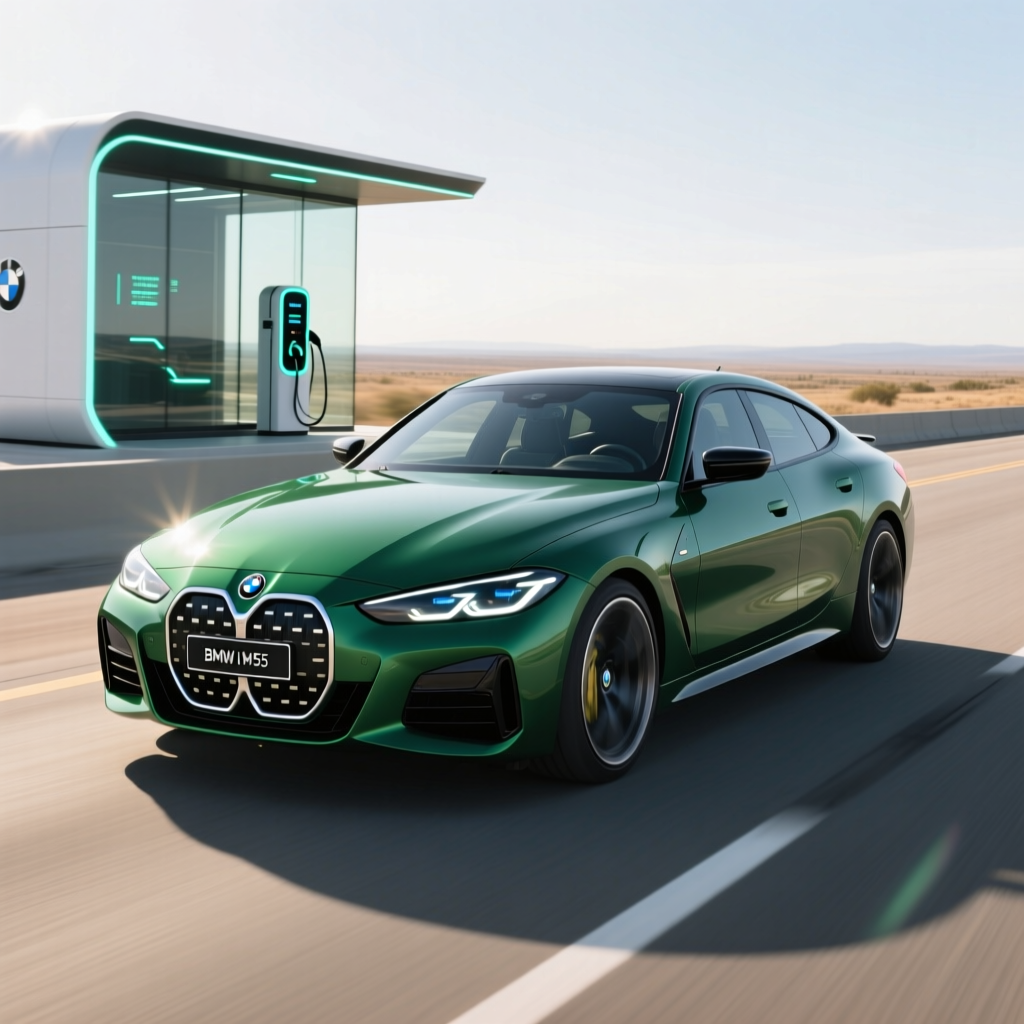
The exterior design carries over the 4 Series Gran Coupe's controversial yet distinctive large kidney grille, which on the i4 is finished in a unique mesh pattern and serves as a housing for various sensors. The silhouette is sleek and coupe-like, with a practical liftgate that provides access to a reasonably sized cargo area. M-specific touches include unique bumpers, side skirts, a subtle rear spoiler, and available M Sport brakes with blue calipers.
Real-World Range and Efficiency
Range anxiety remains one of the most common concerns for prospective EV buyers, and the BMW i4 M50's EPA-rated range of up to 270 miles (with 19-inch wheels) places it solidly in the competitive middle of the luxury EV segment. Opt for the larger 20-inch M wheels, and that figure drops to approximately 227 miles. However, EPA ratings only tell part of the story.
Independent testing by organizations such as Edmunds has shown that BMW's range estimates tend to be conservative in real-world driving conditions. In mixed driving scenarios that include city, suburban, and highway segments, many owners report achieving between 240 and 280 miles on a full charge when equipped with the standard wheel package. Highway driving at sustained speeds above 70 mph naturally reduces range, with observed figures typically falling between 210 and 240 miles.
Several factors contribute to the i4 M50's respectable efficiency. BMW's adaptive energy recuperation system uses navigation data and sensor inputs to automatically adjust regenerative braking intensity. When approaching a slower vehicle or a roundabout, the car increases regeneration to slow the vehicle and recapture energy. On open roads, it allows the car to coast freely, minimizing energy losses. Drivers can also manually select from three regeneration levels or engage a one-pedal driving mode with maximum regeneration.
The 81.5 kWh battery pack (76.6 kWh usable) uses prismatic cells supplied by CATL and Samsung SDI. Thermal management is handled by an advanced liquid cooling system that keeps the battery in its optimal temperature window, preserving both performance and longevity. For a deeper look at how range compares across the segment, see our EV range comparison guide.
Charging Speed and Infrastructure
The BMW i4 M50 supports DC fast charging at rates up to 200 kW, which is competitive with the best in its class. At a compatible high-power charging station, BMW claims the battery can be replenished from 10 to 80 percent in approximately 31 minutes. In practice, charging speeds peak around 200 kW at lower states of charge and taper progressively as the battery fills, which is standard behavior for modern lithium-ion packs.
For Level 2 AC charging, the i4 M50 comes with an 11 kW onboard charger as standard, allowing a full charge from empty in approximately 8 hours and 15 minutes. This is perfectly suited for overnight home charging using a Level 2 wallbox. An optional 22 kW onboard charger was available in certain markets, cutting AC charging times roughly in half, though availability varies by region.
One notable advantage BMW provides is access to a broad charging network. Through BMW Charging, owners gain access to hundreds of thousands of charging points across multiple networks. BMW also partnered with Electrify America to offer complimentary charging sessions for new owners, though the specific terms of this program should be confirmed with your local dealer. The navigation system integrates charging stop planning, automatically pre-conditioning the battery when a fast-charging station is set as a destination to ensure optimal charging speeds upon arrival.
The charging port is located on the rear quarter panel on the driver's side and supports both CCS (Combined Charging System) and standard J1772 connectors. For home charging setup tips and recommendations, visit our home EV charging guide.
Interior, Technology, and Comfort
Step inside the BMW i4 M50 and you are greeted by an interior that balances sportiness with luxury in a way that few electric vehicles manage. The cabin features BMW's Curved Display, which combines a 12.3-inch digital instrument cluster and a 14.9-inch central touchscreen into a single, elegantly curved glass panel that sweeps toward the driver. The system runs BMW's iDrive 8 operating system, which offers a modern, visually appealing interface with responsive touch inputs, natural voice recognition, and the signature iDrive rotary controller on the center console.
Material quality is excellent throughout, with soft-touch surfaces, available Vernasca or Merino leather upholstery, and genuine aluminum or carbon fiber trim options. The M Sport seats provide excellent lateral support during spirited driving while remaining comfortable for long highway journeys. Heated front seats are standard, with ventilated front seats and heated rear seats available as options.
The technology suite is comprehensive. Wireless Apple CarPlay and Android Auto are standard, along with a Wi-Fi hotspot, Bluetooth connectivity for multiple devices, and over-the-air software update capability. The available Harman Kardon surround sound system delivers rich, detailed audio with 17 speakers and 535 watts of power. For audiophiles, an optional Bowers & Wilkins system is also available in certain configurations.
BMW's suite of driver assistance features, marketed as Driving Assistant Professional, includes adaptive cruise control with stop-and-go functionality, lane-keeping assist, automatic emergency braking with pedestrian detection, blind-spot monitoring, rear cross-traffic alert, and a surround-view camera system. The Highway Assistant feature, available in select markets, provides hands-free driving assistance at speeds up to 85 mph on divided highways, though the driver must remain attentive. For more on EV safety technology, explore our EV safety features guide.
Practicality is a strong suit for the Gran Coupe body style. The liftgate opens to reveal 16.6 cubic feet of cargo space with the rear seats upright, expanding to approximately 45.6 cubic feet with the 40/20/40 split rear seats folded. This is significantly more versatile than a traditional sedan trunk and makes the i4 M50 surprisingly practical for weekend trips and daily errands alike.
Driving Dynamics and Performance
This is where the BMW i4 M50 truly distinguishes itself from the growing crowd of fast electric vehicles. While many EVs offer impressive straight-line acceleration, the i4 M50 delivers a holistic driving experience that rewards enthusiasts on twisty back roads and during spirited driving sessions.
The dual-motor powertrain launches the i4 M50 from 0 to 60 mph in approximately 3.7 seconds, with some independent tests recording times as low as 3.4 seconds. This places it firmly in sports car territory, and the instant torque delivery from the electric motors makes the acceleration feel even more urgent than the numbers suggest. Launch control is available when the vehicle is in Sport mode, optimizing traction and power delivery for maximum acceleration.
However, the i4 M50's real magic lies in its chassis. BMW's M division equipped this model with an M-specific adaptive suspension that features electronically controlled dampers with individually adjustable settings for each wheel. The result is a car that can switch between comfortable grand touring composure and taut, responsive sportiness at the press of a button. The standard M Sport rear differential and the near 50/50 weight distribution — a BMW hallmark — contribute to handling that feels balanced, predictable, and genuinely engaging.
The steering is precise and well-weighted, offering good feedback for an electric power steering system. The M Sport brakes provide strong, consistent stopping power, with the regenerative braking system blending seamlessly with the friction brakes in most driving situations. BMW's Integrated Braking System ensures smooth transitions between regenerative and mechanical braking, eliminating the grabby or inconsistent brake feel that plagues some competing EVs.
Multiple driving modes — Eco Pro, Comfort, Sport, and Sport Individual — allow drivers to tailor the vehicle's character to their preferences and conditions. In Sport mode, the throttle response sharpens, the steering weights up, the suspension firms up, and the available IconicSounds Electric system generates a futuristic driving soundtrack composed by film score legend Hans Zimmer. While the synthetic sound is polarizing, it adds a sense of drama that many drivers appreciate during spirited driving.
Compared to the Tesla Model 3 Performance, the i4 M50 sacrifices a few tenths in straight-line acceleration but delivers a more refined ride quality, superior interior materials, and a more connected driving experience. Against the Audi e-tron GT, the i4 M50 offers more rear-seat headroom and cargo versatility while matching or exceeding its driving engagement. For a detailed head-to-head, read our BMW i4 vs Tesla Model 3 comparison.
Ownership Costs and Value Proposition
The BMW i4 M50 carries a manufacturer's suggested retail price that positions it in the premium tier of the EV market. When fully equipped with popular option packages — including the Premium Package, Executive Package, larger wheels, and driver assistance upgrades — the price can climb significantly. However, the value proposition becomes more compelling when you consider the total cost of ownership.
Electric vehicles inherently benefit from lower fueling costs compared to their gasoline counterparts. Charging the i4 M50 at home using average residential electricity rates costs a fraction of what you would spend on premium gasoline for an equivalent internal-combustion M440i or M3. Maintenance costs are also reduced, as electric motors require no oil changes, spark plug replacements, or transmission fluid services. Brake wear is minimized thanks to regenerative braking, with many EV owners reporting brake pad life exceeding 80,000 miles.
BMW provides a standard warranty that includes 4 years or 50,000 miles of basic coverage and 8 years or 100,000 miles of battery warranty, whichever comes first. The battery warranty guarantees that the high-voltage battery will retain at least 70 percent of its original capacity during the coverage period. BMW also offers complimentary scheduled maintenance for the first 3 years or 36,000 miles in many markets, which further reduces early ownership costs.
Insurance costs for the i4 M50 tend to be higher than average due to the vehicle's performance capability, premium pricing, and the specialized repair requirements of electric vehicles. Prospective buyers should obtain insurance quotes before purchasing to understand this component of ownership costs. Depreciation is another factor to consider, as EVs have experienced variable resale values depending on market conditions, battery health perceptions, and the pace of new model introductions. However, BMW's brand cachet and the M badge help support residual values relative to less prestigious EV competitors.
Federal and state incentives can significantly offset the purchase price. While eligibility for federal tax credits varies based on current regulations and the vehicle's manufacturing origin, many states and local utilities offer additional rebates, tax credits, or reduced electricity rates for EV owners. Be sure to check the latest incentive availability in your area. For a broader perspective on EV affordability, see our guide to the best electric vehicles under $70,000.
Pros and Cons
Pros
- Engaging driving dynamics — Genuine M-tuned chassis delivers handling and feedback that most electric vehicles cannot match
- Premium interior quality — High-grade materials, excellent fit and finish, and a driver-focused cockpit design
- Advanced technology suite — iDrive 8 with Curved Display, comprehensive driver assistance, and over-the-air updates
- Practical Gran Coupe body style — Liftgate versatility with surprisingly generous cargo capacity
- Strong real-world range — Conservative EPA estimates often exceeded in everyday driving conditions
- 200 kW DC fast charging — Competitive charging speeds with intelligent battery pre-conditioning
- Quiet and refined ride — Excellent sound insulation makes for a serene highway cruiser
Cons
- Controversial exterior styling — The large kidney grille remains divisive among enthusiasts and the general public
- Options add up quickly — Desirable packages and standalone options can push the price significantly higher
- Rear-seat headroom is limited — The sloping roofline compromises headroom for taller rear passengers
- Heavier than combustion equivalents — The battery pack adds weight that is noticeable during direction changes
- No frunk (front trunk) — The CLAR platform does not offer front storage, unlike dedicated EV platforms
- Synthetic driving sounds are polarizing — The Hans Zimmer IconicSounds Electric may not appeal to traditionalists
Key Specifications Comparison
| Specification | BMW i4 M50 | Tesla Model 3 Performance | Audi e-tron GT | Mercedes-AMG EQE Sedan |
|---|---|---|---|---|
| Powertrain | Dual-Motor AWD | Dual-Motor AWD | Dual-Motor AWD | Dual-Motor AWD |
| Horsepower | 536 hp | 510 hp | 522 hp (637 hp w/ Launch Control) | 617 hp |
| Torque | 586 lb-ft | 546 lb-ft | 472 lb-ft | 701 lb-ft |
| 0-60 mph | 3.7 sec | 3.1 sec | 3.9 sec (3.1 sec w/ Launch Control) | 3.2 sec |
| EPA Range (max) | 270 mi | 315 mi | 238 mi | 230 mi |
| Battery (usable) | 76.6 kWh | 75 kWh | 83.7 kWh | 90.6 kWh |
| DC Fast Charging | 200 kW | 250 kW | 270 kW | 170 kW |
| Cargo Volume | 16.6 cu ft | 23 cu ft | 12.9 cu ft | 15.0 cu ft |
| Curb Weight | ~4,900 lbs | ~4,065 lbs | ~5,139 lbs | ~5,500 lbs |
Frequently Asked Questions
Is the BMW i4 M50 a real M car?
The BMW i4 M50 is considered an M Performance model rather than a full M car like the M3 or M4. It was developed with significant input from BMW's M division, featuring M-tuned suspension, M Sport brakes, an M-specific rear differential, and M driving modes. While purists may debate whether the M50 badge carries the same weight as a full M designation, the driving dynamics and performance credentials are genuinely impressive and represent a meaningful step above the standard i4 variants.
How long does the BMW i4 M50 battery last?
BMW designs its high-voltage batteries for long-term durability, and the i4 M50's battery is covered by an 8-year or 100,000-mile warranty that guarantees at least 70 percent of original capacity retention. Based on data from BMW's earlier electric vehicles and industry-wide battery degradation studies, most owners can expect the battery to retain well over 80 percent of its capacity after 100,000 miles of typical use. Proper charging habits — such as avoiding frequent charging to 100 percent and minimizing exposure to extreme temperatures — can further extend battery longevity.
Can the BMW i4 M50 use Tesla Superchargers?
Access to Tesla's Supercharger network has been expanding to non-Tesla vehicles in select regions through Tesla's Supercharger access program. Availability varies by location and requires the use of an adapter in some cases. BMW i4 M50 owners should check Tesla's website or app for current Supercharger access availability in their area. Additionally, the broader CCS charging network — including Electrify America, EVgo, and ChargePoint — provides extensive fast-charging coverage across major highways and urban areas.
How does the i4 M50 compare to the i4 eDrive40?
The i4 eDrive40 uses a single rear motor producing 335 horsepower and offers an EPA-rated range of up to 301 miles, making it the more range-focused and affordable option in the i4 lineup. The M50 adds a front motor for all-wheel drive, increases total output to 536 horsepower, and includes M-specific chassis tuning, brakes, and styling enhancements. The eDrive40 is ideal for buyers who prioritize range and value, while the M50 targets those who want maximum performance and the enhanced driving dynamics that come with the M treatment. Both share the same interior, technology features, and body style.
Is the BMW i4 M50 good for daily commuting?
Absolutely. Despite its performance credentials, the i4 M50 is an excellent daily commuter. In Comfort mode, the ride quality is supple and well-damped, the cabin is whisper-quiet, and the adaptive cruise control with stop-and-go functionality makes highway and traffic driving effortless. The available range of up to 270 miles is more than sufficient for most daily commutes with plenty of reserve, and home charging ensures you start each day with a full battery. The liftgate design and generous cargo area also make it practical for grocery runs, gym bags, and weekend getaways.
Final Verdict
The BMW i4 M50 represents a compelling argument that electrification and driving pleasure are not mutually exclusive. It may not have the longest range in its segment, and its styling will continue to divide opinion, but it delivers where it matters most for a luxury performance EV: behind the wheel. The combination of a beautifully crafted interior, cutting-edge technology, genuine M-tuned dynamics, and the effortless thrust of 536 electric horsepower makes the i4 M50 one of the most well-rounded luxury electric vehicles available.
For buyers who value driving engagement as much as they value luxury and technology, the BMW i4 M50 deserves serious consideration. It proves that BMW's decision to adapt its existing CLAR platform for electric propulsion was not a compromise but rather a strategic choice that leverages decades of chassis engineering expertise. If you are ready to make the switch to electric but refuse to give up the joy of driving, the i4 M50 may be exactly the car you have been waiting for. Browse our complete electric vehicle reviews section for more in-depth analyses and comparisons.