The Electric Gran Coupe That Bridges Performance and Practicality
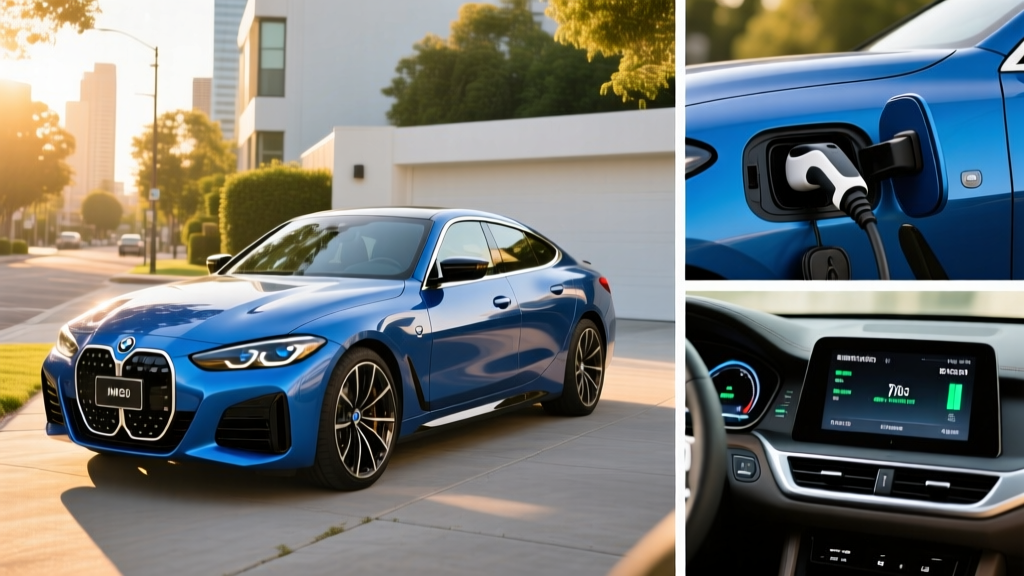
The 2025 BMW i4 M50 occupies a specific niche in the EV market: a dual-motor, all-wheel-drive sport sedan that delivers genuine M-car acceleration without sacrificing daily-driver comfort. Built on BMW's CLAR platform — shared with the 4 Series Gran Coupe — it avoids the "EV skateboard" compromises that plague some competitors, but it also inherits a floor-mounted battery that impacts rear-seat packaging. For buyers cross-shopping the Tesla Model 3 Performance, Polestar 2, and Hyundai Ioniq 6, the i4 M50's blend of build quality, driving dynamics, and 271 miles of EPA range demands serious consideration — with a few caveats on charging speed and federal incentive eligibility.
Range, Efficiency, and the Real-World Reality Check
The EPA rates the 2025 BMW i4 M50 at 271 miles of combined range with the standard 19-inch wheels. Opt for the available 20-inch performance rubber, and that figure drops to approximately 245 miles. BMW equips the M50 with an 81.5 kWh usable battery (gross capacity is approximately 83.9 kWh) using NMC (nickel manganese cobalt) lithium-ion chemistry — chosen for its higher energy density, which is necessary to package this much capacity beneath the Gran Coupe's floor.
EPA Estimate: 271 miles (19" wheels) / ~245 miles (20" wheels)
Expect in real-world highway driving (70-80 mph): ~220–240 miles
Cold-weather impact (below 32°F): Plan for 20–30% reduction — as low as ~190 miles on the highway in deep cold. The i4 M50 includes a heat pump as standard equipment, which mitigates cabin-heating energy draw but cannot fully eliminate cold-induced battery resistance.
City/regenerative driving: You can approach or slightly exceed the EPA combined figure in stop-and-go traffic with regen set to High or Adaptive.
Efficiency lands at 97 MPGe combined (34 kWh/100 mi) per fueleconomy.gov. That's competitive with the Audi e-tron GT but trails the more aerodynamic Hyundai Ioniq 6 (140 MPGe) and Tesla Model 3 Long Range (132 MPGe). The M50's weight — approximately 4,900 lbs — and its dual-motor powertrain work against highway efficiency. If maximizing miles per kWh is your top priority, this isn't the EV for you. If you value power delivery and all-weather traction, the efficiency trade-off is rational.
| Spec | Value |
|---|---|
| EPA Range (19" wheels) | 271 miles |
| Battery (usable / gross) | 81.5 kWh / ~83.9 kWh (NMC) |
| Drivetrain | Dual-motor AWD |
| Horsepower | 536 hp (combined, boost mode) |
| Torque | 586 lb-ft |
| 0-60 mph | 3.7 seconds |
| MPGe (combined) | 97 MPGe / 34 kWh/100 mi |
| Max DC Fast Charge | 205 kW (CCS1) |
| 10–80% DC Charge Time | ~31 minutes |
| Level 2 AC Charge Rate | 11 kW (onboard charger) |
| Cargo Volume | 16.6 cu ft (rear seats up) / 45.6 cu ft (folded) |
| Base MSRP | $70,700 |
| Battery Warranty | 8 years / 100,000 miles |
Charging Speed: DC Fast, Level 2, and What You Need at Home
Charging infrastructure compatibility is where the i4 M50's European engineering shows both strengths and limitations. The vehicle uses a CCS1 connector for DC fast charging and a J1772 inlet for Level 2 AC. It does not natively support NACS (Tesla's connector), though BMW has confirmed NACS adoption for future model years, and CCS-to-NACS adapters are available for Supercharger access.
On a DC fast charger, the i4 M50 peaks at 205 kW. In practice, the charge curve is moderately aggressive between 10% and 50% state of charge (SoC), then tapers noticeably above 80% — typical behavior for NMC chemistry managed conservatively to preserve long-term battery health. BMW quotes a 10–80% charge time of approximately 31 minutes at an adequately powerful station ( Electrify America's 350 kW stalls, for example, will not bottleneck this car).
| Level | Power | Miles of Range Added | Typical Use Case |
|---|---|---|---|
| Level 1 (120V) | ~1.4 kW | ~3–4 mi/hr | Emergency / overnight trickle |
| Level 2 (240V, 48A) | 11 kW | ~28–32 mi/hr | Home / workplace daily charging |
| DC Fast (peak) | 205 kW | ~100 mi in ~10 min (10-50% SoC) | Road trips, rapid top-ups |
At home on a Level 2 wallbox (240V, 48-amp circuit), the i4's 11 kW onboard charger refills the battery at roughly 30 miles of range per hour. A full 0–100% charge takes about 8.5 hours — plan on plugging in when you get home and waking up to a full battery. BMW offers its own Wallbox at approximately $700 (equipment only); third-party options from ChargePoint, Emporia, and Wallbox are equally compatible. Installation costs for a dedicated 60-amp circuit typically run $800–$2,000 depending on panel proximity and local permitting, though a panel upgrade to 200A service can push total costs to $3,500+ in older homes.
Preconditioning note: The i4 M50 supports battery preconditioning when you navigate to a DC fast charger via the built-in navigation system. This warms the battery to optimal temperature before arrival, which is especially important in cold weather to achieve peak 205 kW rates. Always set your charger as a navigation destination — arriving without preconditioning in winter can cut your peak charge rate in half.
Performance: M-Badge Acceleration With Electric Torque Delivery
The M50 variant pairs a front-axle motor with a rear-axle motor for a combined output of 536 horsepower and 586 lb-ft of torque when Launch Control (Sport Boost) is engaged. The result is a 0–60 mph time of 3.7 seconds — legitimately quick, and more importantly, instantly accessible. Unlike an internal-combustion M3 that needs rev-matching and clutch management, the i4 M50 delivers its full torque from a standstill, every time.
The dual-motor AWD system is rear-biased under normal driving, and BMW's torque vectoring creates a neutral-to-oversteer balance that belies the car's ~4,900-lb curb weight. The adaptive M suspension (standard on the M50) manages body roll effectively, though you'll feel the mass during rapid direction changes on canyon roads. Steering is precise if somewhat numb — a common EV trait due to the absence of engine vibration feedback through the column.
Regenerative braking offers three modes: Low (coasting), Medium, and High (near one-pedal driving), plus an Adaptive mode that uses radar and camera data to modulate regen based on traffic ahead. Adaptive mode is the standout — it slows the car aggressively when approaching a slower vehicle and releases regen on open road, minimizing brake-pedal use in mixed driving.
Interior, Tech, and Daily Livability
BMW's Curved Display dominates the dashboard: a 12.3-inch digital instrument cluster merges with a 14.9-inch central touchscreen running iDrive 8.5. The system supports wireless Apple CarPlay and Android Auto, over-the-air updates, and a customizable widget-based home screen. Response times are quick, and the voice assistant handles natural-language commands competently. Physical shortcut buttons remain for climate and volume — a welcome ergonomic choice.
The Driving Assistant Professional package (available, not standard) adds Highway Assistant — BMW's Level 2 hands-free driving system for divided highways at speeds up to 85 mph. This requires eyes-on attention via a driver-monitoring camera. It is not autonomous driving; it's a sophisticated lane-centering and adaptive cruise system that reduces fatigue on long trips. Competent, but not class-leading compared to GM's Super Cruise or Ford's BlueCruise in hands-free highway coverage.
BMW's Driving Assistant Professional and Highway Assistant are SAE Level 2 systems. The driver must remain attentive, keep eyes on the road, and be prepared to take over at any moment. These are not self-driving systems. Hands-free operation is permitted only on mapped divided highways under specific conditions.
Interior space is where the CLAR platform's shared architecture reveals its trade-offs. Front-seat comfort is excellent — the sport seats are well-bolstered and heated (ventilated optional). Rear legroom measures 34.2 inches, which is adequate for adults under 6 feet but tighter than a Tesla Model 3 (35.3 inches). The center rear seat is best reserved for short trips due to a pronounced floor tunnel — a legacy of the platform's ICE origins.
Cargo capacity is a strong point for the segment: 16.6 cubic feet behind the rear seats, expanding to 45.6 cu ft with the 40/20/40 split rear seats folded. The liftback design provides a wide opening that makes loading bulky items easier than a traditional sedan trunk. There is no front trunk (frunk); the space under the hood houses the front motor and power electronics.
Pricing, Trims, and Federal Tax Credit Eligibility
The 2025 BMW i4 is offered in three trims. The M50 sits at the top of the performance range:
| Trim | Drivetrain | HP | EPA Range | Base MSRP |
|---|---|---|---|---|
| eDrive40 | RWD (single motor) | 335 hp | 301 mi | $57,900 |
| xDrive40 | AWD (dual motor) | 396 hp | 282 mi | $61,900 |
| M50 | AWD (dual motor) | 536 hp | 271 mi | $70,700 |
Our as-tested M50, equipped with the Premium Package ($2,500), Driving Assistant Professional ($1,700), 20-inch wheels ($1,200), and Tanzanite Blue metallic paint ($1,050), came to approximately $78,400 before destination charges.
Does the i4 M50 Qualify for the $7,500 Federal EV Tax Credit?
This is where the news turns unfavorable for the M50. Under current IRS §30D rules, the federal clean vehicle credit has several eligibility gates:
- MSRP Cap: Sedans must have an MSRP at or below $55,000. The i4 M50's $70,700 base price exceeds this threshold — the M50 does not qualify for the §30D credit.
- Buyer Income Cap: Modified AGI must not exceed $150,000 (single) / $300,000 (joint). Even if the price qualified, this gate would apply.
- Battery Sourcing: Critical minerals and battery components must meet phased-in domestic/free-trade sourcing percentages. BMW sources battery cells from CATL (China) and Samsung SDI (South Korea), which complicates full credit eligibility even on lower-priced trims.
The i4 eDrive40 ($57,900) also exceeds the $55,000 sedan cap. As of the 2025 model year, no i4 trim qualifies for the full $7,500 federal credit. However, some buyers may be eligible for the used EV credit (up to $4,000 on vehicles priced under $25,000 on the pre-owned market) or state-level incentives — check your state's programs via the AFDC database. Always consult a tax professional for your specific situation.
Ownership Costs: Warranty, Insurance, and Long-Term Battery Health
BMW backs the i4 M50 with a 4-year/50,000-mile limited warranty and an 8-year/100,000-mile high-voltage battery warranty. The battery warranty guarantees that the pack will retain at least 70% of its original capacity during the coverage period. If degradation exceeds 30% within 8 years or 100,000 miles, BMW will repair or replace the battery at no cost. This is industry-standard and aligns with federal mandates for emissions-related components.
Insurance costs run higher than the segment average. Expect annual premiums of approximately $2,800–$3,600 depending on your state, driving record, and coverage levels — roughly 15–25% more than a comparably priced gas-powered 4 Series, reflecting the higher repair costs associated with EV battery and structural components.
Maintenance is minimal compared to ICE vehicles: no oil changes, no spark plugs, no transmission fluid. Budget for cabin air filter replacement (~$150/year), brake fluid flush every two years (~$180), and tire rotation. Expect to replace tires every 25,000–35,000 miles — the M50's weight and instant torque accelerate tire wear, especially on the rear axle. A set of four OEM-spec Michelin Pilot Sport EV tires runs approximately $1,200–$1,600 installed.
Pros and Cons: The Honest Assessment
✅ Pros
- 3.7-second 0–60 with effortless electric torque delivery
- Excellent build quality and cabin materials — premium BMW feel
- Standard heat pump for cold-weather efficiency
- 16.6 cu ft liftback cargo area is practical for the class
- iDrive 8.5 is responsive with wireless CarPlay/Android Auto
- Adaptive regen mode is genuinely useful in traffic
- Strong 8-year/100,000-mile battery warranty
❌ Cons
- Does NOT qualify for $7,500 federal tax credit (MSRP exceeds $55K cap)
- 205 kW peak DC charge rate trails Hyundai/Kia's 800V architecture (~350 kW)
- Rear floor tunnel compromises middle-seat comfort
- 97 MPGe is below rivals like Ioniq 6 and Model 3
- No frunk — all under-hood space consumed by power electronics
- Options packages push as-tested price past $78,000 quickly
- CCS-only (no native NACS) limits Tesla Supercharger access without adapter
Who Should Buy the BMW i4 M50 — And Who Shouldn't
Choose the i4 M50 if:
- You want a luxury sport sedan with sub-4-second acceleration and don't need 300+ miles of range
- You can install a Level 2 home charger and mostly drive under 200 miles daily
- You value interior refinement, build quality, and brand cachet over spec-sheet dominance
- You live in a region with reliable CCS charging infrastructure (Electrify America, EVgo)
- Federal tax credit ineligibility doesn't break your budget
Look elsewhere if:
- Maximizing range is your top priority → Hyundai Ioniq 6 (361 mi EPA, $42,715)
- You need the fastest possible road-trip charging → Kia EV6 GT (800V, ~350 kW peak)
- You want federal tax credit eligibility → Tesla Model 3 Long Range ($47,740, may qualify depending on sourcing)
- Rear-seat space for tall adults is essential → Tesla Model 3 or BMW i5 (larger platform)
Frequently Asked Questions
What is the real-world range of the 2025 BMW i4 M50?
The EPA rates it at 271 miles on 19-inch wheels. In real-world highway driving at 70–80 mph, expect 220–240 miles. In cold weather (below freezing), plan for as little as 190 miles on the highway due to battery resistance and cabin heating demands. City driving with regenerative braking can approach or slightly exceed the EPA figure.
How fast does the i4 M50 charge at home and on the road?
On DC fast charging, it peaks at 205 kW and reaches 10–80% in approximately 31 minutes. At home on a Level 2 wallbox (240V, 48A), the 11 kW onboard charger adds about 30 miles of range per hour, fully recharging overnight in roughly 8.5 hours. Level 1 (120V) adds only 3–4 miles per hour and is suitable only for emergency trickle charging.
Does the 2025 BMW i4 M50 qualify for the federal EV tax credit?
No. The §30D credit caps sedan MSRP at $55,000, and the i4 M50 starts at $70,700. No current i4 trim qualifies for the full $7,500 credit. State incentives may still apply — check your state's EV rebate programs. A used i4 may qualify for the up-to-$4,000 pre-owned EV credit if the sale price is under $25,000.
Is the i4 M50 worth buying over the Tesla Model 3 Performance?
It depends on your priorities. The Model 3 Performance is faster (3.1 sec 0–60), more efficient, has longer range (315 mi EPA), charges faster on the Supercharger network, and costs significantly less (~$54,990). The i4 M50 wins on interior material quality, ride refinement, steering feel, and brand prestige. If you value driving dynamics and luxury over raw specs and value, the BMW justifies its premium.
What is the battery replacement cost if it fails out of warranty?
Out-of-warranty high-voltage battery replacement for the i4 M50 is estimated at $15,000–$22,000 including parts and labor, based on current BMW NMC pack pricing. However, NMC batteries in thermally managed systems like BMW's typically retain 85–90% capacity at 100,000 miles. Complete failure outside the warranty window is uncommon; gradual degradation is the more realistic long-term scenario.
Can I use Tesla Superchargers with the i4 M50?
Not natively. The i4 M50 uses a CCS1 connector. Tesla has begun opening select Supercharger stalls to non-Tesla EVs via the built-in Magic Dock adapter (CCS-compatible), and third-party CCS-to-NACS adapters are available. However, access remains more limited than for native NACS vehicles. For road trips, plan routes around Electrify America, EVgo, and ChargePoint DC fast-charging networks.